Acta Aeronautica et Astronautica Sinica ›› 2024, Vol. 45 ›› Issue (23): 30368.doi: 10.7527/S1000-6893.2024.30368
• Reviews • Previous Articles Next Articles
Xu ZENG1, Deshuang DENG1, Hongjuan YANG1, Zhengyan YANG2, Shuyi MA3, Lei YANG1( ), Zhanjun WU4
Received:2024-03-09
Revised:2024-04-05
Accepted:2024-06-12
Online:2024-12-15
Published:2024-07-31
Contact:
Lei YANG
E-mail:yangl@dlut.edu.cn
Supported by:CLC Number:
Xu ZENG, Deshuang DENG, Hongjuan YANG, Zhengyan YANG, Shuyi MA, Lei YANG, Zhanjun WU. Research progress in low-velocity impact monitoring technology for aircraft structures[J]. Acta Aeronautica et Astronautica Sinica, 2024, 45(23): 30368.
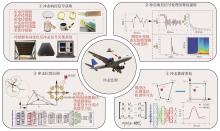
Fig.1
Main contents of aerostructure impact monitoring

Table 1
Summary of advantages and disadvantages of sensors for impact monitoring
| 传感器类型 | 优点 | 缺点 | |
|---|---|---|---|
| 压电传感器 | 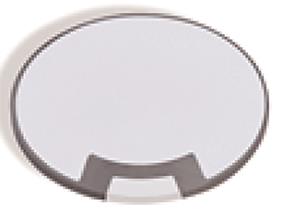 | 频率响应范围宽,动态响应速度快,测量信号的信噪比高 | 材料性质随温度变化,测量中易受到振动的干扰 |
| 光纤光栅传感器 | 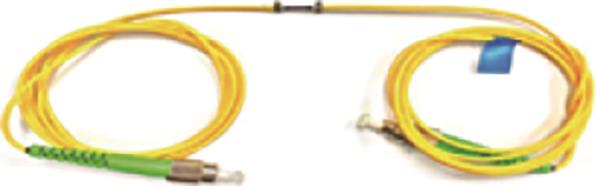 | 重量轻,耐腐蚀,可嵌入,能够实现多参数测量,抗电磁干扰 | 制造成本较高,容易脆断,需要精确的校准和补偿 |
| 应变传感器 | 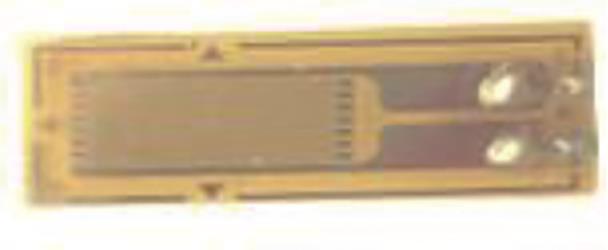 | 制造成本低,重量轻,动态响应速度快,简单易用 | 稳定性受到温度的影响,测量信号的信噪比较差 |
| 声发射传感器 | 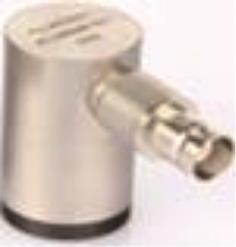 | 频率响应范围宽,动态响应速度快,灵敏度高 | 体积较大,制造成本高,对环境噪声敏感 |
| 加速度传感器 | 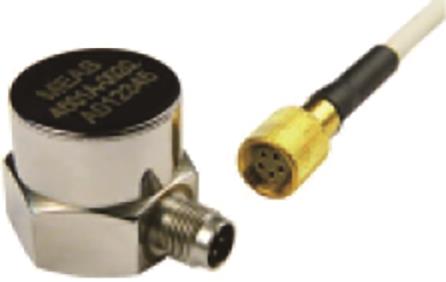 | 频率响应范围宽,低功耗,动态响应速度快 | 体积较大,制造成本较高,测量中易受到振动的干扰 |
| 柔性传感器 | 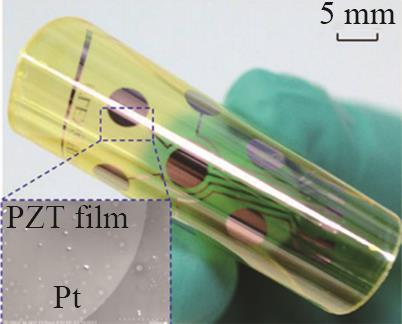 | 体积小、重量轻,适应复杂结构表面 | 软硬接口处对机械变形敏感,抗疲劳性能较差 |
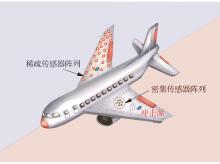
Fig.2
Distributed and dense sensor array layout diagram

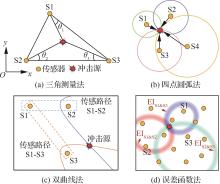
Fig.3
Typical impact localization methods based on time difference
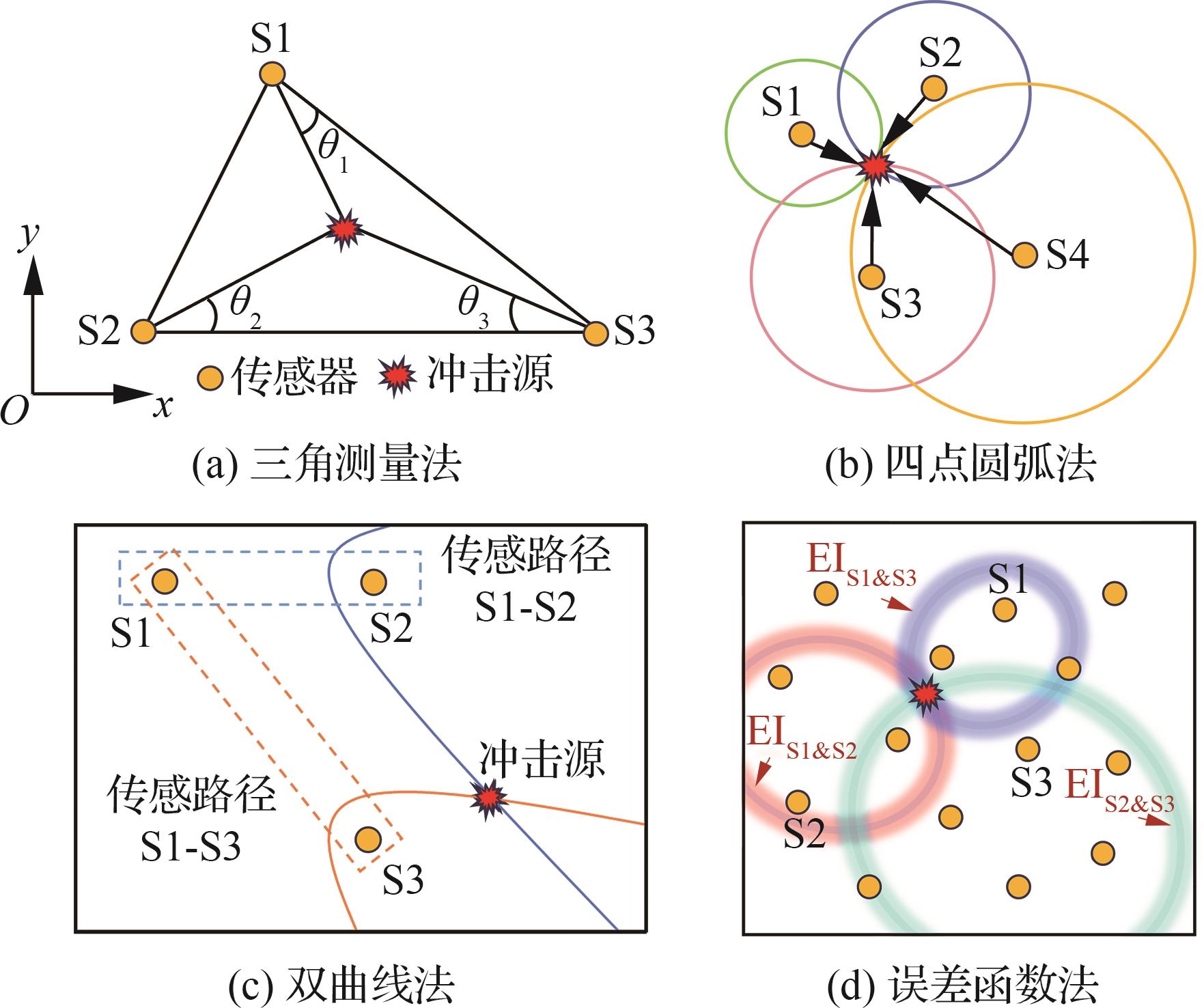
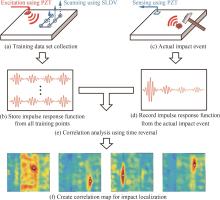
Fig.4
Time reversal focusing impact localization method[65]
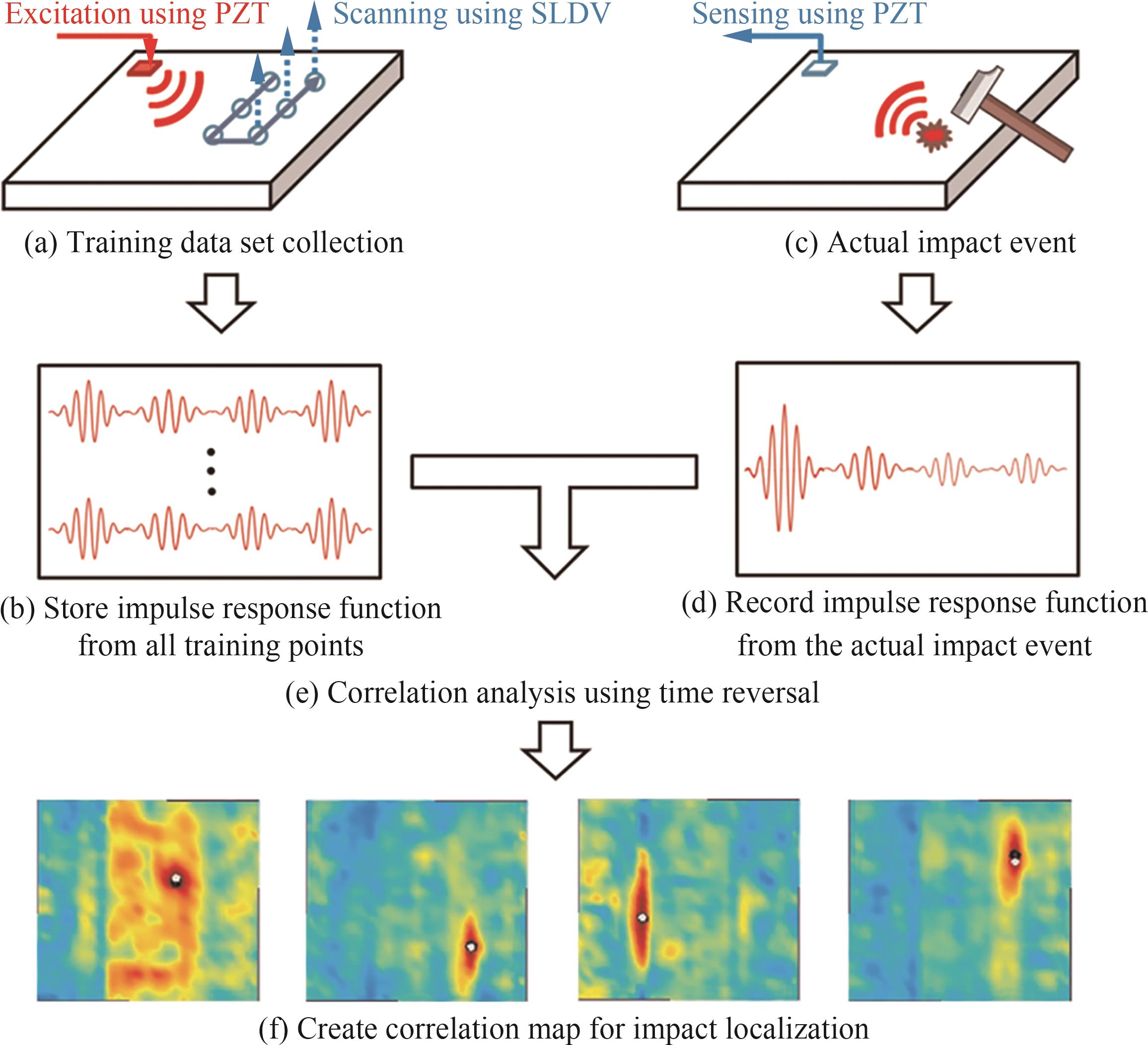
Fig.5
Virtual time reversal focusing method for impact localization based on phase synthesis[69]
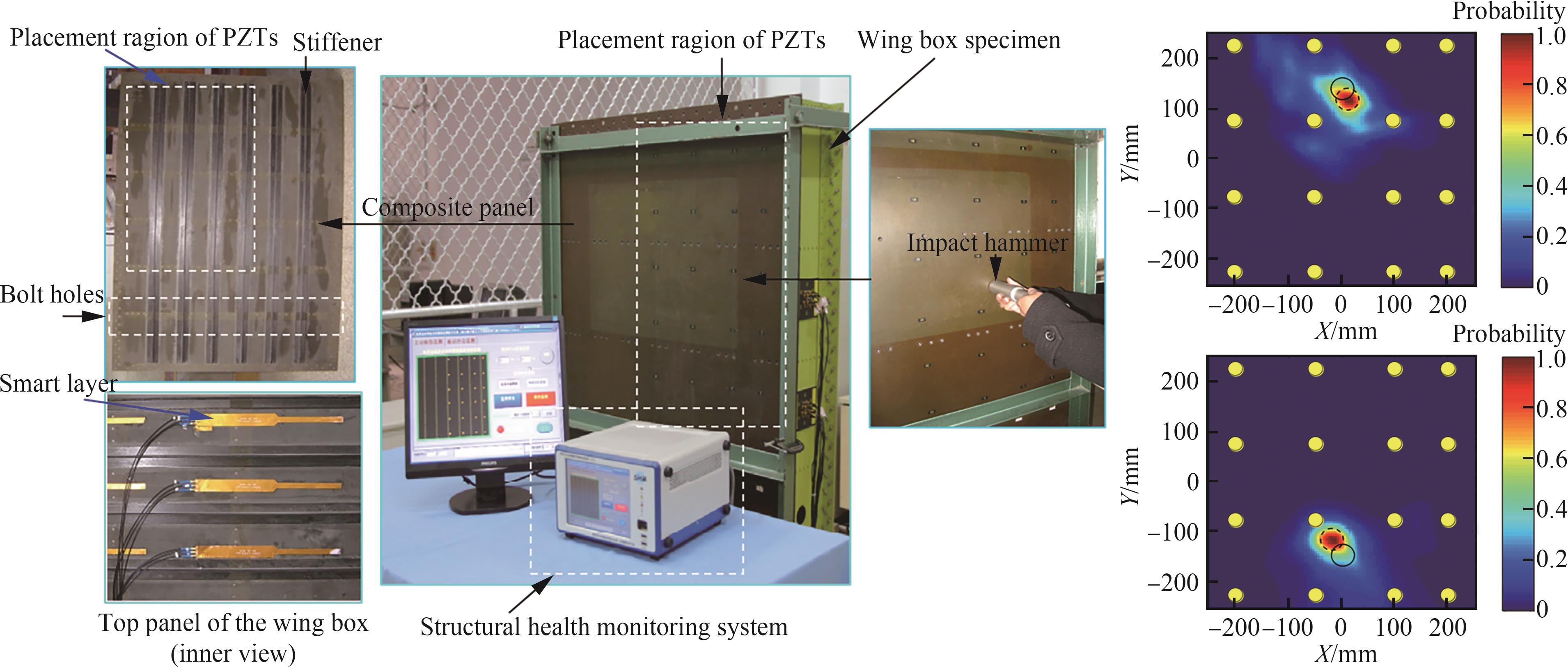
Fig.6
Experimental verification of reference database method on real composite wing box structure[78]
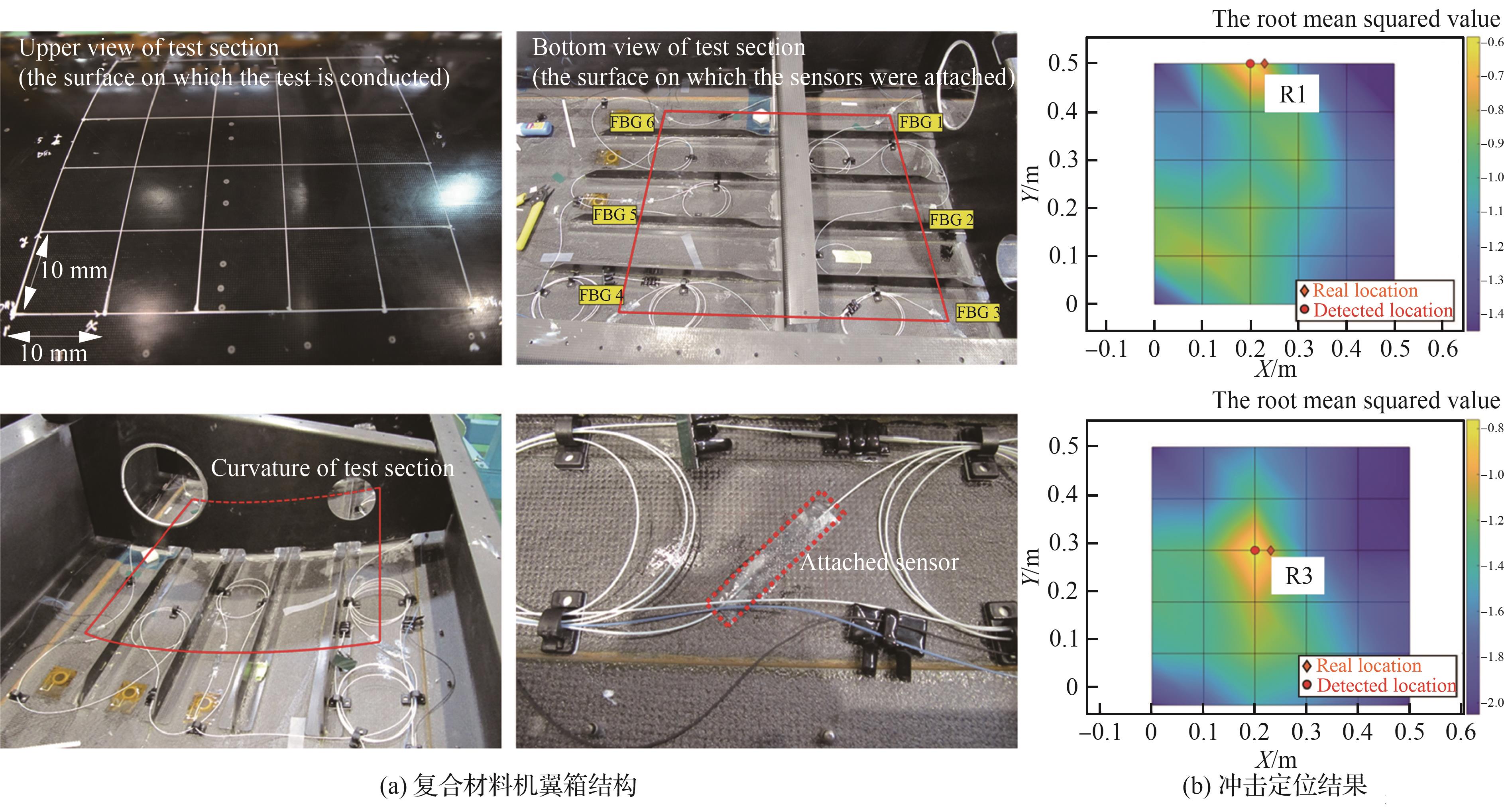
Fig.7
Impact monitoring method based on transfer learning[111]
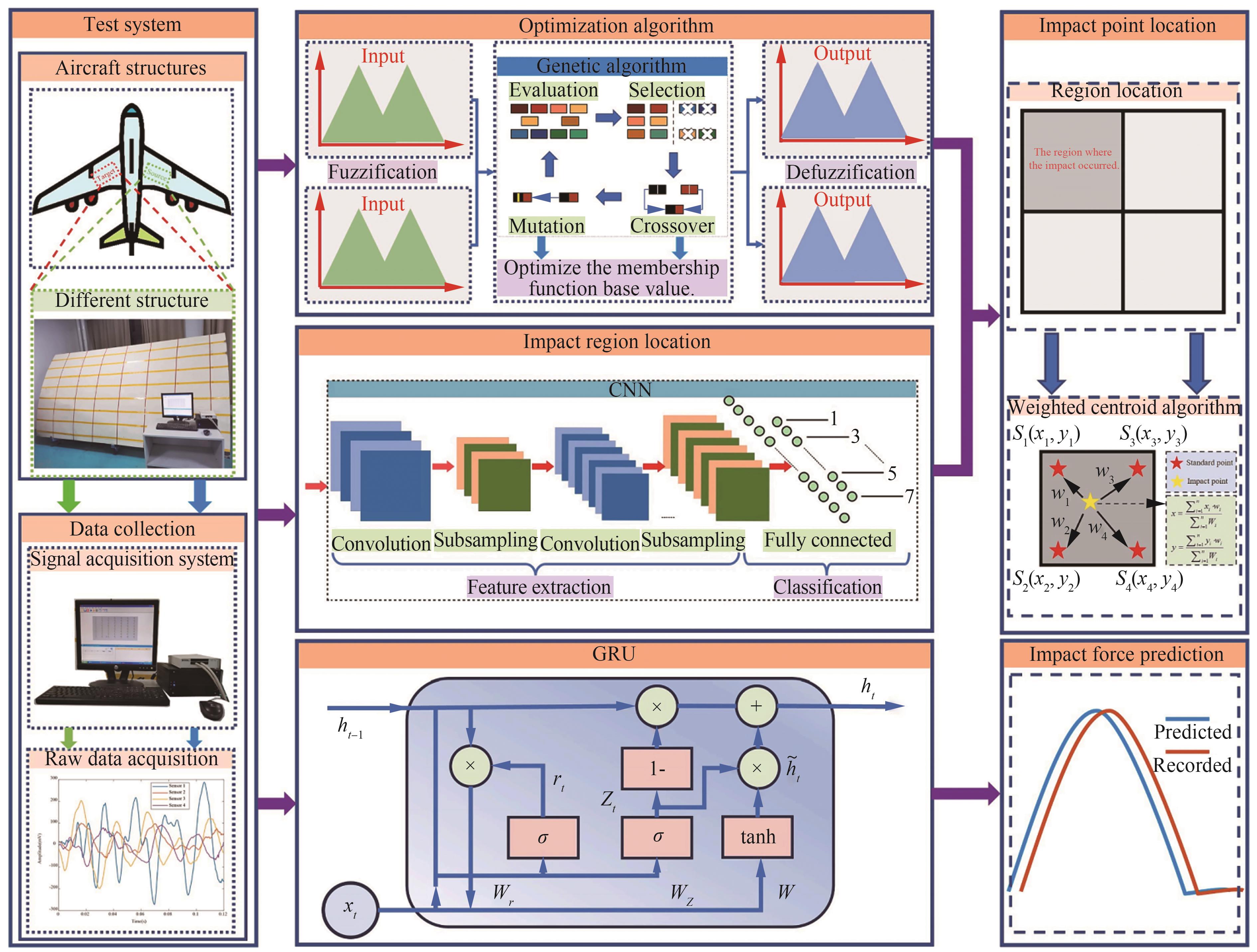
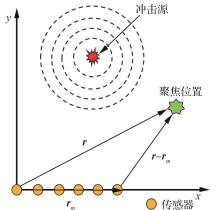
Fig.8
Beamforming method for impact localization
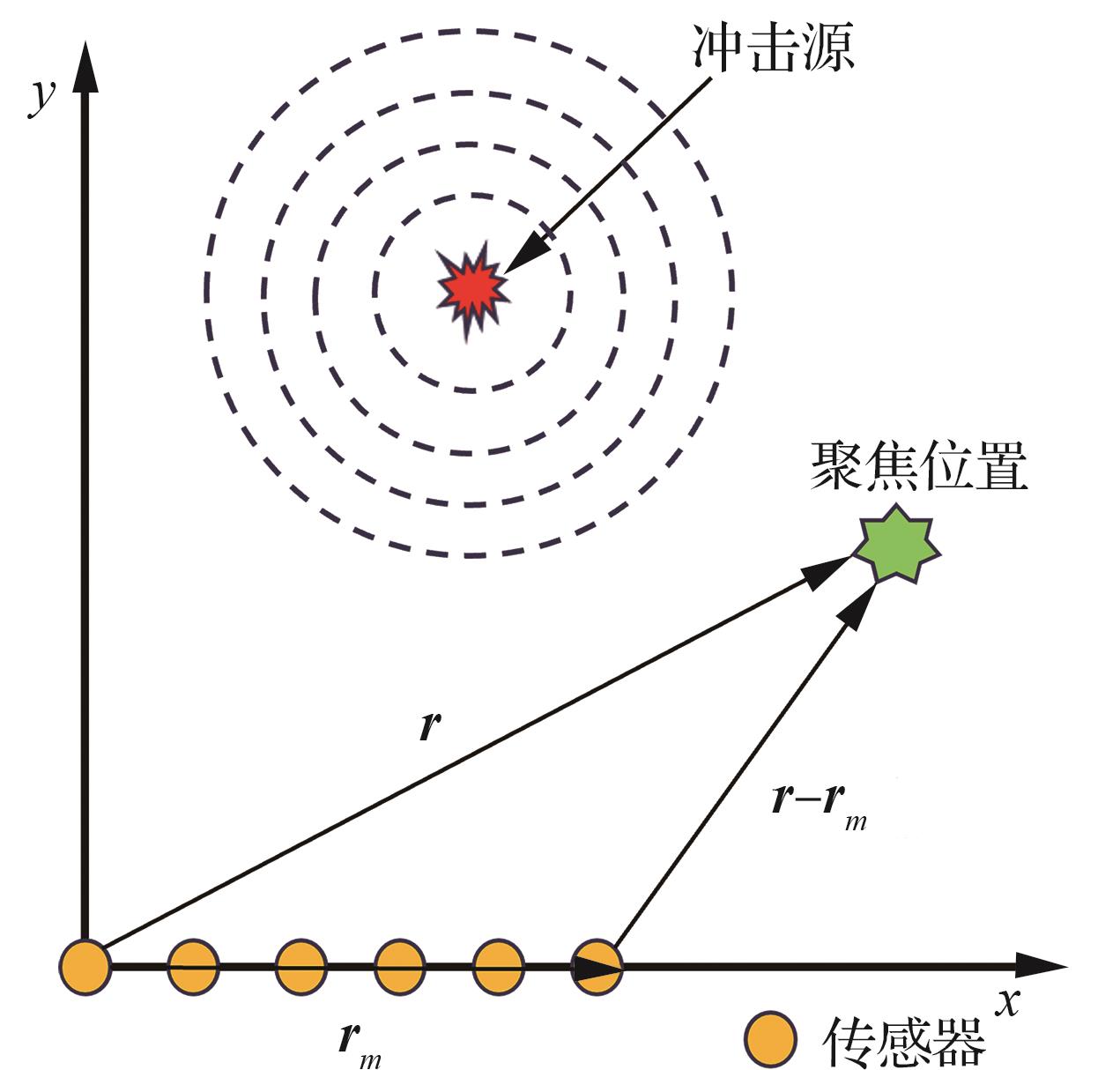
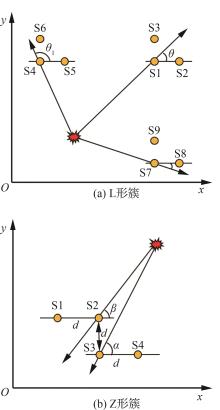
Fig.9
Sensor clusters methods for impact localization
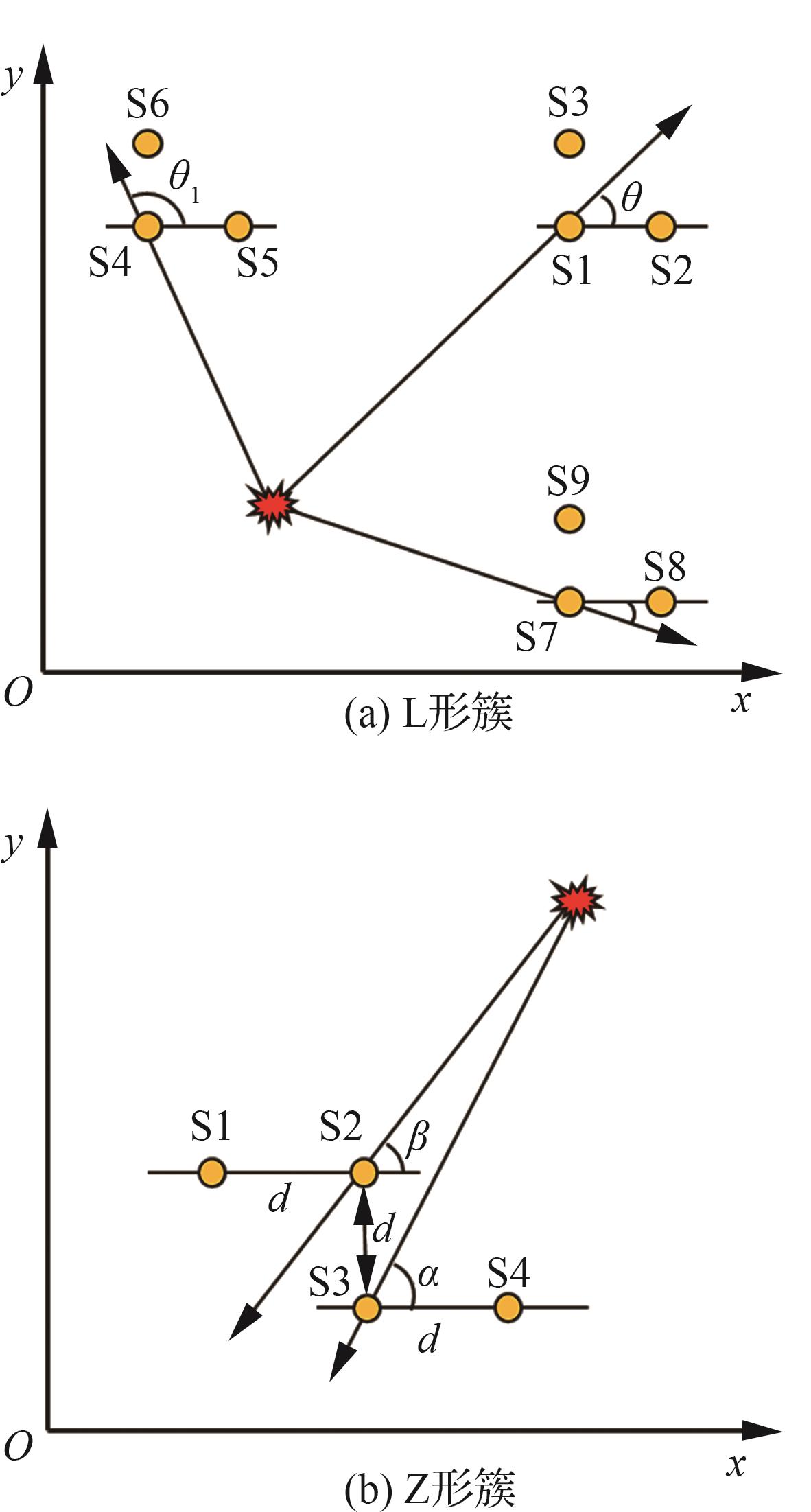
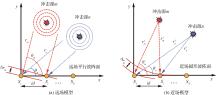
Fig.10
Linear sensor array impact signal model
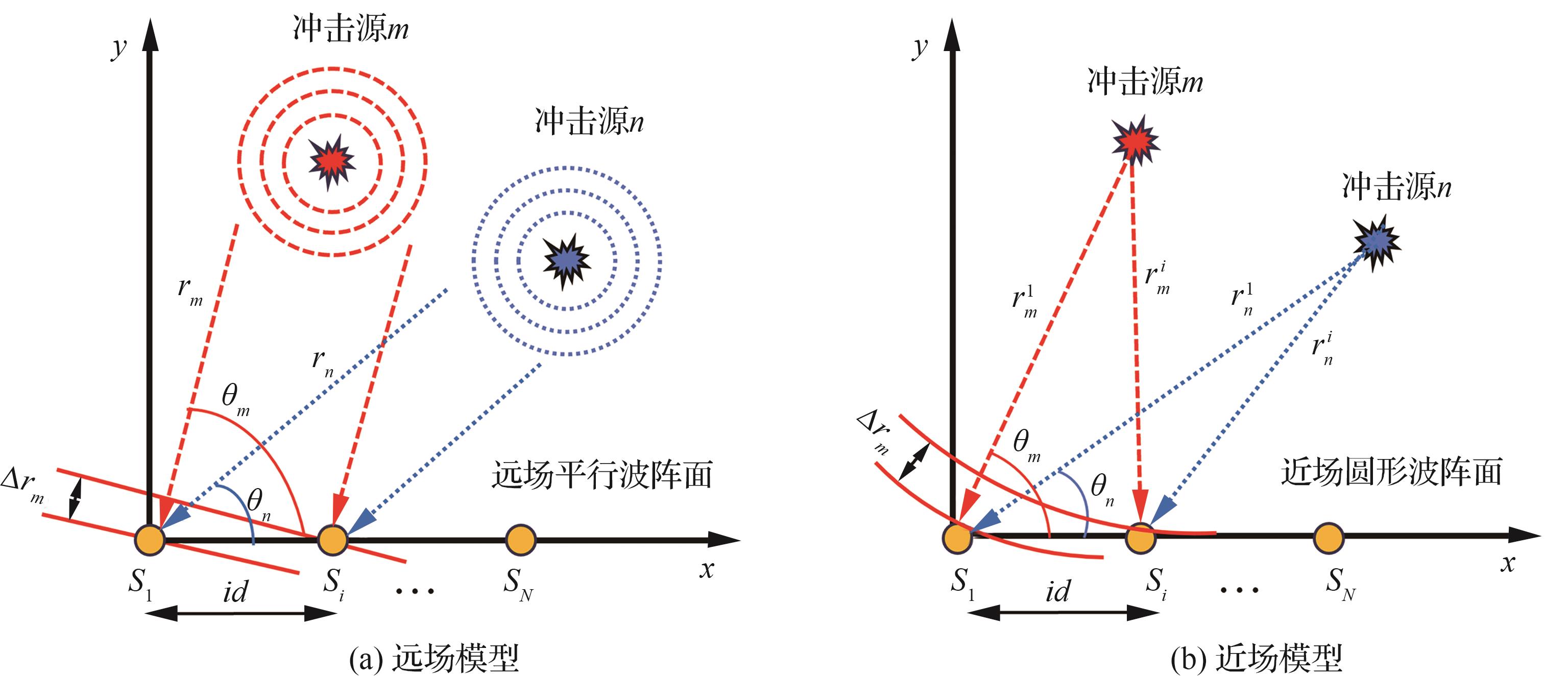
Fig.11
Experimental verification of near field 2D-MUSIC impact localization method[139-140]
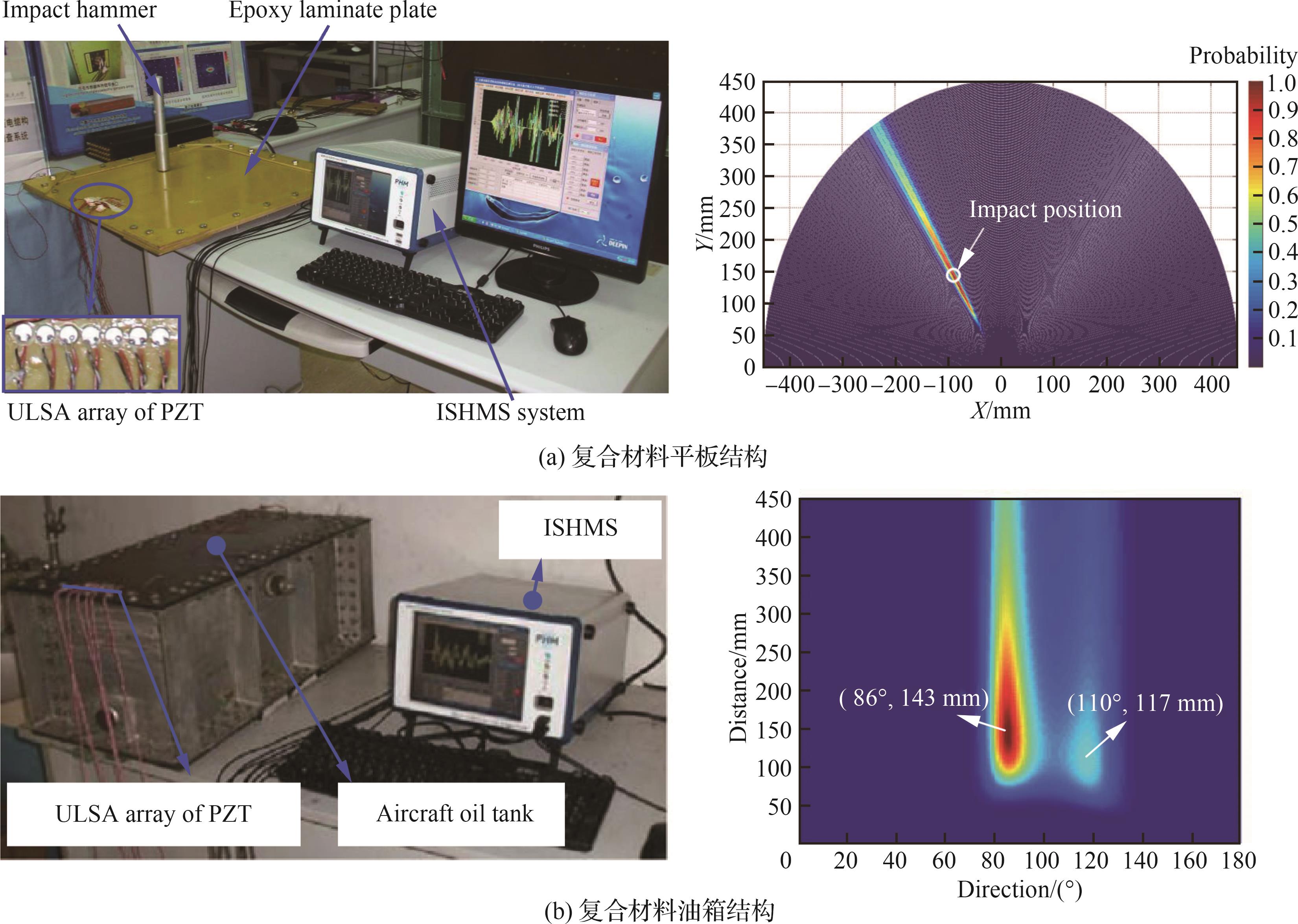
Fig.12
MUSIC impact localization method based on plum blossom array[144]
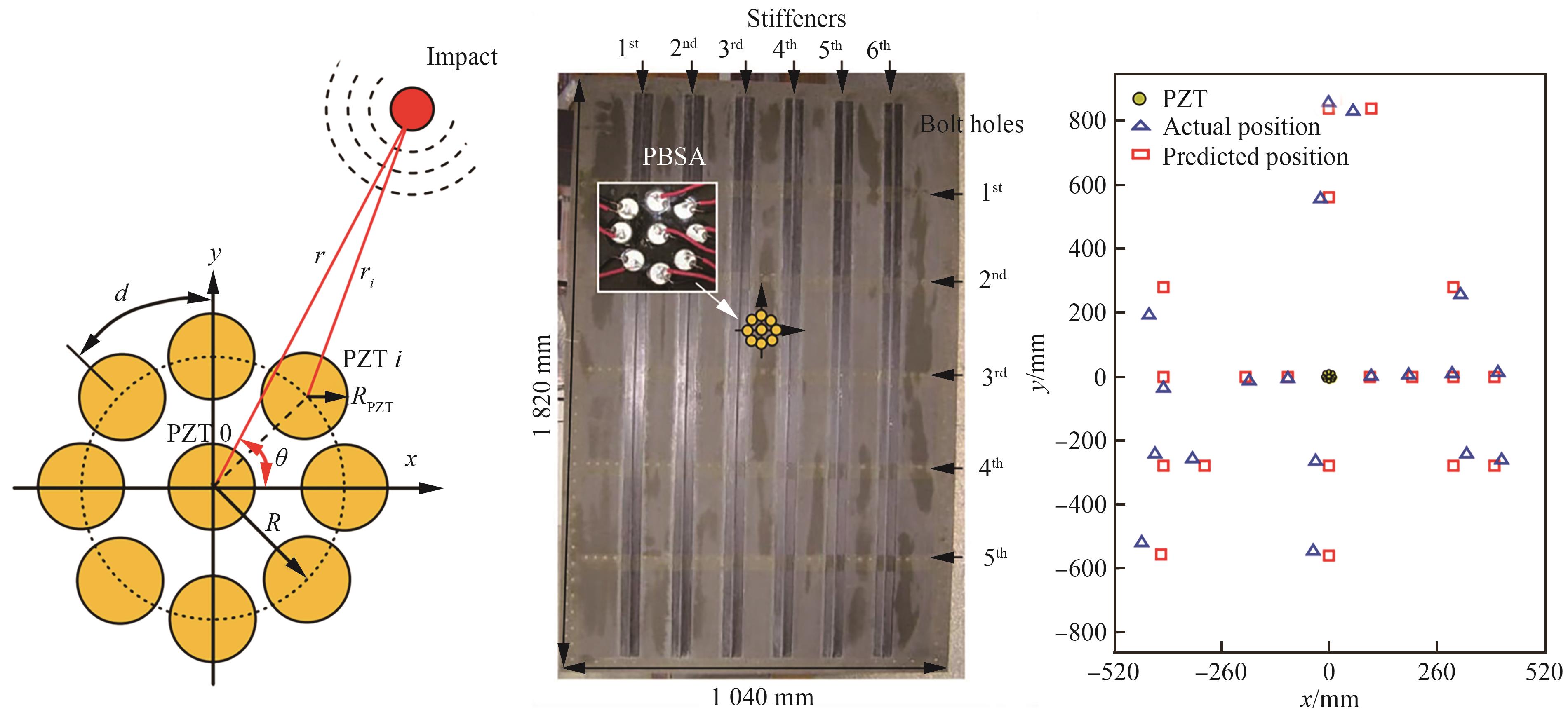
Fig.13
Spatial wavenumber filter impact localization method[145]
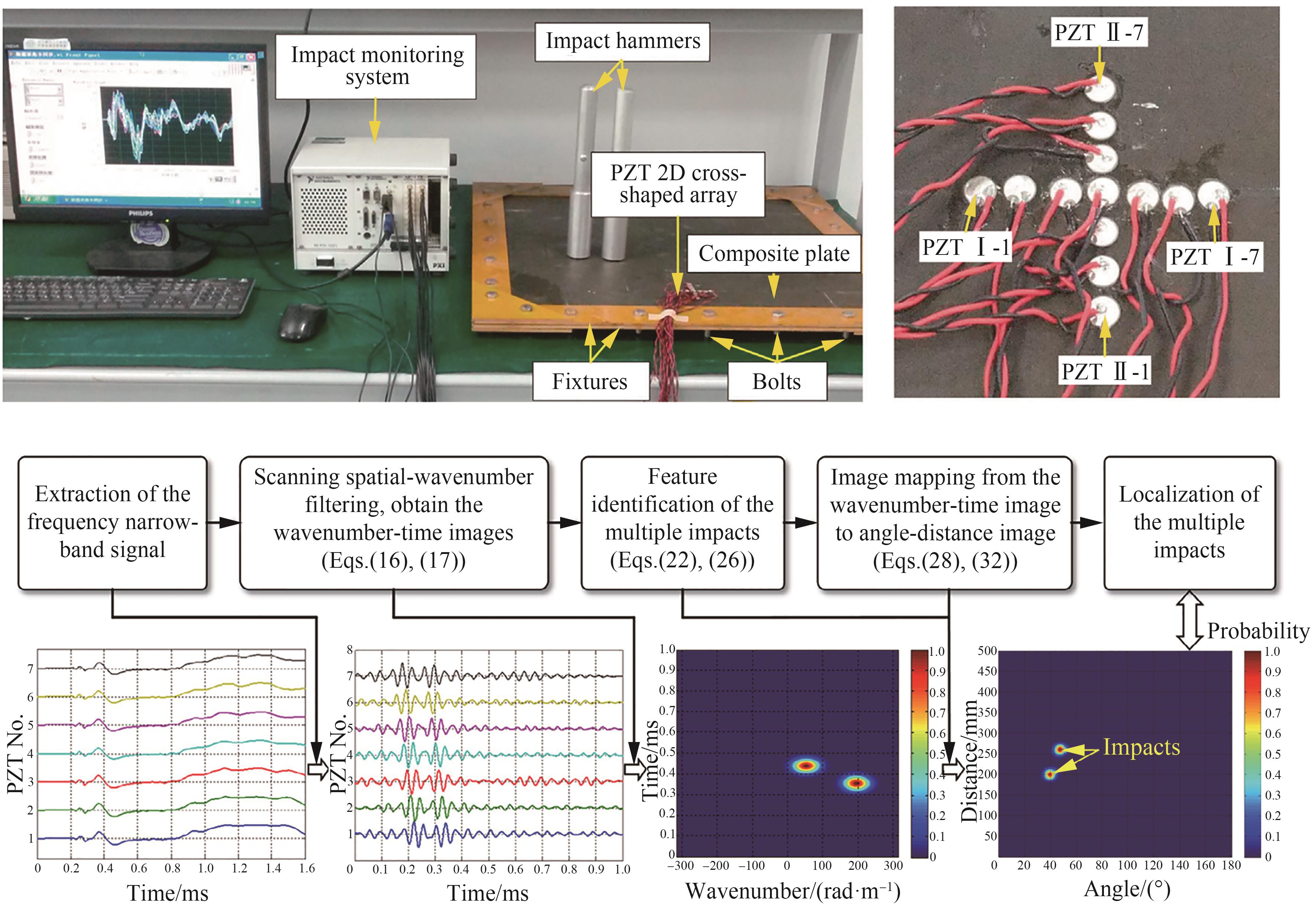
Fig.14
Impact monitoring on Airbus A350-900[149]

Table 2
Comparison of impact location methods
| 传感器布置形式 | 定位方法 | 适用范围 | 优点 | 缺点 |
|---|---|---|---|---|
| 稀疏阵列 | 时差法 | 简单平板结构 | 算法简单易实现,在各向同性结构上通常具有可靠的定位效果 | 在复杂结构上的定位效果较差,甚至失效 |
| 时间反转法 | 简单平板/复杂结构 | 聚焦能力强,抗噪性能好,无需传播媒介的先验知识 | 需要昂贵的全波场测量设备获取传递函数,或者需要数量较多的传感器合成聚焦信号 | |
| 数据驱动法 | 简单平板/复杂结构 | 仅使用少量传感器即可实现较好效果,无需进行复杂的结构建模 | 需要大量参考数据训练网络模型,占据较多存储资源 | |
| 密集阵列 | 波束成形法 | 简单平板结构 | 简单有效,具有良好的聚焦性能 | 不适用于复杂结构的冲击定位 |
| 传感器簇法 | 简单平板结构 | 算法实现简单,能通过较少传感器实现较好的定位结果 | 在复杂结构上的定位结构较差,甚至失效 | |
| 多重信号分类法 | 简单平板/复杂结构 | 抗噪性能好,实时性较好,精度较高 | 信号处理方法较复杂,一维阵列的定位存在盲区 | |
| 空间波数滤波器法 | 简单平板/复杂结构 | 抗噪性能好,实时性较好,精度较高,不需要波速分布 | 信号处理方法较复杂,全场监测存在困难 |
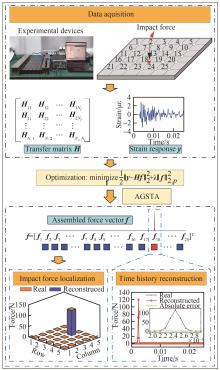
Fig.15
Impact force identification method based on FOGS Lp[163]
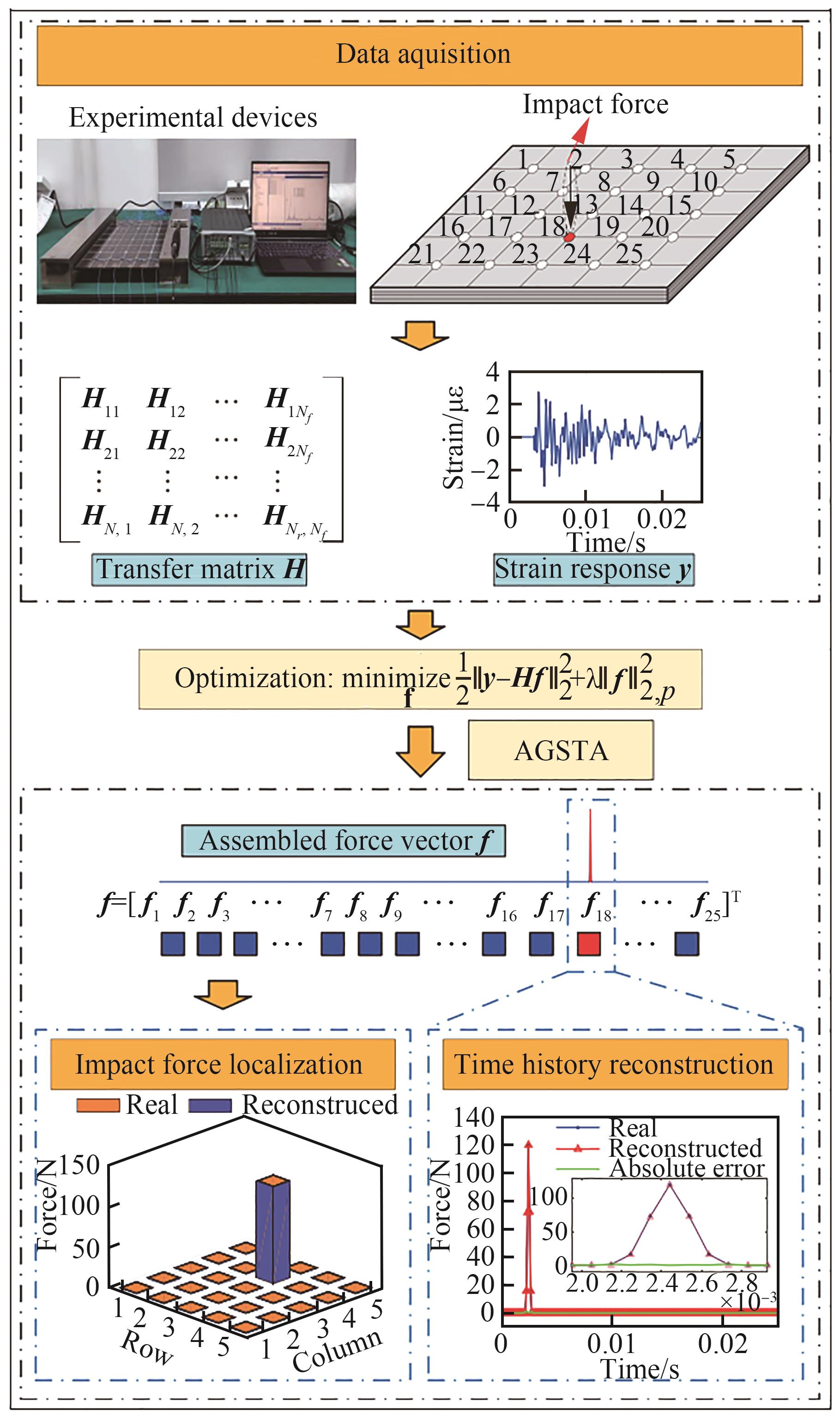
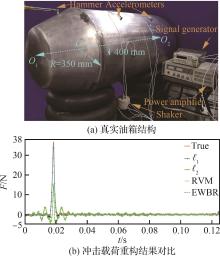
Fig.16
Element-wise Bayesian regularization for impact load identification[165]
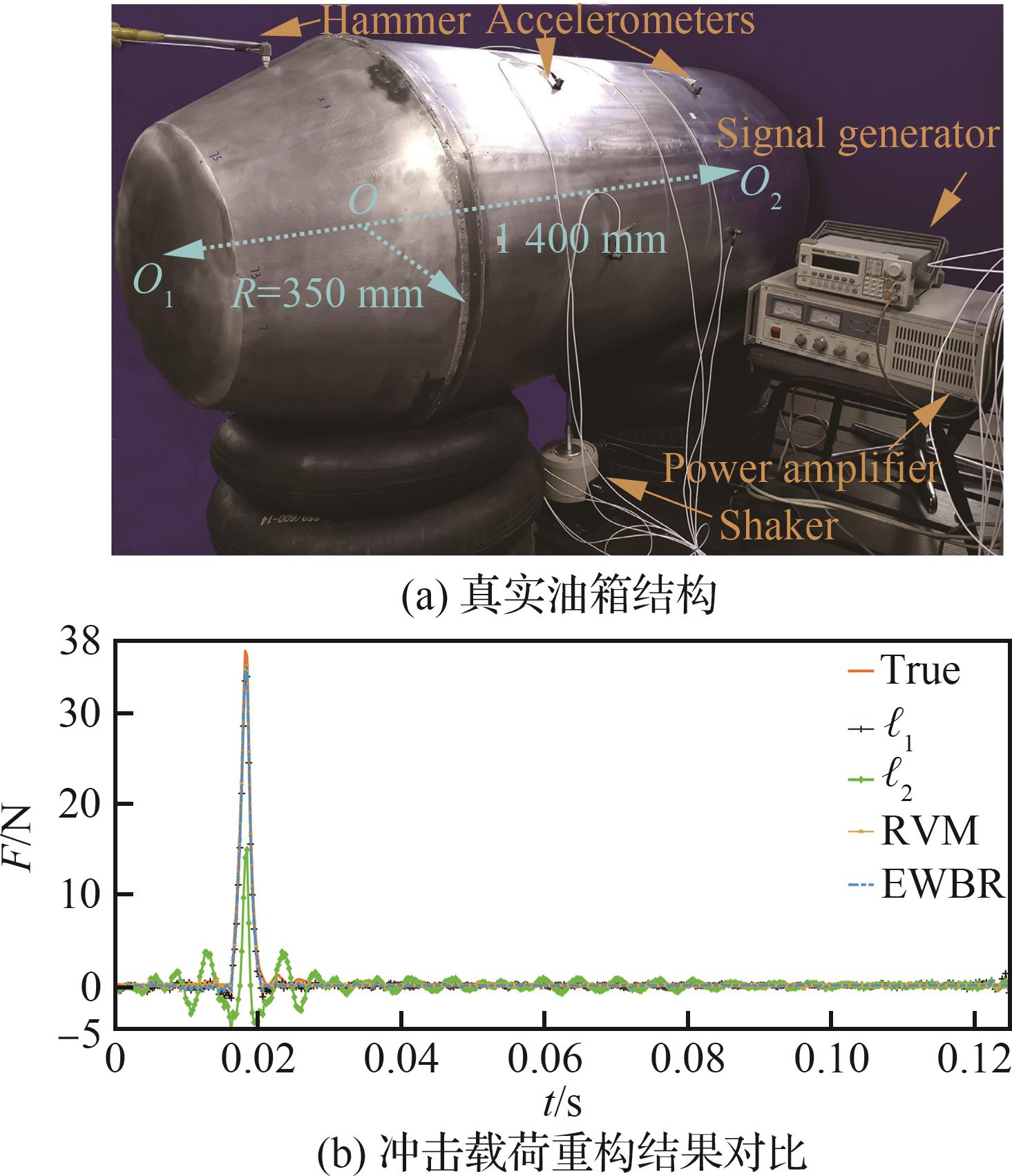
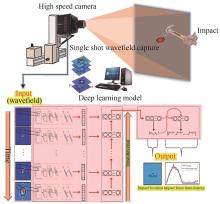
Fig.17
Impact localization and load reconstruction based on machine vision and deep learning[170]
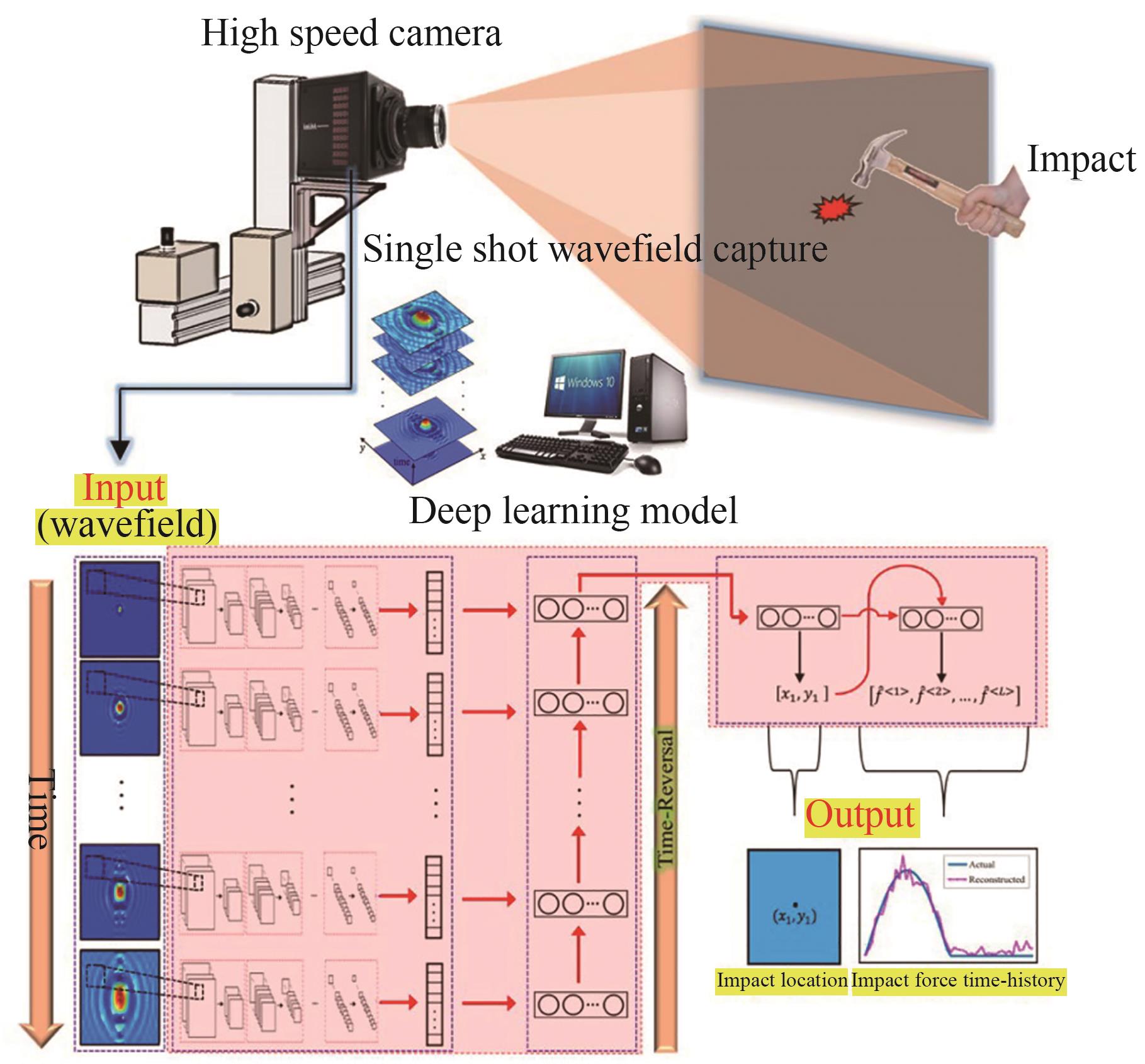
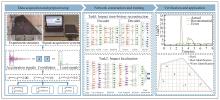
Fig.18
Feature learning-based method for impact load reconstruction and localization[171]
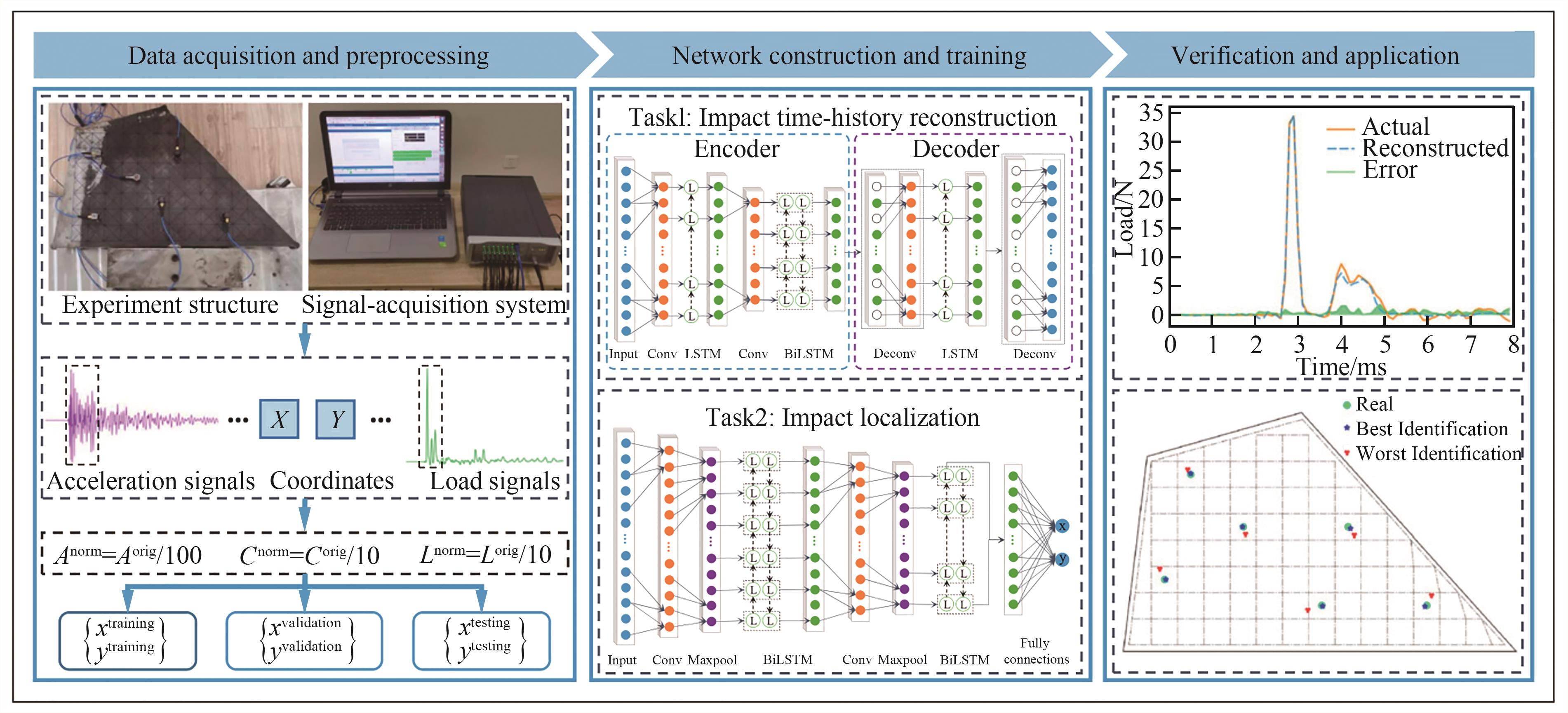
Table 3
Comparison of impact load reconstruction methods
| 载荷重构方法 | 优点 | 缺点 |
|---|---|---|
| 模型法 | 物理概念清晰,描述简单,可解释性和泛化性强 | 对于大型复杂结构建模困难、计算成本高,考虑结构的非线性力学行为时的鲁棒性较差 |
| 机器学习方法 | 具有很强的特征学习能力和非线性表示能力,能够适用于复杂结构 | 需要大量的样本数据,可解释性及泛化性差,对数据质量具有强依赖性 |
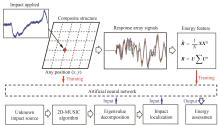
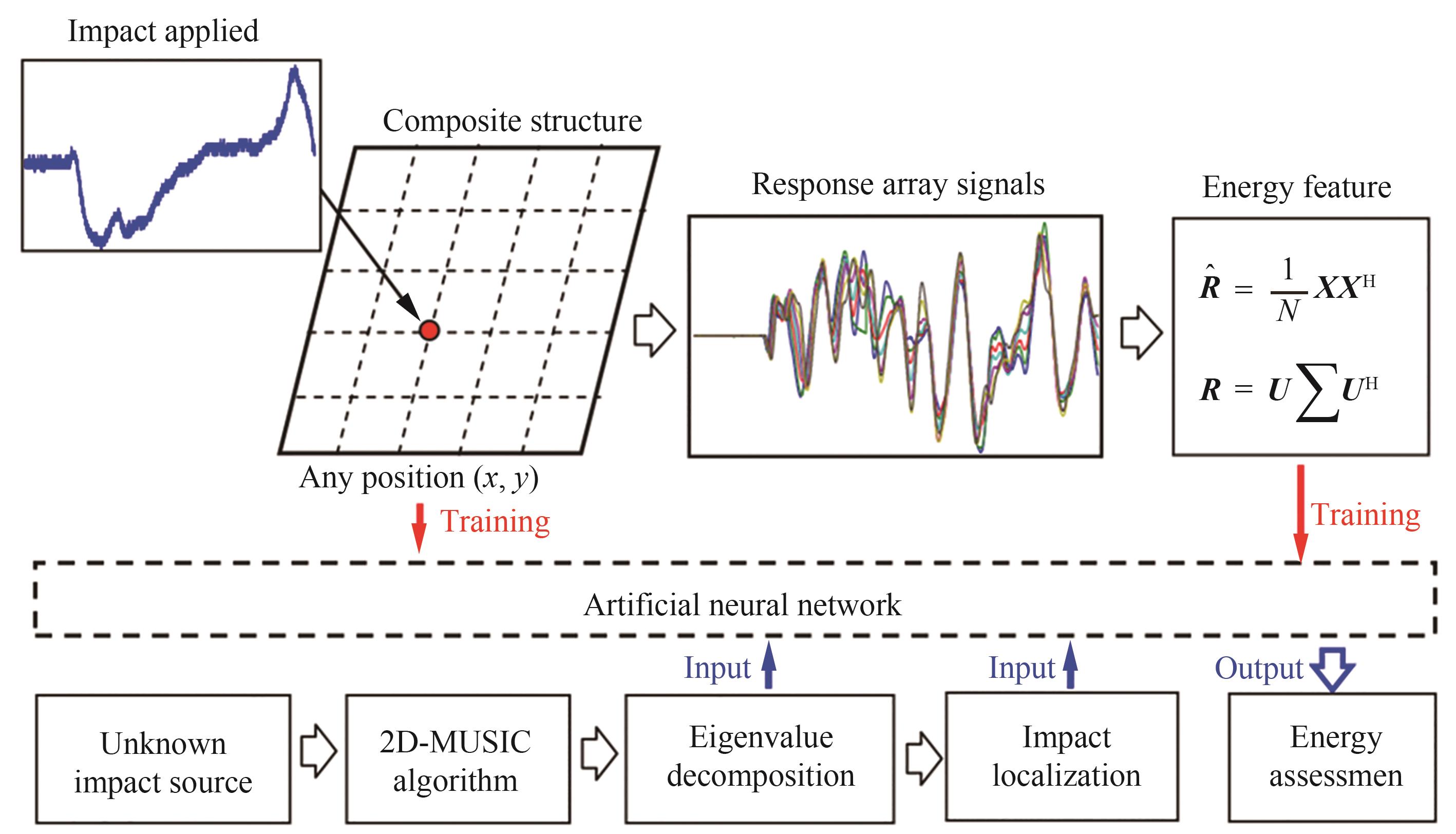
Fig.19
Impact energy level assessment of composite structures using MUSIC-ANN approach[173]
| 1 | 杜善义. 先进复合材料与航空航天[J]. 复合材料学报, 2007, 24(1): 1-12. |
| DU S Y. Advanced composite materials and aerospace engineering[J]. Acta Materiae Compositae Sinica, 2007, 24(1): 1-12 (in Chinese). | |
| 2 | 寇天翔. 航空航天领域先进复合材料的应用探讨[J]. 中国高新科技, 2021(21): 112, 122. |
| KOU T X. Discussion on application of advanced composite materials in aerospace field[J]. China High-Tech, 2021(21): 112, 122 (in Chinese). | |
| 3 | 王奕首, 卿新林. 复合材料连接结构健康监测技术研究进展[J]. 复合材料学报, 2016, 33(1): 1-16. |
| WANG Y S, QING X L. Progress on study of structural health monitoring technology for composite joints[J]. Acta Materiae Compositae Sinica, 2016, 33(1): 1-16 (in Chinese). | |
| 4 | GHOLIZADEH S. A review of impact behaviour in composite materials[C]∥the 10th International Conference on Mechanical and Aerospace Engineering Engineering. Piscataway: IEEE, 2019: 2071-2321. |
| 5 | WANG Y S, WANG M H, WU D, et al. Time series analysis and sparse sensor network-based impact monitoring for aircraft complex structures[J]. Structural Health Monitoring, 2023, 22(6): 4069-4088. |
| 6 | YAN Y X, WANG M H, ZHANG Y, et al. A low-velocity impact localization method for composite stiffened plate based on AIC and WPT[J]. IEEE Sensors Journal, 2024, 24(7): 10993-11002. |
| 7 | RICHARDSON M O W, WISHEART M J. Review of low-velocity impact properties of composite materials[J]. Composites Part A: Applied Science and Manufacturing, 1996, 27(12): 1123-1131. |
| 8 | 苏永振. 航空材料结构低速冲击健康监测研究[D]. 南京: 南京航空航天大学, 2010: 4-5. |
| SU Y Z. Study on health monitoring of aviation material structure under low-speed impact[D].Nanjing: Nanjing University of Aeronautics and Astronautics, 2010: 4-5 (in Chinese). | |
| 9 | KATUNIN A, PAWLAK S, WRONKOWICZ-KATUNIN A, et al. Damage progression in fibre reinforced polymer composites subjected to low-velocity repeated impact loading[J]. Composite Structures, 2020, 252: 112735. |
| 10 | CESTINO E, ROMEO G, PIANA P, et al. Numerical/experimental evaluation of buckling behaviour and residual tensile strength of composite aerospace structures after low velocity impact[J]. Aerospace Science and Technology, 2016, 54: 1-9. |
| 11 | VANNIAMPARAMBIL P A, CARMI R, KHAN F, et al. An active-passive acoustics approach for bond-line condition monitoring in aerospace skin stiffener panels[J]. Aerospace Science and Technology, 2015, 43: 289-300. |
| 12 | GIURGIUTIU V. Shm of aerospace composites-challenges and opportunities[C]∥The Composites and Advanced Materials Expo. Dallas: CAMX, 2015: 26-39. |
| 13 | SHAHDIN A, MORLIER J, NIEMANN H, et al. Correlating low energy impact damage with changes in modal parameters: Diagnosis tools and FE validation[J]. Structural Health Monitoring, 2011, 10(2): 199-217. |
| 14 | ZHU K G, QING X P, LIU B. A two-step impact localization method for composite structures with a parameterized laminate model[J]. Composite Structures, 2018, 192: 500-506. |
| 15 | YANG H J, YANG L, YANG Z Y, et al. Ultrasonic detection methods for mechanical characterization and damage diagnosis of advanced composite materials: A review[J]. Composite Structures, 2023, 324: 117554. |
| 16 | JIN J, ZHU Y H, ZHANG Y B, et al. Micrometeoroid and orbital debris impact detection and location based on FBG sensor network using combined artificial neural network and mahalanobis distance method[J]. IEEE Transactions on Instrumentation and Measurement, 2021, 70: 7005210. |
| 17 | ZHU K G, QING X P, LIU B, et al. A passive localization method for stiffened composite structures with a parameterized laminate model[J]. Journal of Sound and Vibration, 2020, 489: 115683. |
| 18 | QI L, ZENG Z M, SUN L C, et al. An impact location algorithm for spacecraft stiffened structure based on posterior possibility correlation[J]. Sensors, 2020, 20(2): 368. |
| 19 | LIN M, CHANG F K. The manufacture of composite structures with a built-in network of piezoceramics[J]. Composites Science and Technology, 2002, 62(7-8): 919-939. |
| 20 | QING X, BEARD S, KUMAR A, et al. Advances in the development of built-in diagnostic system for filament wound composite structures[J]. Composites Science and Technology, 2006, 66(11-12): 1694-1702. |
| 21 | 唐守锋, 熊克, 李刚. 压电智能夹层及其特性分析[J]. 传感器技术, 2005, 24(7): 32-34. |
| TANG S F, XIONG K, LI G. Piezoelectrics smart layer and analysis of its properties[J]. Transducer and Microsystem Technologies, 2005, 24(7): 32-34 (in Chinese). | |
| 22 | JIANG W S, DU L Y, LUO Z, et al. Impact localization with a weighted spectral cross correlation method[J]. Aerospace Science and Technology, 2022, 126: 107591. |
| 23 | 赵刚, 李书欣, 刘立胜, 等. 应变片在复合材料低能量冲击定位中的应用[J]. 振动、 测试与诊断, 2018, 38(3): 526-530. |
| ZHAO G, LI S X, LIU L S, et al. Application of strain gauge in low energy impact location of composite materials[J]. Journal of Vibration, Measurement & Diagnosis, 2018, 38(3): 526-530 (in Chinese). | |
| 24 | HOSSAIN M S, ONG Z C, NG S C, et al. Inverse identification of impact locations using multilayer perceptron with effective time-domain feature[J]. Inverse Problems in Science and Engineering, 2018, 26(3): 443-461. |
| 25 | ZHU C, XU Z Y, HOU C, et al. Flexible, monolithic piezoelectric sensors for large-area structural impact monitoring via MUSIC-assisted machine learning[J]. Structural Health Monitoring, 2024, 23(1): 121-136. |
| 26 | 朱臣. 多功能柔性压电器件设计制造及智能蒙皮应用[D]. 武汉: 华中科技大学, 2022: 5-6. |
| ZHU C. Design and manufacture of multi-functional flexible piezoelectric devices and application of intelligent skin[D].Wuhan: Huazhong University of Science and Technology, 2022:5-6 (in Chinese). | |
| 27 | AMBROZIŃSKI Ł, STEPINSKI T, UHL T. Efficient tool for designing 2D phased arrays in lamb waves imaging of isotropic structures[J]. Journal of Intelligent Material Systems and Structures, 2015, 26(17): 2283-2294. |
| 28 | GUPTA V, SHARMA M, THAKUR N. Optimization criteria for optimal placement of piezoelectric sensors and actuators on a smart structure: A technical review[J]. Journal of Intelligent Material Systems and Structures, 2010, 21(12): 1227-1243. |
| 29 | STASZEWSKI W J, WORDEN K, WARDLE R, et al. Fail-safe sensor distributions for impact detection in composite materials[J]. Smart Materials and Structures, 2000, 9(3): 298-303. |
| 30 | SCOTT M, WORDEN K. A bee swarm algorithm for optimising sensor distributions for impact detection on a composite panel[J]. Strain, 2015, 51(2): 147-155. |
| 31 | MALLARDO V, ALIABADI M H, SHARIF KHODAEI Z. Optimal sensor positioning for impact localization in smart composite panels[J]. Journal of Intelligent Material Systems and Structures, 2013, 24(5): 559-573. |
| 32 | MARKMILLER J F C, CHANG F K. Sensor network optimization for a passive sensing impact detection technique[J]. Structural Health Monitoring, 2010, 9(1): 25-39. |
| 33 | DIPIETRANGELO F, NICASSIO F, SCARSELLI G. Structural health monitoring for impact localisation via machine learning[J]. Mechanical Systems and Signal Processing, 2023, 183: 109621. |
| 34 | 彭涛, 崔立林, 黄秀峰, 等. 低信噪比下针对平板结构冲击的快速定位算法[J]. 振动与冲击, 2023, 42(10): 180-187. |
| PENG T, CUI L L, HUANG X F, et al. Fast localization algorithm for impact of flat plate structure under low SNR[J]. Journal of Vibration and Shock, 2023, 42(10): 180-187 (in Chinese). | |
| 35 | HAYWOOD J, COVERLEY P T, STASZEWSKI W J, et al. An automatic impact monitor for a composite panel employing smart sensor technology[J]. Smart Materials and Structures, 2005, 14(1): 265-271. |
| 36 | WILLBERG C, DUCZEK S, VIVAR PEREZ J M, et al. Comparison of different higher order finite element schemes for the simulation of Lamb waves[J]. Computer Methods in Applied Mechanics and Engineering, 2012, 241-244: 246-261. |
| 37 | FELDMAN M. Hilbert transforms[M]. Amsterdam: Elsevier, 2001: 642-648. |
| 38 | 张宇, 岳桂轩, 李欣颖, 等. 基于互相关碰撞强度谱的航天器碰撞定位技术[J]. 航天器环境工程, 2021, 38(1): 7-16. |
| ZHANG Y, YUE G X, LI X Y, et al. Impact positioning based on cross-correlation impact intensity map for spacecraft[J]. Spacecraft Environment Engineering, 2021, 38(1): 7-16 (in Chinese). | |
| 39 | 张阳, 杨宇, 齐舸, 等. 复合材料加筋结构冲击定位算法有效性分析[J]. 航空工程进展, 2023, 14(4): 110-115. |
| ZHANG Y, YANG Y, QI G, et al. Effectiveness analysis of impact location algorithm for composite reinforced structures[J]. Advances in Aeronautical Science and Engineering, 2023, 14(4): 110-115 (in Chinese). | |
| 40 | YANG X B, WANG K, ZHOU P Y, et al. Imaging damage in plate waveguides using frequency-domain multiple signal classification (F-MUSIC)[J]. Ultrasonics, 2022, 119: 106607. |
| 41 | WEN X L, SUN Q Z, LI W H, et al. Localization of low velocity impacts on CFRP laminates based on FBG sensors and BP neural networks[J]. Mechanics of Advanced Materials and Structures, 2022, 29(26): 5478-5487. |
| 42 | 郭松林, 王朝晖. 基于卷积神经网络的冲击地压微震定位法[J]. 电子测试, 2021(13): 67-69. |
| GUO S L, WANG C H. Microseismic location method of rock burst based on convolutional neural network[J]. Electronic Test, 2021(13): 67-69 (in Chinese). | |
| 43 | 杨雷, 邓德双, 田广,等. 基于误差函数的复材加筋板概率成像冲击定位[J]. 振动测试与诊断, 2024, 44(1): 88-93. |
| YANG L, DENG D S, TIAN G, et al. Probabilistic imaging impact location of composite stiffened plates based on error function[J]. Journal of Vibration, Measurement & Diagnosis, 2024, 44(1): 88-93 (in Chinese). | |
| 44 | 苏永振, 袁慎芳, 张炳良. 基于声发射和神经网络的复合材料冲击定位[J]. 传感器与微系统, 2009, 28(9): 56-58, 61. |
| SU Y Z, YUAN S F, ZHANG B L. Impact localization for composite based on acoustic emission and neural networks[J]. Transducer and Microsystem Technologies, 2009, 28(9): 56-58, 61 (in Chinese). | |
| 45 | 路士增, 姜明顺, 隋青美, 等. 基于小波变换和支持向量多分类机的光纤布拉格光栅低速冲击定位系统[J]. 中国激光, 2014, 41(3): 0305006. |
| LU S Z, JIANG M S, SUI Q M, et al. Identification of impact location by using fiber Bragg grating based on wavelet transform and support vector classifiers[J]. Chinese Journal of Lasers, 2014, 41(3): 0305006 (in Chinese). | |
| 46 | ZHAO G, HU H X, LI S X, et al. Localization of impact on composite plates based on integrated wavelet transform and hybrid minimization algorithm[J]. Composite Structures, 2017, 176: 234-243. |
| 47 | PHAM D T, JI Z, PEYROUTET O, et al. Localisation of impacts on solid objects using the Wavelet Transform and Maximum Likelihood Estimation[M]∥Intelligent Production Machines and Systems. Amsterdam: Elsevier, 2006: 541-547. |
| 48 | LIU Q, WANG F D, LIU M X, et al. A two-step localization method using wavelet packet energy characteristics for low-velocity impacts on composite plate structures[J]. Mechanical Systems and Signal Processing, 2023, 188: 110061. |
| 49 | LU S Z, JIANG M S, SUI Q M, et al. Low velocity impact localization system of CFRP using fiber Bragg grating sensors[J]. Optical Fiber Technology, 2015, 21: 13-19. |
| 50 | MEO M, ZUMPANO G, PIGGOTT M, et al. Impact identification on a sandwich plate from wave propagation responses[J]. Composite Structures, 2005, 71(3-4): 302-306. |
| 51 | JEONG H, JANG Y S. Fracture source location in thin plates using the wavelet transform of dispersive waves[J]. IEEE Transactions on Ultrasonics, Ferroelectrics, and Frequency Control, 2000, 47(3): 612-619. |
| 52 | ZHU X B. Aluminum alloy material structure impact localization by using FBG sensors[J]. Photonic Sensors, 2014, 4(4): 344-348. |
| 53 | BENEDETTO J J. Noise reduction in terms of the theory of frames[M]∥Wavelet Analysis and Its Applications. Amsterdam: Elsevier, 1998: 259-284. |
| 54 | QIU L, LIU B, YUAN S F, et al. Impact imaging of aircraft composite structure based on a model-independent spatial-wavenumber filter[J]. Ultrasonics, 2016, 64: 10-24. |
| 55 | 邱雷, 袁慎芳, 苏永振, 等. 基于Shannon复数小波和时间反转聚焦的复合材料结构多源冲击成像定位方法[J]. 航空学报, 2010, 31(12): 2417-2424. |
| QIU L, YUAN S F, SU Y Z, et al. Multiple impact source imaging and localization on composite structure based on Shannon complex wavelet and time reversal focusing[J]. Acta Aeronautica et Astronautica Sinica, 2010, 31(12): 2417-2424 (in Chinese). | |
| 56 | LIANG D, YUAN S F, LIU M L. Distributed coordination algorithm for impact location of preciseness and real-time on composite structures[J]. Measurement, 2013, 46(1): 527-536. |
| 57 | MIGOT A, GIURGIUTIU V. Impact localization using sparse PWAS networks and wavelet transform[C]∥Structural Health Monitoring 2017. Lancaster: DEStech Publications, Inc., 2017: 391-398. |
| 58 | YAN S, LI B W. Impact localization of thin plate structures using pzt-array based passive wave method[J]. IOP Conference Series: Earth and Environmental Science, 2019, 283(1): 012040. |
| 59 | GORGIN R, WANG Z P, WU Z J, et al. Probability based impact localization in plate structures using an error index[J]. Mechanical Systems and Signal Processing, 2021, 157: 107724. |
| 60 | CIAMPA F, MEO M. Acoustic emission source localization and velocity determination of the fundamental mode A0 using wavelet analysis and a Newton-based optimization technique[J]. Smart Materials and Structures, 2010, 19(4): 045027. |
| 61 | WARD J, CROXFORD A, PAGET C. Passive impact localisation for the structural health monitoring of new airframe materials[J]. Journal of Physics: Conference Series, 2013, 457: 012010. |
| 62 | LIU M Z, YANG J X, CAO Y P, et al. A new method for arrival time determination of impact signal based on HHT and AIC[J]. Mechanical Systems and Signal Processing, 2017, 86: 177-187. |
| 63 | DAS A K, LEUNG C K. A new power-based method to determine the first arrival information of an acoustic emission wave[J]. Structural Health Monitoring, 2019, 18(5-6): 1620-1632. |
| 64 | CHEN C, LI Y, YUAN F G. Impact and damage location detection on plate-like structures using time-Reversal method[C]∥the 8th International Workshop on Structural Health Monitoring. Quebec: Stanford, 2011,8: 274-281. |
| 65 | PARK B, SOHN H, OLSON S E, et al. Impact localization in complex structures using laser-based time reversal[J]. Structural Health Monitoring, 2012, 11(5): 577-588. |
| 66 | CIAMPA F, BOCCARDI S, MEO M. Factors affecting the imaging of the impact location with inverse filtering and diffuse wave fields[J]. Journal of Intelligent Material Systems and Structures, 2016, 27(11): 1523-1533. |
| 67 | DE SIMONE M E, CIAMPA F, MEO M. A hierarchical method for the impact force reconstruction in composite structures[J]. Smart Materials and Structures, 2019, 28(8): 085022. |
| 68 | YU Z X, XU C, SUN J Y, et al. Impact localization and force reconstruction for composite plates based on virtual time reversal processing with time-domain spectral finite element method[J]. Structural Health Monitoring, 2023, 22(6): 4149-4170. |
| 69 | QIU L, YUAN S F, ZHANG X Y, et al. A time reversal focusing based impact imaging method and its evaluation on complex composite structures[J]. Smart Materials and Structures, 2011, 20(10): 105014. |
| 70 | 武湛君, 曾旭, 邓德双, 等. 基于自适应时间反转聚焦的加筋复材板冲击定位[J]. 复合材料学报, 2024, 41(1): 507-520. |
| WU Z J, ZENG X, DENG D S, et al. Impact localization on stiffened composite plate based on adaptive time reversal focusing[J]. Acta Materiae Compositae Sinica, 2024, 41(1): 507-520 (in Chinese). | |
| 71 | FRIEDEN J, CUGNONI J, BOTSIS J, et al. Low energy impact damage monitoring of composites using dynamic strain signals from FBG sensors-Part I: Impact detection and localization[J]. Composite Structures, 2012, 94(2): 438-445. |
| 72 | JANG B W, LEE Y G, KIM C G, et al. Impact source localization for composite structures under external dynamic loading condition[J]. Advanced Composite Materials, 2015, 24(4): 359-374. |
| 73 | KIM J H, KIM Y Y, PARK Y, et al. Low-velocity impact localization in a stiffened composite panel using a normalized cross-correlation method[J]. Smart Materials and Structures, 2015, 24(4): 045036. |
| 74 | SHRESTHA P, KIM J H, PARK Y, et al. Impact localization on composite structure using FBG sensors and novel impact localization technique based on error outliers[J]. Composite Structures, 2016, 142: 263-271. |
| 75 | SHRESTHA P, PARK Y, KIM C G. Low velocity impact localization on composite wing structure using error outlier based algorithm and FBG sensors[J]. Composites Part B: Engineering, 2017, 116: 298-312. |
| 76 | JANG B W, KIM C G. Impact localization on a composite stiffened panel using reference signals with efficient training process[J]. Composites Part B: Engineering, 2016, 94: 271-285. |
| 77 | KWON H, PARK Y, SHIN C, et al. Embedded silicon carbide fiber sensor network based low-velocity impact localization of composite structures[J]. Smart Materials and Structures, 2020, 29(5): 055030. |
| 78 | JANG B W. Practical method for localizing low-velocity impact on a UAV composite wingbox structure under loading conditions[J]. Advanced Composite Materials, 2024, 33(2): 290-304. |
| 79 | ARENA M, VISCARDI M. Vibration parameters for impact detection of composite panel: A neural network based approach[J]. Journal of Composites Science, 2021, 5(7): 185. |
| 80 | FU T, ZHANG Z C, LIU Y J, et al. Development of an artificial neural network for source localization using a fiber optic acoustic emission sensor array[J]. Structural Health Monitoring, 2015, 14(2): 168-177. |
| 81 | FU T, WEI P, LIU D Y, et al. 3-D source location by neural network for FBG acoustic emission sensors[J]. IEEE Sensors Journal, 2021, 21(24): 27473-27481. |
| 82 | CAPRINO G, LOPRESTO V, LEONE C, et al. Acoustic emission source location in unidirectional carbon-fiber-reinforced plastic plates with virtually trained artificial neural networks[J]. Journal of Applied Polymer Science, 2011, 122(6): 3506-3513. |
| 83 | SAREGO G, ZACCARIOTTO M, GALVANETTO U. Artificial neural networks for impact force reconstruction on composite plates and relevant uncertainty propagation[J]. IEEE Aerospace and Electronic Systems Magazine, 2018, 33(8): 38-47. |
| 84 | GHAJARI M, SHARIF-KHODAEI Z, ALIABADI F M H. Impact detection using artificial neural networks[J]. Key Engineering Materials, 2011, 488-489: 767-770. |
| 85 | SUNG D U, OH J H, KIM C G, et al. Impact monitoring of smart composite laminates using neural network and wavelet analysis[J]. Journal of Intelligent Material Systems and Structures, 2000, 11(3): 180-190. |
| 86 | SENO A H, ALIABADI F M H. A comparative study of impact localisation in composite structures using neural networks under environmental and operational variations[J]. Key Engineering Materials, 2019, 827: 410-415. |
| 87 | LECLERC J R, WORDEN K, STASZEWSKI W J, et al. Impact detection in an aircraft composite panel—a neural-network approach[J]. Journal of Sound and Vibration, 2007, 299(3): 672-682. |
| 88 | WORDEN K, STASZEWSKI W J. Impact location and quantification on a composite panel using neural networks and a genetic algorithm[J]. Strain, 2000, 36(2): 61-68. |
| 89 | MASERAS-GUTIERREZ M A, STASZEWSKI W J, FOUND M S, et al. Detection of impacts in composite materials using piezoceramic sensors and neural networks[J]. Smart Structures, 3329: 491-497. |
| 90 | JANG B W, KIM C G. Impact localization of composite stiffened panel with triangulation method using normalized magnitudes of fiber optic sensor signals[J]. Composite Structures, 2019, 211: 522-529. |
| 91 | XU Q S. A comparison study of extreme learning machine and least squares support vector machine for structural impact localization[J]. Mathematical Problems in Engineering, 2014, 2014(1): 906732. |
| 92 | SAI Y Z, ZHAO X X, WANG L L, et al. Impact localization of CFRP structure based on FBG sensor network[J]. Photonic Sensors, 2020, 10(1): 88-96. |
| 93 | JIANG M S, LU S Z, SUI Q M, et al. Low velocity impact localization on CFRP based on FBG sensors and ELM algorithm[J]. IEEE Sensors Journal, 2015, 15(8): 4451-4456. |
| 94 | JIANG M S, LI X Y, WANG S C, et al. Impact localization system by using FBG sensors and extreme learning machine algorithm[J]. Applied Mechanics and Materials, 2015, 740: 664-667. |
| 95 | LIU Q, WANG F D, LI J D, et al. A hybrid support vector regression with multi-domain features for low-velocity impact localization on composite plate structure[J]. Mechanical Systems and Signal Processing, 2021, 154: 107547. |
| 96 | YUE N, SHARIF KHODAEI Z, FERRI ALIABADI M H. Passive sensing of sensorized composite panels: Support vector machine[J]. Key Engineering Materials, 2016, 713: 199-202. |
| 97 | KIM K R, LEE Y S. Acoustic emission source localization in plate-like structures using least-squares support vector machines with delta t feature[J]. Journal of Mechanical Science and Technology, 2014, 28(8): 3013-3020. |
| 98 | HESSER D F, KOCUR G K, MARKERT B. Active source localization in wave guides based on machine learning[J]. Ultrasonics, 2020, 106: 106144. |
| 99 | PANG Z, YUAN M, SONG H, et al. Impact localization method for composite plate based on low sampling rate embedded fiber Bragg grating sensors[J]. Mathematical Problems in Engineering, 2017, 2017(1): 7083295. |
| 100 | WANG F D, KANG Y T, XIAO W S, et al. A novel low-velocity impact region identification method for cantilever beams using a support vector machine[J]. Mathematical Problems in Engineering, 2022, 2022: 2906535. |
| 101 | HESSER D F, MOSTAFAVI S, KOCUR G K, et al. Identification of acoustic emission sources for structural health monitoring applications based on convolutional neural networks and deep transfer learning[J]. Neurocomputing, 2021, 453: 1-12. |
| 102 | JONES R T, SIRKIS J S, FRIEBELE E J. Detection of impact location and magnitude for isotropic plates using neural networks[J]. Journal of Intelligent Material Systems and Structures, 1997, 8(1): 90-99. |
| 103 | PARK S O, JANG B W, LEE Y G, et al. Detection of impact location for composite stiffened panel using FBG sensors[J]. Advanced Materials Research, 2010, 123-125: 895-898. |
| 104 | FENG B, RIBEIRO A L, PASADAS D J, et al. Locating low velocity impacts on a composite plate using multi-frequency image fusion and artificial neural network[J]. Journal of Nondestructive Evaluation, 2022, 41(2): 34. |
| 105 | FU H M, VONG C M, WONG P K, et al. Fast detection of impact location using kernel extreme learning machine[J]. Neural Computing and Applications, 2016, 27(1): 121-130. |
| 106 | TABIAN I, FU H, SHARIF KHODAEI Z. Impact detection on composite plates based on convolution neural network[J]. Key Engineering Materials, 2019, 827: 476-481. |
| 107 | FENG B, CHENG S, DENG K X, et al. Localization of low-velocity impact in CFRP plate using time-frequency features of guided wave and convolutional neural network[J]. Wave Motion, 2023, 119: 103127. |
| 108 | LI S J, PENG G L, JI M Y, et al. Impact identification of composite cylinder based on improved deep metric learning model and weighted fusion Tikhonov regularized total least squares[J]. Composite Structures, 2022, 283: 115144. |
| 109 | SENO A H, SHARIF KHODAEI Z, FERRI ALIABADI M H. Passive sensing method for impact localisation in composite plates under simulated environmental and operational conditions[J]. Mechanical Systems and Signal Processing, 2019, 129: 20-36. |
| 110 | ZHAO B W, WANG Y H, ZENG X P, et al. Impact monitoring on complex structure using VMD-MPE feature extraction and transfer learning[J]. Ultrasonics, 2024, 136: 107141. |
| 111 | ZHAO B W, ZHANG Y L, LIU Q J, et al. Impact monitoring of large size complex metal structures based on sparse sensor array and transfer learning[J]. Ultrasonics, 2024, 140: 107305. |
| 112 | 赵志伟. 噪声目标被动定位方法研究[D]. 哈尔滨: 哈尔滨工程大学, 2008: 24-25. |
| ZHAO Z W. Research on passive location method of noise target[D].Harbin: Harbin Engineering University, 2008: 24-25 (in Chinese). | |
| 113 | WAITE A D. Sonar for practising engineers[M]. New Jersey : John Wiley & Sons Inc, 1996: 255-257. |
| 114 | WU R, MA Y, JAMES R D. Array pattern synthesis and robust beamforming for a complex sonar system[J]. IEE Proceedings-Radar, Sonar and Navigation, 1997, 144(6): 370. |
| 115 | KIM S M, KIM S M. Wireless visible light communication technology using optical beamforming[J]. Optical Engineering, 2013, 52(10): 106101. |
| 116 | LEE M S. Wideband capon beamforming for a planar phased radar array with antenna switching[J]. ETRI Journal, 2009, 31(3): 321-323. |
| 117 | WAGNER G S, OWENS T J. Signal detection using multi-channel seismic data[J]. Bulletin of the Seismological Society of America, 1996, 86(1A): 221-231. |
| 118 | HAN J H, KIM Y J. Time-frequency beamforming for nondestructive evaluations of plate using ultrasonic Lamb wave[J]. Mechanical Systems and Signal Processing, 2015, 54-55: 336-356. |
| 119 | YOO B, PUREKAR A S, ZHANG Y, et al. Piezoelectric-paint-based two-dimensional phased sensor arrays for structural health monitoring of thin panels[J]. Smart Materials and Structures, 2010, 19(7): 075017. |
| 120 | ZHONG Y T, XIANG J W. Impact location on a stiffened composite panel using improved linear array[J]. Smart Structures and Systems, 2019, 24: 173-182. |
| 121 | YANG J, GAN W S, TAN K S, et al. Acoustic beamforming of a parametric speaker comprising ultrasonic transducers[J]. Sensors and Actuators A: Physical, 2005, 125(1): 91-99. |
| 122 | JOHNSON D H, DUDGEON D E. Array signal processing: Concepts and techniques[M]. Simon & Schuster, 1992. |
| 123 | HE T, PAN Q, LIU Y G, et al. Near-field beamforming analysis for acoustic emission source localization[J]. Ultrasonics, 2012, 52(5): 587-592. |
| 124 | MCLASKEY G C, GLASER S D, GROSSE C U. Beamforming array techniques for acoustic emission monitoring of large concrete structures[J]. Journal of Sound Vibration, 2010, 329(12): 2384-2394. |
| 125 | NAKATANI H, HAJZARGARBASHI T, ITO K, et al. Impact localization on a cylindrical plate by near-field beamforming analysis[C]∥SPIE Proceedings Sensors and Smart Structures Technologies for Civil, Mechanical, and Aerospace Systems 2012. SPIE, 2012: 8345. |
| 126 | SAI Y Z, JIANG M S, SUI Q M, et al. Low velocity impact localization system using FBG array and MVDR beamforming algorithm[J]. Photonic Sensors, 2015, 5(4): 357-364. |
| 127 | KUNDU T, NAKATANI H, TAKEDA N. Acoustic source localization in anisotropic plates[J]. Ultrasonics, 2012, 52(6): 740-746. |
| 128 | YIN S X, CUI Z W, KUNDU T. Acoustic source localization in anisotropic plates with “Z” shaped sensor clusters[J]. Ultrasonics, 2018, 84: 34-37. |
| 129 | GAO Q, JEON J Y, PARK G, et al. A novel T-shaped sensor cluster for acoustic source localization[J]. Structural Health Monitoring, 2022, 21(2): 451-464. |
| 130 | GAO Q, JEON J Y, XIANG J W, et al. Impact localization using nonequidistant T-shaped sensor clusters[J]. IEEE Sensors Journal, 2023, 23(3): 2970-2977. |
| 131 | SCHMIDT R. Multiple emitter location and signal parameter estimation[J]. IEEE Transactions on Antennas and Propagation, 1986, 34(3): 276-280. |
| 132 | 赵汉青, 文必洋, 吴敏. MUSIC算法在相干探海雷达中的应用[J]. 武汉大学学报(理学版), 2001, 47(5): 649-652. |
| ZHAO H Q, WEN B Y, WU M. Application of MUSIC algorithm in coherent radar detecting sea surface targets[J]. Journal of Wuhan University (Natural Science Edition), 2001, 47(5): 649-652 (in Chinese). | |
| 133 | 景杨, 王立婷, 胡银丰. 基于矩阵空域滤波的窄带MUSIC算法研究与应用[J]. 声学与电子工程, 2018(2): 13-15, 26. |
| JING Y, WANG L T, HU Y F. Research and application of narrow band MUSIC algorithm based on matrix spatial filtering[J]. Acoustics and Electronics Engineering, 2018(2): 13-15, 26 (in Chinese). | |
| 134 | 姜彦宇, 罗宇. MUSIC算法在国产多波束测深仪中的应用研究[J]. 海洋测绘, 2017, 37(1): 43-46. |
| JIANG Y Y, LUO Y. Application of MUSIC algorithm in domestic multibeam echo sounder[J]. Hydrographic Surveying and Charting, 2017, 37(1): 43-46 (in Chinese). | |
| 135 | 楼大年, 张宁, 夏猛. MUSIC算法在反射面多波束天线测向中的应用与改进[J]. 空间电子技术, 2013, 10(2): 50-54. |
| LOU D N, ZHANG N, XIA M. Direction-finding via multiple-beam antennas with array-feed reflectors using the MUSIC algorithm and its improvement[J]. Space Electronic Technology, 2013, 10(2): 50-54 (in Chinese). | |
| 136 | 蒋建彬, 周傲松. 星上高分辨率测向技术研究[J]. 航天器工程, 2005, 14(4): 1-5. |
| JIANG J B, ZHOU A S. Research on high resolution direction finding technology on satellite[J]. Spacecraft engineering, 2005, 14(4): 1-5 (in Chinese). | |
| 137 | 段崇棣. MUSIC算法在通信卫星干扰源定位中的应用[J]. 空间电子技术, 2005, 2(1): 37-41. |
| DUAN C D. Application of MUSIC algorithm in interference source location of communication satellites[J]. Space Electronic Technology, 2005, 2(1): 37-41 (in Chinese). | |
| 138 | 苏永振, 袁慎芳, 王瑜. 基于多重信号分类算法的复合材料冲击定位[J]. 复合材料学报, 2010, 27(3): 105-110. |
| SU Y Z, YUAN S F, WANG Y. Impact localization in composite using multiple signal classification method[J]. Acta Materiae Compositae Sinica, 2010, 27(3): 105-110 (in Chinese). | |
| 139 | YUAN S F, ZHONG Y T, QIU L, et al. Two-dimensional near-field multiple signal classification algorithm–based impact localization[J]. Journal of Intelligent Material Systems and Structures, 2015, 26(4): 400-413. |
| 140 | ZHONG Y T, YUAN S F, QIU L. Multi-impact source localisation on aircraft composite structure using uniform linear PZT sensors array[J]. Structure and Infrastructure Engineering, 2015, 11(3): 310-320. |
| 141 | YUAN S F, BAO Q, QIU L, et al. A single frequency component-based re-estimated MUSIC algorithm for impact localization on complex composite structures[J]. Smart Material Structures, 2015, 24(10): 105021. |
| 142 | ZHANG Z H, ZHONG Y T, XIANG J W. TAM and MUSIC approach for impact-source localization under deformation conditions[J]. Sensors, 2020, 20(11): 3151. |
| 143 | 钟永腾, 袁慎芳, 邱雷. 基于梅花阵列的复合材料全方位冲击定位方法[J]. 复合材料学报, 2014, 31(5): 1369-1374. |
| ZHONG Y T, YUAN S F, QIU L. Omni-directional impact localization method on composite structure using plum blossom array[J]. Acta Materiae Compositae Sinica, 2014, 31(5): 1369-1374 (in Chinese). | |
| 144 | ZHONG Y T, XIANG J W. A two-dimensional plum-blossom sensor array-based multiple signal classification method for impact localization in composite structures[J]. Computer-Aided Civil and Infrastructure Engineering, 2016, 31(8): 633-643. |
| 145 | REN Y Q, QIU L, YUAN S F, et al. A diagnostic imaging approach for online characterization of multi-impact in aircraft composite structures based on a scanning spatial-wavenumber filter of guided wave[J]. Mechanical Systems and Signal Processing, 2017, 90: 44-63. |
| 146 | 刘建, 裘进浩, 常伟杰. 运用矩形压电片的冲击载荷定位新方法[J]. 振动、测试与诊断, 2010, 30(3): 257-259. |
| LIU J, QIU J H, CHANG W J. Location of impact load using rectangular piezoelectric sensors[J]. Journal of Vibration, Measurement & Diagnosis, 2010, 30(3): 257-259 (in Chinese). | |
| 147 | MATT H M, DI SCALEA F L. Macro-fiber composite piezoelectric rosettes for acoustic source location in complex structures[J]. Smart Material Structures, 2007, 16(4): 1489-1499. |
| 148 | 蒋帅, 沈意平, 王送来, 等. 基于压电纤维传感器应力波方向检测的结构冲击定位研究[J]. 仪器仪表学报, 44(1): 27-37. |
| JIANG S, SHEN Y P, WANG S L, et al. Research on structural impact source location based on sensing of stress wave direction by the piezoelectric fiber sensor [J]. Chinese Journal of Scientific Instrument, 2023, 44(1): 27-37 (in Chinese). | |
| 149 | GOUTAUDIER D, OSMOND G, GENDRE D. Impact localization on a composite fuselage with a sparse network of accelerometers[J]. Comptes Rendus Mécanique, 2020, 348(3): 191-209. |
| 150 | GOUTAUDIER D, GENDRE D, KEHR-CANDILLE V, et al. Single-sensor approach for impact localization and force reconstruction by using discriminating vibration modes[J]. Mechanical Systems and Signal Processing, 2020, 138: 106534. |
| 151 | GAUL L, HURLEBAUS S. Determination of the impact force on a plate by piezoelectric film sensors[J]. Archive of Applied Mechanics, 1999, 69(9): 691-701. |
| 152 | WU E, TSAI T D, YEN C S. Two methods for determining impact-force history on elastic plates[J]. Experimental Mechanics, 1995, 35(1): 11-18. |
| 153 | HU N, FUKUNAGA H, MATSUMOTO S, et al. An efficient approach for identifying impact force using embedded piezoelectric sensors[J]. International Journal of Impact Engineering, 2007, 34(7): 1258-1271. |
| 154 | HU N, MATSUMOTO S, NISHI R, et al. Identification of impact forces on composite structures using an inverse approach[J]. Structural Engineering and Mechanics, 2007, 27(4): 409-424. |
| 155 | WU E, YEH J C, YEN C S. Impact on composite laminated plates: An inverse method[J]. International Journal of Impact Engineering, 1994, 15(4): 417-433. |
| 156 | WU E, YEH J C, YEN C S. Identification of impact forces at multiple locations on laminated plates[J]. AIAA Journal, 1994, 32(12): 2433-2439. |
| 157 | PARK J, HA S, CHANG F K. Monitoring impact events using a system-identification method[J]. AIAA Journal, 2009, 47(9): 2011-2021. |
| 158 | SI L, BAIER H. An ensemble impact monitoring and identification technique for fiber composite structures under multiple disturbances[J]. Structural Health Monitoring, 2016, 15(3): 247-265. |
| 159 | YAN G. A Bayesian approach for impact load identification of stiffened composite panel[J]. Inverse Problems in Science and Engineering, 2014, 22(6): 940-965. |
| 160 | JACQUELIN E, BENNANI A, HAMELIN P. Force reconstruction: Analysis and regularization of a deconvolution problem[J]. Journal of Sound and Vibration, 2003, 265(1): 81-107. |
| 161 | QIAO B J, ZHANG X W, GAO J W, et al. Sparse deconvolution for the large-scale ill-posed inverse problem of impact force reconstruction[J]. Mechanical Systems and Signal Processing, 2017, 83: 93-115. |
| 162 | REZAYAT A, NASSIRI V, DE PAUW B, et al. Identification of dynamic forces using group-sparsity in frequency domain[J]. Mechanical Systems and Signal Processing, 2016, 70-71: 756-768. |
| 163 | ZHOU R, WANG Y N, QIAO B J, et al. Impact force identification on composite panels using fully overlapping group sparsity based on Lp -norm regularization[J]. Structural Health Monitoring, 2024, 23(1): 137-161. |
| 164 | YAN G, SUN H. A non-negative Bayesian learning method for impact force reconstruction[J]. Journal of Sound and Vibration, 2019, 457: 354-367. |
| 165 | FENG W, LI Q F, LU Q H, et al. Element-wise Bayesian regularization for fast and adaptive force reconstruction[J]. Journal of Sound and Vibration, 2021, 490: 115713. |
| 166 | ARREDONDO M T, FRITZEN C. Impact monitoring in smart structures based on Gaussian processes[C]∥Proceedings of the 4th International Symposium on NDT in Aerospace. Berlin: NDT. net, 2012: 13-15. |
| 167 | MERUANE V, ESPINOZA C, LÓPEZ DROGUETT E, et al. Impact identification using nonlinear dimensionality reduction and supervised learning[J]. Smart Materials and Structures, 2019, 28(11): 115005. |
| 168 | GHAJARI M, SHARIF-KHODAEI Z, ALIABADI M H, et al. Identification of impact force for smart composite stiffened panels[J]. Smart Materials and Structures, 2013, 22(8): 085014. |
| 169 | ZHOU J, DONG L L, GUAN W, et al. Impact load identification of nonlinear structures using deep recurrent neural network[J]. Mechanical Systems and Signal Processing, 2019, 133: 106292. |
| 170 | ZARGAR S A, YUAN F G. Impact diagnosis in stiffened structural panels using a deep learning approach[J]. Structural Health Monitoring, 2021, 20(2): 681-691. |
| 171 | CHEN T, GUO L, DUAN A, et al. A feature learning-based method for impact load reconstruction and localization of the plate-rib assembled structure[J]. Structural Health Monitoring, 2022, 21(4): 1590-1607. |
| 172 | WU Z J, XU L T, WANG Y S, et al. Impact energy identification on a composite plate using basis vectors[J]. Smart Materials and Structures, 2015, 24(9): 095007. |
| 173 | ZHONG Y T, XIANG J W, GAO H F, et al. Impact energy level assessment of composite structures using MUSIC-ANN approach[J]. Structural Control and Health Monitoring, 2016, 23(5): 825-837. |
| 174 | DATTA A, AUGUSTIN M J, GUPTA N, et al. Impact localization and severity estimation on composite structure using fiber Bragg grating sensors by least square support vector regression[J]. IEEE Sensors Journal, 2019, 19(12): 4463-4470. |
| 175 | DAMM A M, SPITZMULLER C, RAICHLE A T S, et al. Deep learning for impact detection in composite plates with sparsely integrated sensors[J]. Smart Material Structures, 2020, 29(12): 125014. |
| 176 | LU S Z, DONG H J, ZHANG R F, et al. Low energy impact damage identification method of CFRP structure based on wavelet transform and probabilistic neural network[J]. Optik, 2021, 232: 166490. |
| 177 | LU G, LIANG D K, XU Y M. The energy class discrimination of low velocity impacts on composite material structure by Bragg grating sensor technique[J]. Composites Part B: Engineering, 2012, 43(2): 594-598. |
| 178 | LU G, ZHU T Y, XU Y M. Low velocity impact energy monitoring and recognition of composite laminates with variable thickness based on optical fiber sensor network[J]. Applied Sciences, 2021, 11(2): 584. |
| [1] | Xiangfan NIE, Yang LI, Yazhou WANG, Quanhong WAN, Weifeng HE. Research progress and prospect of laser shock peening technology in aircraft structure [J]. Acta Aeronautica et Astronautica Sinica, 2023, 44(24): 28595-028595. |
| [2] | HE Xiaofan, DONG Yinghao, LI Yuhai, LIU Wenting. Probabilistic fracture mechanics approach accounting for both the variability of load spectra and of structural properties [J]. ACTA AERONAUTICAET ASTRONAUTICA SINICA, 2015, 36(4): 1142-1149. |
| [3] | QIU Lei, QIAN Weifeng, YUAN Shenfang, MEI Hanfei. A Two-step Decision Logic Based Miniaturized Impact Region Monitoring System [J]. ACTA AERONAUTICAET ASTRONAUTICA SINICA, 2014, 35(9): 2551-2558. |
| [4] | Chen Qunzhi;Li Ximing;Zhou Xiyuan;Wang Yingli;Wu Zhen. INVESTIGATION OF CORROSION EQUIVALENT RELATIONSHIPS BETWEEN THE ACCELERATED ENVIRONMENT AND THE TYPICAL SERVICE ENVIRONMENTS OF AIRCRAFT STRUCTURES [J]. ACTA AERONAUTICAET ASTRONAUTICA SINICA, 1998, 19(4): 414-418. |
| [5] | SunJianhua;QuShihong. A STUDY ON A PARAMETRIC IDENTIFICATION METHOD OF FLIGHT LOAD [J]. ACTA AERONAUTICAET ASTRONAUTICA SINICA, 1994, 1(1): 109-112. |
| [6] | Sun Jianhua;Qu Shihong. ASTUDY ON FLIGHT LOAD ESTIMATION OF AIRCRAFT STRUCTURAL COMPONENTS [J]. ACTA AERONAUTICAET ASTRONAUTICA SINICA, 1994, 1(1): 106-108. |
| [7] | SunJianhua;QuShihong. A STUDY ON A PARAMETRIC IDENTIFICATION METHOD OF FLIGHT LOAD [J]. ACTA AERONAUTICAET ASTRONAUTICA SINICA, 1994, 15(1): 109-112. |
| [8] | Sun Jianhua;Qu Shihong. ASTUDY ON FLIGHT LOAD ESTIMATION OF AIRCRAFT STRUCTURAL COMPONENTS [J]. ACTA AERONAUTICAET ASTRONAUTICA SINICA, 1994, 15(1): 106-108. |
| [9] | Shen Zhen;Tang Xiaodong;Chen Puhui. DAMAGE TOLERANCE AND DURABILITY DESIGN OF COMPOSITE AIRCRAFT STRUCTURES [J]. ACTA AERONAUTICAET ASTRONAUTICA SINICA, 1991, 12(12): 620-622. |
| Viewed | ||||||
|
Full text |
|
|||||
|
Abstract |
|
|||||
Address: No.238, Baiyan Buiding, Beisihuan Zhonglu Road, Haidian District, Beijing, China
Postal code : 100083
E-mail:hkxb@buaa.edu.cn
Total visits: 6658907 Today visits: 1341All copyright © editorial office of Chinese Journal of Aeronautics
All copyright © editorial office of Chinese Journal of Aeronautics
Total visits: 6658907 Today visits: 1341

 CJA
CJA
