Acta Aeronautica et Astronautica Sinica ›› 2024, Vol. 45 ›› Issue (24): 630568.doi: 10.7527/S1000-6893.2024.30568
• special column • Previous Articles Next Articles
Yiqiang SUN1, Tanxiao ZHU1, Qinglin NIU2, Zhihong HE1, Shikui DONG1( )
)
Received:2024-04-22
Revised:2024-05-25
Accepted:2024-06-25
Online:2024-12-25
Published:2024-07-08
Contact:
Shikui DONG
E-mail:dongsk@hit.edu.cn
Supported by:CLC Number:
Yiqiang SUN, Tanxiao ZHU, Qinglin NIU, Zhihong HE, Shikui DONG. Altitude-scaling law for multi-band radiation signals from liquid-propellant rocket engine exhaust plumes[J]. Acta Aeronautica et Astronautica Sinica, 2024, 45(24): 630568.
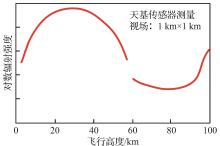
Fig.1
Trend of rocket engine plume radiation intensity with flight altitude
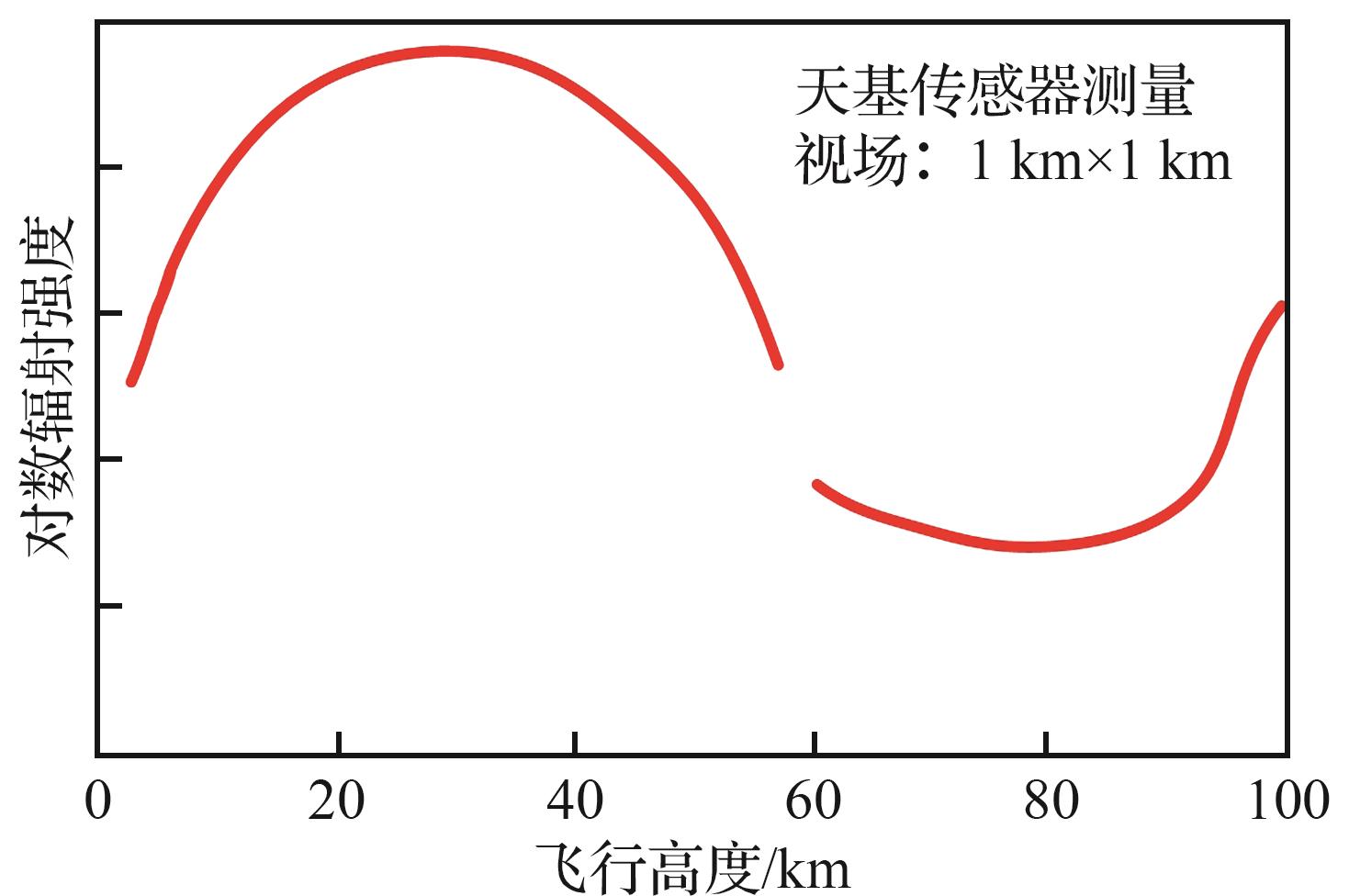
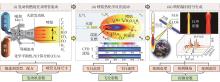
Fig.2
Model for full chain generation of plume radiation signals
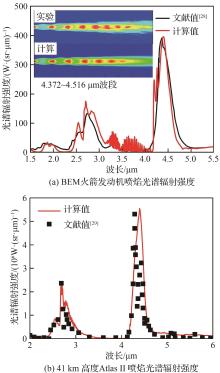
Fig.3
Comparison between calculated and literature values of infrared radiation
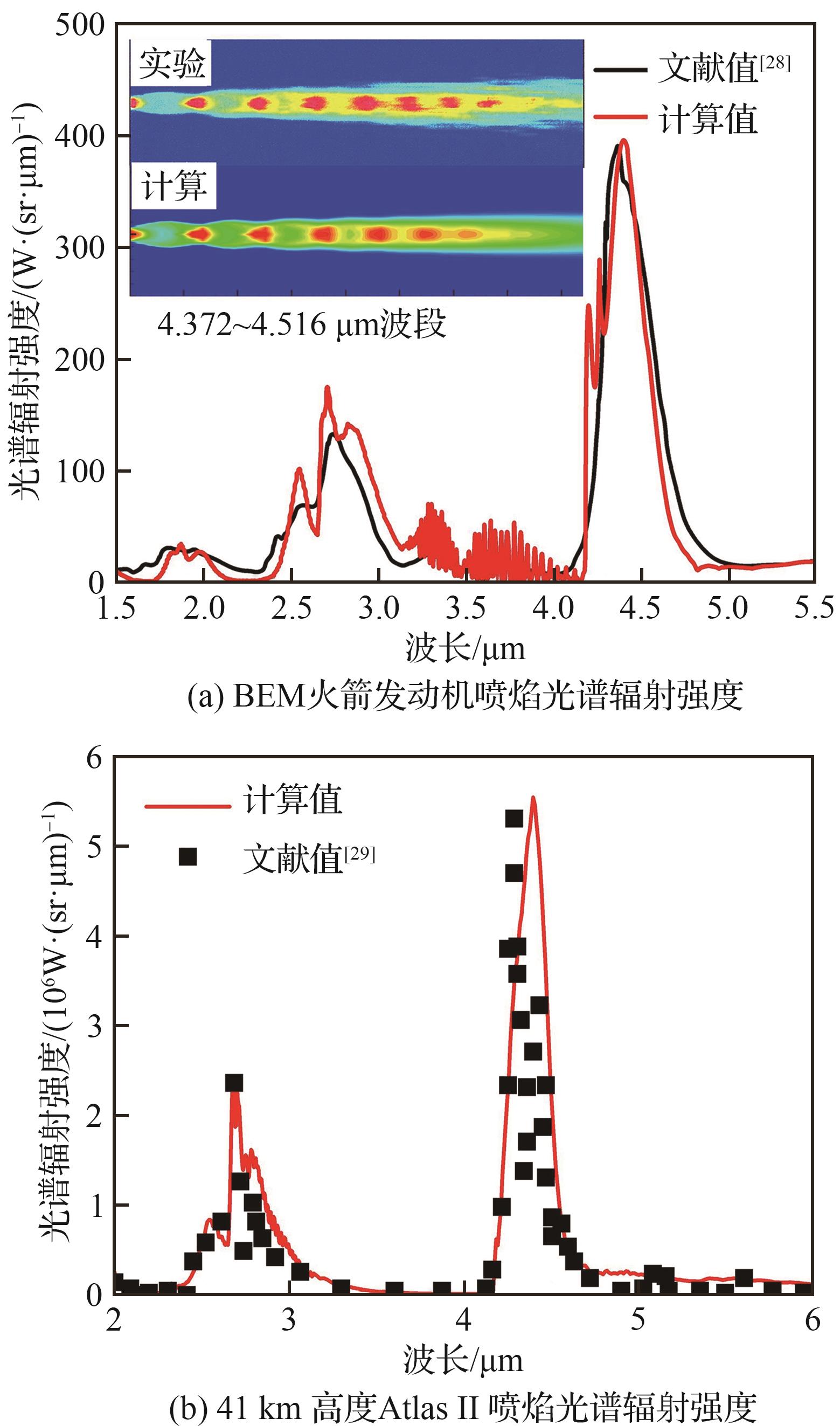

Table 1
Performance parameters of RD-180 rocket engine[21,30-32]
| 参数 | 指标 |
|---|---|
| 推进剂 | LOX/RP-1 |
| 真空推力 | 4 152 |
| 燃烧室压力 | 257 |
| 氧燃比 | 2.72 |
| 膨胀比 | 37 |
| 喷口出口直径 | 1.43 |
| 运载火箭 | Atlas III/Atlas V |
| 发动机数目 | 1(2喷管) |
Table 2
Equivalent nozzle exit parameters for RD-180 engine
| 等效喷口出口参数 | 数值 | |
|---|---|---|
| 出口半径 | 1.049 | |
| 出口压力 | 70 065 | |
| 出口温度 | 1 935 | |
| 出口速度 | 3 340 | |
| 出口气体质量分数 | H | 0.000 013 |
| O | 0 | |
| OH | 0.000 119 | |
| H2O | 0.284 044 | |
| CO | 0.239 839 | |
| CO2 | 0.470 111 | |
| H2 | 0.005 871 | |
| O2 | 0.000 003 | |
| N2 | 0 | |
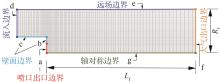
Fig.4
Flow field calculation domain and boundary condition setting
Table 3
Atlas Ⅲ rocket flight trajectory and atmospheric inflow parameters
| 飞行时间t/s | 飞行高度h/km | 飞行速度V/(m·s-1) | 大气压力P∞/Pa | 大气温度T∞/K |
|---|---|---|---|---|
| 62.69 | 11 | 414.26 | 22 632 | 216.65 |
| 73.69 | 15 | 550.19 | 12 044 | 216.65 |
| 87.46 | 21 | 793.32 | 4 677.8 | 217.65 |
| 96.22 | 25 | 961.23 | 2 511.0 | 221.65 |
| 107.17 | 31 | 1 226.74 | 1 008.20 | 227.65 |
| 114.81 | 35 | 1 417.76 | 558.92 | 237.05 |
| 124.14 | 41 | 1 703.44 | 242.39 | 253.85 |
| 130.31 | 45 | 1 900.92 | 143.13 | 265.05 |
| 139.52 | 51 | 2 221.28 | 66.94 | 270.65 |
| 145.11 | 55 | 2 441.25 | 39.97 | 259.45 |
| 153.27 | 61 | 2 791.95 | 17.66 | 242.65 |
Table 4
Grid distributions of different computational domains
飞行高度 h/km | 计算域 | 网格数 | ||
|---|---|---|---|---|
| g | d | |||
| 11 | 500 | 50 | 1 000 | 80 |
| 15~25 | 1 500 | 80 | 1 500 | 100 |
| 31~61 | 2 500 | 120 | 2 000 | 150 |
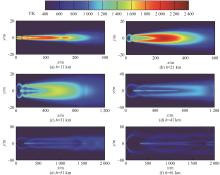
Fig.5
Temperature contour plots for RD-180 rocket motor
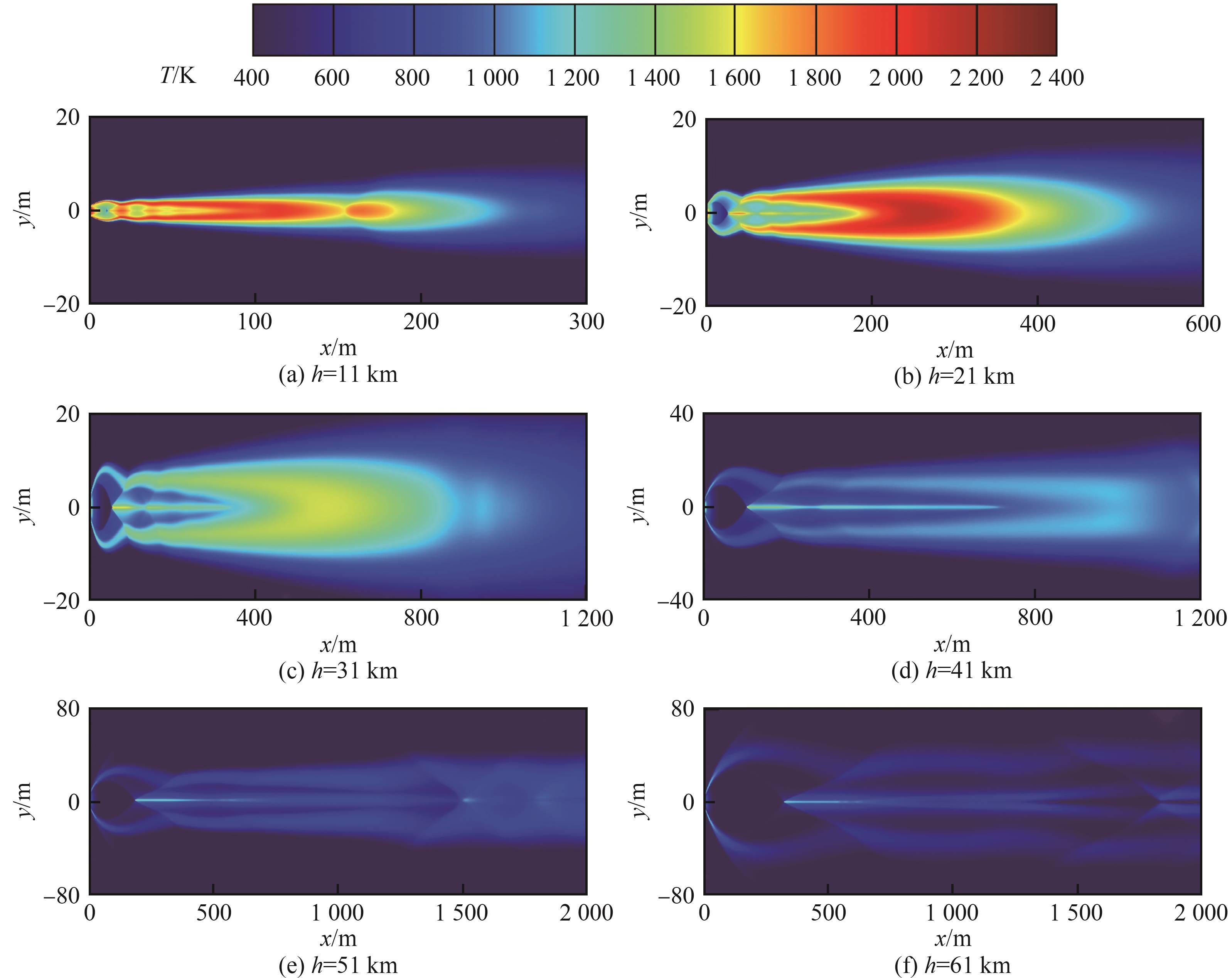
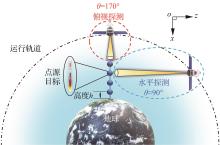
Fig.6
Schematic diagram of space-based detection
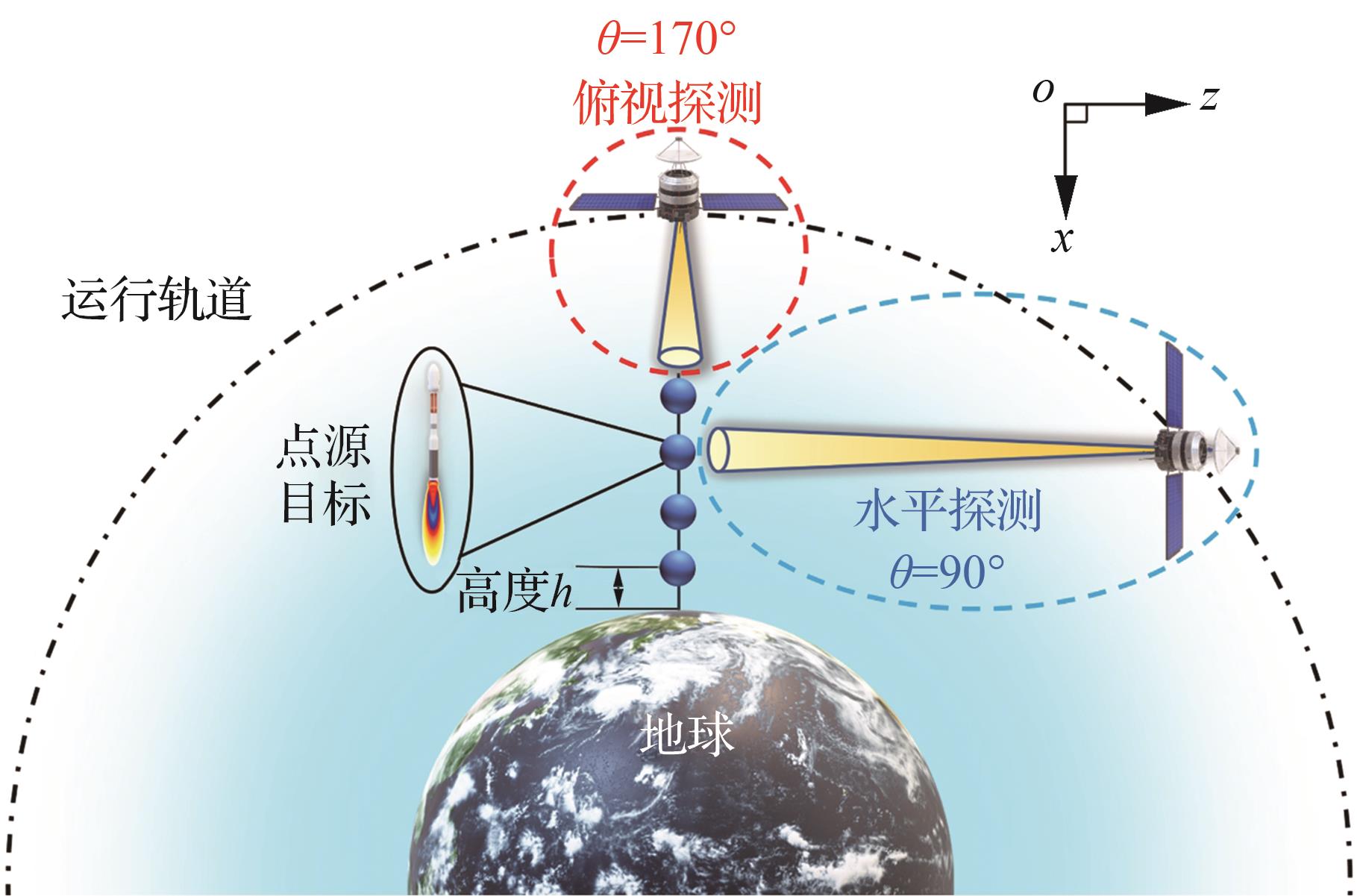
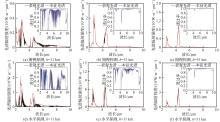
Fig.7
Intrinsic and apparent spectral radiation intensity of RD-180 rocket motor
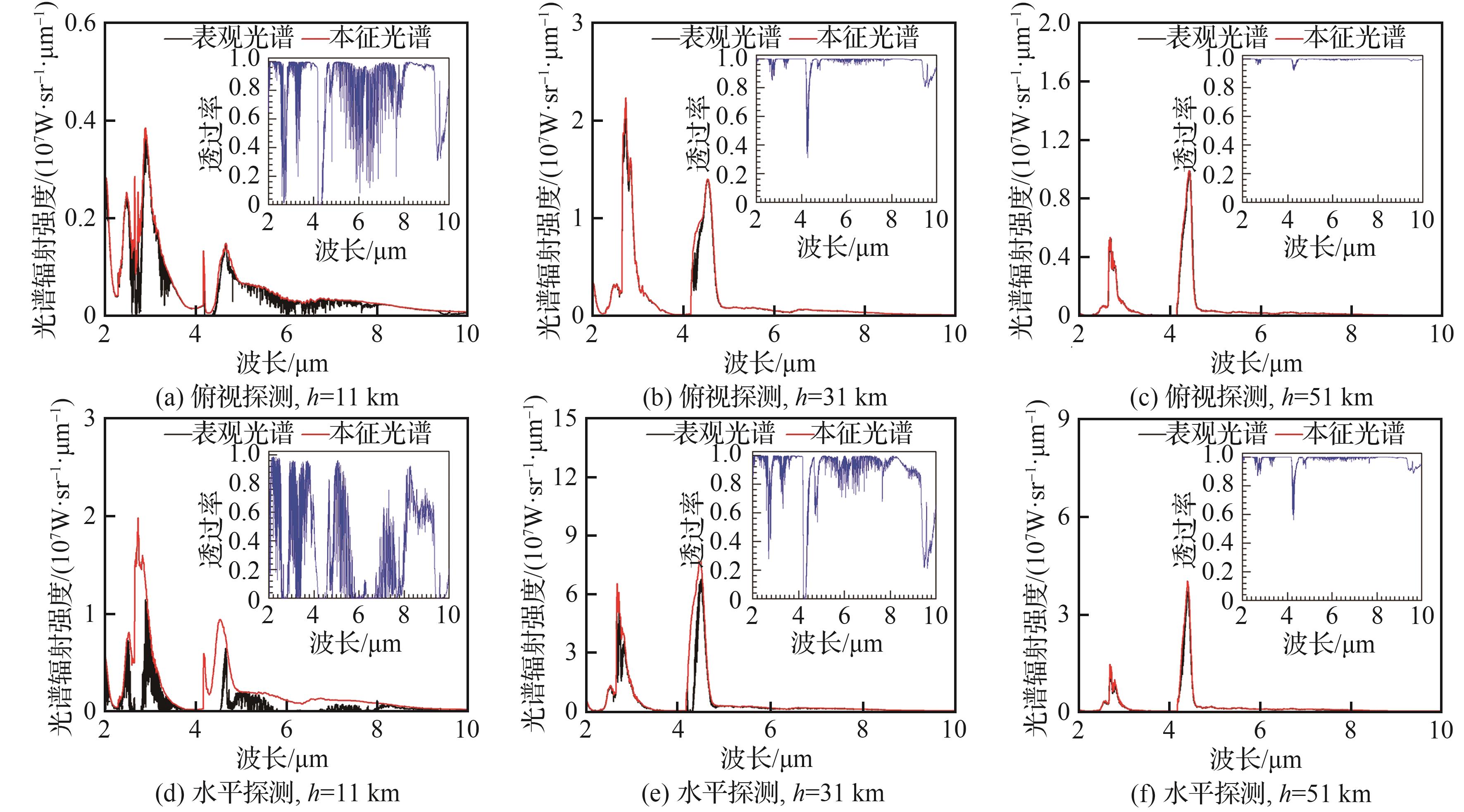
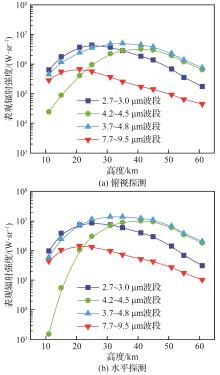
Fig.8
Apparent radiant intensity of RD-180 engine plume in range of 11~61 km for two detection modes
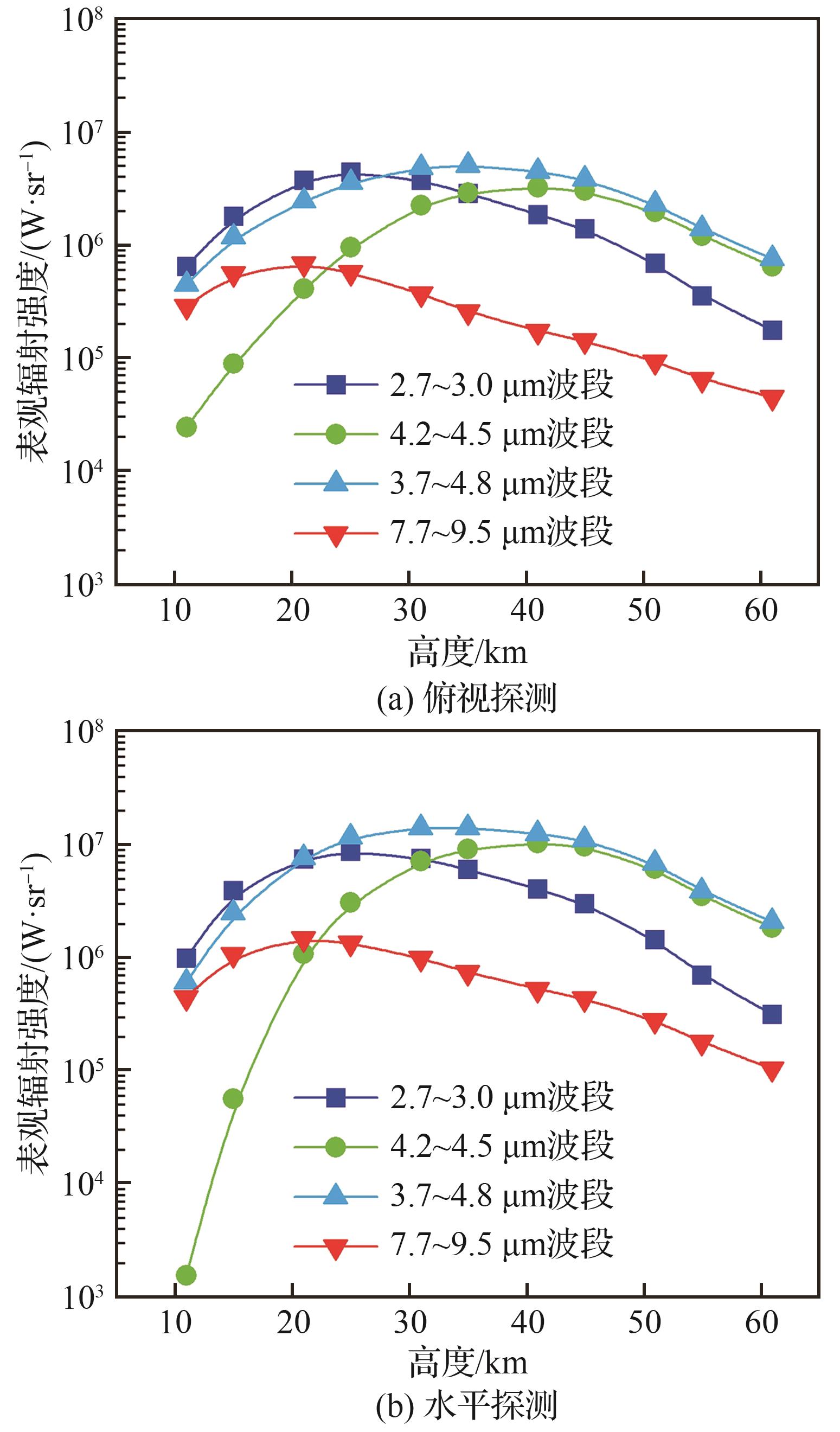
Table 5
Apparent radiant intensity of RD-180 engine plume in overhead observation
h/ km | 表观辐射强度/(W·sr-1) | |||
|---|---|---|---|---|
| 2.7~3.0 μm | 4.2~4.5 μm | 3.7~4.8 μm | 7.7~9.5 μm | |
| 11 | 650 164.3 | 24 296.6 | 451 535.6 | 288 750.4 |
| 15 | 1 806 391.0 | 89 115.7 | 1 177 685.7 | 561 602.2 |
| 21 | 3 734 857.6 | 414 252.8 | 2 473 676.6 | 686 605.7 |
| 25 | 4 409 546.4 | 962 849.5 | 3 588 292.1 | 574 781.6 |
| 31 | 3 730 992.5 | 2 246 681.3 | 4 817 205.5 | 374 466.5 |
| 35 | 2 872 447.4 | 2 914 147.5 | 5 063 578.5 | 260 125.3 |
| 41 | 1 868 262.1 | 3 242 472.9 | 4 476 037.9 | 173 789.3 |
| 45 | 1 405 029.8 | 3 025 619.3 | 3 826 237.2 | 143 084.6 |
| 51 | 697 687.6 | 1 966 429.4 | 2 309 414.6 | 93 278.2 |
| 55 | 358 444.7 | 1 210 248.2 | 1 391 954.7 | 64 849.1 |
| 61 | 178 226.5 | 653 674.4 | 755 557.3 | 44 783.3 |
Table 6
Apparent radiant intensity of RD-180 engine plume under horizontal observation
h/ km | 表观辐射强度/(W·sr-1) | |||
|---|---|---|---|---|
| 2.7~3.0 μm | 4.2~4.5 μm | 3.7~4.8 μm | 7.7~9.5 μm | |
| 11 | 1 004 666.6 | 1 560.5 | 616 546.3 | 452 390.0 |
| 15 | 3 966 876.9 | 56 815.5 | 2 511 613.0 | 1 078 757.8 |
| 21 | 7 536 788.5 | 1 095 478.0 | 7 711 916.9 | 1 498 686.3 |
| 25 | 8 784 653.3 | 3 116 166.6 | 11 699 000.0 | 1 372 791.5 |
| 31 | 7 652 861.2 | 7 220 551.5 | 14 273 600.0 | 1 002 264.6 |
| 35 | 6 103 040.4 | 9 216 720.9 | 14 254 200.0 | 746 998.4 |
| 41 | 4 080 041.5 | 10 353 600.0 | 12 612 500.0 | 530 745.4 |
| 45 | 3 027 854.3 | 9 754 882.7 | 11 162 000.0 | 442 896.8 |
| 51 | 1 466 582.5 | 6 204 441.3 | 6 878 999.0 | 283 259.7 |
| 55 | 714 409.9 | 3 530 278.1 | 3 931 006.1 | 182 360.3 |
| 61 | 319 869.9 | 1 856 914.8 | 2 108 277.1 | 105 357.1 |
Fig.9
Intrinsic spectral radiation intensity of RD-180 engine
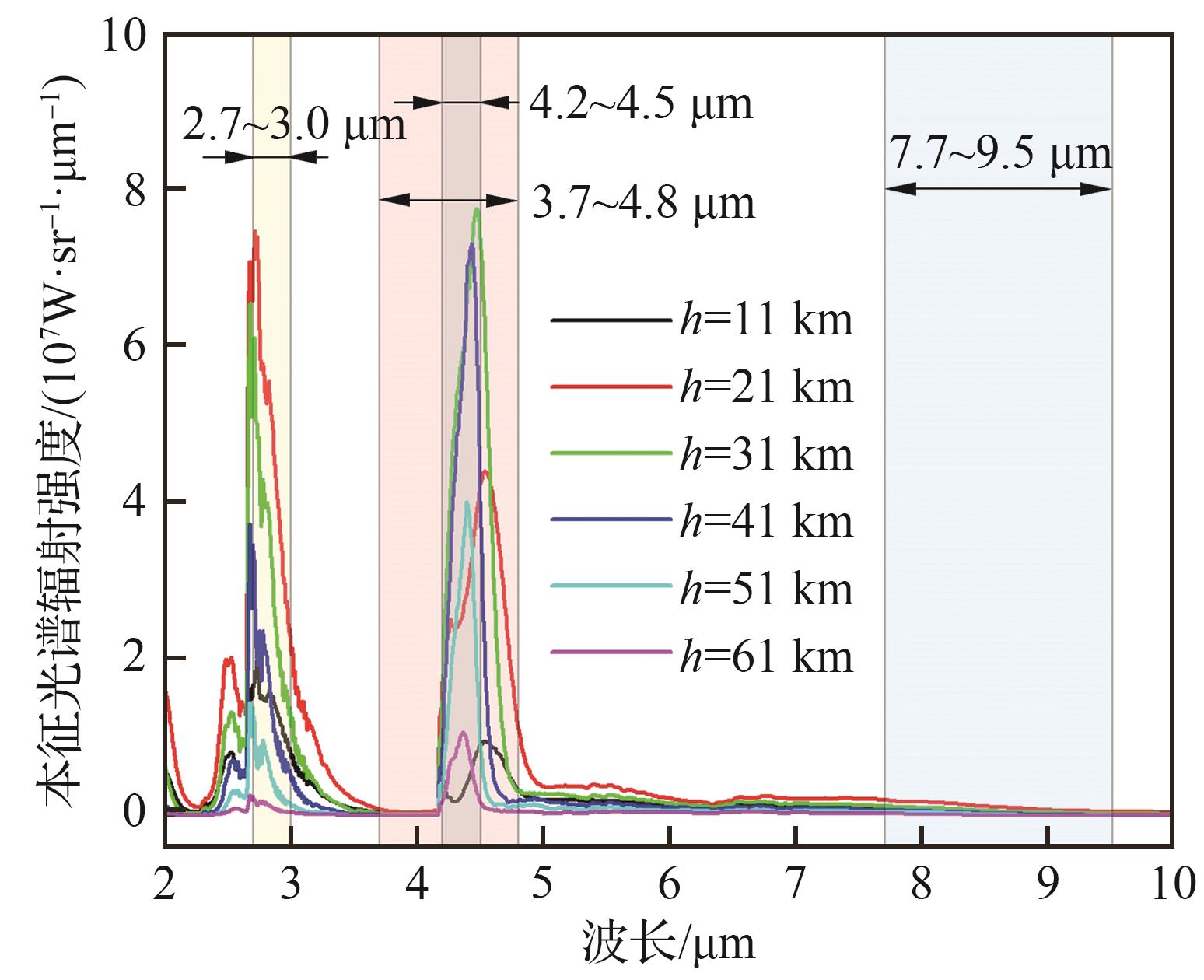
Fig.10
RSOD of the RD-180 engine plume in range of 11-61 km for two detection modes
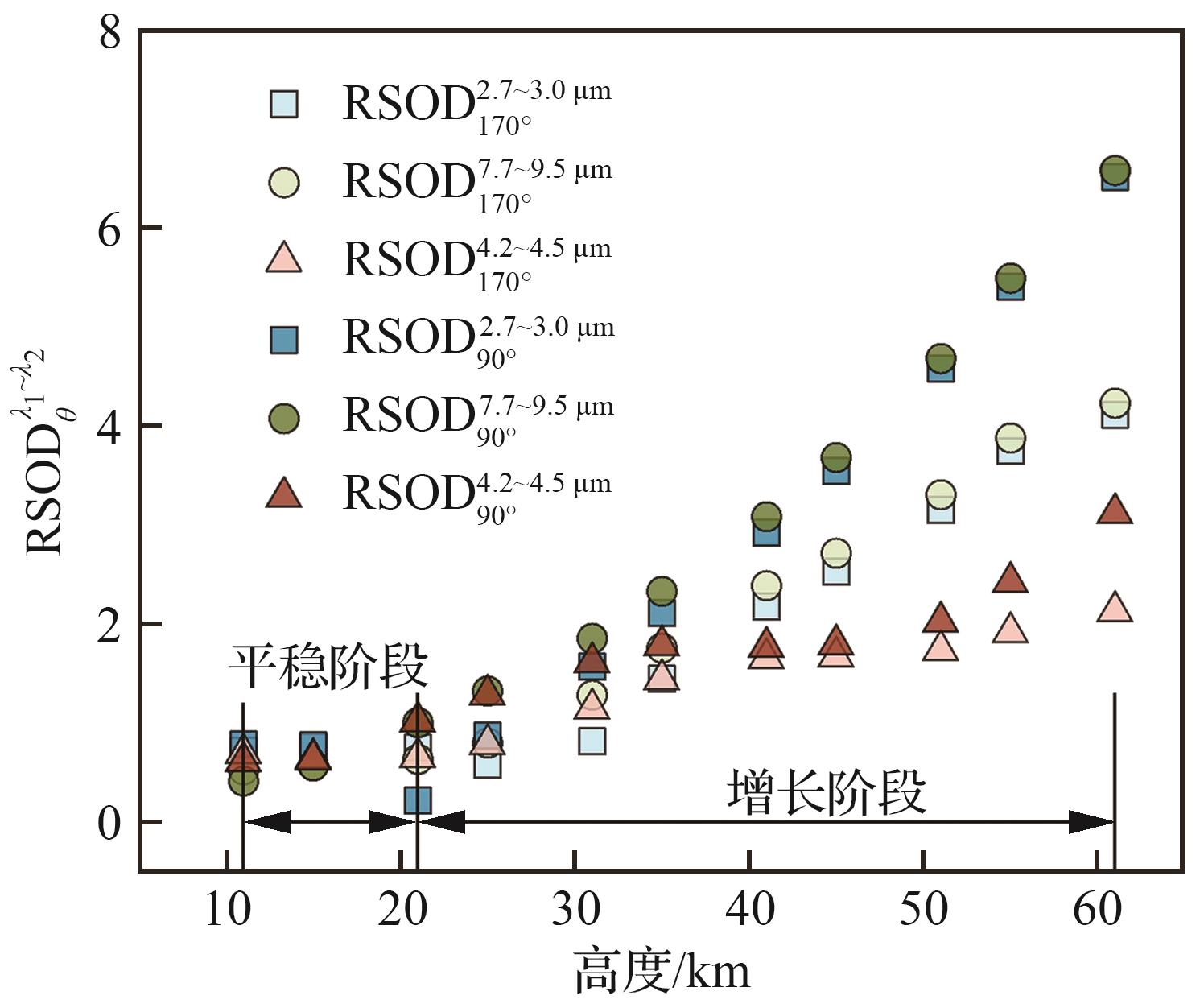
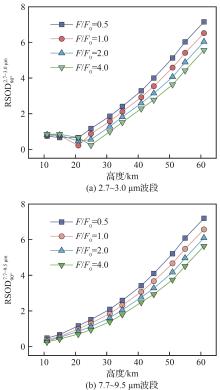
Fig.11
Effect of different thrust ratios on RSOD
Table 7
Performance parameters of RS-56 and RD-191 rocket motors
| 发动机名称 | RS-56-OBA | RS-56-OSA | RD-191 |
|---|---|---|---|
| 推进剂 | LOX/RP-1 | ||
| 真空推力 | 1 047 | 380.6 | 2 090 |
| 燃烧室压力 | 44.68 | 51.37 | 257 |
| 氧燃比 | 2.25 | 2.27 | 2.6 |
| 膨胀比 | 8 | 25 | 37 |
| 喷口出口直径 | 1.32 | 1.32 | 1.43 |
| 运载火箭 | Atlas II | Angara | |
| 发动机数目 | 2 | 1 | 1 |
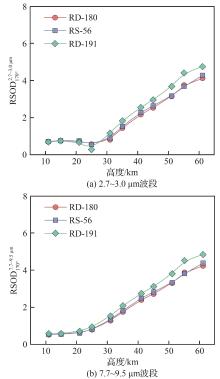
Fig.12
RSOD of RD-180, RS-56 and RD-191 rocket motors in overhead observation
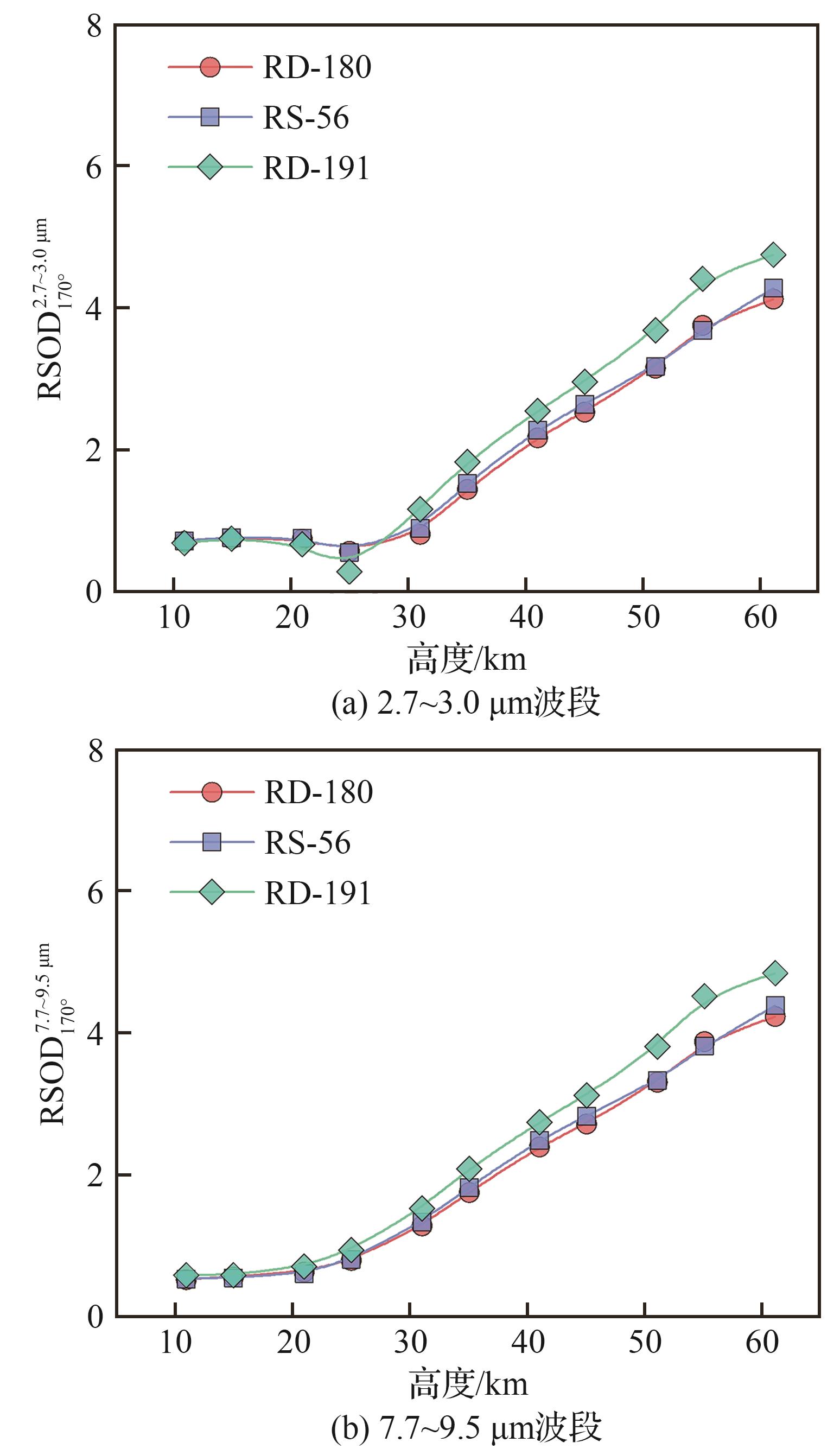
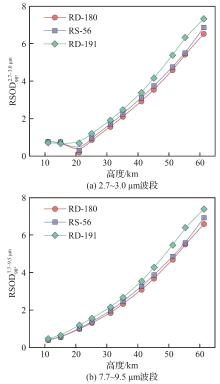
Fig.13
RSOD of RD-180, RS-56 and RD-191 rocket motors in horizontal observation
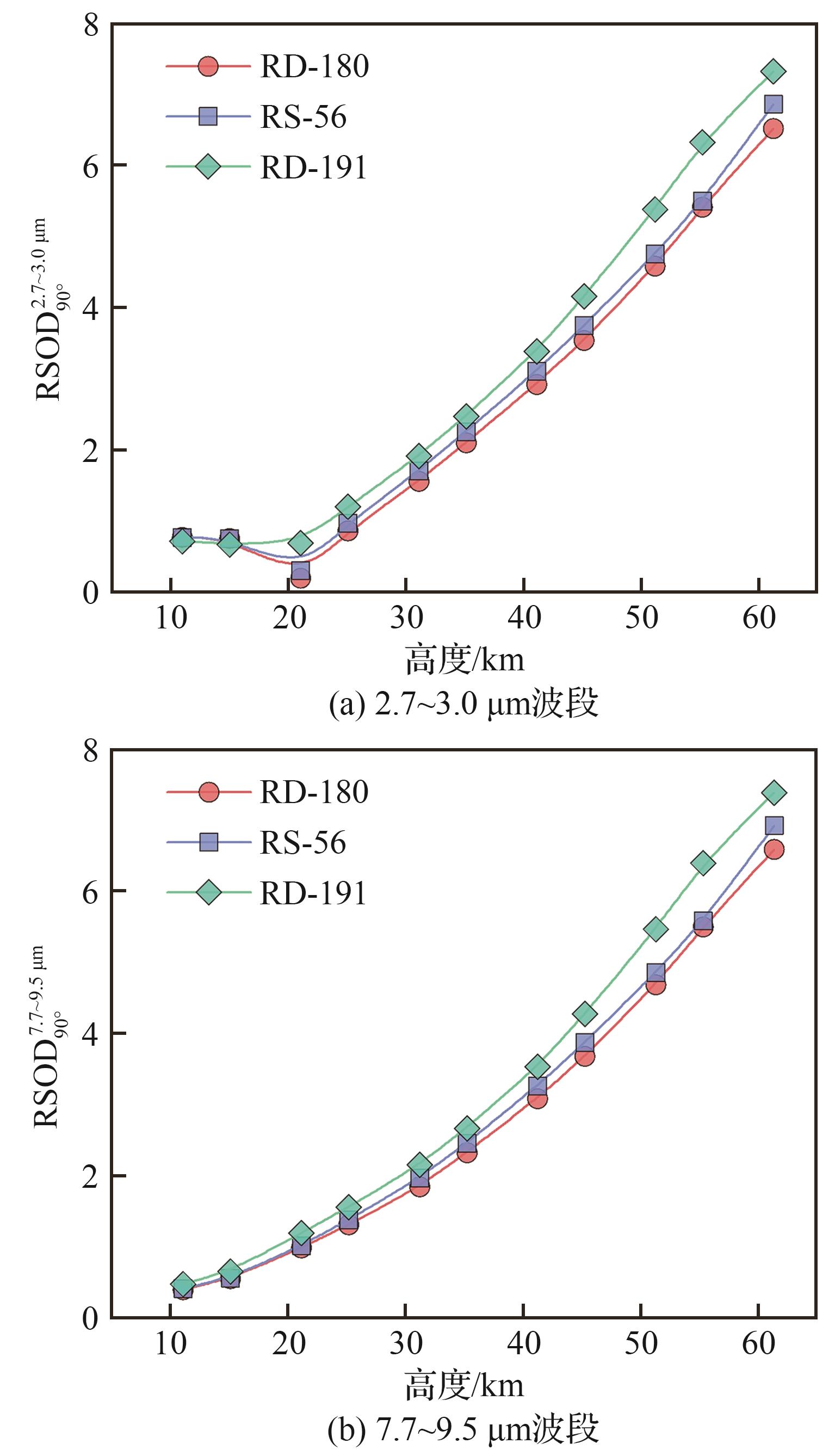
Table 8
Performance parameters of RD-275M and RS-68 rocket motors
| 发动机名称 | RD-275M | RS-68 |
|---|---|---|
| 推进剂 | UDMH/N2O4 | LOX/LH2 |
| 真空推力 | 1 830 | 3 313 |
| 燃烧室压力 | 165 | 97.2 |
| 氧燃比 | 2.67 | 6.0 |
| 膨胀比 | 26.2 | 21.5 |
| 喷口出口直径 | 1.431 | 2.44 |
| 运载火箭 | Proton-M | Delta IV |
| 发动机数目 | 3 | 1 |
Table 9
Nozzle exit parameters for RD-275M and RS-68 engines
| 发动机名称 | RD-275M | RS-68 | |
|---|---|---|---|
| 出口压力 | 62 903.7 | 47 594.7 | |
| 出口温度 | 1 610.2 | 1 673.0 | |
| 出口速度 | 3 089.3 | 4 052.9 | |
| 出口气体质量分数 | H | 0.000 001 | 0.000 006 |
| O | 0 | 0 | |
| OH | 0.000 004 | 0.000 017 | |
| H2O | 0.289 270 | 0.965 127 | |
| CO | 0.071 850 | 0 | |
| CO2 | 0.286 180 | 0 | |
| H2 | 0.004 190 | 0.034 850 | |
| O2 | 0 | 0 | |
| N2 | 0.348 505 | 0 | |
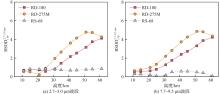
Fig.14
RSOD of RD-180, RD-275M and RS-68 rocket motors in overhead observation
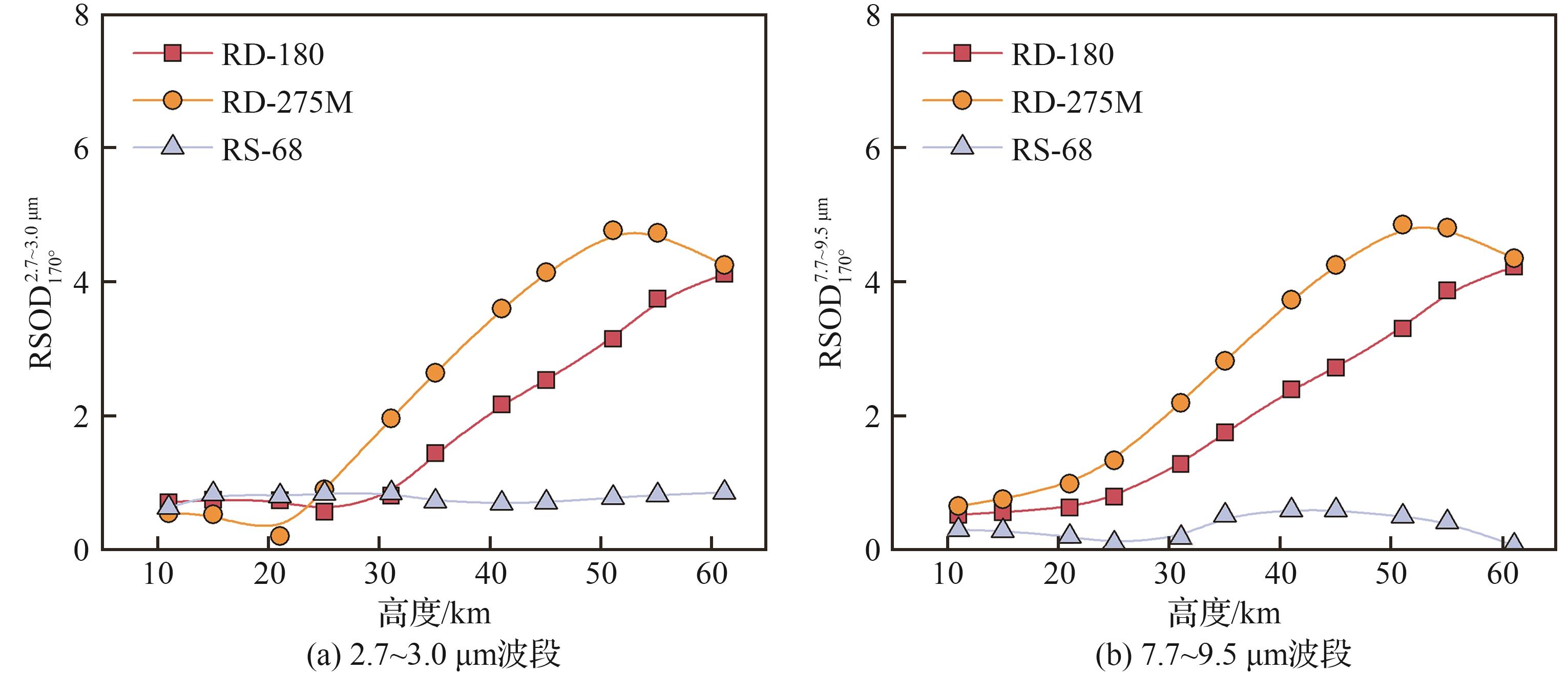
Fig.15
RSOD of RD-180, RD-275M and RS-68 rocket motors in horizontal observation
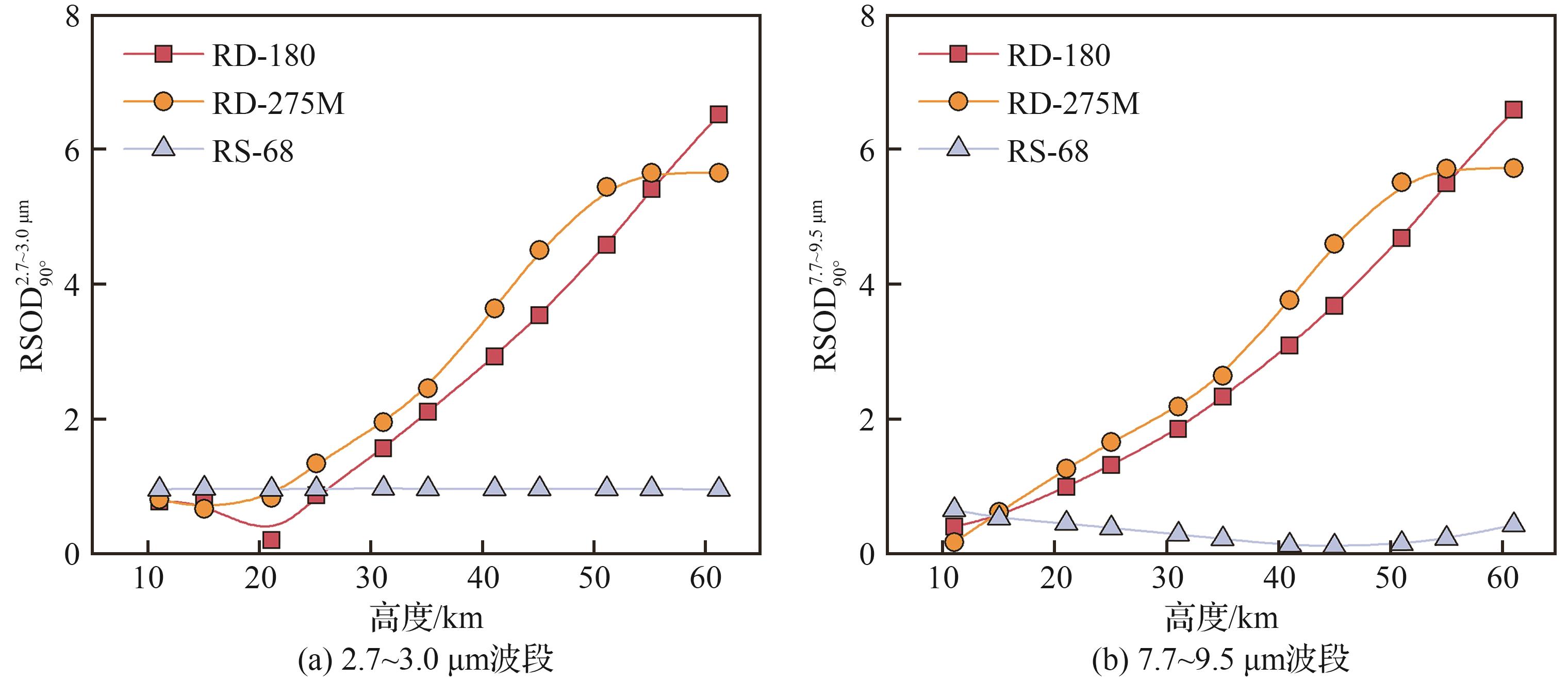
Fig.16
Numerator and denominator of RSOD for RD-275M engine
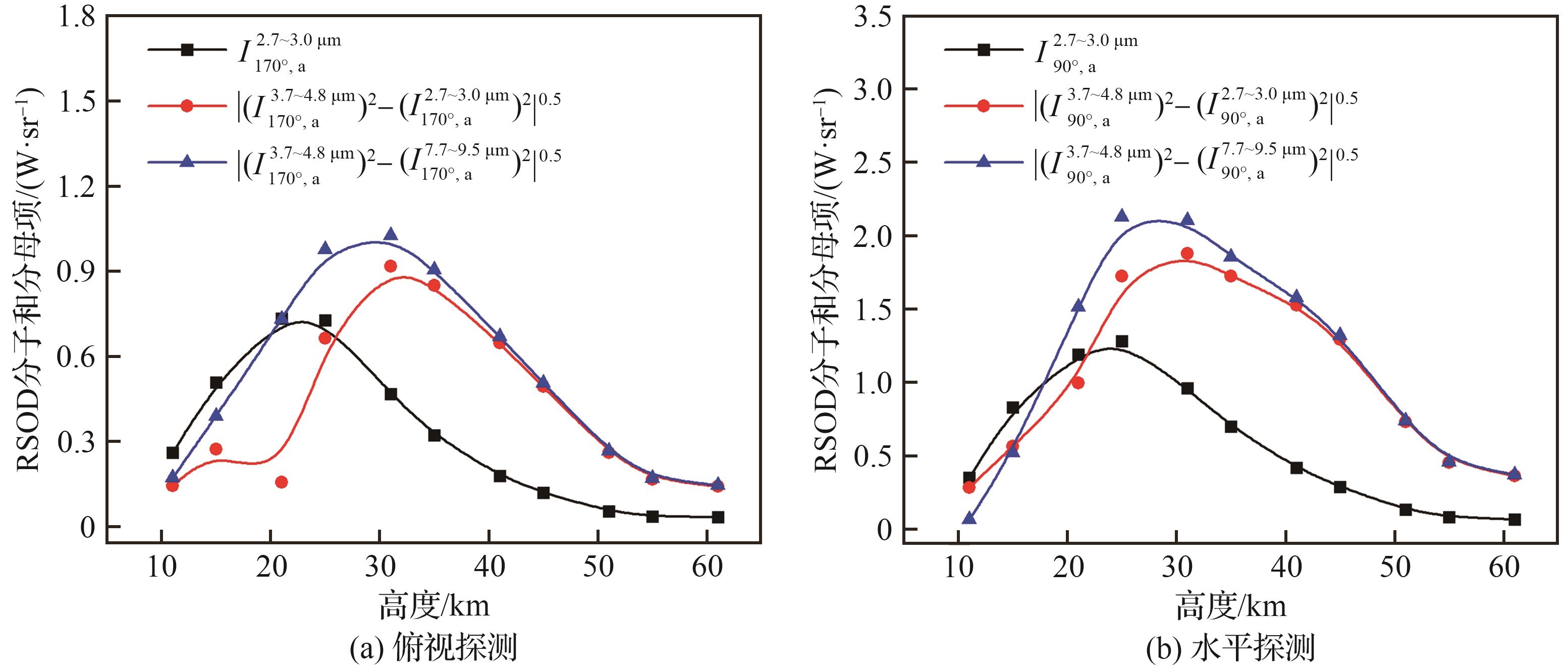
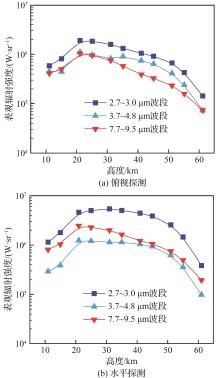
Fig.17
Apparent radiation intensity of the RS-68 engine plume
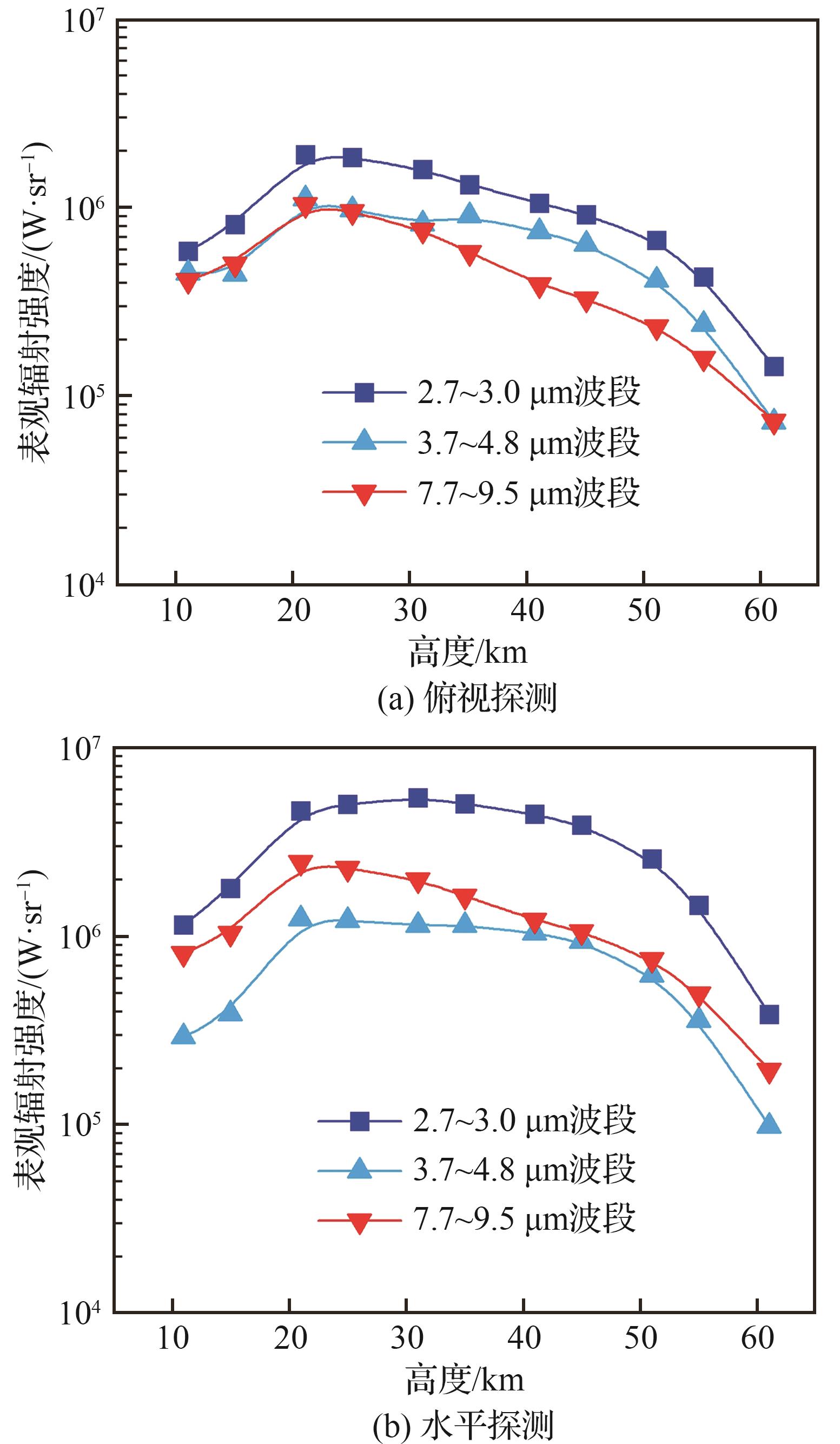
Fig.18
RSOD fitting curves for RD-180 engine in two detection modes
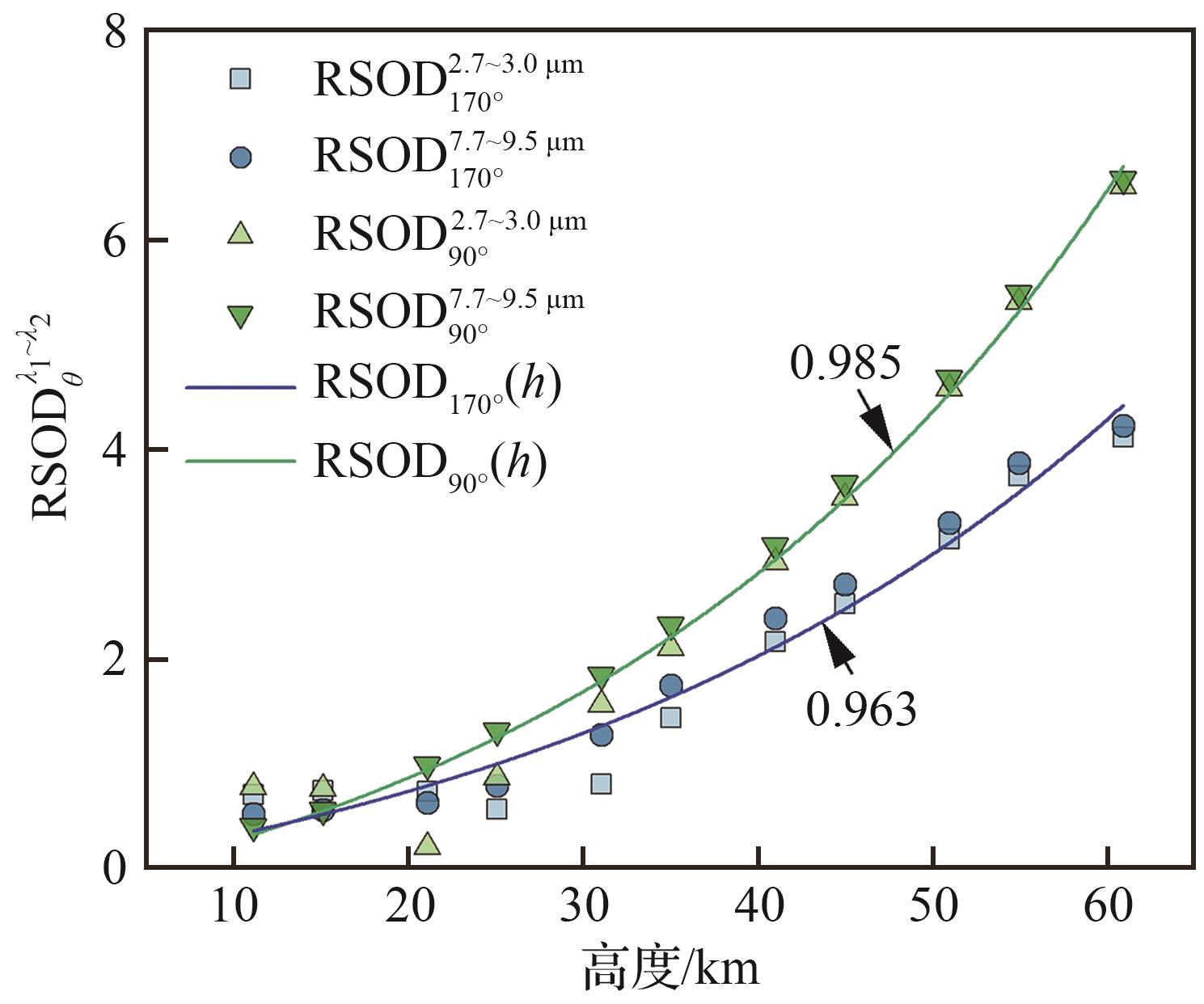
Table 10
Coefficients and R2 for RSODh
| 发动机 | 探测方式 | ||||
|---|---|---|---|---|---|
| RD-180 | 水平 | -1.340 | 1.187 | 31.878 | 0.985 |
| 俯视 | -0.970 | 0.987 | 35.902 | 0.963 | |
| RD-191 | 水平 | -2.066 | 1.798 | 36.295 | 0.992 |
| 俯视 | -1.729 | 1.566 | 41.417 | 0.961 | |
| RS-56 | 水平 | -1.484 | 1.317 | 32.842 | 0.989 |
| 俯视 | -1.067 | 1.071 | 37.006 | 0.967 |
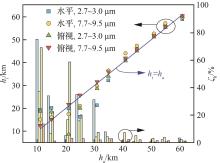
Fig.19
RD-180 engine inversion results
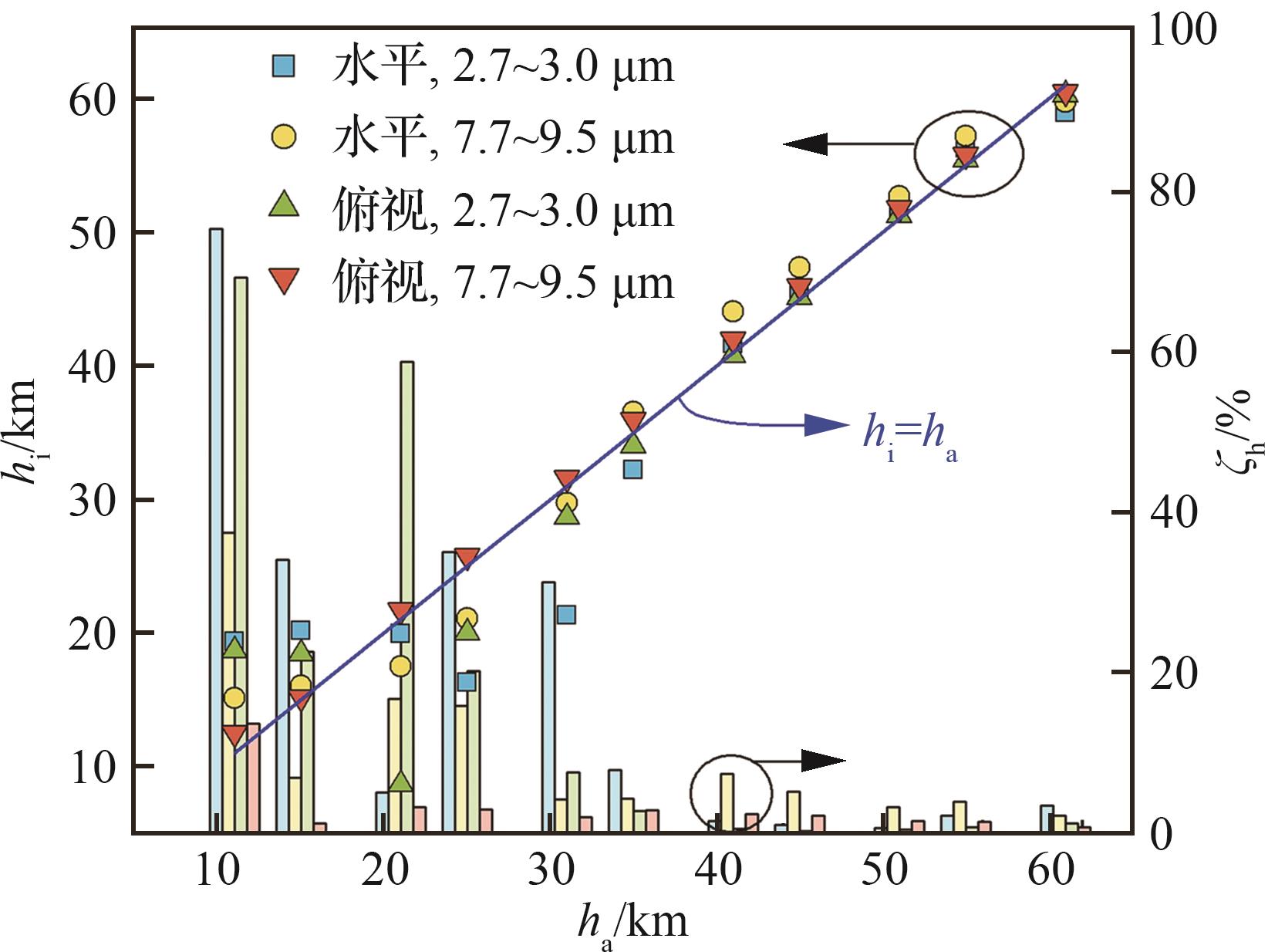
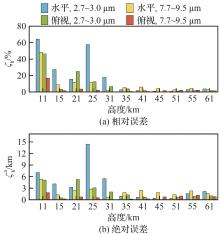
Fig.20
Accuracy of inversion heights for RD-191 engine
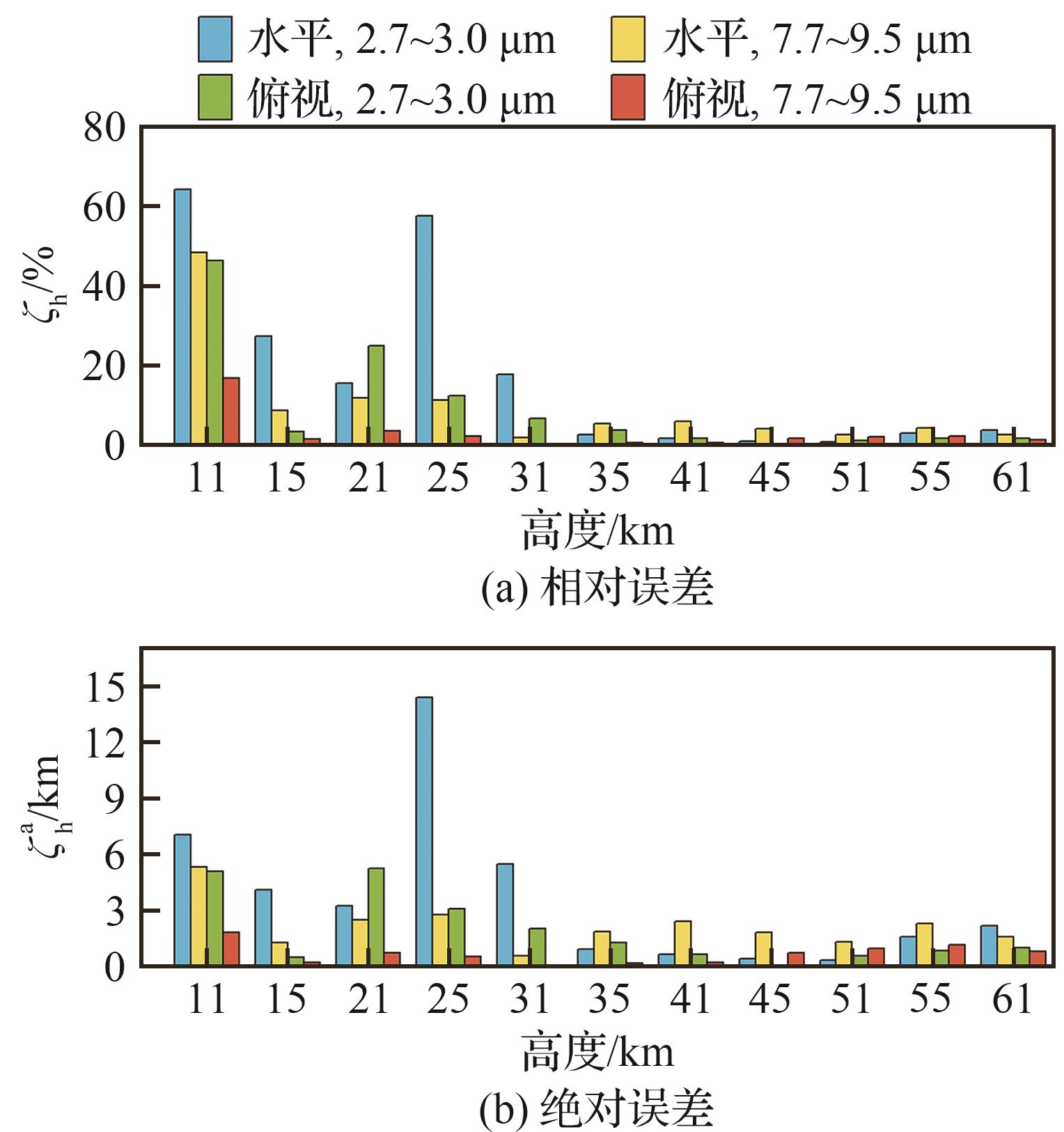
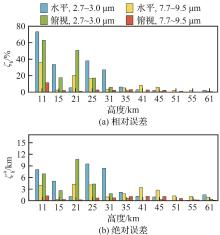
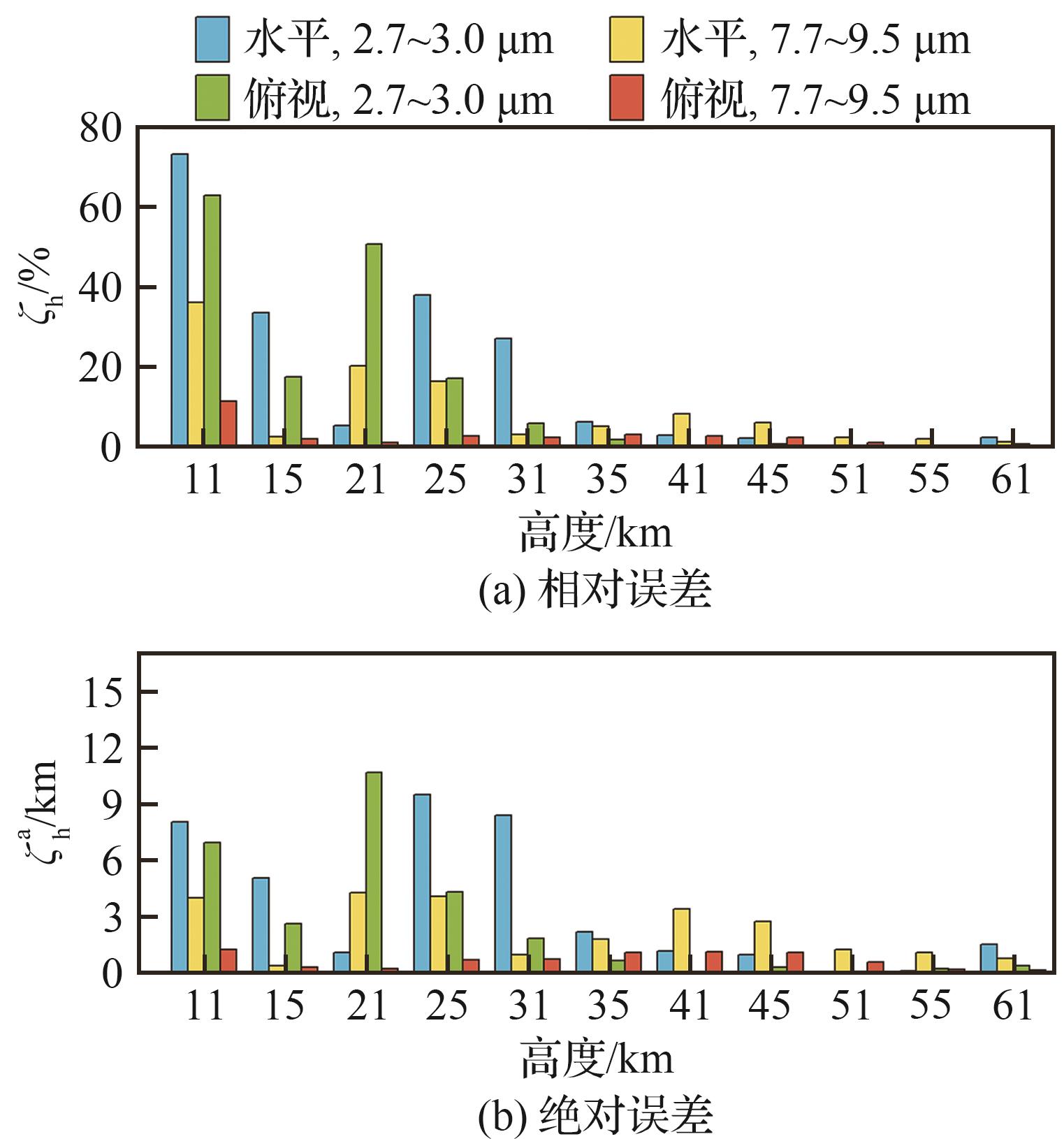
Fig.21
Accuracy of inversion heights for the RS-56 engine
| 1 | SIMMONS F. Rocket exhaust plume phenomenology[M]. Reston: AIAA, 2000. |
| 2 | HIGGINS C J, SMITHSON T, COXHILL I, et al. Characterising the infrared signature of a liquid propellant engine plume[C]∥Proceedings of the 52nd AIAA/SAE/ASEE Joint Propulsion Conference. Reston: AIAA, 2016. |
| 3 | STOWE R, RINGUETTE S, FOURNIER P, et al. Effect of flight and motor operating conditions on infrared signature predictions of rocket exhaust plumes[J]. International Journal of Energetic Materials and Chemical Propulsion, 2015, 14(1): 29-56. |
| 4 | CALHOON W JR, KENZAKOWSKI D. Flowfield and radiation analysis of missile exhaust plumes using a turbulent-chemistry interaction model[C]∥Proceedings of the 36th AIAA/ASME/SAE/ASEE Joint Propulsion Conference and Exhibit. Reston: AIAA, 2000. |
| 5 | PAIVA C, SLUSHER H. Space-based missile exhaust plume sensing: Strategies for DTCI of liquid and solid IRBM systems[C]∥Proceedings of the Space 2005. Reston: AIAA, 2005. |
| 6 | NIU Q L, FU D B, DONG S K, et al. A simplified model for fast estimating infrared thermal radiation of low-altitude under-expanded exhaust plumes[J]. International Journal of Heat and Mass Transfer, 2019, 136: 276-287. |
| 7 | SMOOT L, SIMONSEN J, WILLIAMS G. Exhaust plume prediction model for a low-altitude supersonic missile[C]∥Proceedings of the 8th Joint Propulsion Specialist Conference. Reston: AIAA, 1972. |
| 8 | VITKIN E I, KARELIN V G, KIRILLOV A A, et al. A physico-mathematical model of rocket exhaust plumes[J]. International Journal of Heat and Mass Transfer, 1997, 40(5): 1227-1241. |
| 9 | LI J L, BAI L, BAI J Y, et al. Narrow-band infrared radiation characteristics of rocket exhaust plume by using correction function related to thermodynamic state[J]. Infrared Physics and Technology, 2022, 125: 104260. |
| 10 | ZIRKIND R. Radiation from rocket-exhaust plumes[J]. Symposium (International) on Combustion, 1967, 11(1): 613-620. |
| 11 | LIU Z Y, YE Q, DING F, et al. Study on the influence of flight altitude on the rocket plume radiation enhancement effect caused by afterburning[J]. International Journal of Aeronautical and Space Sciences, 2021, 22(5): 1019-1030. |
| 12 | KIM S, KIM S, KIM M, et al. Infrared signature of NEPE, HTPB rocket plume under varying flight conditions and motor size[J]. Infrared Physics and Technology, 2021, 112: 103590. |
| 13 | DASH S M, PEARCE B E, PERGAMENT H S, et al. Prediction of rocket plume flowfields for infrared signature studies[J]. Journal of Spacecraft and Rockets, 1980, 17(3): 190-199. |
| 14 | WOODROFFE J. One-dimensional model for low-altitude rocket exhaust plumes[C]∥Proceedings of the 13th Aerospace Sciences Meeting. Reston: AIAA, 1975. |
| 15 | NIE W S, FENG S J, XIE Q F, et al. Numerical simulation of liquid rocket exhaust plume radiation[C]∥Proceedings of the 39th AIAA Thermophysics Conference. Reston: AIAA, 2007. |
| 16 | ZHOU Z T, WANG X, LU C Y, et al. Numerical analysis on thermal environment of liquid rocket with afterburning under different altitudes[J]. Applied Thermal Engineering, 2020, 178: 115584. |
| 17 | NIU Q L, DUAN X H, MENG X Y, et al. Numerical analysis of point-source infrared radiation phenomena of rocket exhaust plumes at low and middle altitudes[J]. Infrared Physics & Technology, 2019, 99: 28-38. |
| 18 | SUN Y Q, DONG S K, NIU Q L, et al. NIPC-based uncertainty analysis of infrared radiation from rocket exhaust plumes caused by nozzle exit conditions[J]. Infrared Physics & Technology, 2020, 108: 103376. |
| 19 | NIU Q L, HE Z H, DONG S K. IR radiation characteristics of rocket exhaust plumes under varying motor operating conditions[J]. Chinese Journal of Aeronautics, 2017, 30(3): 1101-1114. |
| 20 | GORDON S, MCBRIDE B J. Computer program for calculation of complex chemical equilibrium compositions and applications. Part 1: Analysis[M]. Ohio: NASA Lewis Research Center, 1994: 2-3. |
| 21 | SUTTON G P, BIBLARZ O. Rocket propulsion elements[M]. 8th. ed. New Jersey: John Wiley & Sons, Inc, 2010, 18-51. |
| 22 | 牛青林. 连续流域高速目标辐射现象学研究[D]. 哈尔滨: 哈尔滨工业大学, 2019: 27-28. |
| NIU Q L. Phenomenological study on radiation of high-speed targets in continuous basins[D].Harbin: Harbin Institute of Technology, 2019: 27-28 (in Chinese). | |
| 23 | WANG W, WEI Z, ZHANG Q, et al. Study on infrared signature of solid rocket motor afterburning exhaust plume[C]∥46th AIAA/ASME/SAE/ASEE Joint Propulsion Conference & Exhibit. Reston: AIAA, 2010. |
| 24 | KRAKOW B, BABROV H J, MACLAY G J, et al. Use of the Curtis-Godson approximation in calculations of radiant heating by inhomogeneous hot gases[J]. Applied Optics, 1966, 5(11): 1791-1800. |
| 25 | LUDWIG C B, MALKMUS W, REARDON J, et al. Handbook of infrared radiation from combustion gases[M]. Washington, D.C.: NASA Marshall Space Flight Center, 1973: 220-223. |
| 26 | 余其铮. 辐射换热原理[M]. 哈尔滨: 哈尔滨工业大学出版社, 2000: 10-12. |
| YU Q Z. Radiation heat transfer principle[M]. Harbin: Harbin Institute of Technology Press, 2000: 10-12 (in Chinese). | |
| 27 | BERK G A, ACHARYA P, CHETWYND J, et al. ADLER-GOLDEN. Modtran4 user’s manual[M]. Ohio: Air Force Research Laboratory, 1999. |
| 28 | AVITAL G, COHEN Y, GAMSS L, et al. Experimental and computational study of infrared emission from underexpanded rocket exhaust plumes[J]. Journal of Thermophysics and Heat Transfer, 2001, 15(4): 377-383. |
| 29 | OZAWA T, GARRISON M B, LEVIN D A. Accurate molecular and soot infrared radiation model for high-temperature flows[J]. Journal of Thermophysics and Heat Transfer, 2007, 21(1): 19-27. |
| 30 | POPP M, TANNER L, KATORGIN B, et al. RD-180 engine production and flight experience[C]∥Proceedings of the 40th AIAA/ASME/SAE/ASEE Joint Propulsion Conference and Exhibit. Reston: AIAA, 2004. |
| 31 | HAGGER R, JOYNER C, CHELKIS F. Kerosene booster engine-use for atlas commercial orbital transportation service capabilities and more[C]∥Proceedings of the 42nd AIAA/ASME/SAE/ASEE Joint Propulsion Conference & Exhibit. Reston: AIAA, 2006. |
| 32 | KATORGIN B, CHVANOV V, YU F, et al. Atlas with RD-180 now[C]∥Proceedings of the 37th Joint Propulsion Conference and Exhibit. Reston: AIAA, 2001. |
| 33 | PLASTININ Y, KARABADZHAK G, KHMELININ B, et al. Investigation of soot density in the LOX/kerosene engine booster exhaust of Atlas II and Atlas III from remote measurements of radiation intensity[C]∥Proceedings of the 43rd AIAA Aerospace Sciences Meeting and Exhibit. Reston: AIAA, 2005. |
| 34 | BARTON P, PEARCE B, FREEMAN G, et al. Spectral imagery data and mechanisms[C]∥Proceedings of the 39th Aerospace Sciences Meeting and Exhibit. Reston: AIAA, 2001. |
| 35 | KATORGIN B, CHVANOV V, CHELKIS F, et al. RD-180 program history[C]∥Proceedings of the 37th Joint Propulsion Conference and Exhibit. Reston: AIAA, 2001. |
| 36 | RAO R, SINHA K, CANDLER G, et al. Numerical simulations of Atlas II rocket motor plumes[C]∥Proceedings of the 35th Joint Propulsion Conference and Exhibit. Reston: AIAA, 1999. |
| 37 | VISWANATH K, BRENTNER K S, GIMELSHEIN S F, et al. Investigation of soot combustion in underexpanded jet plume flows[J]. Journal of Thermophysics and Heat Transfer, 2005, 19(3): 282-293. |
| 38 | PLASTININ Y, KARABDZHAK G, KHMELININ B, et al. Ultraviolet, visible and infrared spectra modeling for solid and liquid-fuel rocket exhausts[C]∥Proceedings of the 39th Aerospace Sciences Meeting and Exhibit. Reston: AIAA, 2001. |
| 39 | JONES J P, KUFFEL L, SORTO-RAMOS E, et al. Investigating the legacy of air-breathing and rocket propulsion systems[C]∥Proceedings of the AIAA Propulsion and Energy 2020 Forum. Reston: AIAA, 2020. |
| 40 | SOLLER S, WAGNER R, KIRCHBERGER C, et al. characterisation of combustion and heat transfer using GOX/Kerosene in a single-element rocket combustor[C]∥Proceedings of the 41st AIAA/ASME/SAE/ASEE Joint Propulsion Conference & Exhibit. Reston: AIAA, 2005. |
| 41 | ALLGOOD D, AHUJA V. Computational plume modeling of conceptual ARES vehicle stage tests[C]∥Proceedings of the 43rd AIAA/ASME/SAE/ASEE Joint Propulsion Conference & Exhibit. Reston: AIAA, 2007. |
| [1] | Shaoyi LI, Mengjie WEI, Junyan YANG, Xi YANG, Zhongjie MENG. Research status and prospects of infrared multi-band imaging terminal guidance technology [J]. Acta Aeronautica et Astronautica Sinica, 2024, 45(20): 630427-630427. |
| Viewed | ||||||
|
Full text |
|
|||||
|
Abstract |
|
|||||
Address: No.238, Baiyan Buiding, Beisihuan Zhonglu Road, Haidian District, Beijing, China
Postal code : 100083
E-mail:hkxb@buaa.edu.cn
Total visits: 6658907 Today visits: 1341All copyright © editorial office of Chinese Journal of Aeronautics
All copyright © editorial office of Chinese Journal of Aeronautics
Total visits: 6658907 Today visits: 1341

 CJA
CJA
