Acta Aeronautica et Astronautica Sinica ›› 2024, Vol. 45 ›› Issue (23): 330391.doi: 10.7527/S1000-6893.2024.30391
• Electronics and Electrical Engineering and Control • Previous Articles Next Articles
Hongxu ZHAO1,2, Ziyang LI2, Xudong SHI2( )
)
Received:2024-03-14
Revised:2024-04-30
Accepted:2024-06-11
Online:2024-12-15
Published:2024-06-17
Contact:
Xudong SHI
E-mail:xdshi@cauc.edu.cn
Supported by:CLC Number:
Hongxu ZHAO, Ziyang LI, Xudong SHI. Conduction immunity pre-test method based on bulk current injection probe[J]. Acta Aeronautica et Astronautica Sinica, 2024, 45(23): 330391.
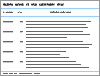
Table 1
Structural parameters of FCC F-1206A
| 参数 | 数值 |
|---|---|
| 金属外壳外径/mm | 64.5 |
| 金属外壳内径/mm | 20 |
| 磁芯外径/mm | 53 |
| 磁芯内径/mm | 32 |
| 磁芯宽度/mm | 57 |
| 金属外壳宽度/mm | 70 |
| 金属外壳厚度/mm | 3 |

Fig.1
Physical and simulation models of FCC F-1206A


Fig.2
Grid division of FCC F-1206A simulation model


Fig.3
FCC F-1206A instantaneous surface charge density


Fig.4
Physical and simulation models of FCC BCICF-1 calibration fixture


Fig.5
Relative permeability response of first/secondorder Debye model


Fig.6
FCC F-1206A lumped parameter circuit


Fig.7
Relative permeability of FCC F-1206A


Fig.8
Verification of FCC F-1206A current injection probe


Fig.9
Validation of scattering parameter of calibration fixture


Fig.10
Validation of voltage standing wave ratio of calibration fixture


Fig.11
Front view and section view of simulation combination model


Fig.12
Validation of insertion loss of combination model


Fig.13
Validation of terminal response voltage of combination model


Fig.14
Simulation model test platform


Fig.15
Conduction immunity experiment test platform

Table 2
Structural parameters of the cable to be tested in the experimental test
| 参数 | 数值 |
|---|---|
| 线长(非屏蔽线)/mm | 1 200 |
| 线芯半径(非屏蔽线)/mm | 0.32 |
| 绝缘层外径(非屏蔽线)/mm | 0.36 |
| 线长(屏蔽线)/mm | 1 200 |
| 线芯半径(屏蔽线)/mm | 0.26 |
| 绝缘层外径(屏蔽线)/mm | 0.76 |
| 屏蔽层外径(屏蔽线)/mm | 0.98 |
| 护套外径(屏蔽线)/mm | 1.25 |
| 线束组成数量 | 6 |

Fig.16
Schematic diagram of cable to be tested and aviation connector


Fig.17
Comparison of experimental results

| 1 | GRASSI F, ROSTAMZADEH C, KOLBE P, et al. Assessing linearity of injection probes used in BCI test setups for automotive applications[C]∥2013 IEEE International Symposium on Electromagnetic Compatibility. Piscataway: IEEE Press, 2013: 128-133. |
| 2 | GARDELLA P J, MARIANI E. Analysis of the impact of the monitoring equipment on the common-mode to differential-mode conversion in bulk current injection tests[C]∥2021 IEEE International Joint EMC/SI/PI and EMC Europe Symposium. Piscataway: IEEE Press, 2021: 486-491. |
| 3 | YANG K, LU J X, DING M, et al. Improved measurement of the low-frequency complex permeability of ferrite annulus for low-noise magnetic shielding[J]. IEEE Access, 2019, 7: 126059-126065. |
| 4 | 陈功. Do160G与Do160F在EMC方面的对比分析[J].河北科技大学学报, 2011, 32(S1): 119-121, 126. |
| CHEN G. Comparative analysis of Do160G and Do160F in EMC[J]. Journal of Hebei University of Science and Technology, 2011, 32(S1): 119-121, 126 (in Chinese). | |
| 5 | 潘晓东, 魏光辉, 万浩江, 等. 电子设备电磁辐射敏感度测试相关问题研究[J]. 强激光与粒子束, 2020, 32(7): 200088. |
| PAN X D, WEI G H, WAN H J, et al. Research on several test issues of electromagnetic radiation susceptibility for electronic equipment[J]. High Power Laser and Particle Beams, 2020, 32(7): 200088 (in Chinese). | |
| 6 | 马振洋,左晶,史春蕾 等.机载电子设备屏蔽效能测试与优化[J].航空学报, 2020, 41(7): 323538. |
| MA Z Y, ZUO J, SHI C L, et al. Test and optimization of shield effectiveness for airborne electronic equipment[J]. Acta Aeronautica et Astronautica Sinica, 2020, 41(7): 323538 (in Chinese). | |
| 7 | 卢新福, 魏光辉, 潘晓东, 等. 差模电流注入等效电磁脉冲辐射技术仿真研究[J]. 中国舰船研究, 2015, 10(2): 99-103, 115. |
| LU X F, WEI G H, PAN X D, et al. Simulation study on the differential-mode current injection equivalent to electromagnetic pulse radiation[J]. Chinese Journal of Ship Research, 2015, 10(2): 99-103, 115 (in Chinese). | |
| 8 | GRASSI F, MARLIANI F, PIGNARI S A. Circuit modeling of injection probes for bulk current injection[J]. IEEE Transactions on Electromagnetic Compatibility, 2007, 49(3): 563-576. |
| 9 | LIU X, CROSTA L, GRASSI F, et al. Spice modeling of probes for pulse current injection[C]∥2019 ESA Workshop on Aerospace EMC (Aerospace EMC). Piscataway: IEEE Press, 2019: 1-6. |
| 10 | OGANEZOVA I, BUNLON X, GHEONJIAN A, et al. A new and easy approach to create BCI models[C]∥2014 IEEE International Symposium on Electromagnetic Compatibility (EMC). Piscataway: IEEE Press, 2014: 91-96. |
| 11 | 潘晓东, 魏光辉, 卢新福, 等. 电磁注入等效替代辐照理论模型及实现技术[J]. 高电压技术, 2012, 38(9):2293-2301. |
| PAN X D, WEI G H, LU X F, et al. Theoretical model and implementation technology of electromagnetic injection equivalent substitution irradiation[J]. High Voltage Technology, 2012, 38(9): 2293-2301 (in Chinese). | |
| 12 | 潘晓东, 魏光辉, 卢新福, 等. 注入法等效替代电磁辐照法试验技术研究[J]. 电波科学学报, 2013, 28(1): 97-104. |
| PAN X D, WEI G H, LU X F, et al. Testing technology of using injection as a substitute for electromagnetic radiation[J]. Chinese Journal of Radio Science, 2013, 28(1): 97-104 (in Chinese). | |
| 13 | 卢新福, 魏光辉, 潘晓东, 等. 基于定向耦合网络的强电磁场辐照等效试验方法[J]. 电波科学学报, 2013, 28(5): 877-882, 896. |
| LU X F, WEI G H, PAN X D, et al. Experimental methods equivalent to high electromagnetic field radiation based on directional coupling network[J]. Chinese Journal of Radio Science, 2013, 28(5): 877-882, 896 (in Chinese). | |
| 14 | SPADACINI G, BADINI L, GRASSI F, et al. Enforcing correlation between conducted and radiated susceptibility test setups for aerospace involving shielded cables[C]∥2018 IEEE International Symposium on Electromagnetic Compatibility and 2018 IEEE Asia-Pacific Symposium on Electromagnetic Compatibility (EMC/APEMC). Piscataway: IEEE Press, 2018: 723-728. |
| 15 | 赵宏旭, 申海洋, 陈业, 等. 大电流注入探头与机载屏蔽线缆耦合解析模型[J]. 航空学报, 2023, 44(6): 327053. |
| ZHAO H X, SHEN H Y, CHEN Y, et al. Coupling mechanism between bulk current injection probe and airborne shielded cable[J]. Acta Aeronautica et Astronautica Sinica, 2023, 44(6): 327053 (in Chinese). | |
| 16 | KONDO Y, UEYAMA S, IZUMICHI M, et al. Simulation of bulk current injection test using integrated circuit immunity macro model and electromagnetic analysis[C]∥2016 International Symposium on Electromagnetic Compatibility-EMC EUROPE. Piscataway: IEEE Press, 2016: 118-122. |
| 17 | MASHRIKI I M, RAZAVI S M J, ARMAKI S H M. Analyzing the resonance resultant from the capacitive effects in bulk current injection probe[J]. Radioengineering, 2020, 29(1): 109-116. |
| 18 | MIROPOLSKY S, SAPADINSKY A, FREI S. A generalized accurate modelling method for automotive bulk current injection (BCI) test setups up to 1 GHz[C]∥2013 9th International Workshop on Electromagnetic Compatibility of Integrated Circuits (EMC Compo). Piscataway: IEEE Press, 2013: 63-68. |
| 19 | MIROPOLSKY S, JAHN S, KLOTZ F, et al. Experimental validation of the generalized accurate modelling method for system-level bulk current injection setups up to 1 GHz[C]∥2015 10th International Workshop on the Electromagnetic Compatibility of Integrated Circuits (EMC Compo). Piscataway: IEEE Press, 2015: 137-142. |
| 20 | 周雁然, 景莘慧, 周忠元. 注入电流探头校准夹具的设计[J]. 计量学报, 2016, 37(5): 531-534. |
| ZHOU Y R, JING S /X)H, ZHOU Z Y. Design of BuIk Current injection probe CaIibration-jig[J]. Acta Metrologica Sinica, 2016, 37(5): 531-534 (in Chinese). | |
| 21 | 周雁然. 注入电流探头及其校准夹具的设计研究[D]. 南京: 东南大学, 2015. |
| ZHOU Y R. Design and research of injection current probe and its calibration fixture[D].Nanjing: Southeast University, 2015 (in Chinese). | |
| 22 | GRASSI F. Accurate modeling of ferrite-core effects in probes for Bulk Current Injection[C]∥2009 IEEE International Conference on Microwaves, Communications, Antennas and Electronics Systems. Piscataway: IEEE Press, 2009: 1-6. |
| 23 | LIU X K, GRASSI F, SPADACINI G, et al. Behavioral modeling of complex magnetic permeability with high-order Debye model and equivalent circuits[J]. IEEE Transactions on Electromagnetic Compatibility, 2021, 63(3): 730-738. |
| 24 | 吴进. 10 kHz: 400 MHz注入电流探头的研制及测试研究[D]. 南京: 东南大学, 2013. |
| WU J. Development and test of 10 kHz—400 MHz injection current probe[D]. Nanjing: Southeast University, 2013 (in Chinese). | |
| 25 | 朱亮亮. 基于全波电磁场仿真的注入电流探头流程化设计方法研究[D]. 江苏: 东南大学, 2020. |
| ZHU LL. Process design method of injecting current probe based on full wave electromagnetic field simulation[D]. Jiangsu: Southeast University, 2020 (in Chinese). | |
| 26 | 射频连接器界面: [S]. 北京: 总装备部军标出版发行部, 2005. |
| RF connector interface: [S]. Beijing: Military Standard Publishing and Distribution Department of the General Equipment Department, 2005 (in Chinese). |
| [1] | Fangyi SHENG, Guolin YANG, Fantong MENG, Zhigang DONG, Renke KANG. Finite element simulation analysis in helical milling of countersunk hole [J]. Acta Aeronautica et Astronautica Sinica, 2024, 45(1): 428690-428690. |
| [2] | Hongxu ZHAO, Haiyang SHEN, Ye CHEN, Xudong SHI. Coupling mechanism between bulk current injection probe and airborne shielded cable [J]. ACTA AERONAUTICAET ASTRONAUTICA SINICA, 2023, 44(6): 327053-327053. |
| [3] | Tianchun ZOU, Yuezhang JU, Yuxi GUAN, Zegang LI, Hongcheng CHEN. Effect of stacking sequence on fatigue behavior of CFRP⁃Al joint [J]. Acta Aeronautica et Astronautica Sinica, 2023, 44(18): 428264-428264. |
| [4] | Jiangbo CHEN, Kai ZENG, Baoying XING, Hongshen ZHANG, Yanfang DING, Xiaocong HE. Aluminum alloy clinch-bonding with hot melt adhesive film and joint failure analysis [J]. Acta Aeronautica et Astronautica Sinica, 2023, 44(14): 428029-428029. |
| [5] | CAO Zhenzhong, ZHANG Fan, ZHANG Dingguo, YU Yi. Containment of aero-engine casing with bolted flanges [J]. ACTA AERONAUTICAET ASTRONAUTICA SINICA, 2021, 42(9): 224563-224563. |
| [6] | DUAN Jiatong, SUI Fucheng, LIU Hanhai, XIE Fang, OUYANG Tian, BAO Rui. Fatigue crack growth performance of thin-walled structure under bending load [J]. ACTA AERONAUTICAET ASTRONAUTICA SINICA, 2021, 42(5): 524326-524326. |
| [7] | ZHANG Min, TIAN Xitian, LI Bo. Shape control for press bend forming of integral panels [J]. ACTA AERONAUTICAET ASTRONAUTICA SINICA, 2020, 41(7): 623620-623620. |
| [8] | WANG Cunxian, GAO Haomai, GONG Xu, SUO Tao, LI Yulong, TANG Zhongbin, XUE Pu, HOU Liang, LIN Jiajian. Impact responses of aeronautic riveting structures [J]. ACTA AERONAUTICAET ASTRONAUTICA SINICA, 2019, 40(1): 522484-522484. |
| [9] | WU Song, ZANG Xu, LONG Xinjun, GUO Qiwei. Dynamic modeling and analysis of hanging modal test system [J]. ACTA AERONAUTICAET ASTRONAUTICA SINICA, 2018, 39(S1): 722191-722191. |
| [10] | YANG Qiang, WEN Congcong, SUN Zhili, ZHANG Mengjun. Reliability analysis of fatigue life of aviation electrical connector contact parts [J]. ACTA AERONAUTICAET ASTRONAUTICA SINICA, 2018, 39(10): 222123-222123. |
| [11] | MA Yiwei, WANG Zhihong, LIU Dong, ZHU Xinglin, YANG Zhishuo. Optimization of Rotational Speed of Main Roll in Profile Ring Rolling of GH4169 Alloy [J]. ACTA AERONAUTICAET ASTRONAUTICA SINICA, 2011, 32(8): 1555-1562. |
| [12] | HUANG Zhi-gang;KE Ying-lin;Wang Li-tao. Coupled Thermo-mechanical Model for Metal Orthogonal Cutting Process and Finite Element Simulation [J]. ACTA AERONAUTICAET ASTRONAUTICA SINICA, 2004, 25(3): 317-320. |
| Viewed | ||||||
|
Full text |
|
|||||
|
Abstract |
|
|||||
Address: No.238, Baiyan Buiding, Beisihuan Zhonglu Road, Haidian District, Beijing, China
Postal code : 100083
E-mail:hkxb@buaa.edu.cn
Total visits: 6658907 Today visits: 1341All copyright © editorial office of Chinese Journal of Aeronautics
All copyright © editorial office of Chinese Journal of Aeronautics
Total visits: 6658907 Today visits: 1341

 CJA
CJA
