Acta Aeronautica et Astronautica Sinica ›› 2026, Vol. 47 ›› Issue (11): 232325.doi: 10.7527/S1000-6893.2025.32325
• Solid Mechanics and Vehicle Conceptual Design •
Ye YUAN1,2, Qixiao ZHU1,2, Rui ZHU1,2, Xiaochen HANG3, Pan LI1,2, Qingguo FEI1,2( )
)
Received:2025-05-30
Revised:2025-08-11
Accepted:2025-09-23
Online:2025-11-03
Published:2025-10-09
Contact:
Qingguo FEI
E-mail:qgfei@seu.edu.cn
Supported by:CLC Number:
Ye YUAN, Qixiao ZHU, Rui ZHU, Xiaochen HANG, Pan LI, Qingguo FEI. Random load identification method and verification in thermal environment based on Tikhonov regularization[J]. Acta Aeronautica et Astronautica Sinica, 2026, 47(11): 232325.
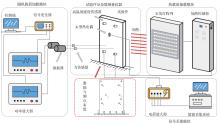
Fig.1
Schematic diagram of random load identification platform in a thermal environment
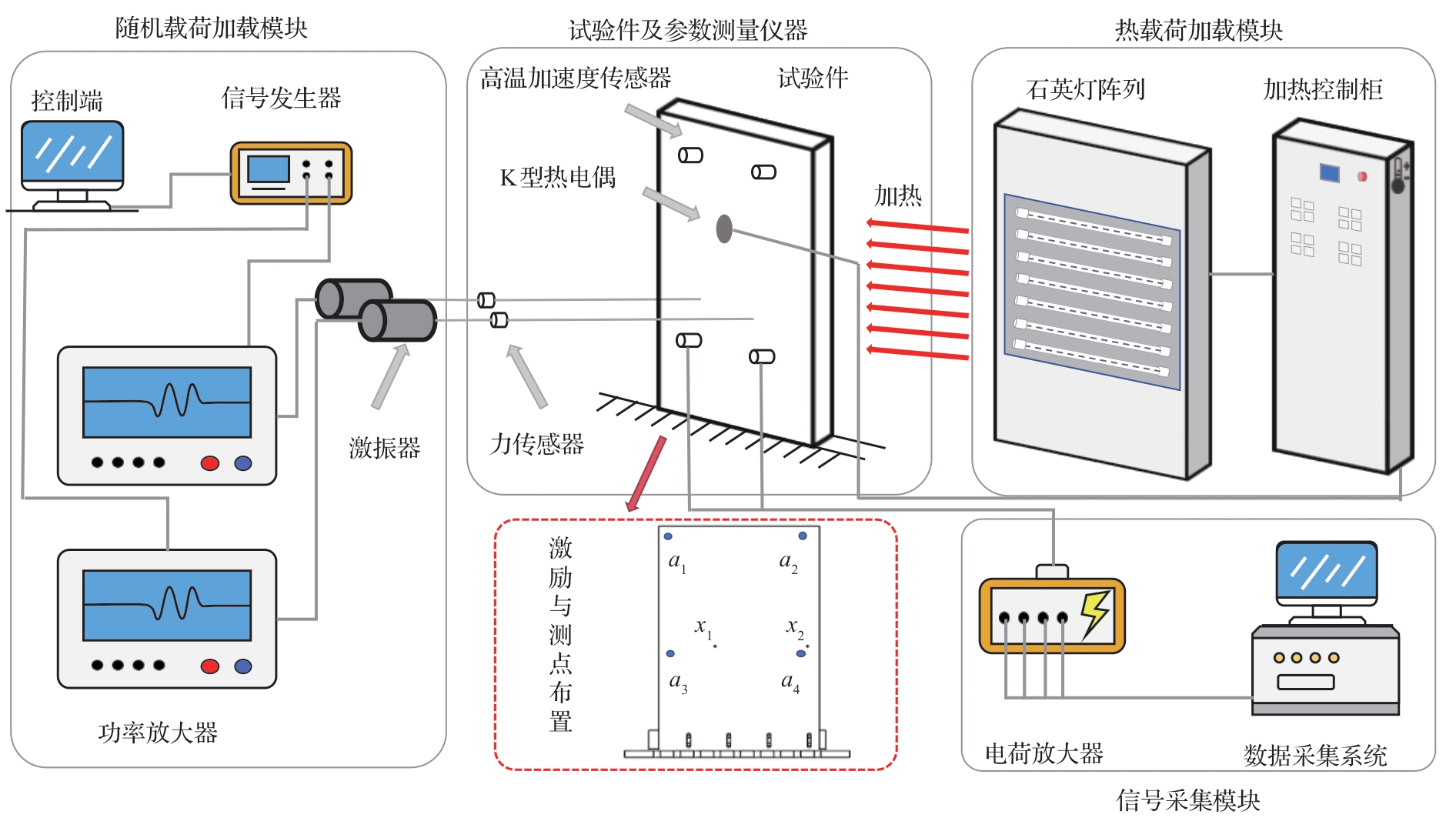
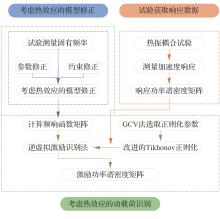
Fig.2
Flowchart of random load identification considering thermal effect
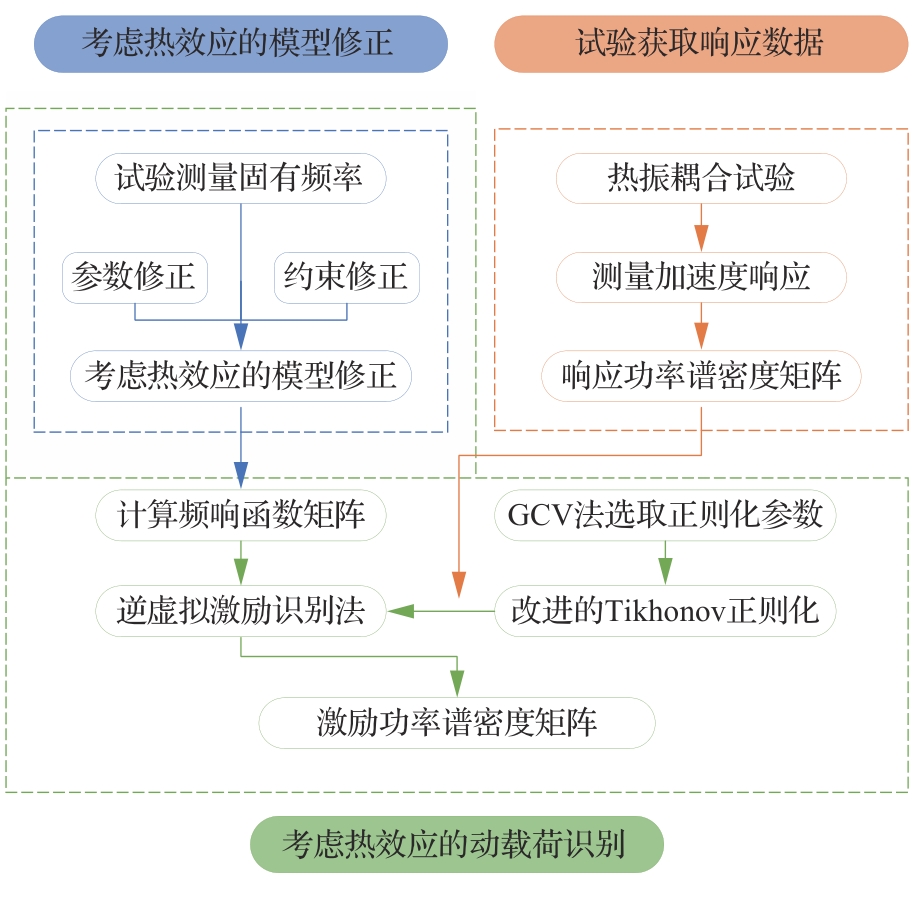
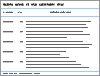
Table 1
Natural frequencies of plate structure at different temperatures
| T/℃ | 固有频率/Hz | ||||
|---|---|---|---|---|---|
| 1阶 | 2阶 | 3阶 | 4阶 | 5阶 | |
| 20 | 10.52 | 30.81 | 58.95 | 97.64 | 151.94 |
| 500 | 10.11 | 30.81 | 57.34 | 96.46 | 138.64 |
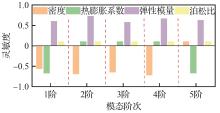
Fig.3
Quantitative analysis of sensitivity of structural parameters to natural frequencies
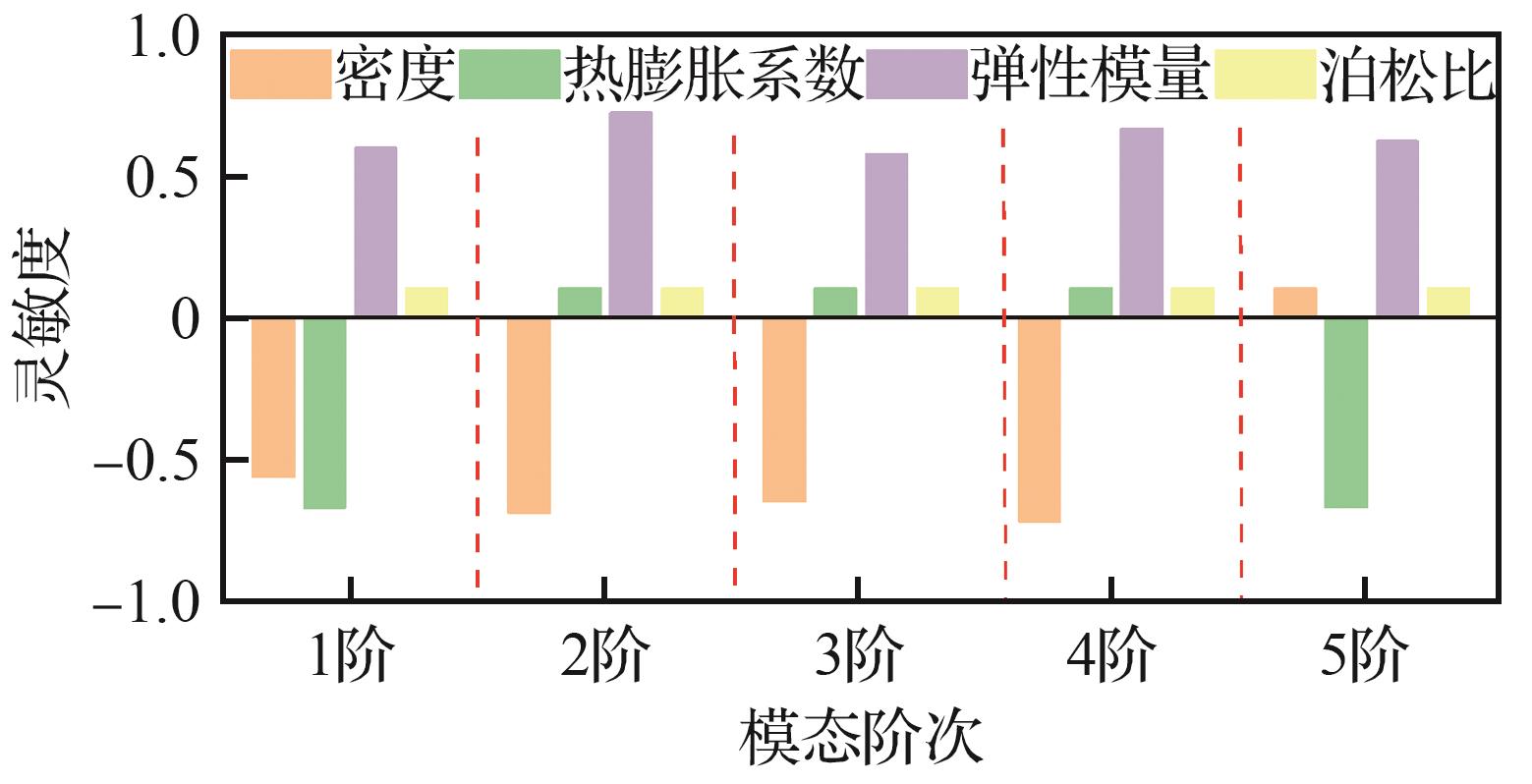
Table 2
Natural frequency correction results for plate structure at 20 ℃
| 模态阶次 | 固有频率/Hz | 误差/% | ||
|---|---|---|---|---|
| 试验值 | 修正前 | 修正后 | ||
| 1阶 | 10.52 | 11.57 | 10.48 | 0.38 |
| 2阶 | 30.81 | 38.87 | 30.68 | 0.42 |
| 3阶 | 58.95 | 71.81 | 61.98 | 5.14 |
| 4阶 | 97.64 | 131.17 | 102.59 | 5.07 |
| 5阶 | 151.94 | 180.20 | 148.01 | 2.59 |
Table 3
Natural frequency correction results for plate structure at 500 ℃
| 模态阶次 | 固有频率/Hz | 误差/% | ||
|---|---|---|---|---|
| 试验值 | 修正前 | 修正后 | ||
| 1阶 | 10.11 | 9.52 | 10.21 | 0.99 |
| 2阶 | 30.81 | 43.07 | 29.87 | 3.05 |
| 3阶 | 57.34 | 60.80 | 60.35 | 5.25 |
| 4阶 | 96.46 | 120.6 | 99.90 | 3.57 |
| 5阶 | 138.64 | 137.56 | 144.14 | 3.97 |
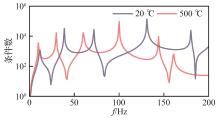
Fig.4
Number of conditions in frequency response function matrix at each temperature
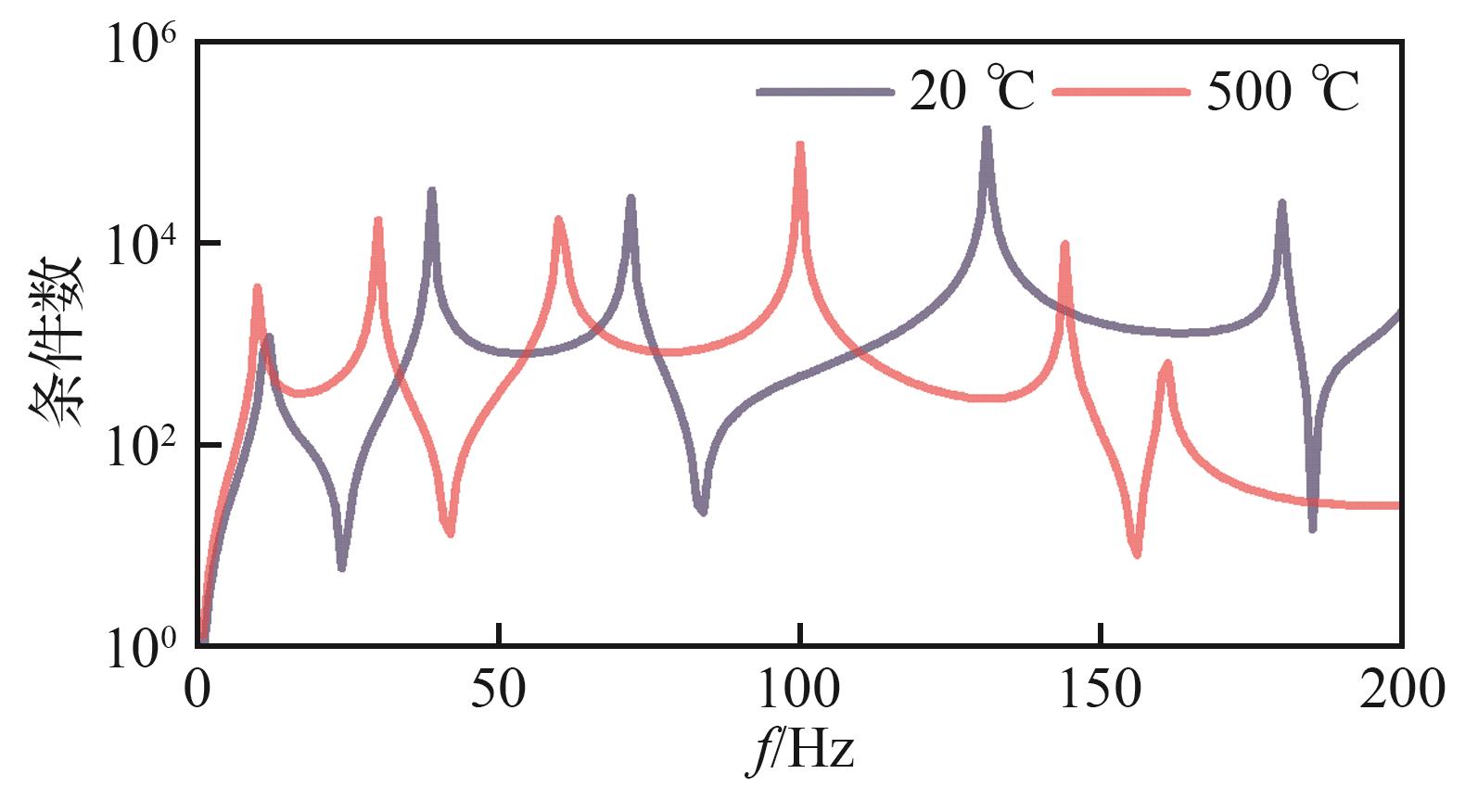
Fig.5
Flowchart of thermo-vibration coupling test
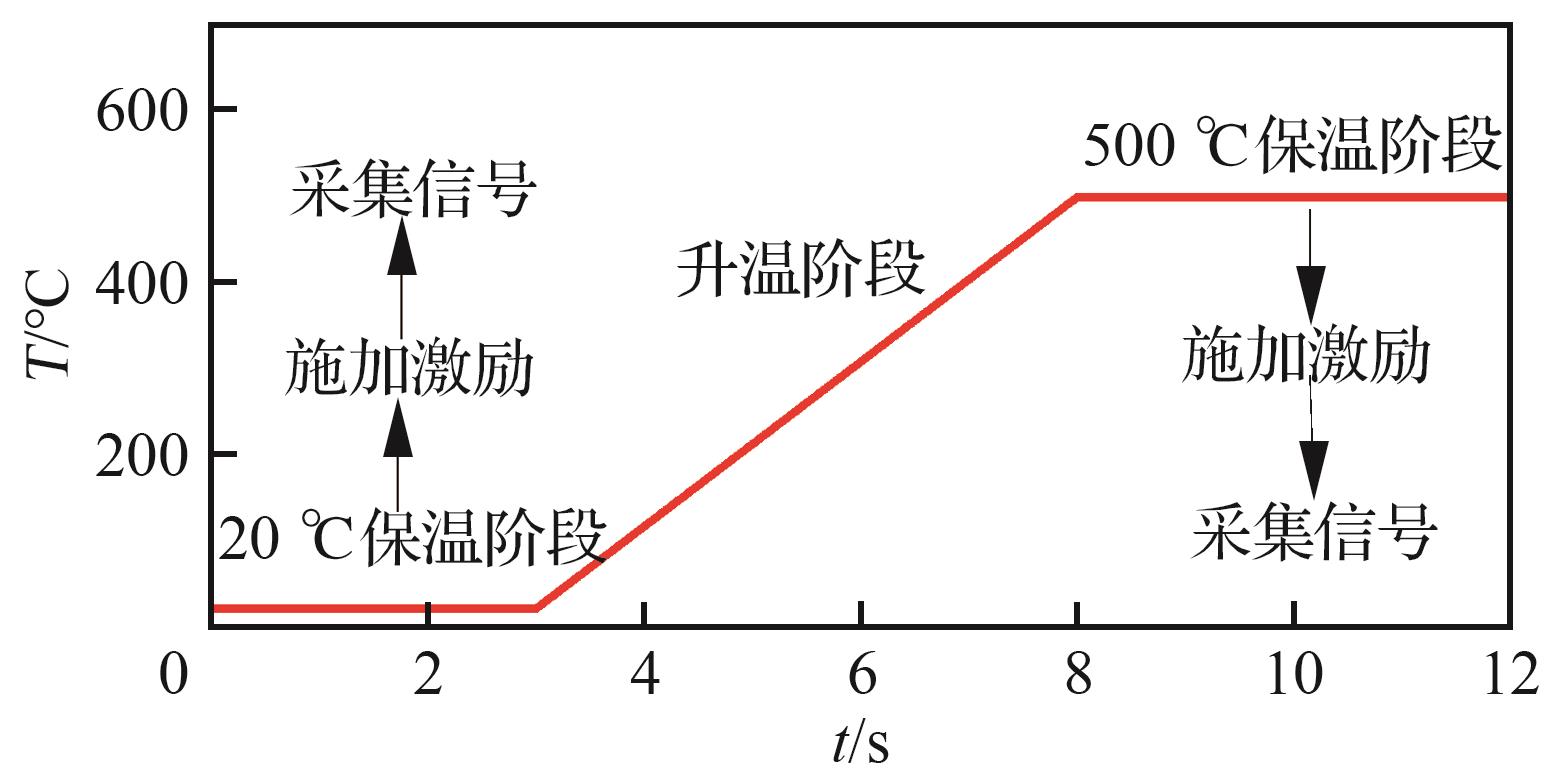
Fig.6
Layout of random load identification test in thermal environment
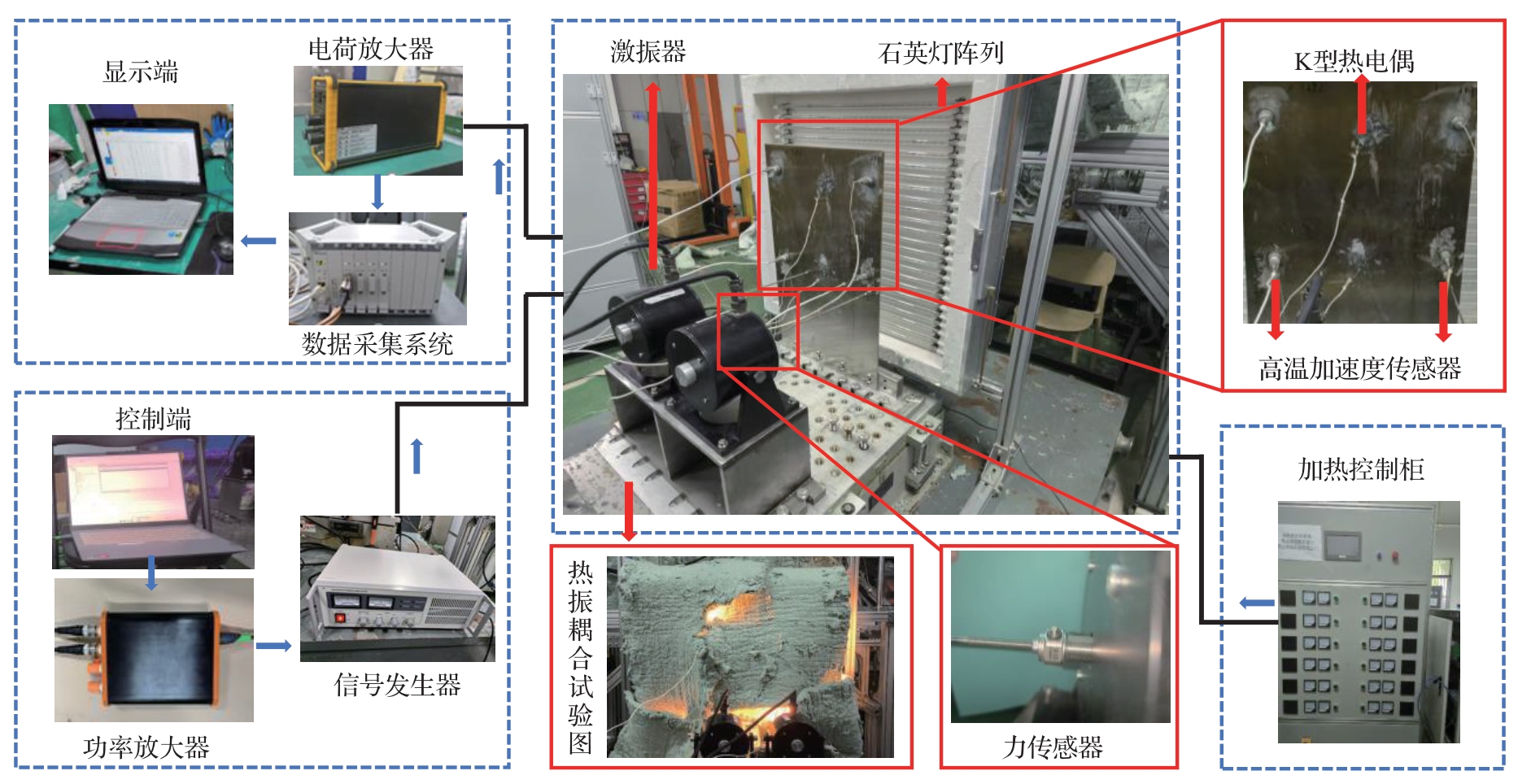
Fig.7
Load identification results at 20 ℃
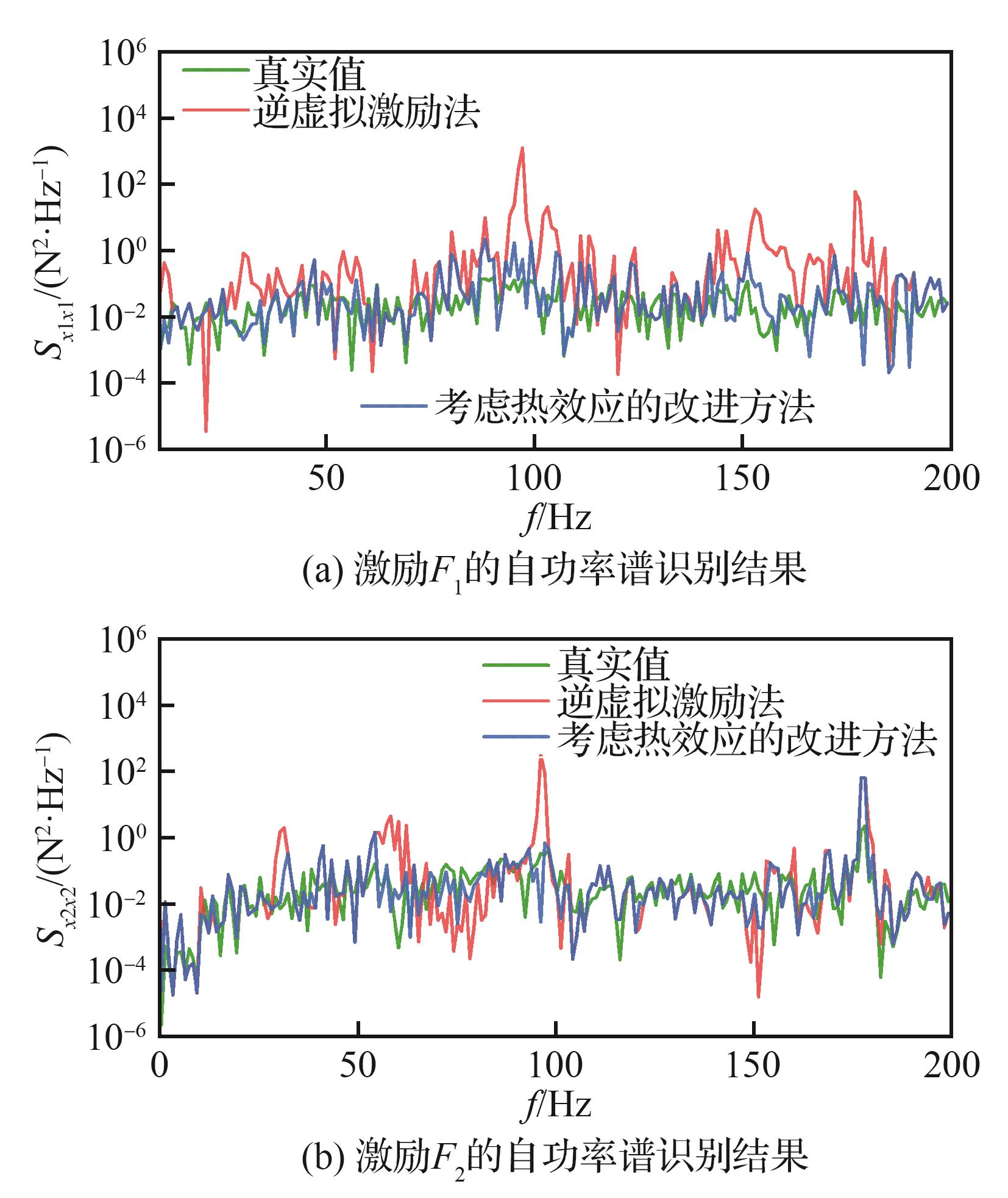
Fig.8
Load identification results at 500 ℃
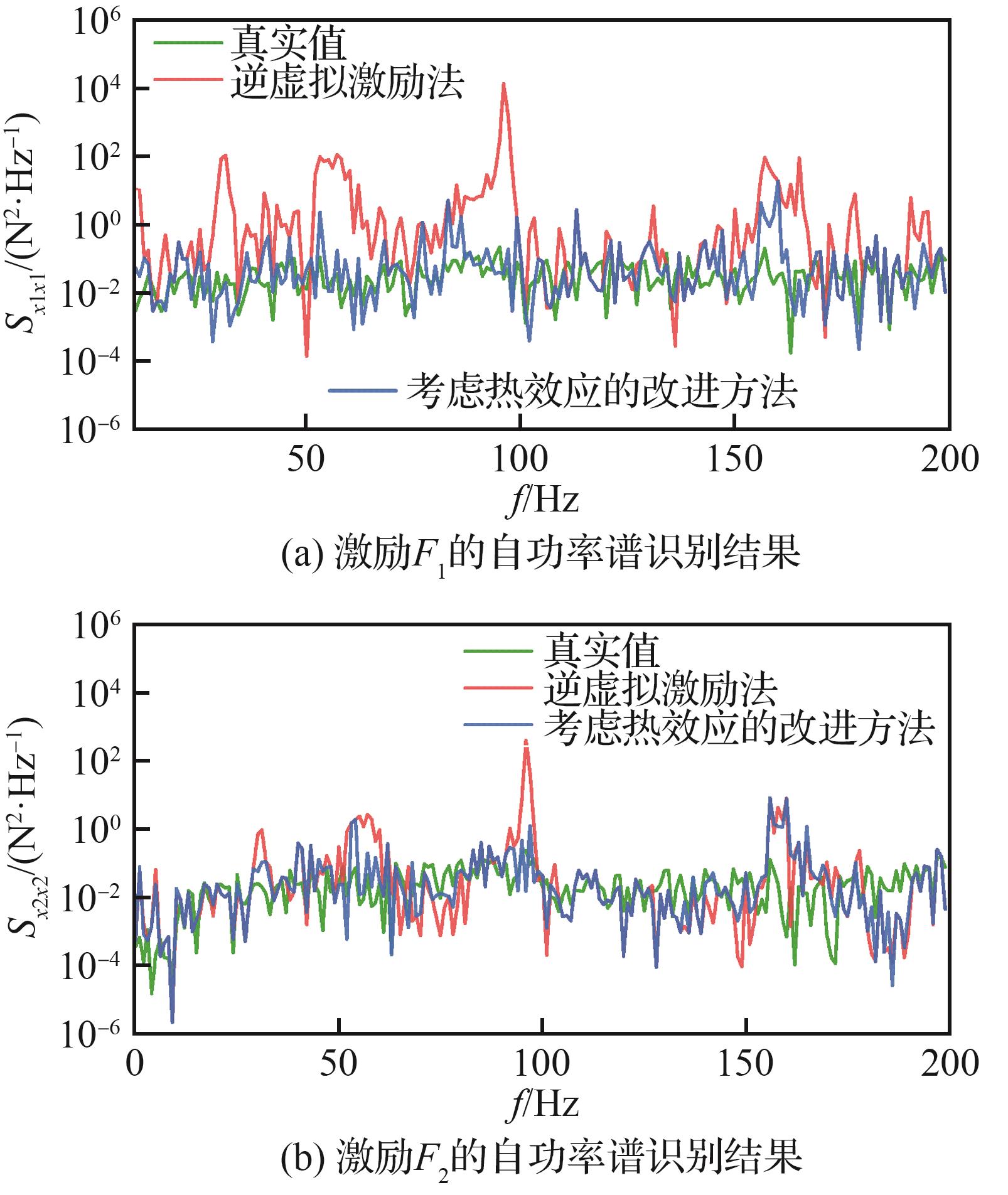
Table 4
Error analysis of 0-100 Hz recognition results at different temperatures
| T/℃ | 识别误差/dB | |||
|---|---|---|---|---|
| F1 | F1改进方法 | F2 | F2改进方法 | |
| 20 | 2.74 | 0.63 | 1.87 | 0.21 |
| 500 | 3.74 | 0.75 | 2.12 | 0.48 |
Table 5
Error analysis of 100-200 Hz recognition results at different temperatures
| T/℃ | 识别误差/dB | |||
|---|---|---|---|---|
| F1 | F1改进方法 | F2 | F2改进方法 | |
| 20 | 1.87 | 0.54 | 1.30 | 1.29 |
| 500 | 1.94 | 0.94 | 0.97 | 0.92 |
| [1] | 王文睿. 炮舱结构在冲击载荷作用下的振动特性分析[D]. 西安: 西北工业大学, 2007. |
| WANG W R. Analysis of vibration characteristics of gun cabin structure under impact load[D]. Xi’an: Northwestern Polytechnical University, 2007 (in Chinese). | |
| [2] | 赵志彬. 飞机炮舱结构有限元静力分析及疲劳寿命估算[D]. 西安: 西北工业大学, 2007. |
| ZHAO Z B. Finite element static analysis and fatigue life es timation of aircraft gun cabin structure[D]. Xi’an: Northwestern Polytechnical University, 2007 (in Chinese). | |
| [3] | 陈忠明, 何连珠. 炮舱结构段的动特性与动响应分析[J]. 飞机设计, 1998, 18(3): 16-23. |
| CHEN Z M, HE L Z. Dynamic characteristics and dynamic response analysis of gun cabin structure section[J]. Aircraft Design, 1998, 18(3): 16-23 (in Chinese). | |
| [4] | 解发瑜, 李刚, 徐忠昌. 高超声速飞行器概念及发展动态[J]. 飞航导弹, 2004(5): 27-31, 54. |
| XIE F Y, LI G, XU Z C. Concept and development trend of hypersonic vehicle[J]. Winged Missiles Journal, 2004(5): 27-31, 54 (in Chinese). | |
| [5] | 杨智春, 贾有. 动载荷的识别方法[J]. 力学进展, 2015, 45(1): 29-54. |
| YANG Z C, JIA Y. The identification of dynamic loads[J]. Advances in Mechanics, 2015, 45(1): 29-54 (in Chinese). | |
| [6] | 刘江华, 吕锦锋, 赵楠, 等. 热振耦合环境TC4钛合金铆接结构振动疲劳对比试验研究[J]. 应用力学学报, 2023, 40(4): 745-753. |
| LIU J H, LYU J F, ZHAO N, et al. Experimental study on vibration fatigue of TC4 titanium alloy riveted structure in thermal vibration coupling environment[J]. Chinese Journal of Applied Mechanics, 2023, 40(4): 745-753 (in Chinese). | |
| [7] | 彭富豪, 吴乙万, 白鸿柏, 等. 板状结构可变边界热振耦合试验系统研制[J]. 计算机测量与控制, 2020, 28(4): 241-245. |
| PENG F H, WU Y W, BAI H B, et al. Development of coupled thermo-vibration test system for plate structure with variable boundary[J]. Computer Measurement & Control, 2020, 28(4): 241-245 (in Chinese). | |
| [8] | 赵旭升, 牟让科. 舱段结构热振耦合试验方法[J]. 工程与试验, 2022, 62(4): 101-103. |
| ZHAO X S, MU R K. Thermal vibration coupling test method for cabin structure[J]. Engineering & Test, 2022, 62(4): 101-103 (in Chinese). | |
| [9] | 周涛, 贾地, 高晟耀, 等. 舰艇高温管路热振耦合试验系统研制[J]. 计算机测量与控制, 2021, 29(5): 136-140. |
| ZHOU T, JIA D, GAO S Y, et al. Development of thermal vibration coupling test system for warship pipeline[J]. Computer Measurement & Control, 2021, 29(5): 136-140 (in Chinese). | |
| [10] | 李宇峰. 热防护复合结构的热振平台设计及热振特性研究[D]. 西安: 西安建筑科技大学, 2016. |
| LI Y F. Thermal-vibration platform design and thermal-vibration characteristics of the thermo-defend composite structure[D]. Xi’an: Xi’an University of Architecture and Technology, 2016 (in Chinese). | |
| [11] | 陈奥辉, 姜金辉. 分布动载荷时域识别的动标定试验方法[J]. 南京航空航天大学学报, 2024, 56(3): 561-570. |
| CHEN A H, JIANG J H. Research on dynamic calibration experiment of distributed dynamic load identification in time-domain[J]. Journal of Nanjing University of Aeronautics & Astronautics, 2024, 56(3): 561-570 (in Chinese). | |
| [12] | ZHU R, YUAN W X, FEI Q G, et al. Low-resource dynamic loading identification of nonlinear system using pretraining[J]. Engineering Structures, 2025, 323: 119238. |
| [13] | 杨智春, 杨特. 动载荷识别物理嵌入式神经网络模型与方法[J]. 航空学报, 2025, 46(5): 531450. |
| YANG Z C, YANG T. Physical embedded neural network model and method for dynamic load identification[J]. Acta Aeronautica et Astronautica Sinica, 2025, 46(5): 531450 (in Chinese). | |
| [14] | 杨特, 杨智春, 梁舒雅, 等. 平稳随机载荷的信号特征提取与深度神经网络识别[J]. 航空学报, 2022, 43(9): 225952. |
| YANG T, YANG Z C, LIANG S Y, et al. Feature extraction and identification of stationary random dynamic load using deep neural network[J]. Acta Aeronautica et Astronautica Sinica, 2022, 43(9): 225952 (in Chinese). | |
| [15] | 林家浩, 智浩, 郭杏林. 平稳随机振动荷载识别的逆虚拟激励法(一)[J]. 计算力学学报, 1998, 15(2): 127-136. |
| LIN J H, ZHI H, GUO X L. Inverse pseudo excitation method for loading identification of stationary random vibration (1)[J]. Chinese Journal of Computational Mechanics, 1998, 15(2): 127-136 (in Chinese). | |
| [16] | 刘恒春, 朱德懋, 孙久厚. 振动载荷识别的奇异值分解法[J]. 振动工程学报, 1990, 3(1): 24-33. |
| LIU H C, ZHU D M, SUN J H. A singular value decomposition method for the identification vibration loads[J]. Journal of Vibration Engineering, 1990, 3(1): 24-33 (in Chinese). | |
| [17] | O’CALLAHAN J, PIERGENTILI F. Force estimation using operational data[C]∥Proceedings of the 14th Inter national Modal Analysis Conference (IMAC). 1996: 1586-1592. |
| [18] | KARLSSON S E S. Identification of external structural loads from measured harmonic responses[J]. Journal of Sound and Vibration, 1996, 196(1): 59-74. |
| [19] | 田燕, 王菁, 郑海起. 多载荷识别频响函数矩阵求逆法的改进算法[J]. 军械工程学院学报, 2002, 14(4): 13-17. |
| TIAN Y, WANG J, ZHENG H Q. Improved algorithm of inverse matrix of frequency response function in multi-load identification[J]. Journal of Ordnance Engineering College, 2002, 14(4): 13-17 (in Chinese). | |
| [20] | 吕洪彬. 基于逆系统的动态载荷识别研究[D]. 大连: 大连理工大学, 2010. |
| LYU H B. Research on dynamic load identification based on inverse system[D]. Dalian: Dalian University of Technology, 2010 (in Chinese). | |
| [21] | YU L, CHAN T H T. Moving force identification based on the frequency-time domain method[J]. Journal of Sound and Vibration, 2003, 261(2): 329-349. |
| [22] | JACQUELIN E, BENNANI A, HAMELIN P. Force reconstruction: Analysis and regularization of a deconvolution problem[J]. Journal of Sound and Vibration, 2003, 265(1): 81-107. |
| [23] | LIU Y, SHEPARD W S JR. Dynamic force identification based on enhanced least squares and total least-squares schemes in the frequency domain[J]. Journal of Sound and Vibration, 2005, 282(1-2): 37-60. |
| [24] | 梅立泉, 崔维庚. 面载荷识别的TSVD正则化方法[J]. 应用力学学报, 2010, 27(1): 140-144. |
| MEI L Q, CUI W G. TSVD regularization method for area load reconstruction[J]. Chinese Journal of Applied Mechanics, 2010, 27(1): 140-144 (in Chinese). | |
| [25] | 毛玉明, 陈健, 刘靖华, 等. 考虑模型误差的动载荷反演问题研究[J]. 振动与冲击, 2012, 31(24): 16-19. |
| MAO Y M, CHEN J, LIU J H, et al. Dynamic loading estimation problem with structural model errors[J]. Journal of Vibration and Shock, 2012, 31(24): 16-19 (in Chinese). | |
| [26] | 井雯, 姜金辉, 许锋, 等. 基于改进正则化的多点平稳随机载荷识别方法[J]. 振动、测试与诊断, 2025, 45(2): 219-224. |
| JING W, JIANG J H, XU F, et al. Multi-point stationary random load identification method based on improved regularization[J]. Journal of Vibration,Measurement & Diagnosis, 2025, 45(2): 219-224 (in Chinese). | |
| [27] | 彭珍瑞, 周雪文. 基于混合正则化方法的结构载荷识别与响应重构[J]. 振动与冲击, 2024, 43(6): 104-112. |
| PENG Z R, ZHOU X W. Structural load identification and response reconstruction based on a hybrid regularization method[J]. Journal of Vibration and Shock, 2024, 43(6): 104-112 (in Chinese). | |
| [28] | 蔡芳盛, 严刚, 曾捷, 等. 基于非负贝叶斯正则化的冲击载荷光纤识别法[J]. 振动.测试与诊断, 2023, 43(3): 427-434, 615. |
| CAI F S, YAN G, ZENG J, et al. An optical fiber technique of impact load identification method based on non-negative Bayesian regularization[J]. Journal of Vibration, Measurement & Diagnosis, 2023, 43(3): 427-434, 615 (in Chinese). | |
| [29] | 龙旭, 胡运涛, 林华刚, 等. 基于贝叶斯正则化的多源/连续冲击载荷识别及试验研究[J]. 振动与冲击, 2024, 43(21): 55-63. |
| LONG X, HU Y T, LIN H G, et al. Identification and test study on multi-source/continuous impact load based on Bayesian regularization[J]. Journal of Vibration and Shock, 2024, 43(21): 55-63 (in Chinese). | |
| [30] | 曹鹏, 刘剑. 利用拉丁超立方与相关性采样的通风系统仿真不确定研究[J]. 安全与环境学报, 2025, 25(3): 1016-1025. |
| CAO P, LIU J. Uncertainty analysis of ventilation system simulation using Latin hypercube and correlation sampling methods[J]. Journal of Safety and Environment, 2025, 25(3): 1016-1025 (in Chinese). | |
| [31] | ZHU R, FEI Q G, JIANG D, et al. Dynamic sensitivity analysis based on Sherman-Morrison-Woodbury formula[J]. AIAA Journal, 2019, 57(11): 4992-5001. |
| [32] | 何宇轩, 尹涛, 王曦. 有限元模型修正中的贝叶斯深度神经网络构架优化设计[J]. 振动与冲击, 2025, 44(6): 184-190. |
| HE Y X, YIN T, WANG X. Architecture design of the Bayesian deep neural network in structural model updating[J]. Journal of Vibration and Shock, 2025, 44(6): 184-190 (in Chinese). | |
| [33] | NOVATI P, RUSSO M R. A GCV based Arnoldi-Tikhonov regularization method[J]. BIT Numerical Mathematics, 2014, 54(2): 501-521. |
| [34] | 李晓旺, 赵海涛, 陈吉安. 基于测点优选和改进L曲线法的动载荷识别[J]. 上海交通大学学报, 2020, 54(6): 569-576. |
| LI X W, ZHAO H T, CHEN J A. Force identification based on measuring point selection and improved L-curve method[J]. Journal of Shanghai Jiao Tong University, 2020, 54(6): 569-576 (in Chinese). | |
| [35] | ZHU R, JIANG D, MARCHESIELLO S, et al. Automatic nonlinear subspace identification using clustering judgment based on similarity filtering[J]. AIAA Journal, 2023, 61(6): 2666-2674. |
| [36] | ZHU R, FEI Q G, JIANG D, et al. Identification of nonlinear stiffness and damping parameters using a hybrid approach[J]. AIAA Journal, 2021, 59(11): 4686-4695. |
| [1] | Yang YUE, Jiayi WANG, Shengqing YANG, Yaoke DU, Wenyan WANG. Convex optimization based autonomous trajectory capture for strictly-regressive orbit [J]. Acta Aeronautica et Astronautica Sinica, 2026, 47(8): 332954-332954. |
| [2] | Qixiao ZHU, Yanxin HUANG, Rui ZHU, Xiaochen HANG, Qingguo FEI. Research progress on dynamic load characteristics, measurement and identification technology of aircraft structure [J]. Acta Aeronautica et Astronautica Sinica, 2026, 47(5): 232510-232510. |
| [3] | Lingjie MENG, Hongguang LI, Xinjun LI. SAR image simulation method guided by geomorphic category information [J]. Acta Aeronautica et Astronautica Sinica, 2025, 46(7): 331003-331003. |
| [4] | Zhichun YANG, Te YANG. Physical embedded neural network model and method for dynamic load identification [J]. Acta Aeronautica et Astronautica Sinica, 2025, 46(5): 531450-531450. |
| [5] | YANG Te, YANG Zhichun, LIANG Shuya, KANG Zaifei, JIA You. Feature extraction and identification of stationary random dynamic load using deep neural network [J]. ACTA AERONAUTICAET ASTRONAUTICA SINICA, 2022, 43(9): 225952-225952. |
| [6] | XIA Peng, YANG Te, XU Jiang, WANG Le, YANG Zhichun. Reversed time sequence dynamic load identification method using time delay neural network [J]. ACTA AERONAUTICAET ASTRONAUTICA SINICA, 2021, 42(7): 224452-224452. |
| [7] | DUI Hongna, LIU Dongliang, ZHANG Zhixian, PAN Shaozhen, YANG Long. Distributed load recovery approach based on strain measurements [J]. ACTA AERONAUTICAET ASTRONAUTICA SINICA, 2021, 42(5): 524337-524337. |
| [8] | LI Jiaxing, WANG Dayi, E Wei, GE Dongming. Autonomous navigation technology based on optical image under large dynamic disturbance [J]. ACTA AERONAUTICAET ASTRONAUTICA SINICA, 2021, 42(11): 524907-524907. |
| [9] | WU Xiao, ZENG Jie, HU Zikang, LI Ming, HU Xitao. Dynamic load identification method for variable cross-section cantilever structure [J]. ACTA AERONAUTICAET ASTRONAUTICA SINICA, 2020, 41(9): 223806-223806. |
| [10] | LI Yebo, LI Qiuhong, WANG Jiankang, HUANG Xianghua, ZHAO Yongping. Sensor Fault Adaptive Diagnosis of Aero-engines Based on ImOS-ELM [J]. ACTA AERONAUTICAET ASTRONAUTICA SINICA, 2013, 34(10): 2316-2324. |
| [11] | JIA You, YANG Zhichun. A New Approach to Identify Buffet Loads for Aircraft Vertical Tail [J]. ACTA AERONAUTICAET ASTRONAUTICA SINICA, 2013, 34(10): 2333-2340. |
| [12] | Yan Gang;Zhou Li. Impact Load Identification for Stiffened Composite Structure [J]. ACTA AERONAUTICAET ASTRONAUTICA SINICA, 2008, 29(5): 1150-1156. |
| [13] | SHEN Hui-cun;ZHOU Lai-shui. Triangular Mesh Regularization Based on Discrete Curvature Estimation [J]. ACTA AERONAUTICAET ASTRONAUTICA SINICA, 2006, 27(2): 318-324. |
| Viewed | ||||||
|
Full text |
|
|||||
|
Abstract |
|
|||||
Address: No.238, Baiyan Buiding, Beisihuan Zhonglu Road, Haidian District, Beijing, China
Postal code : 100083
E-mail:hkxb@buaa.edu.cn
Total visits: 6658907 Today visits: 1341All copyright © editorial office of Chinese Journal of Aeronautics
All copyright © editorial office of Chinese Journal of Aeronautics
Total visits: 6658907 Today visits: 1341

 CJA
CJA
