Acta Aeronautica et Astronautica Sinica ›› 2025, Vol. 46 ›› Issue (16): 231624.doi: 10.7527/S1000-6893.2024.31624
• Solid Mechanics and Vehicle Conceptual Design • Previous Articles
Fulin LI1, Min CHEN1,2, Hailong TANG3, Jiyuan ZHANG3( ), Yue ZHOU4, Jing MA4
Received:2024-12-06
Revised:2024-12-31
Accepted:2025-01-23
Online:2025-02-19
Published:2025-02-19
Contact:
Jiyuan ZHANG
E-mail:zhangjiyuan94@buaa.edu.cn
Supported by:CLC Number:
Fulin LI, Min CHEN, Hailong TANG, Jiyuan ZHANG, Yue ZHOU, Jing MA. Control law design for variable cycle engine considering environmental indicators[J]. Acta Aeronautica et Astronautica Sinica, 2025, 46(16): 231624.
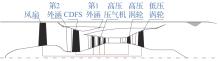
Fig.1
Schematic structure of VCE engine with CDFS
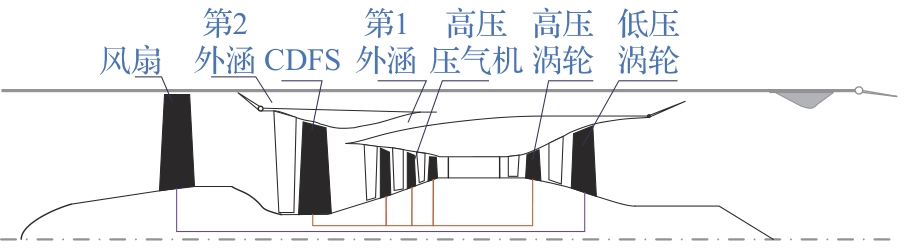
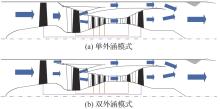
Fig.2
Flow path diagram of two operating modes of VCE engine with CDFS

Table 1
Corresponding equations for airflow mixing process in VABI
| 条件 | 关系式 |
|---|---|
| 流量连续 | |
| 能量守恒 | |
| 动量守恒 | |
| 静压平衡 |
Table 2
Performance comparison of simulation results with GasTurb results
| 参数 | 仿真模型 | GasTurb |
|---|---|---|
| 推力/kN | 192.22 | 192.46 |
| 耗油率/(kg·(daN·h)-1) | 0.709 5 | 0.705 6 |
| 燃油流量/(kg·s-1) | 3.788 6 | 3.772 2 |
| 高压涡轮膨胀比 | 4.643 2 | 4.644 |
| 低压涡轮膨胀比 | 3.089 4 | 3.090 |
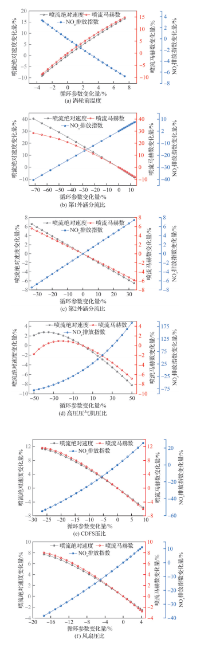
Fig.3
Influence of each cycle parameter on jet velocity and NO x emission indices
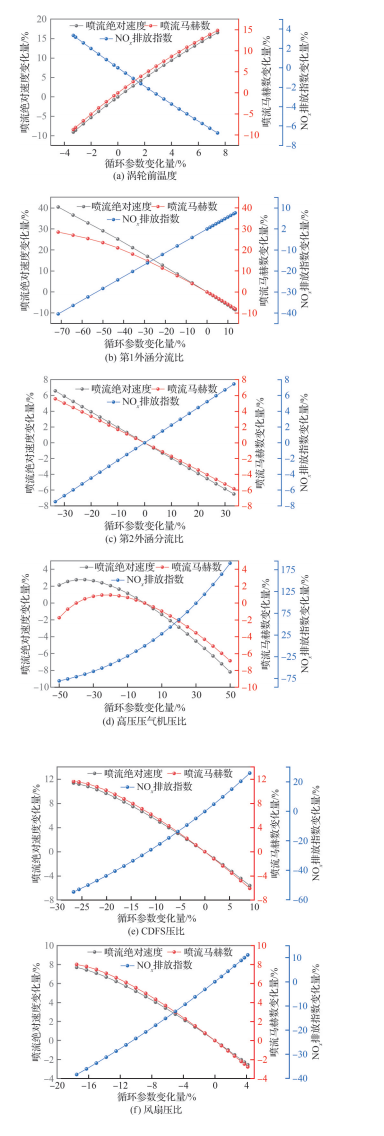
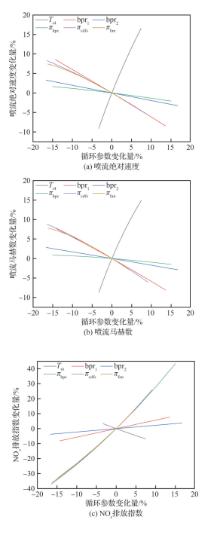
Fig.4
Sensitivity analysis of engine noise emission performance indicators
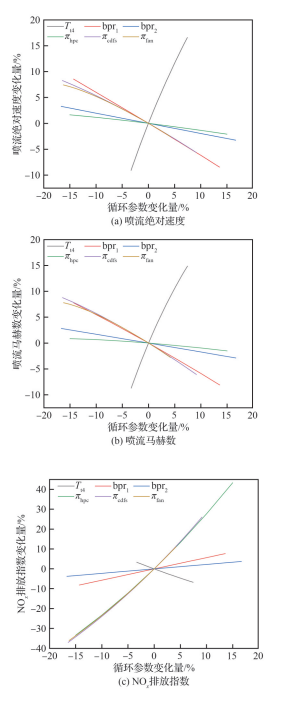
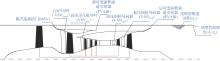
Fig.5
Schematic diagram of adjustable geometry mechanism of VCE engine with CDFS
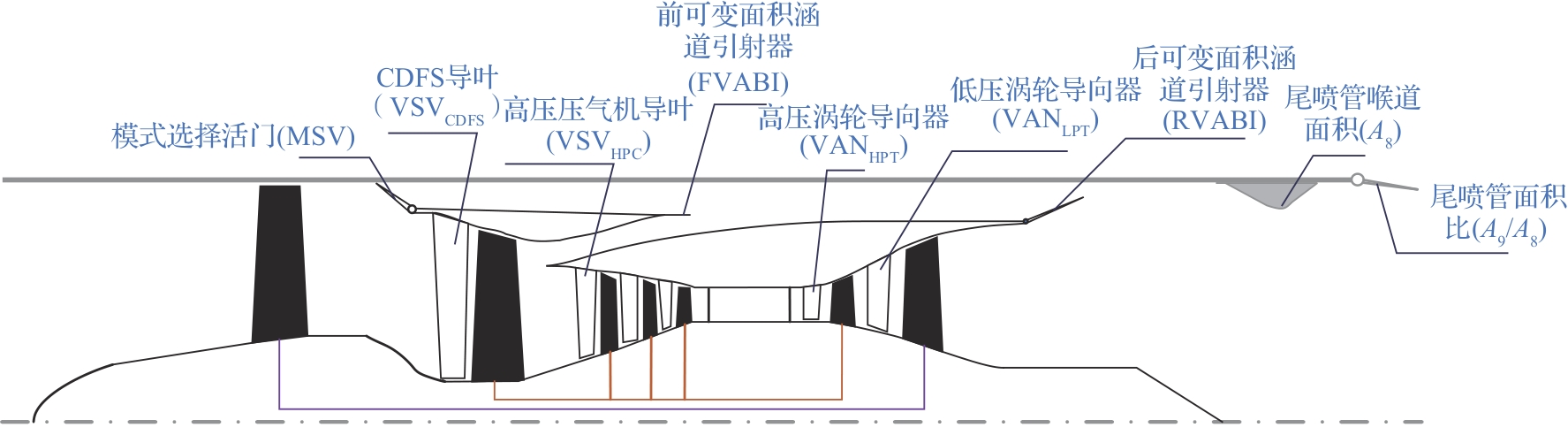
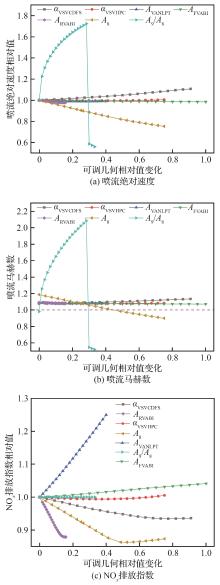
Fig.6
Effect of off-design adjustable geometry parameter tuning on engine performance indexes
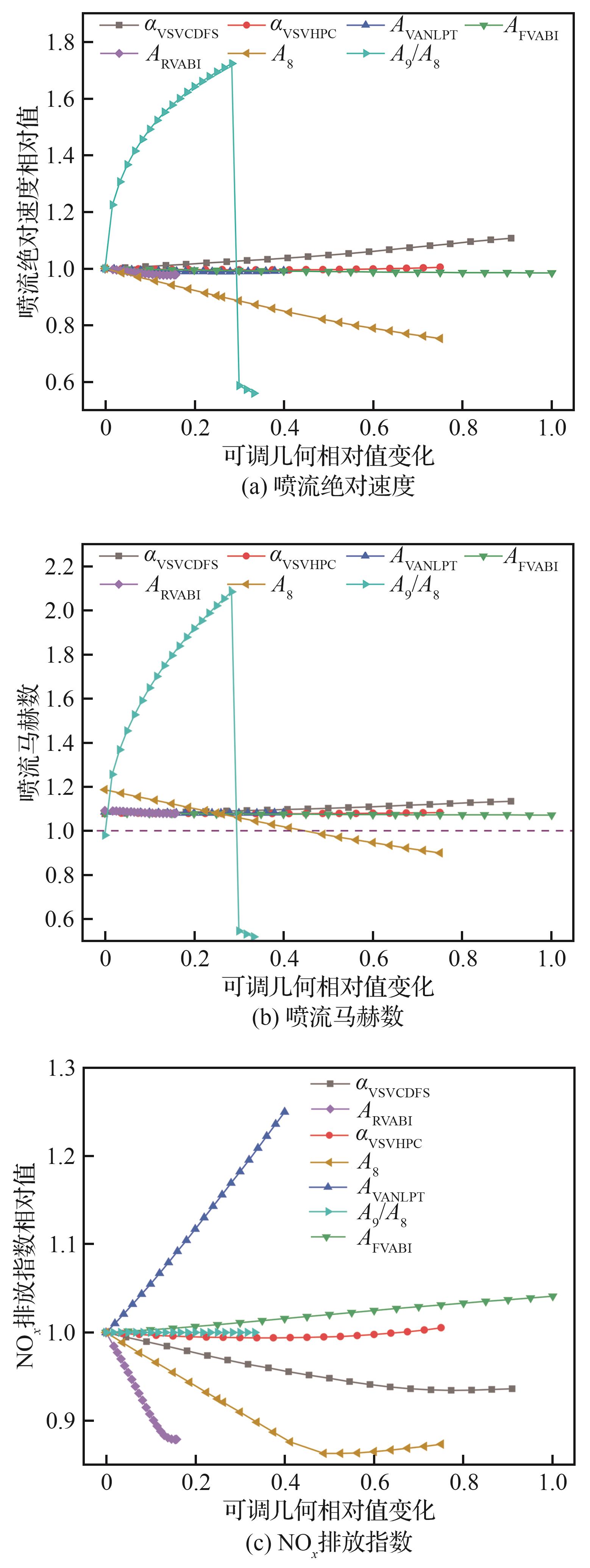
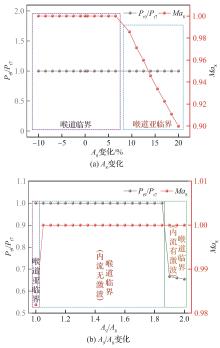
Fig.7
Trends in variation of flow parameter in jet with adjustable geometry of nozzle
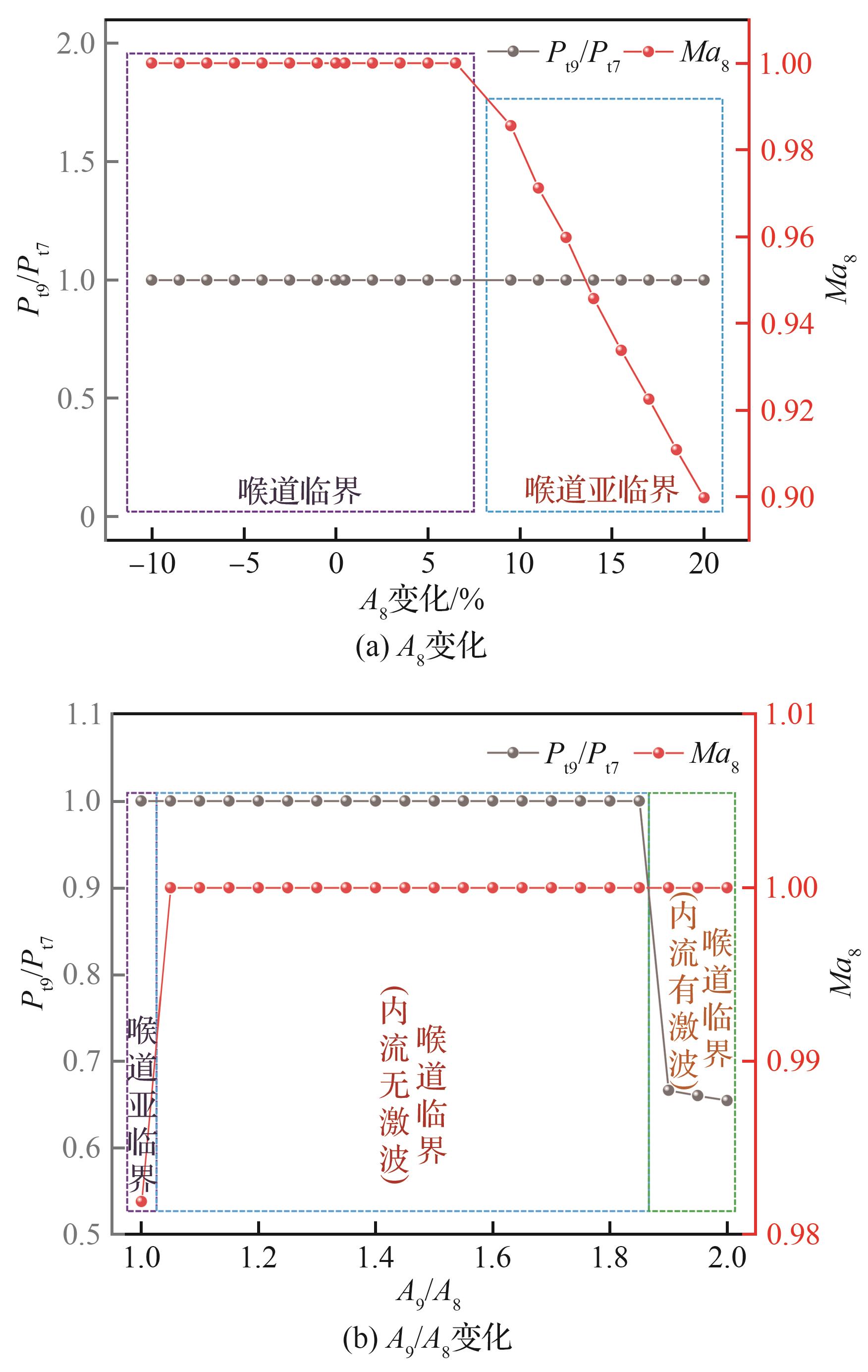
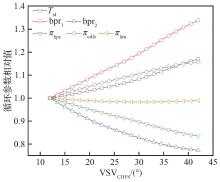
Fig.8
Trends in main cyclic parameters of VSVCDFS conditioning process
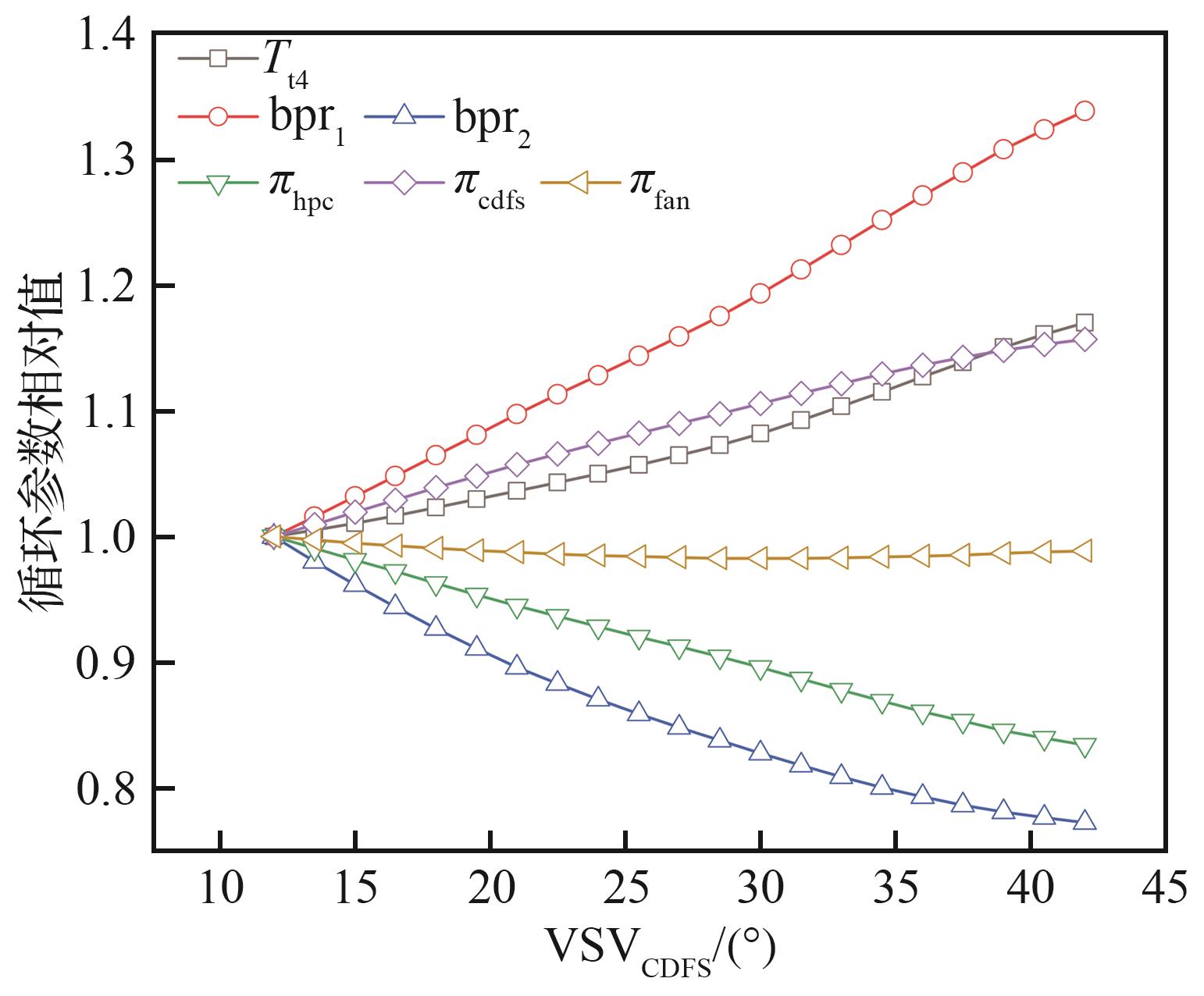
Table 3
Near ground state optimization objectives and corresponding numbers
| 优化目标 | 编号 |
|---|---|
| 无优化(基线) | 1 |
| 常规优化(推力、耗油率) | 2 |
| 常规优化+喷流噪声优化 | 3 |
| 常规优化+NO x 排放优化 | 4 |
| 常规优化+喷流噪声、NO x 排放优化 | 5 |
Table 4
Objective functions corresponding to different optimization objectives for near-ground state
| 优化目标 | 目标函数 |
|---|---|
| 常规优化(推力、耗油率) | |
| 常规优化+喷流噪声优化 | |
| 常规优化+NO x 排放优化 | |
| 常规优化+喷流噪声、NO x 排放优化 |
Fig.9
Multi-objective optimization results of near-ground state
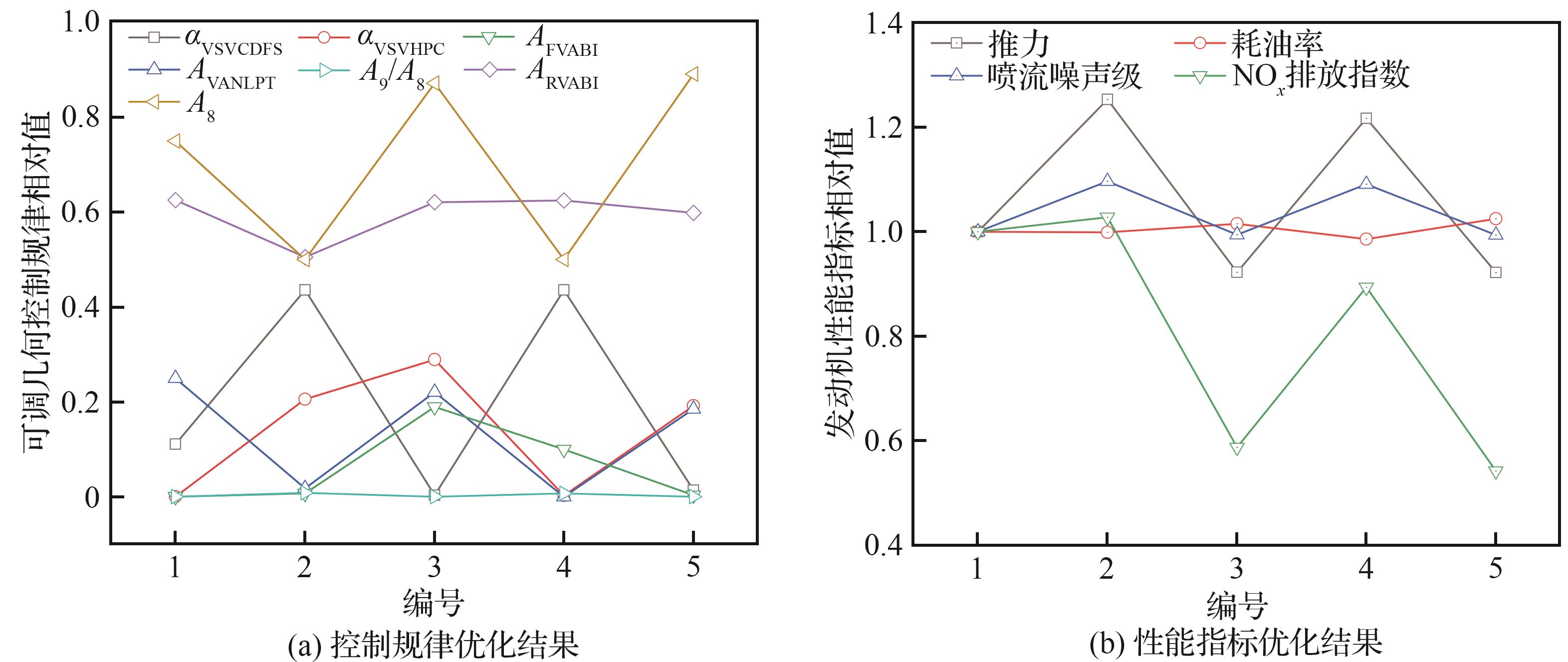
Fig.10
Fan workpoints comparison from optimization targets 2 to 5 for near-ground state
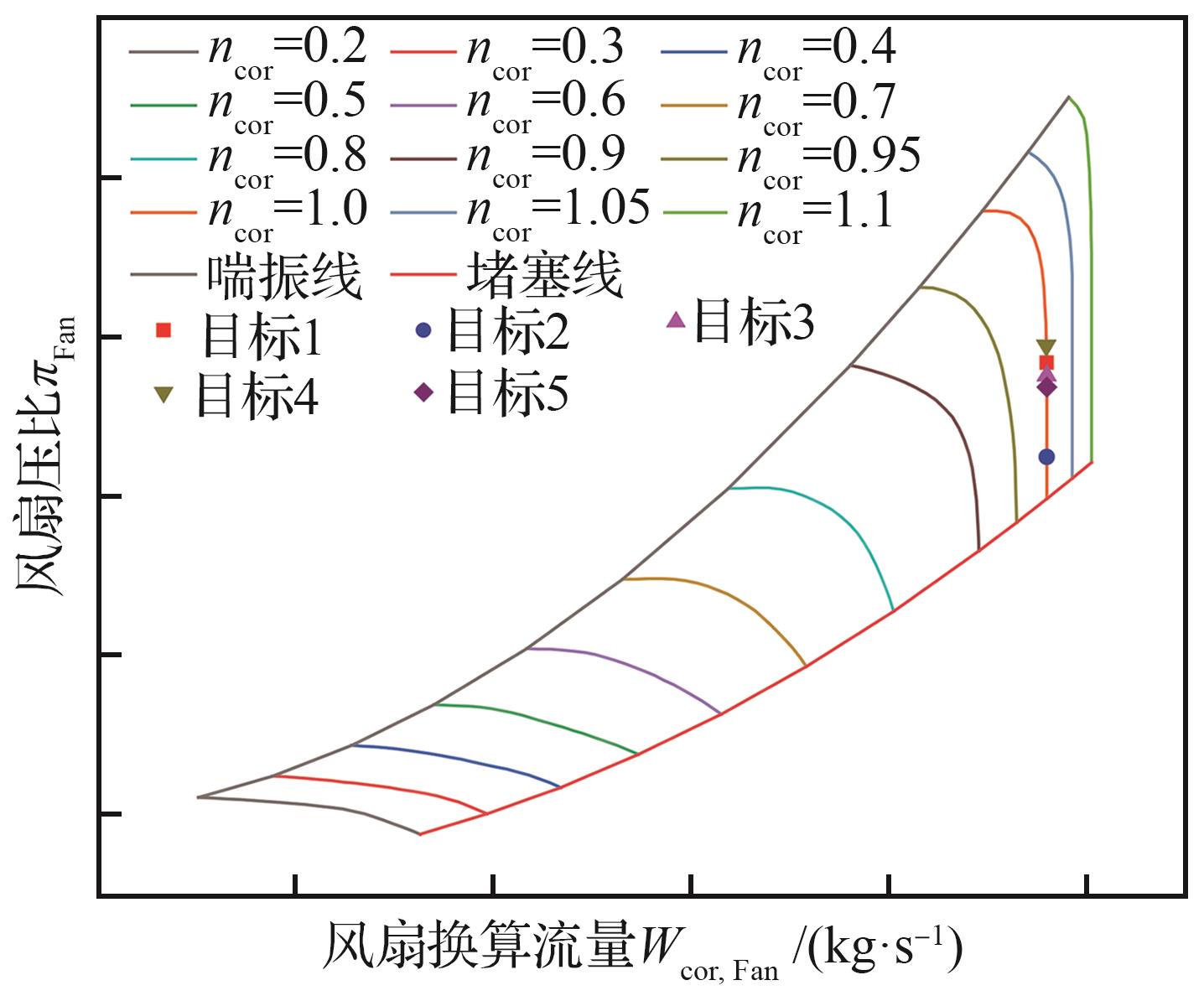
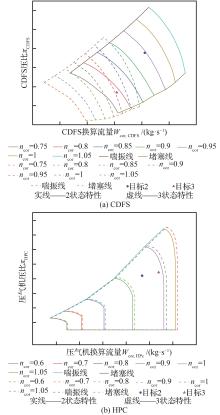
Fig.11
CDFS and HPC workpoints comparison of optimization targets 2,3 for near-ground state
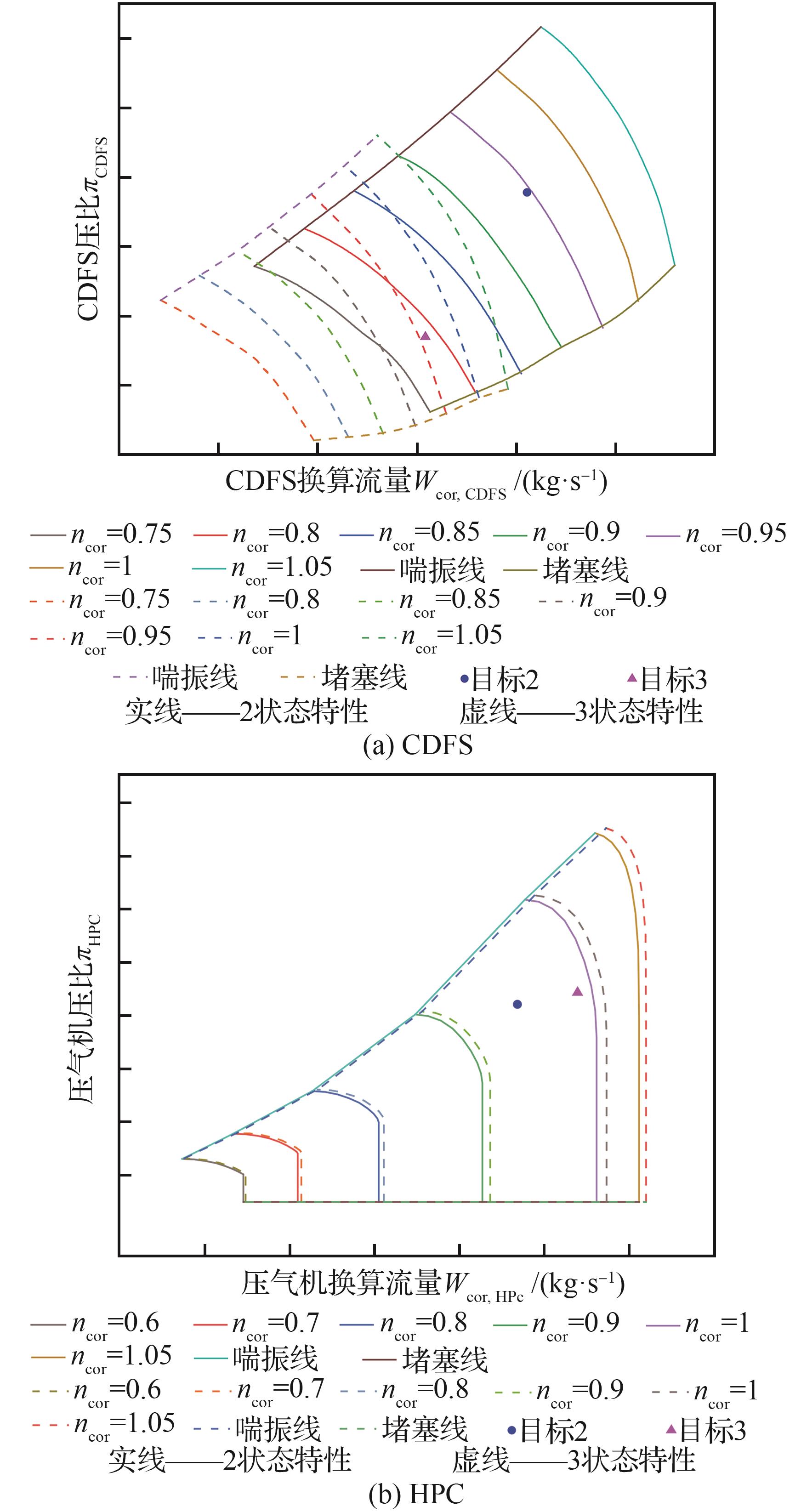
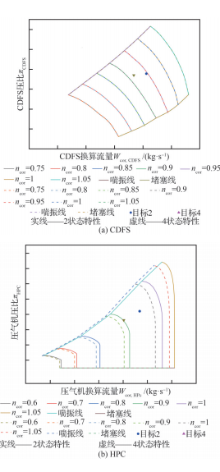
Fig.12
CDFS and HPC workpoints comparison of optimization targets 2, 4 for near-ground state
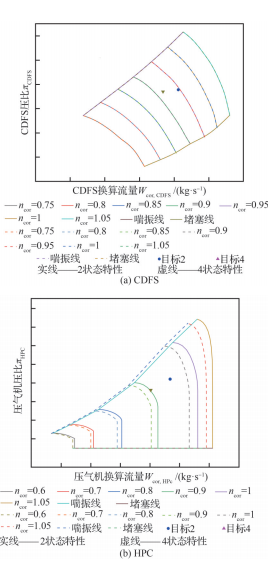
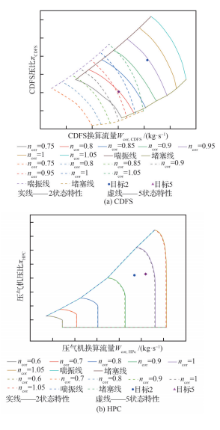
Fig.13
CDFS and HPC workpoints comparison of optimization targets 2, 5 for near-ground state
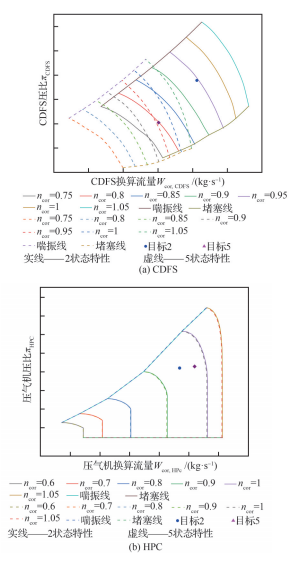
Table 5
Supersonic cruise state optimization objectives and corresponding numbers
| 优化目标 | 编号 |
|---|---|
| 无优化(基线) | 1 |
| 常规优化(推力、耗油率) | 2 |
| 常规优化+NO x 排放优化 | 3 |
Table 6
Objective functions corresponding to different optimization objectives for supersonic cruise state
| 优化目标 | 目标函数 |
|---|---|
| 常规优化(推力、耗油率) | |
| 常规优化+NO x 排放优化 |
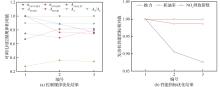
Fig.14
Multi-objective optimization results of supersonic cruise state
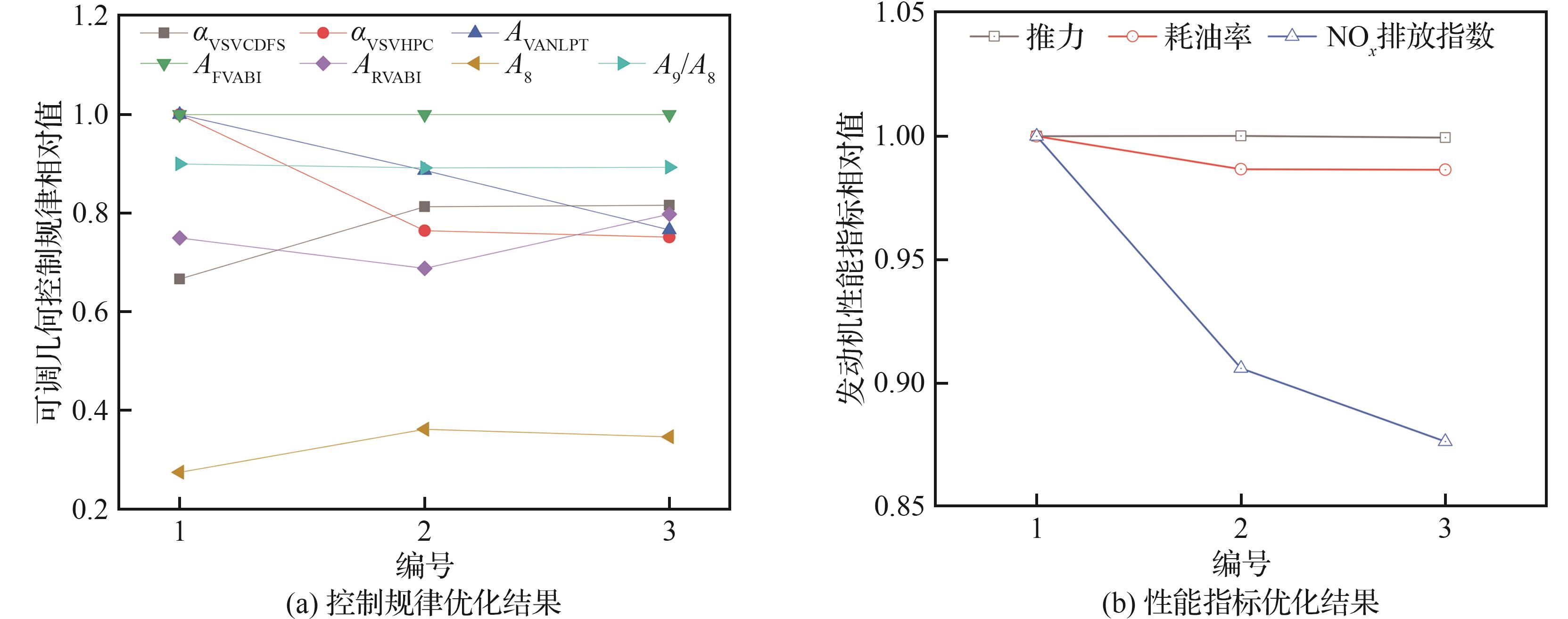
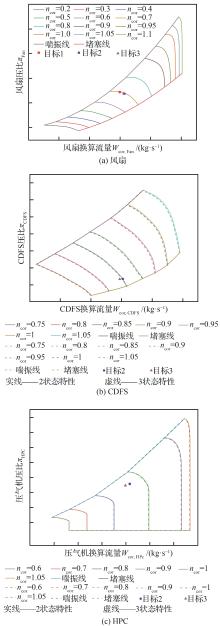
Fig.15
Fan, CDFS and HPC workpoints comparison of optimization targets 2, 3 for supersonic cruise state
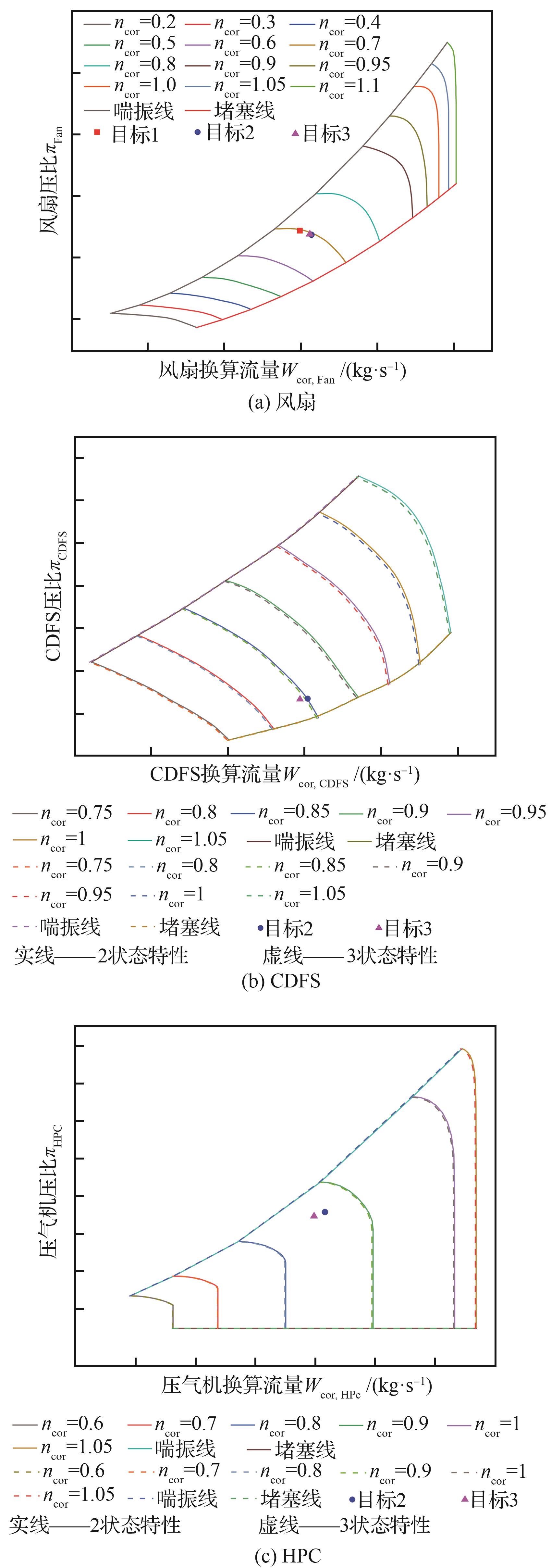
Table 7
Benchmark engine performance data under critical flight conditions
| 飞行状态 | 高度/m | 马赫数 | 温度偏差/K | 推力/kN | 耗油率/(kg·(daN·h)-1) |
|---|---|---|---|---|---|
| 超声速巡航 | 16 154.4 | 2 | 5 | 44.48 | 1.357 |
| 海平面起飞 | 0 | 0.302 | 10 | 149.46 | 1.282 |
Table 8
Overall engine performance program design parameters
| 设计参数 | 数值 |
|---|---|
| 涡轮前温度/K | 1 750 |
| 第1外涵分流比 | 1.4 |
| 第2外涵分流比 | 0.3 |
| 风扇压比 | 2.4 |
| CDFS压比 | 1.37 |
| 高压压气机压比 | 8 |
| 发动机进口换算流量/(kg·s-1) | 480 |
Table 9
Comparison of performance parameters between new engine program and baseline machine
| 性能参数 | 基准机 | 新发动机方案 | 变化率/% |
|---|---|---|---|
| 超巡耗油率/(kg·(daN·h)-1) | 1.357 | 1.083 | |
| 超巡推力/kN | 44.48 | 47.05 | |
| 起飞推力/kN | 149.46 | 149.54 | |
| 起飞耗油率/(kg·(daN·h)-1) | 1.282 | 0.715 | |
| 起飞喷流速度/(m·s-1) | 724.5 | 402.3 |
| [1] | 韩忠华, 钱战森, 乔建领. 声爆预测与低声爆设计方法[M]. 北京: 科学出版社, 2022: 189-192. |
| HAN Z H, QIAN Z S, QIAO J L. Prediction of sonic boom and design method of low sonic boom[M]. Beijing: Science Press, 2022: 189-192 (in Chinese). | |
| [2] | 冯晓强. 超声速客机低声爆机理及设计方法研究[D]. 西安: 西北工业大学, 2014: 3-4. |
| FENG X Q. Study on mechanism and design method of supersonic passenger plane’s low sound explosion[D]. Xi’an: Northwestern Polytechnical University, 2014: 3-4 (in Chinese). | |
| [3] | CHUDOBA B, COLEMAN G, ROBERTS K,et al. What price supersonic speed-A design anatomy of supersonic transportation-part 1[C]∥45th AIAA Aerospace Sciences Meeting and Exhibit. Reston: AIAA, 2007. |
| [4] | 徐悦, 韩忠华, 尤延铖, 等. 新一代绿色超声速民机的发展现状与挑战[J]. 科学通报, 2020, 65(Z1): 127-133. |
| XU Y, HAN Z H, YOU Y C, et al. Progress and challenges of next generation green supersonic civil aircraft[J]. Chinese Science Bulletin, 2020, 65(Z1): 127-133 (in Chinese). | |
| [5] | JOHN D J. The Olympus 593 powerplant for Corcorde[J]. Aircraft Engineering and Aerospace Technology, 1967, 39(4): 6-9. |
| [6] | LOFTIN L K. Toward a second-generation supersonic transport[J]. Journal of Aircraft, 1974, 11(1): 3-9. |
| [7] | CURRY T J, BATTERSON J G. Estimation of handling qualities parameters of the Tu-144 supersonic transport aircraft from flight test data: NASA-CR-2000-210290 [R]. Washington, D.C.: NASA, 2000. |
| [8] | JENSEN D T. Supersonic transport (SST) engines: AIAA-2009-4933 [R]. Reston: AIAA, 2009. |
| [9] | 韩玉琪. 超声速民机动力发展分析[J]. 航空动力, 2023(3): 47-49. |
| HAN Y Q. Analysis of engines for supersonic airliners[J]. Aerospace Power, 2023(3): 47-49 (in Chinese). | |
| [10] | 王占学, 郝旺, 张晓博, 等. 用于超声速民机的变循环发动机研究进展[J]. 航空发动机, 2021, 47(2): 7-16. |
| WANG Z X, HAO W, ZHANG X B, et al. Research progress of variable cycle engine for supersonic civil aircraft[J]. Aeroengine, 2021, 47(2): 7-16 (in Chinese). | |
| [11] | JOHNSON J E. Variable cycle engine developments at general electric 1955-1995[M]∥Developments in High-speed-vehicle Propulsion Systems. Reston: AIAA, 1996: 105-158. |
| [12] | 唐海龙. 面向对象的航空发动机性能仿真系统及其应用[D]. 北京: 北京航空航天大学, 2000: 45-84. |
| TANG H L. Object-oriented aeroengine performance simulation system and its application[D]. Beijing: Beijing University of Aeronautics and Astronautics, 2000: 45-84 (in Chinese). | |
| [13] | 吕雅. 一种自适应循环发动机总体性能分析[D]. 北京: 北京航空航天大学, 2016: 21-78. |
| LYU Y. Study on performance of adaptive cycle engine[D]. Beijing: Beihang University, 2016: 21-78 (in Chinese). | |
| [14] | 苟学中. 变循环发动机建模及控制规律研究[D]. 南京: 南京航空航天大学, 2012: 45-55. |
| GOU X Z. Research on modeling and control laws for variable cycle engine[D]. Nanjing: Nanjing University of Aeronautics and Astronautics, 2012: 45-55 (in Chinese). | |
| [15] | 孙丰勇, 张海波, 叶志锋, 等. 航空发动机超声速巡航性能寻优控制研究[J]. 推进技术, 2015, 36(8): 1248-1256. |
| SUN F Y, ZHANG H B, YE Z F, et al. A study of aero-engine supersonic cruise performance seeking control[J]. Journal of Propulsion Technology, 2015, 36(8): 1248-1256 (in Chinese). | |
| [16] | 孙丰勇, 张海波, 叶志锋. 超声速进气道/发动机一体化控制[J]. 航空动力学报, 2014, 29(10): 2279-2287. |
| SUN F Y, ZHANG H B, YE Z F. Integrated control for supersonic inlet/engine[J]. Journal of Aerospace Power, 2014, 29(10): 2279-2287 (in Chinese). | |
| [17] | 王一凡, 陈浩颖, 张海波. 面向巡航任务的自适应循环发动机进/发匹配[J]. 航空学报, 2024, 45(2): 128637. |
| WANG Y F, CHEN H Y, ZHANG H B. Inlet/engine matching of adaptive cycle engine for cruise mission[J]. Acta Aeronautica et Astronautica Sinica, 2024, 45(2): 128637 (in Chinese). | |
| [18] | 郑俊超. 自适应循环发动机过渡过程控制规律优化方法研究[D]. 北京:北京航空航天大学, 2019: 36-71. |
| ZHENG J C. Transient control schedule optimization method research on an adaptive cycle aero-engine[D]. Beijing: Beihang University, 2019: 36-71 (in Chinese). | |
| [19] | 黄红超, 王占学, 刘增文, 等. 基于iSIGHT的变循环发动机性能优化[J]. 机械设计与制造, 2012(2): 217-219. |
| HUANG H C, WANG Z X, LIU Z W, et al. A Numerical simulation system of the variable cycle engines[J]. Machinery Design & Manufacture, 2012(2): 217-219 (in Chinese). | |
| [20] | 骆广琦, 李游, 刘琨, 等. 变循环发动机组合变几何调节方案[J]. 航空动力学报, 2014, 29(10): 2273-2278. |
| LUO G Q, LI Y, LIU K, et al. Combined variable geometry regulation schemes for variable cycle engine[J]. Journal of Aerospace Power, 2014, 29(10): 2273-2278 (in Chinese). | |
| [21] | 骆广琦, 李游, 吴涛, 等. 基于蜂群算法的变循环发动机最小耗油率优化[J]. 航空发动机, 2016, 42(1): 1-5. |
| LUO G Q, LI Y, WU T, et al. The minimum fuel consumption optimization of variable cycle engine based on artificial bee colony algorithm[J]. Aeroengine, 2016, 42(1): 1-5 (in Chinese). | |
| [22] | 徐永远. 基于智能优化算法的变循环发动机性能寻优[D]. 南京: 南京航空航天大学, 2017: 35-49. |
| XU Y Y. Performance optimization of variable cycle engine based on intelligent optimization algorithm[D]. Nanjing: Nanjing University of Aeronautics and Astronautics, 2017: 35-49 (in Chinese). | |
| [23] | 周红, 王占学, 刘增文, 等. 双外涵变循环发动机可变几何特性研究[J]. 航空学报, 2014, 35(8): 2126-2135. |
| ZHOU H, WANG Z X, LIU Z W, et al. Variable geometry characteristics research of double bypass variable cycle engine[J]. Acta Aeronautica et Astronautica Sinica, 2014, 35(8): 2126-2135 (in Chinese). | |
| [24] | 刘渊, 黄向华, 孙庆彪, 等. 基于改进灰狼优化算法的涡扇发动机性能/喷流噪声综合优化控制研究[J]. 南京航空航天大学学报, 2020, 52(4): 532-539. |
| LIU Y, HUANG X H, SUN Q B, et al. Integrated optimization control of performance and jet noise of turbofan engine based on improved grey wolf optimization algorithm[J]. Journal of Nanjing University of Aeronautics & Astronautics, 2020, 52(4): 532-539 (in Chinese). | |
| [25] | DOULGERIS G, KORAKIANITIS T, AVITAL E J, et al. Effect of jet noise reduction on gas turbine engine efficiency[J]. Proceedings of the Institution of Mechanical Engineers, Part G: Journal of Aerospace Engineering, 2013, 227(9): 1441-1455. |
| [26] | CHEN M, JIA Z H, TANG H L, et al. Research on simulation and performance optimization of Mach 4 civil aircraft propulsion concept[J]. International Journal of Aerospace Engineering, 2019, 2019(1): 2918646. |
| [27] | 张紫煜, 张晓博, 周莉, 等. 考虑污染物排放的开式转子发动机总体性能建模及分析研究[J]. 推进技术, 2024, 45(3): 46-57. |
| ZHANG Z Y, ZHANG X B, ZHOU L, et al. Modeling and performance analysis of open rotor engine considering pollutant emissions[J]. Journal of Propulsion Technology, 2024, 45(3): 46-57 (in Chinese). | |
| [28] | 魏志强, 张文秀, 韩博. 考虑飞机排放因素的飞机巡航性能参数优化方法[J]. 航空学报, 2016, 37(11): 3485-3493. |
| WEI Z Q, ZHANG W X, HAN B. Optimization method of aircraft cruise performance parameters considering pollution emissions[J]. Acta Aeronautica et Astronautica Sinica, 2016, 37(11): 3485-3493 (in Chinese). | |
| [29] | STONE J R, KRESJA E A, CLARK B K. Jet noise modeling for suppressed and unsuppressed aircraft in simulated flight: NASA/TM-2009-215524[R]. Washington, D.C.: NASA, 2009. |
| [30] | 王胜宇, 孙有朝, 李龙彪. 民用航空发动机LTO循环的NO x 排放评估[J]. 航空计算技术, 2020, 50(4): 46-50. |
| WANG S Y, SUN Y C, LI L B. Evaluation of NO x emission in LTO cycle of civil aero engine[J]. Aeronautical Computing Technique, 2020, 50(4): 46-50 (in Chinese). | |
| [31] | 阳永沆. 马赫数4一级客机动力概念方案初步研究[D]. 北京: 北京航空航天大学, 2016: 23-43. |
| YANG Y H. Preliminary research on propulsion system concept of Mach 4 civil aircraft[D]. Beijing: Beihang University, 2016: 23-43 (in Chinese). | |
| [32] | 骆广琦, 桑增产, 王如根, 等. 航空燃气涡轮发动机数值仿真[M]. 北京: 国防工业出版社, 2007: 49-81. |
| LUO G Q, SANG Z C, WANG R G, et al. Numerical methods for aviation gas turbine engine simulation[M]. Beijing: National Defense Industry Press, 2007: 49-81 (in Chinese). | |
| [33] | 朱之丽, 陈敏, 唐海龙, 等. 航空燃气涡轮发动机工作原理及性能[M]. 3版. 上海: 上海交通大学出版社, 2023: 30-53. |
| ZHU Z L, CHEN M, TANG H L, et al. Working principle and performance of aircraft gas turbine engines[M]. 3rd ed. Shanghai: Shanghai Jiao Tong University Press, 2023: 30-53 (in Chinese). | |
| [34] | ZHANG J Y, TANG H L, CHEN M. Linear substitute model-based uncertainty analysis of complicated non-linear energy system performance (case study of an adaptive cycle engine)[J]. Applied Energy, 2019, 249: 87-108. |
| [35] | 周红. 变循环发动机特性分析及其与飞机一体化设计研究[D]. 西安: 西北工业大学, 2016: 38-40. |
| ZHOU H. Investigation on the variable cycle engine characteristics and integration design with aircraft[D]. Xi’an: Northwestern Polytechnical University, 2016: 38-40 (in Chinese). | |
| [36] | FAROKHI S. 飞机推进[M]. 刘洪, 陈方, 杜朝辉, 译. 上海: 上海交通大学出版社, 2010: 200-203. |
| FAROKHI S. propulsion[M]. LIU H, CHEN F, DU Z H, translated. Shanghai: Shanghai Jiao Tong University Press, 2010: 200-203 (in Chinese). | |
| [37] | XU Z W, LI M, TANG H L, et al. A multi-fidelity simulation method research on front variable area bypass injector of an adaptive cycle engine[J]. Chinese Journal of Aeronautics, 2022, 35(4): 202-219. |
| [38] | ZHANG J Y, TANG H L, CHEN M. Robust design of an adaptive cycle engine performance under component performance uncertainty[J]. Aerospace Science and Technology, 2021, 113: 106704. |
| [39] | ZHANG J Y, DONG P C, TANG H L, et al. General design method of control law for adaptive cycle engine mode transition[J]. AIAA Journal, 2021, 60(1): 330-344. |
| [40] | 陈玉春, 刘振德, 袁宁, 等. 一种涡轮发动机加速控制规律设计的新方法[J]. 航空学报, 2008, 29(2): 327-332. |
| CHEN Y C, LIU Z D, YUAN N, et al. A new method of acceleration control law design for turbine engines[J]. Acta Aeronautica et Astronautica Sinica, 2008, 29(2): 327-332 (in Chinese). | |
| [41] | 贾琳渊, 陈玉春, 程荣辉, 等. 变循环发动机过渡态性能直接模拟方法[J]. 航空学报, 2020, 41(12): 123901. |
| JIA L Y, CHEN Y C, CHENG R H, et al. Direct simulation method of transient-state performance of variable cycle engines[J]. Acta Aeronautica et Astronautica Sinica, 2020, 41(12): 123901 (in Chinese). | |
| [42] | COEN P. ARMD Strategic Thrust 2:Innovation in commercial supersonic aircraft: NASA armd-sip-thrust-2-508[R]. Washington,D.C.: NASA,2016. |
| [43] | HARRY R W, JOHN B, MAGEE T, et al. N+2 supersonic concept development and systems integration: NASA/CR-2010-216842[R]. Washington, D.C.: NASA, 2010. |
| [1] | Han ZHOU, Qian CHEN, Hongyu WANG, Haolan SHI, Pengxuan WEI, Jiacheng LI, Tianhong ZHANG, Hanlin SHENG. A high flux dual variable cycle engine model coupled with instability simulation [J]. Acta Aeronautica et Astronautica Sinica, 2025, 46(14): 131436-131436. |
| [2] | Xiaofei YANG, Tailu SUN, Dejun MENG, Haibao YIN, Yongmei WANG. Aerodynamic design method for core⁃driven fan stage considering multiple modes [J]. Acta Aeronautica et Astronautica Sinica, 2024, 45(2): 128625-128625. |
| [3] | Junlin LIU, Xihai XU, Zhicheng ZHANG, Xiaoqian CHEN. Simulation and analysis of noise reduction in high⁃temperature and high⁃speed rocket jet by water injection [J]. ACTA AERONAUTICAET ASTRONAUTICA SINICA, 2023, 44(7): 127122-127122. |
| [4] | Zongyao YANG, Jingzhou ZHANG, Yong SHAN. Suppression of exhaust plume infrared and jet noise of large aspect ratio curved mixing duct [J]. ACTA AERONAUTICAET ASTRONAUTICA SINICA, 2023, 44(5): 126848-126848. |
| [5] | Fangcheng SHI, Zhenxun GAO, Yuyan TIAN, Chongwen JIANG, Tiantian WANG, Chun-Hian LEE. Large eddy simulation of ideally expanded supersonic jet noise [J]. ACTA AERONAUTICAET ASTRONAUTICA SINICA, 2023, 44(2): 626266-626266. |
| [6] | ZHANG Junlong, LEI Hongsheng, TIAN Hao, LI Jie. Noise radiation characteristics and source distribution of subsonic rectangular jet [J]. ACTA AERONAUTICAET ASTRONAUTICA SINICA, 2020, 41(2): 123386-123386. |
| [7] | JIA Linyuan, CHEN Yuchun, CHENG Ronghui, SONG Keran, TAN Tian. Direct simulation method of transient-state performance of variable cycle engines [J]. ACTA AERONAUTICAET ASTRONAUTICA SINICA, 2020, 41(12): 123901-123901. |
| [8] | ZHANG Yingzhe, NI Daming, Incheol LEE, LIN Dakai, YANG Zhigang. Test on hot jet noise of scaled engine nozzle [J]. ACTA AERONAUTICAET ASTRONAUTICA SINICA, 2018, 39(12): 122446-122446. |
| [9] | XIE Zhenwei, GUO Yingqing, JIANG Caihong, TIAN Feilong, LI Ruichao. Fully distributed control of variable cycle engine [J]. ACTA AERONAUTICAET ASTRONAUTICA SINICA, 2016, 37(6): 1809-1818. |
| [10] | WU Fei, SHAO Wanren, HE Jingyu, LI Xiaodong, WANG Deyou. Experimental and prediction research on jet noise for separated exhaust nozzle [J]. ACTA AERONAUTICAET ASTRONAUTICA SINICA, 2016, 37(6): 1790-1797. |
| [11] | ZHOU Hong, WANG Zhanxue, LIU Zengwen, ZHANG Xiaobo, GAO Xiang. Variable Geometry Characteristics Research of Double Bypass Variable Cycle Engine [J]. ACTA AERONAUTICAET ASTRONAUTICA SINICA, 2014, 35(8): 2126-2135. |
| [12] | SHAN Yong, ZHANG Jingzhou, SHAO Wanren, WU Fei. Experimental and Numerical Research on Jet Noise Suppression with Chevron Nozzle for Turbofan Engines [J]. ACTA AERONAUTICAET ASTRONAUTICA SINICA, 2013, 34(5): 1046-1056. |
| [13] | Ning Xuezhen. A STUDY ON SONIC LOAD OF THE VERTICAL TAIL OF F-7 AIRCRAFT [J]. ACTA AERONAUTICAET ASTRONAUTICA SINICA, 1990, 11(11): 637-640. |
| Viewed | ||||||
|
Full text |
|
|||||
|
Abstract |
|
|||||
Address: No.238, Baiyan Buiding, Beisihuan Zhonglu Road, Haidian District, Beijing, China
Postal code : 100083
E-mail:hkxb@buaa.edu.cn
Total visits: 6658907 Today visits: 1341All copyright © editorial office of Chinese Journal of Aeronautics
All copyright © editorial office of Chinese Journal of Aeronautics
Total visits: 6658907 Today visits: 1341

 CJA
CJA
