崔慕添, 马东立, 杨穆清( ), 苏立航, 郭渡宇
收稿日期:2026-01-14
修回日期:2026-02-08
接受日期:2026-04-27
出版日期:2026-05-20
发布日期:2026-05-14
通讯作者:
杨穆清
E-mail:yangmuqing@buaa.edu.cn
Mutian CUI, Dongli MA, Muqing YANG(), Lihang SU, Duyu GUO
Received:2026-01-14
Revised:2026-02-08
Accepted:2026-04-27
Online:2026-05-20
Published:2026-05-14
Contact:
Muqing YANG
E-mail:yangmuqing@buaa.edu.cn
摘要:
飞机总体设计初期需分析比较大量外形方案的气动性能。以计算流体力学(CFD)为代表的高保真方法耗时显著;涡格法(VLM)等快速计算方法常无法满足精度要求;单源数据驱动代理模型可从设计变量直接映射气动特性,但其结果依赖训练样本规模和选取方式。为解决精度、效率与训练成本间的突出矛盾,提出一种融合VLM和CFD多保真数据的无人机气动特性快速计算方法:使用VLM获取简化翼面模型的低保真气动参数,与设计变量、马赫数、表面浸润面积共同构成输入,提升了模型对气动特性的认知能力;采用径向基函数神经网络(RBFNN),基于高低保真差异函数修正策略,构建从简化翼面几何模型的低保真数据到全机完整几何模型的高保真数据的映射,实现减少训练样本数量、提高仿真效率的目的。使用Lambda翼飞行器样本集测试,结果表明:仅需25个训练样本即可实现飞行器高保真气动参数的预测,各项参数的预测精度优于单源数据驱动代理模型,与协同克里金方法预测精度接近、部分参数的预测精度更优。针对典型工程场景设计测试样本,各项气动系数的预测相对误差不超过3%,与CFD计算相比时间减少2个数量级;外推样本的测试进一步验证所提方法的泛用性。将多保真数据融合方法应用于Lambda翼无人机方案优化,最优方案的巡航升阻比提升了13.2%,预测相对误差低于1.2%,表明所提方法提高了设计效率,具备一定的工程应用前景。
中图分类号:
崔慕添, 马东立, 杨穆清, 苏立航, 郭渡宇. 融合涡格法与CFD多保真数据的飞机气动特性快速计算方法[J]. 航空学报, 2026, 47(20): 133367.
Mutian CUI, Dongli MA, Muqing YANG, Lihang SU, Duyu GUO. Rapid prediction method for aircraft aerodynamic characteristics via multi-fidelity data-fusion of vortex lattice method and CFD[J]. Acta Aeronautica et Astronautica Sinica, 2026, 47(20): 133367.
图 1
研究技术路线概览
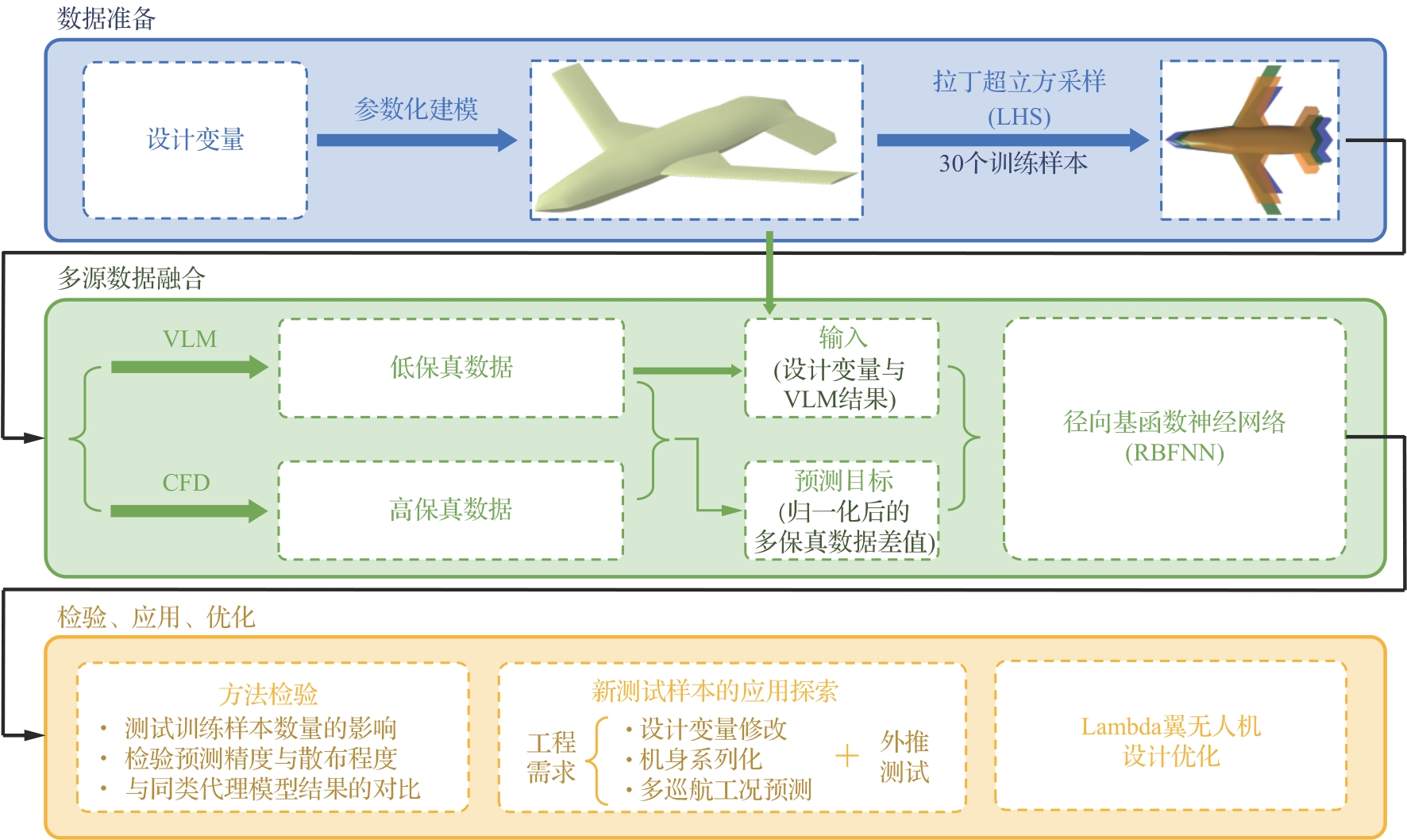
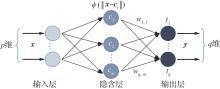
图 2
RBFNN结构
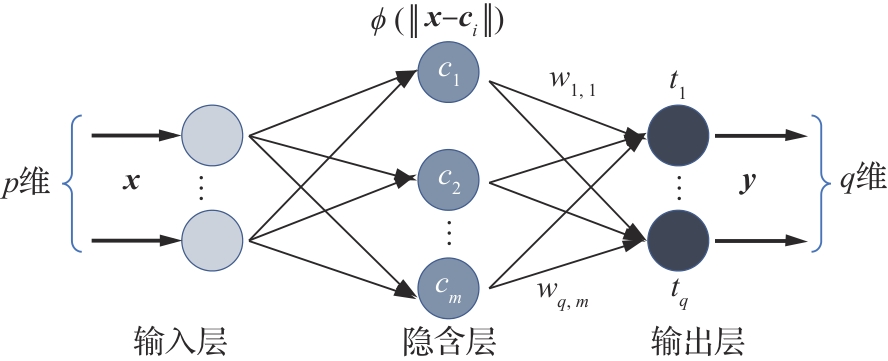
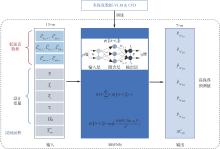
图 3
多保真数据融合模型框架
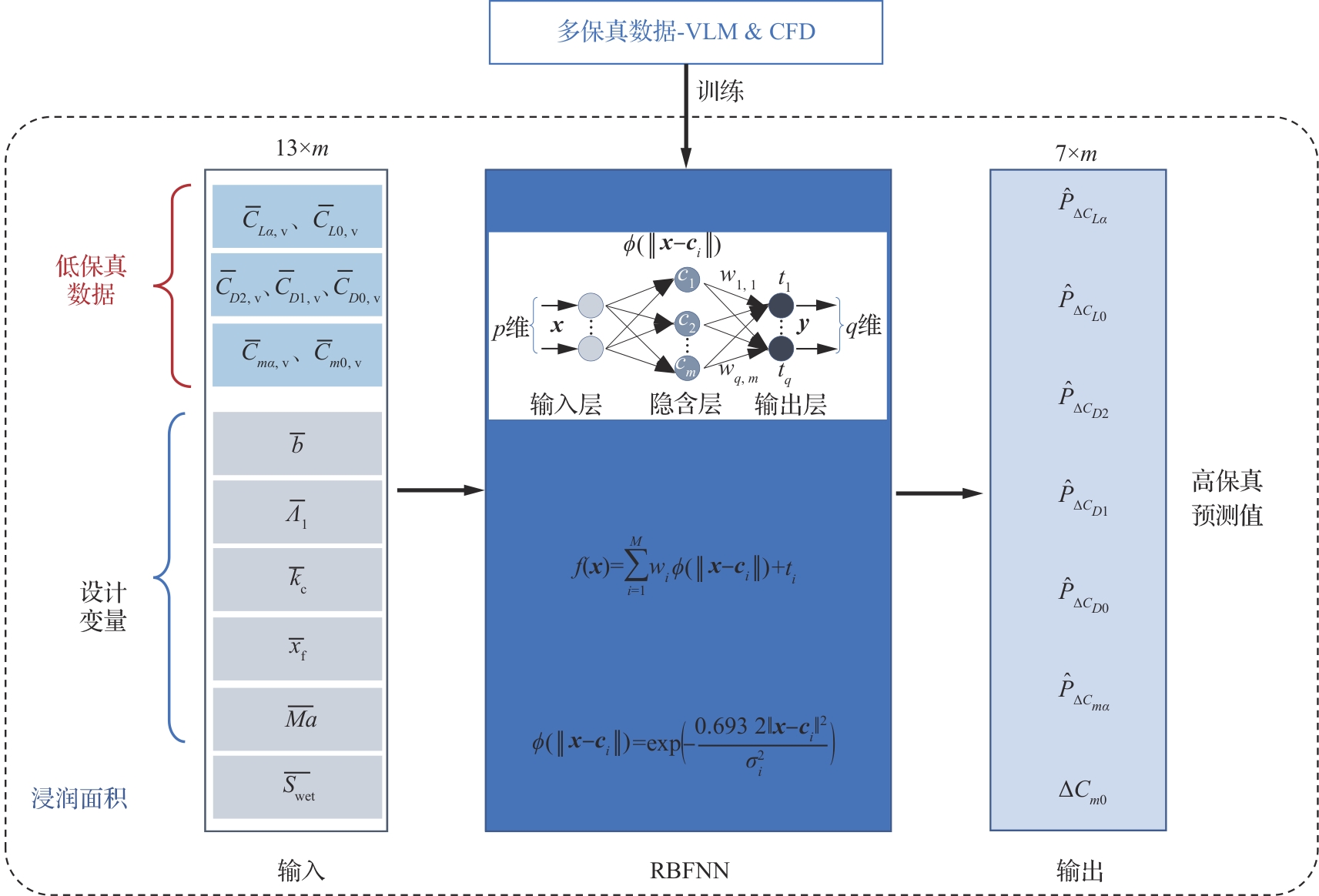
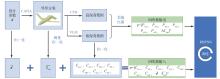
图 4
多保真数据融合模型训练过程
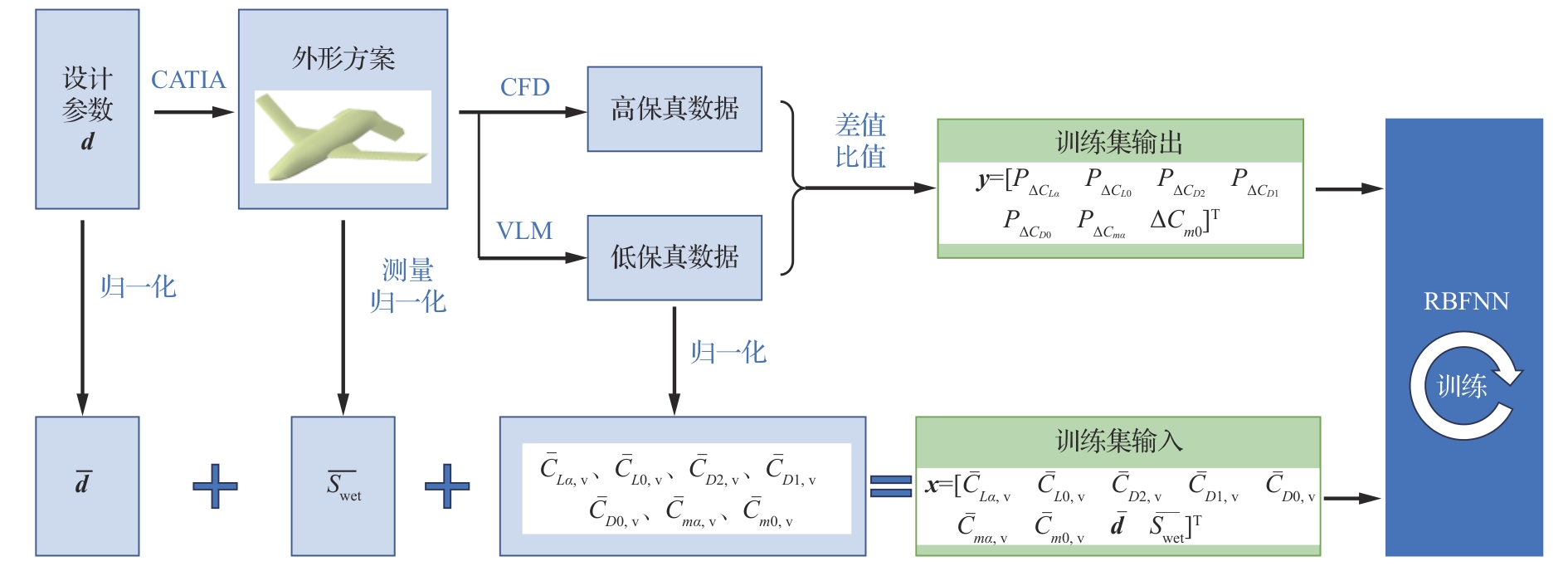
图 5
无人机设计参数的定义
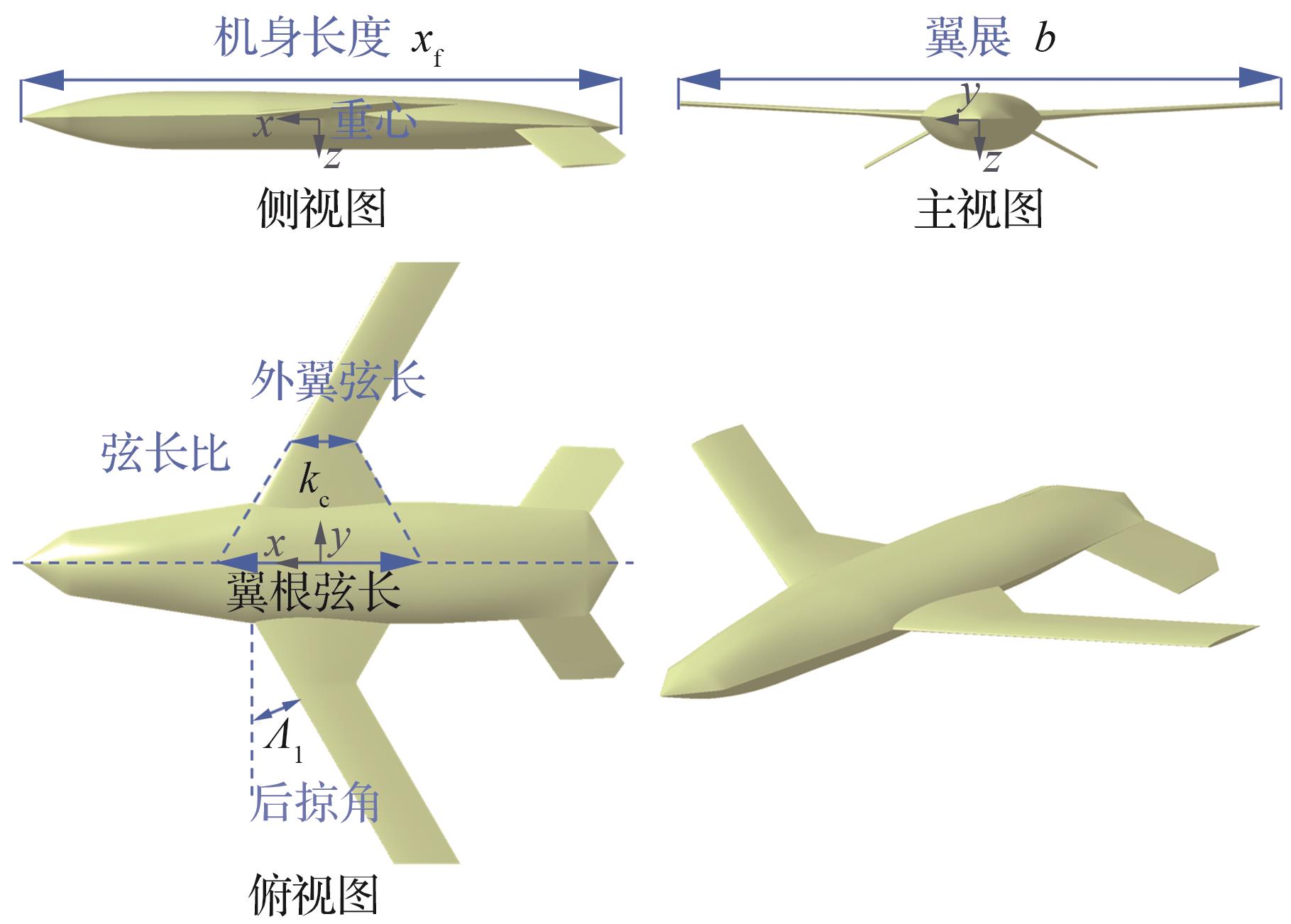
图 6
LHS的代表性外形方案
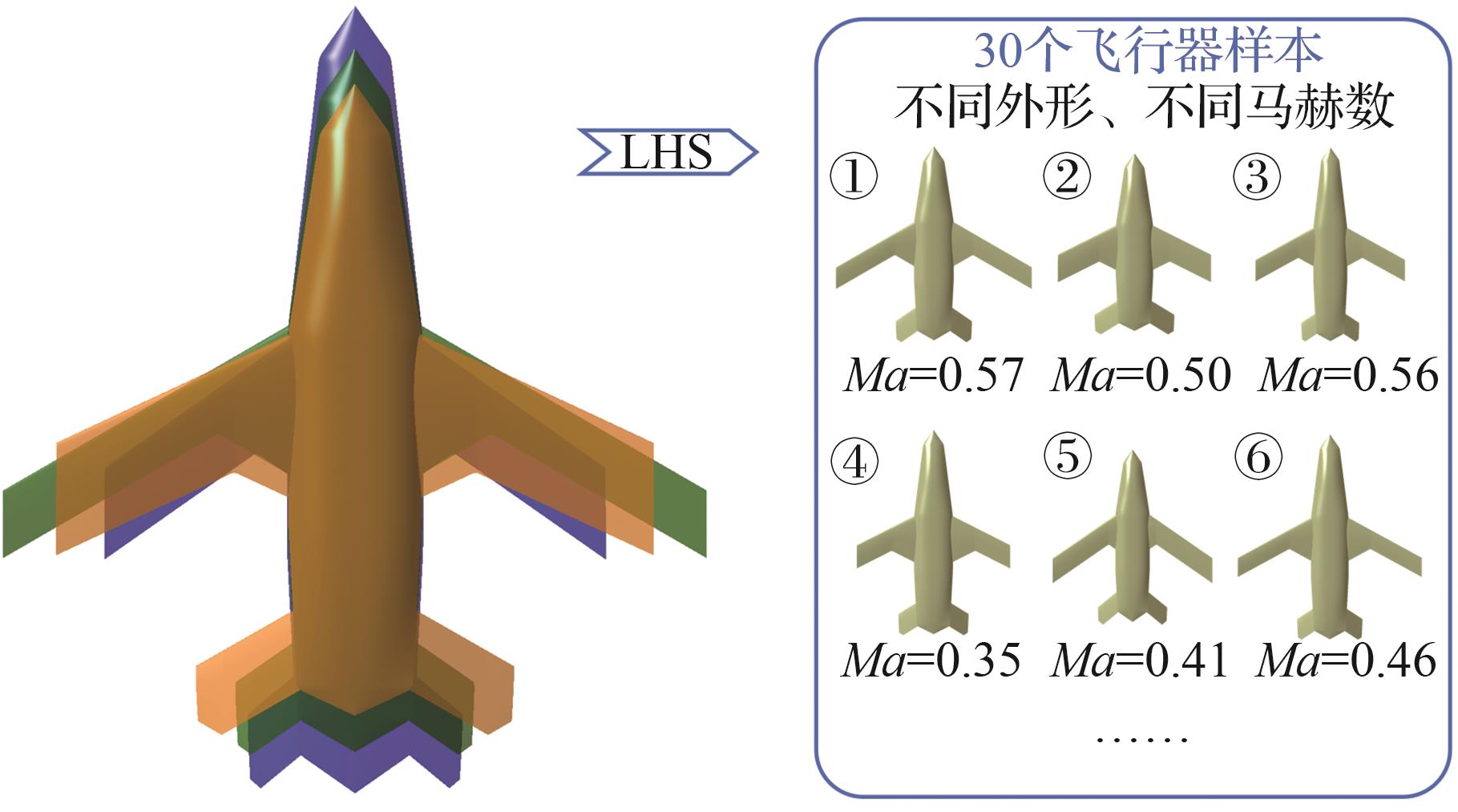
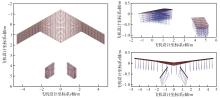
图 7
无人机涡格划分图
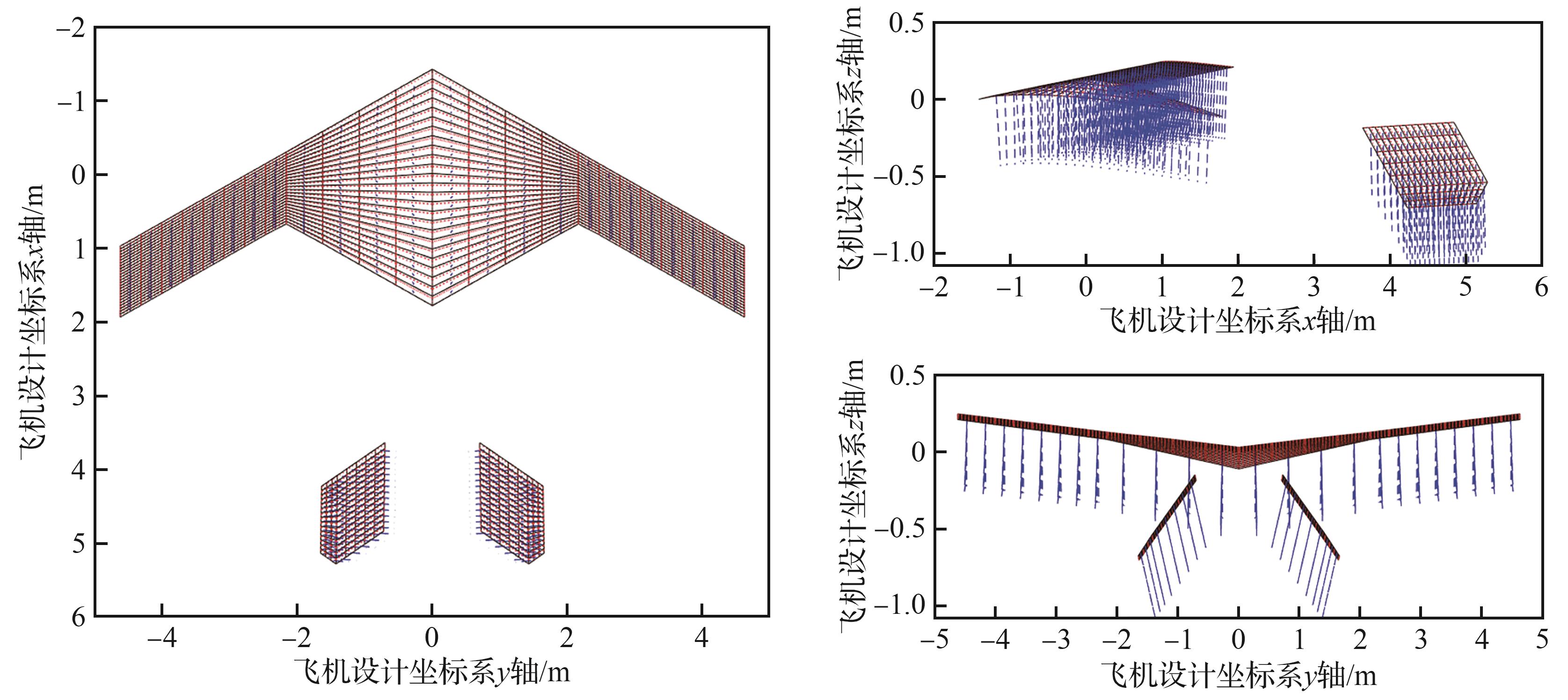
图 8
CHN-F1标模的几何外形和网格
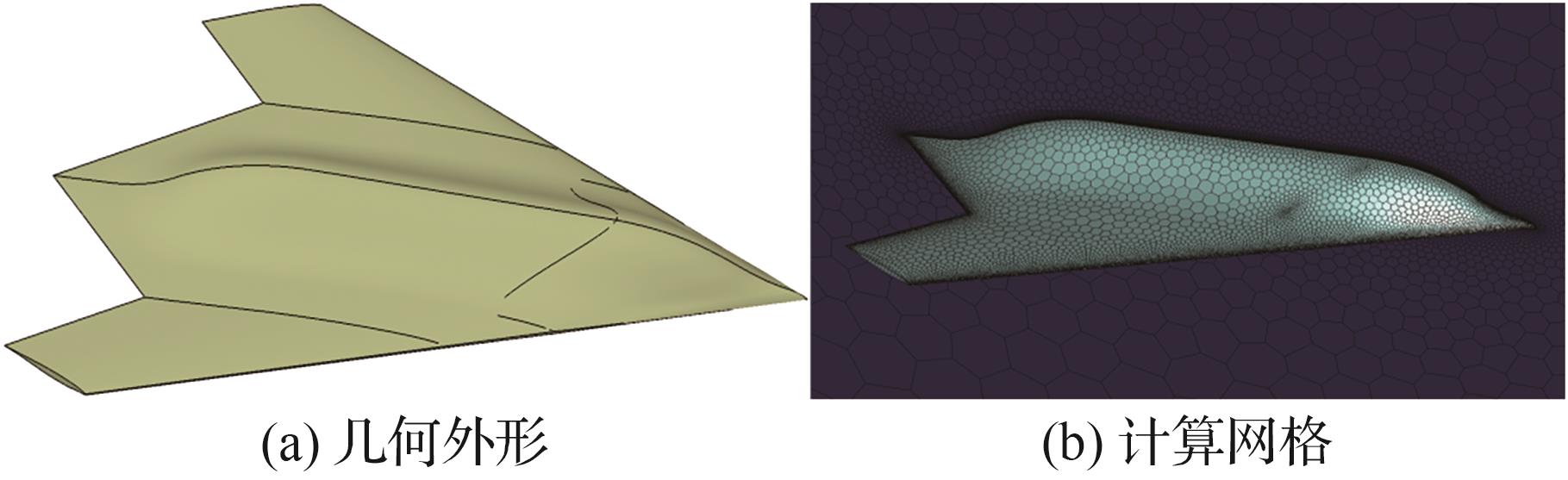
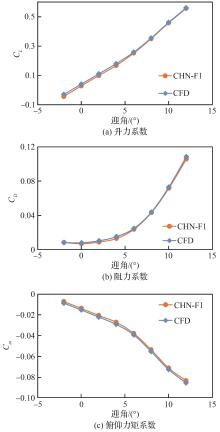
图 9
CFD计算结果与标模数据的对比
表 1
网格数量的无关性验证
| 网格数量/104 | CL | CD | Cm |
|---|---|---|---|
| 294 | 0.404 | 0.021 3 | 0.037 6 |
| 386 | 0.404 | 0.021 2 | 0.037 4 |
| 430 | 0.405 | 0.021 3 | 0.037 5 |
| 494 | 0.405 | 0.021 3 | 0.037 5 |
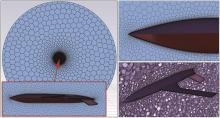
图 10
Lambda翼无人机半模CFD网格
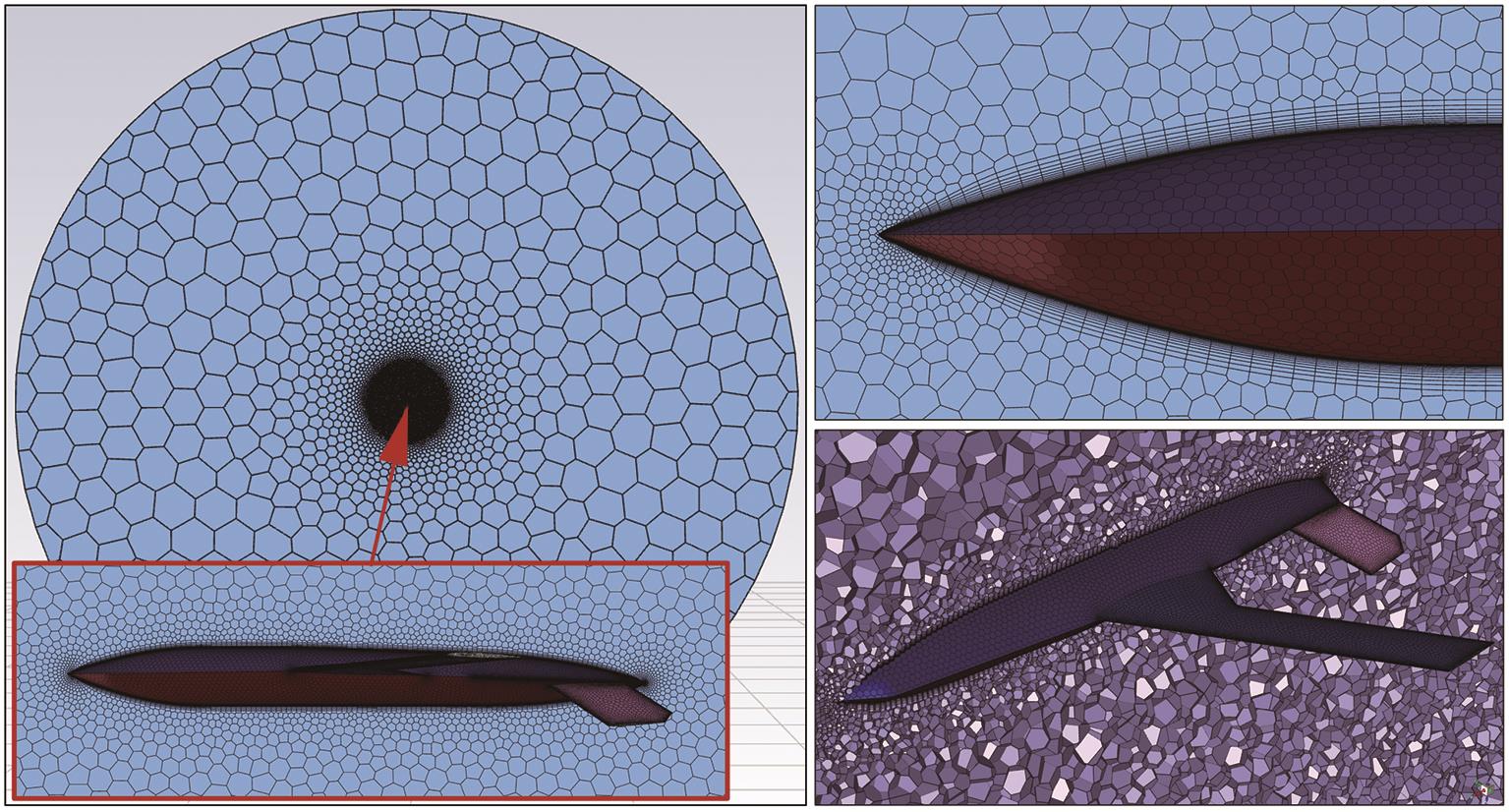
表 2
样本集各项参数的平均拟合R2
| 参数 | VLM翼面模型 | CFD翼面模型 | CFD全机模型 |
|---|---|---|---|
| CL | 1.000 0 | 1.000 0 | 1.000 0 |
| CD | 1.000 0 | 1.000 0 | 1.000 0 |
| Cm | 0.999 8 | 0.999 7 | 0.997 1 |
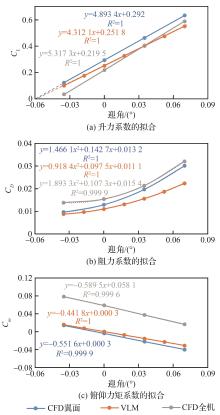
图 11
多保真数据拟合结果
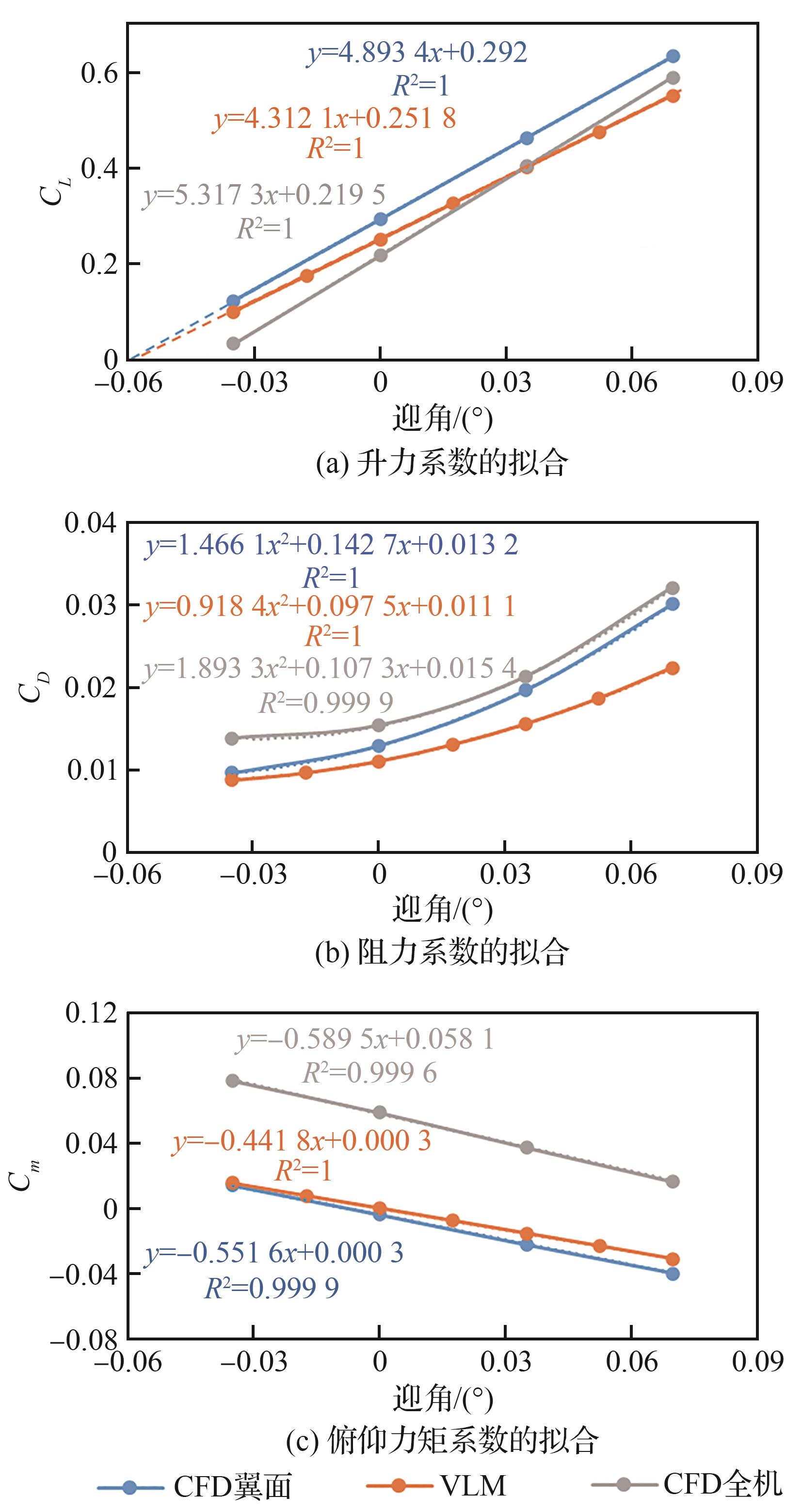
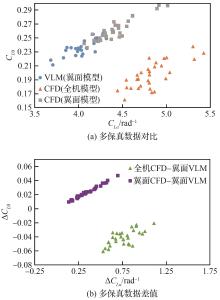
图 12
CLα 和CL0数据分布
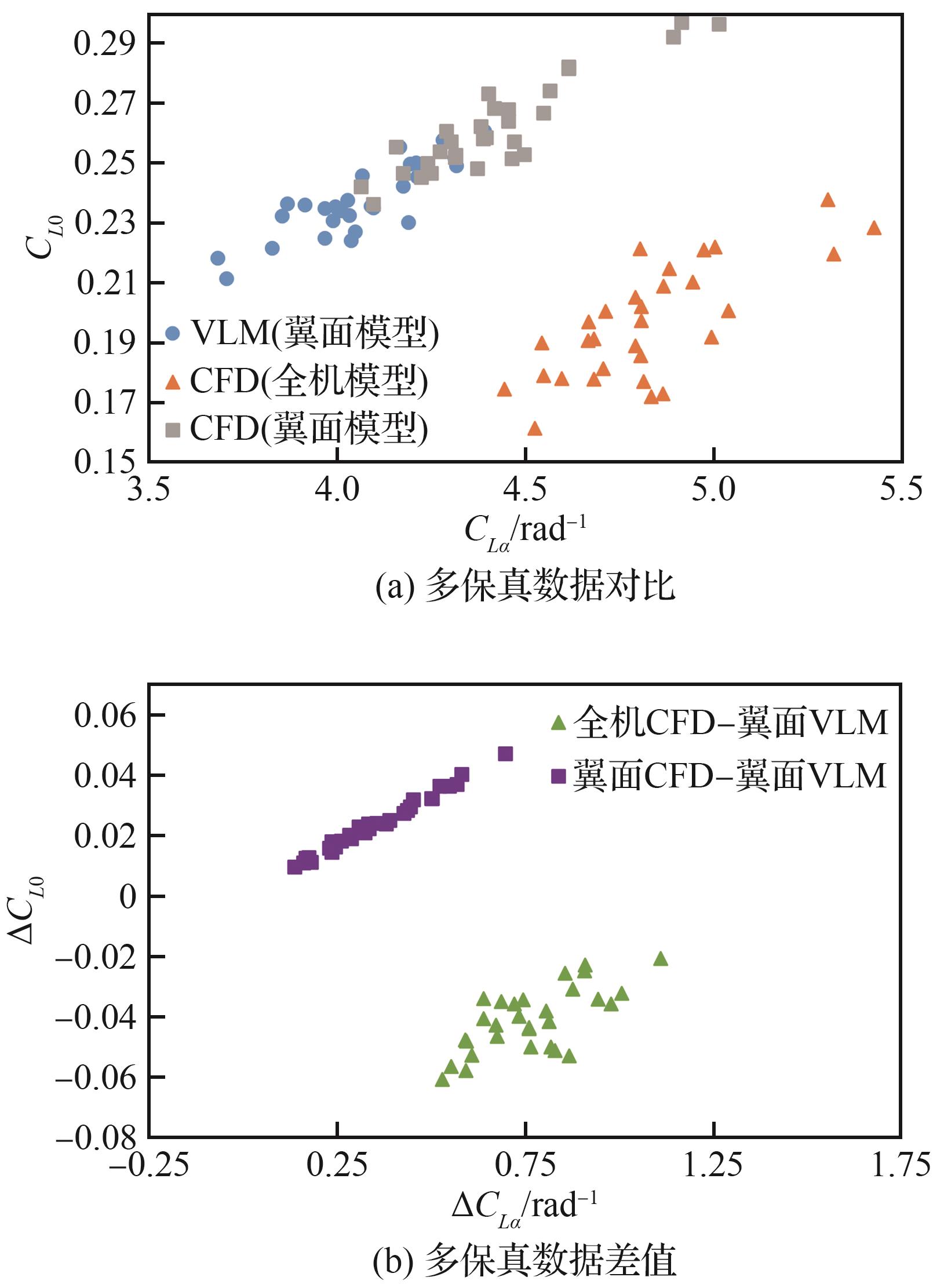
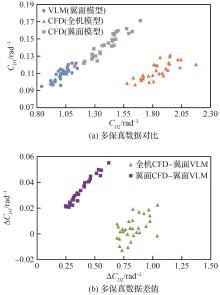
图 13
CD2和CD1数据分布
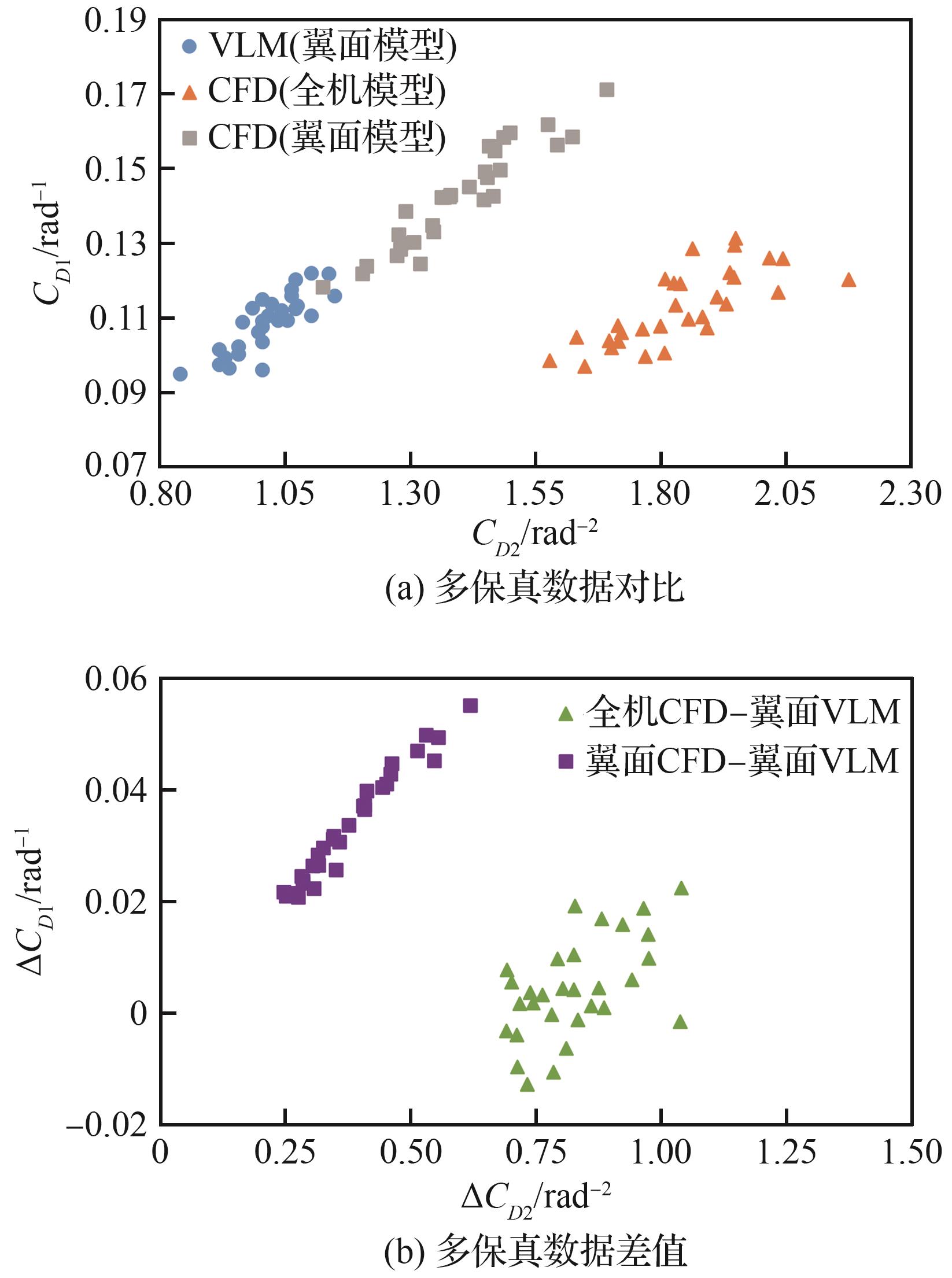
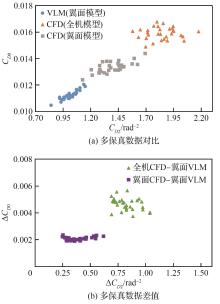
图 14
CD2和CD0数据分布
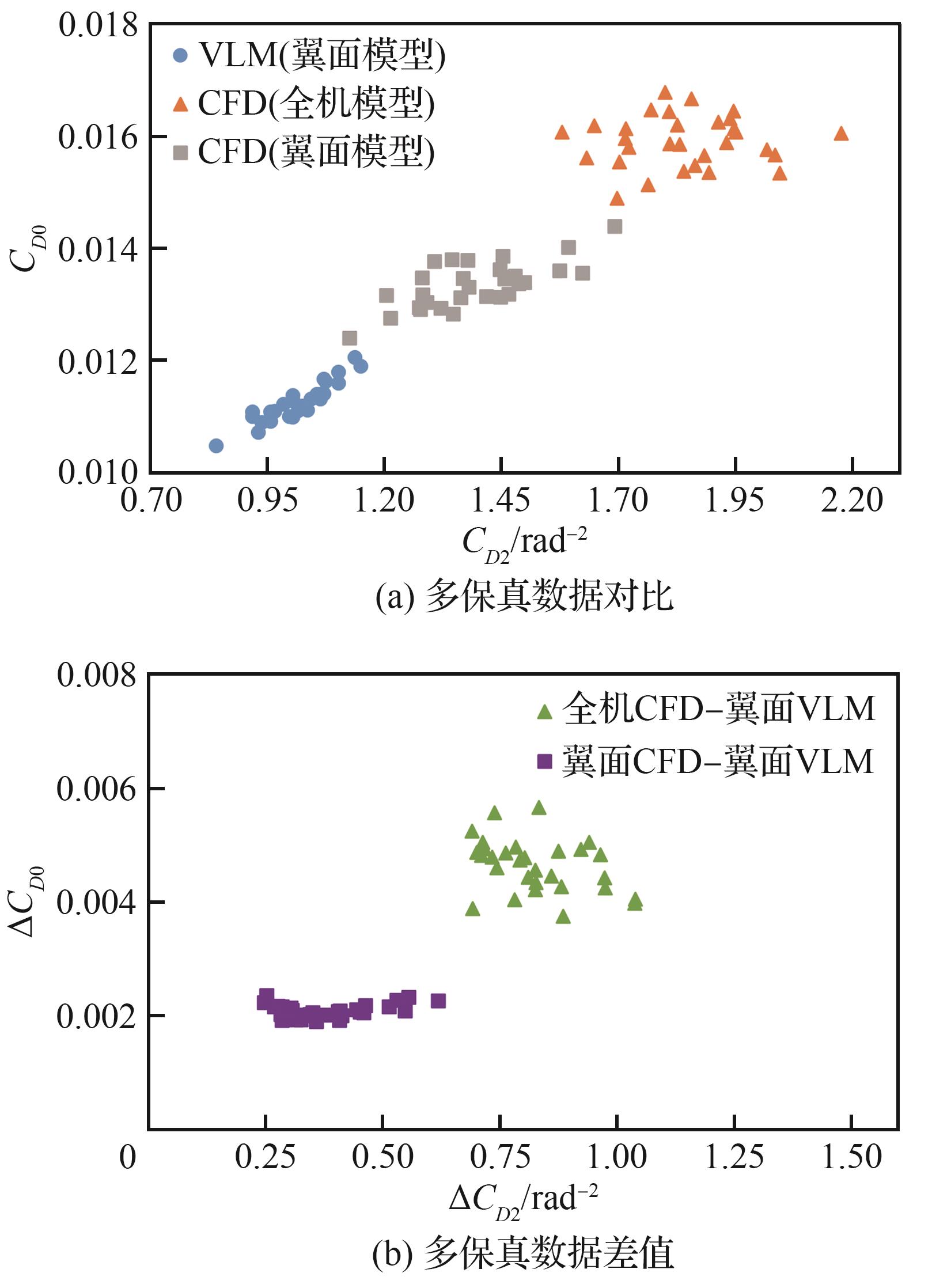
图 15
Cmα 和Cm0数据分布
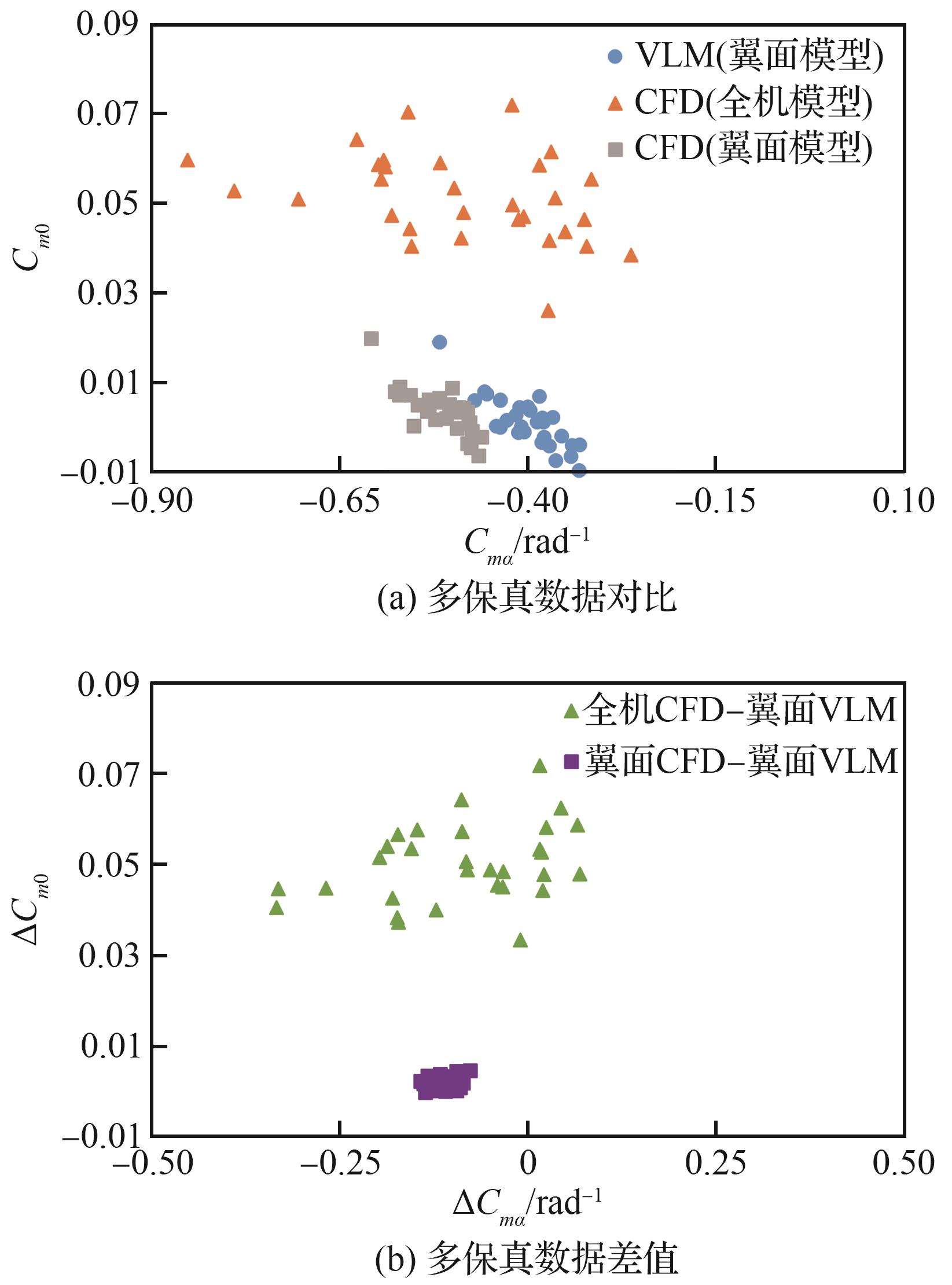
表 3
气动参数范围
| 参数 | 最小值 | 最大值 |
|---|---|---|
| 0.127 | 0.257 | |
| -0.251 | -0.083 | |
| 0.676 | 1.062 | |
| -0.113 | 0.226 | |
| 0.315 | 0.532 | |
| -0.208 | 0.726 | |
| 0.033 | 0.072 |
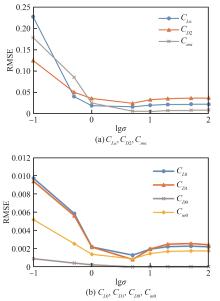
图 16
测试集RMSE随超参数σ的变化
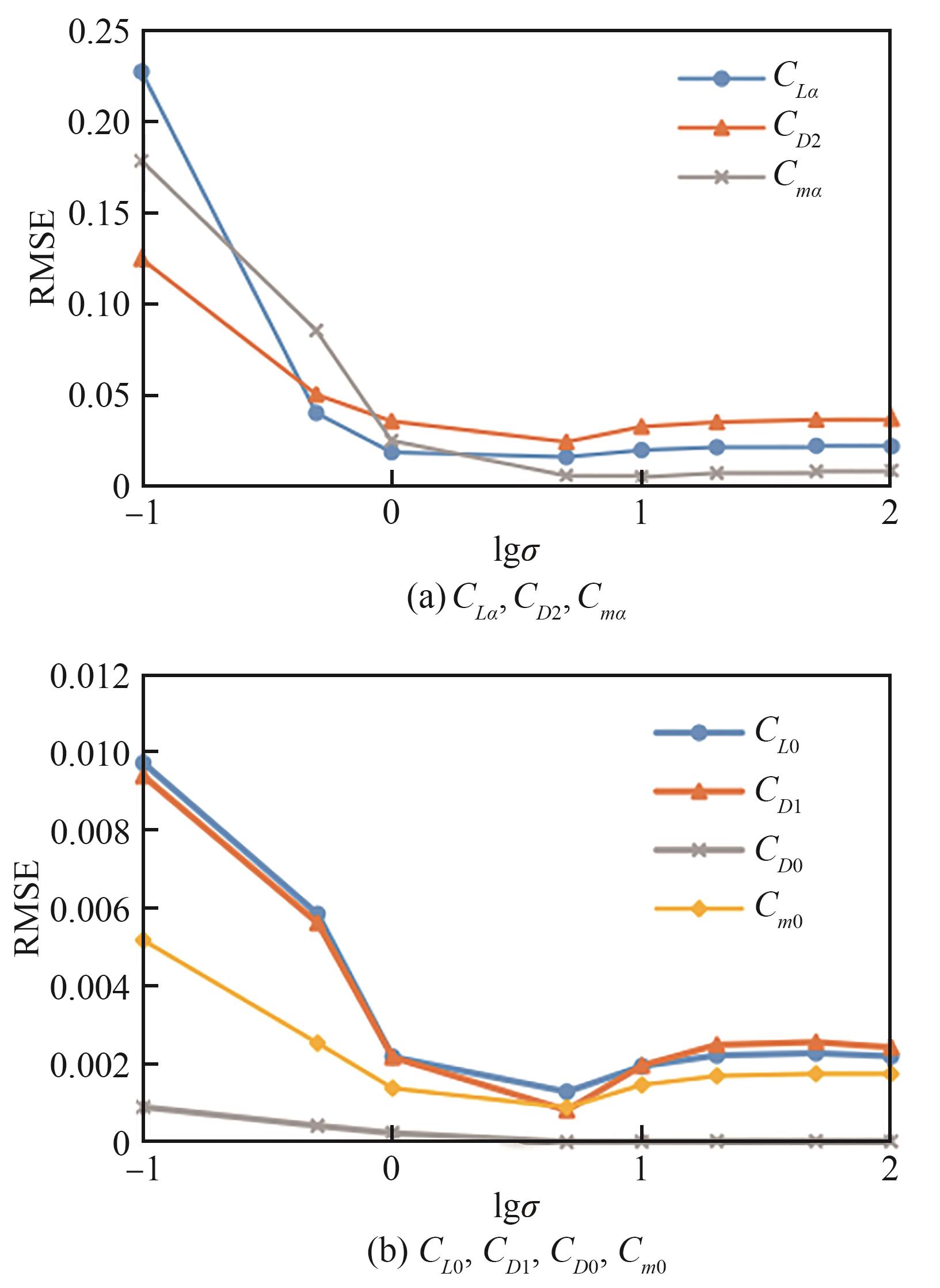
表 4
3种方法的测试集平均RMSE对比
| 参数 | 加法标度 | 比值标度 | 所提混合标度 |
|---|---|---|---|
| CLα /10-3 | 13.5 | 11.9 | 12.0 |
| CL0/10-3 | 0.99 | 1.01 | 1.01 |
| CD2/10-3 | 29.1 | 28.0 | 28.0 |
| CD1/10-3 | 1.39 | 1.38 | 1.37 |
| CD0/10-3 | 0.080 8 | 0.080 2 | 0.079 8 |
| Cmα /10-3 | 15.3 | 13.6 | 13.6 |
| Cm0/10-3 | 1.00 | 4 740 | 1.00 |
图 17
平均RMSE随训练样本数量的变化
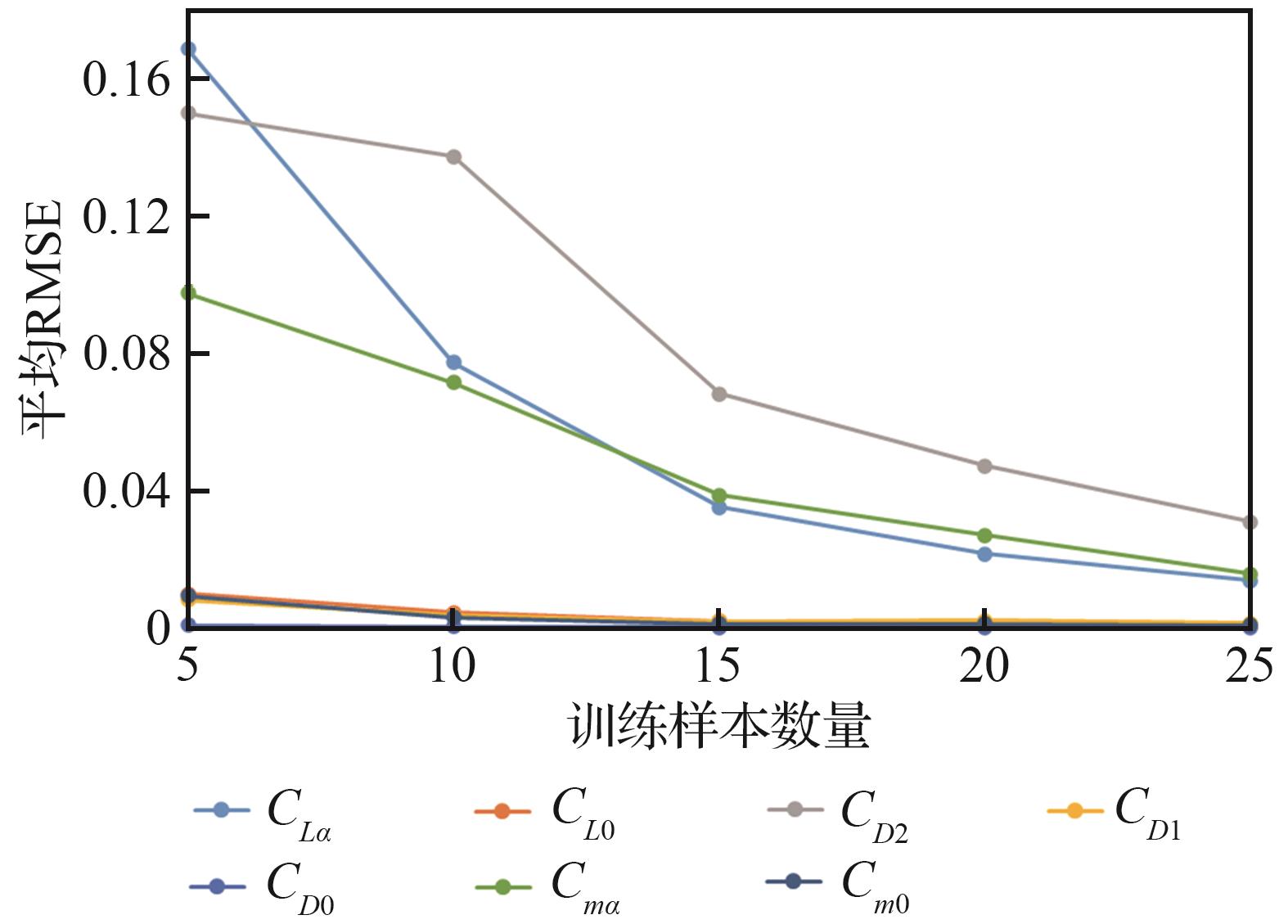
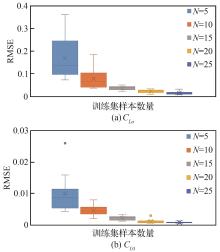
图 18
升力参数预测结果的箱型图
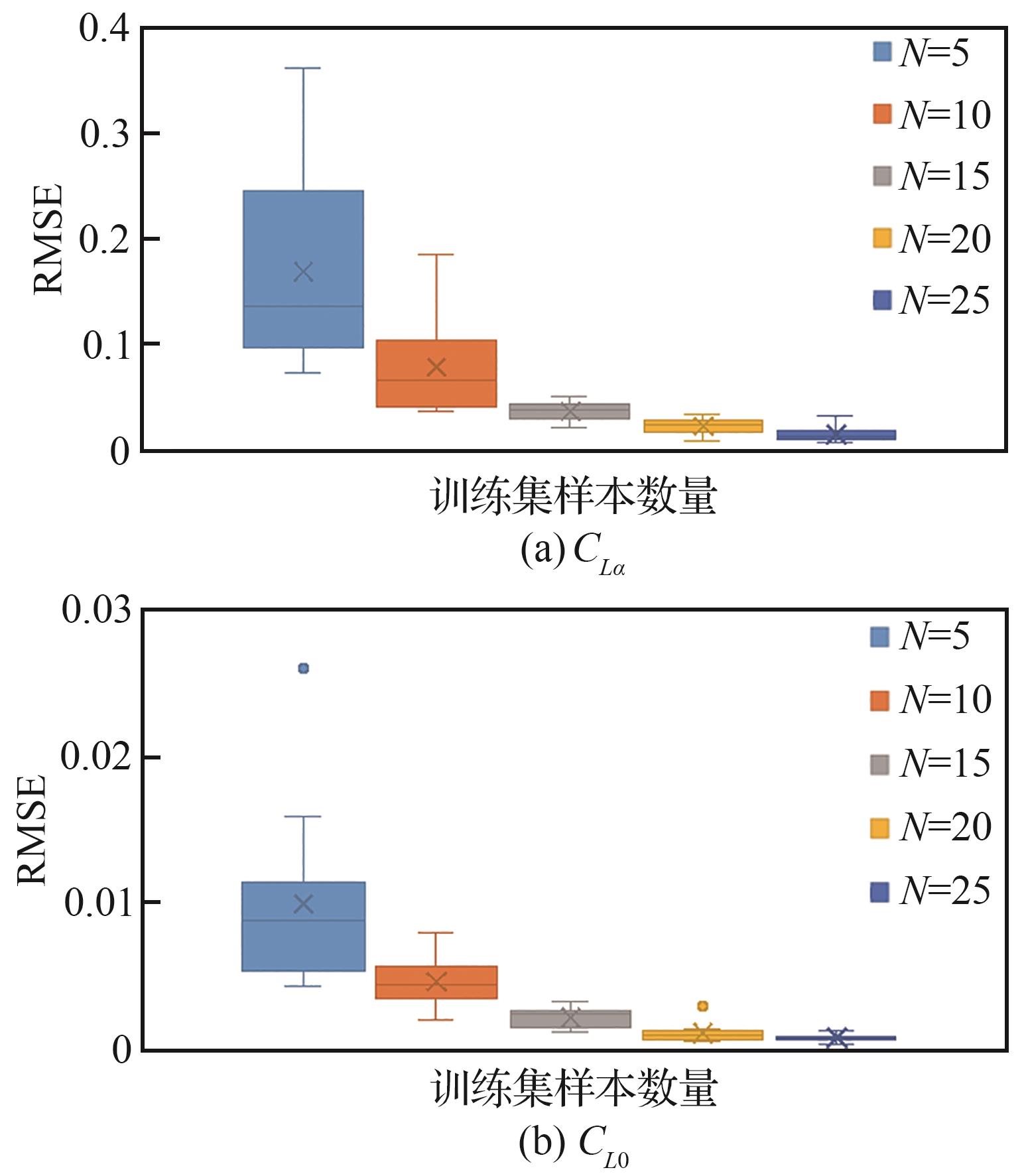
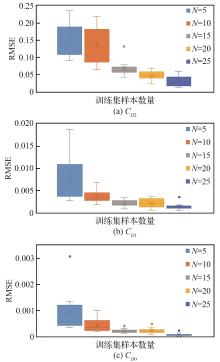
图 19
阻力系数预测结果的箱型图
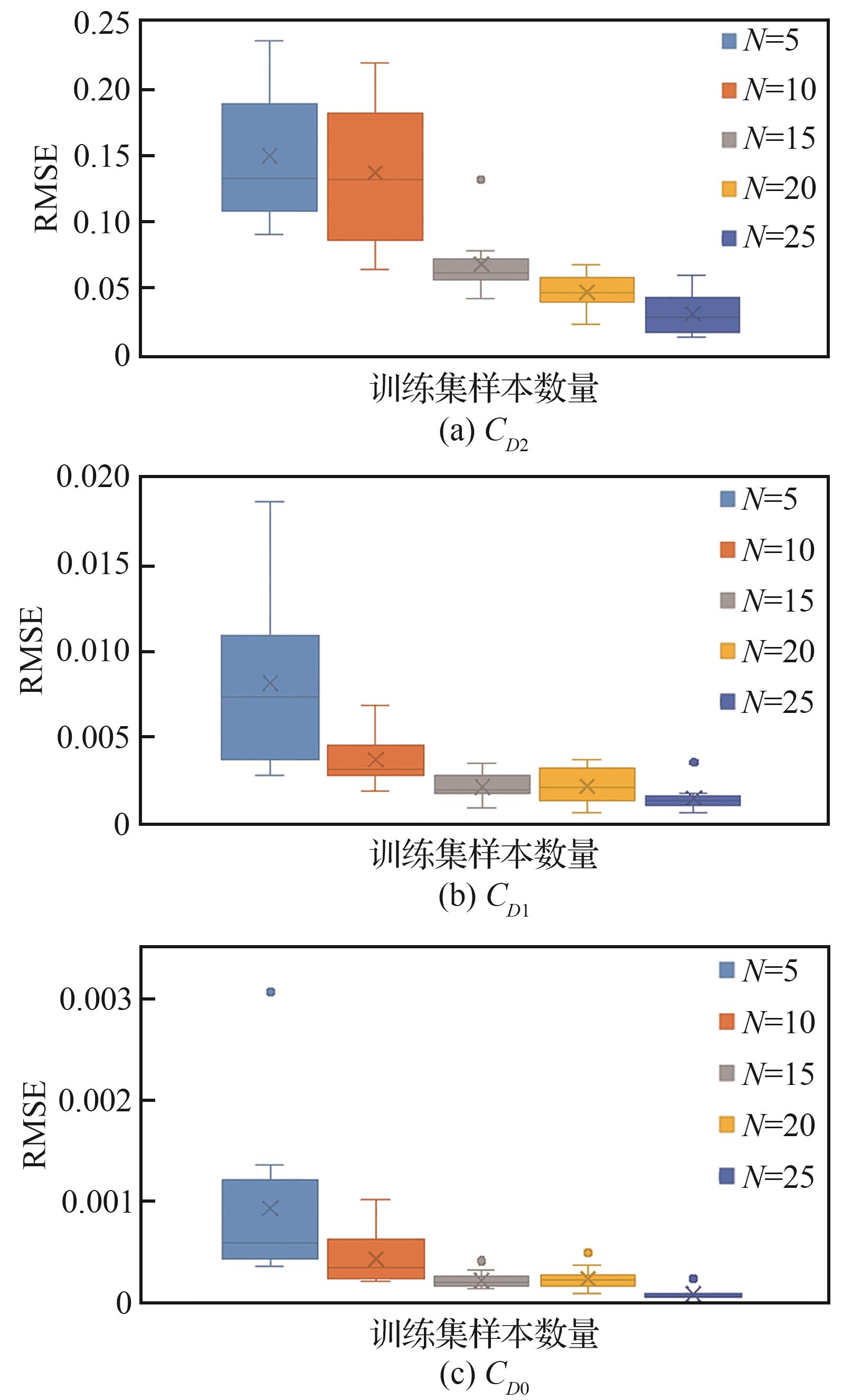
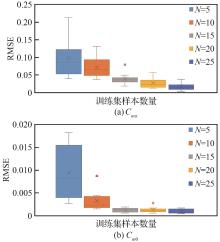
图 20
俯仰力矩参数预测结果的箱型图
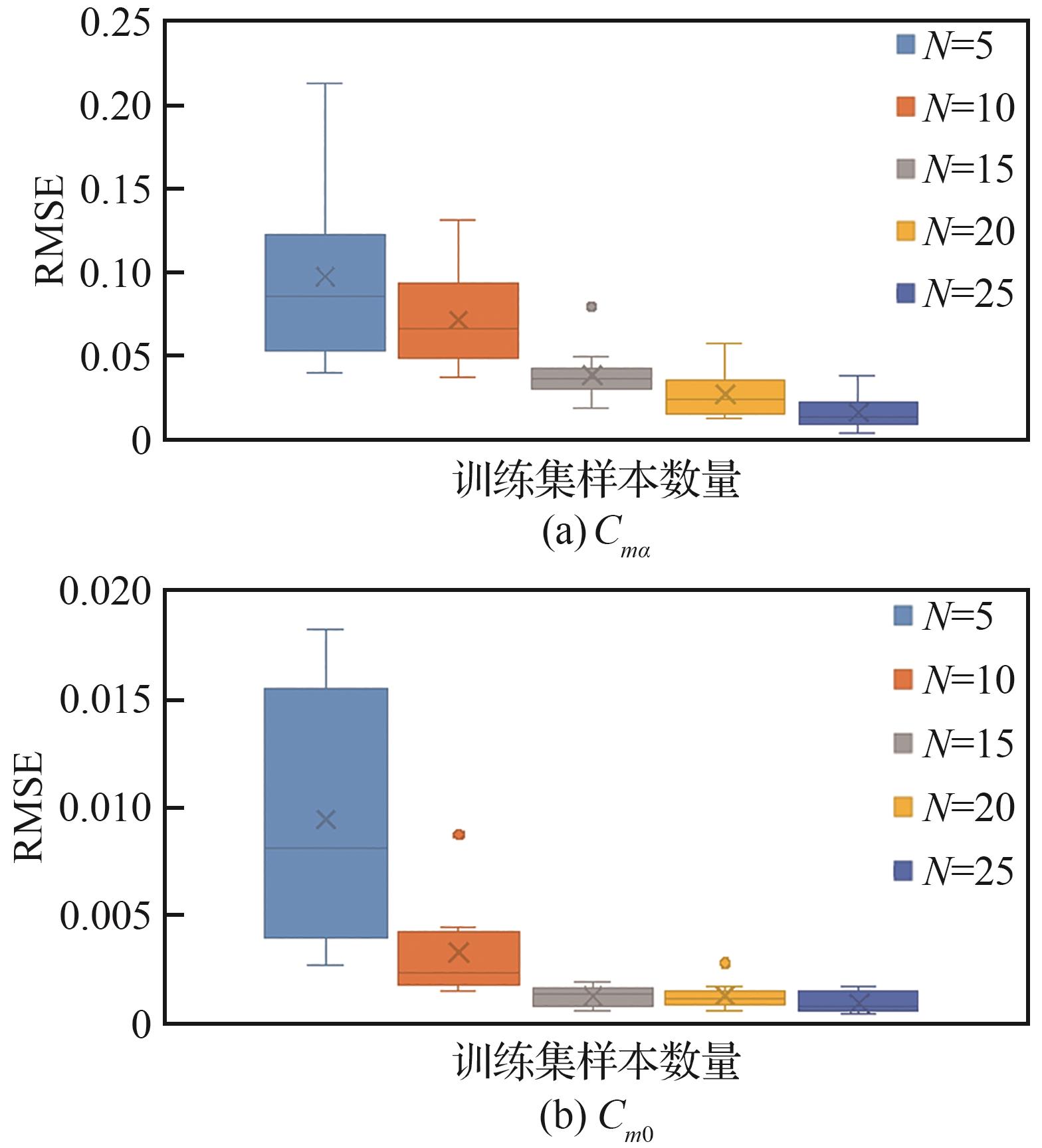
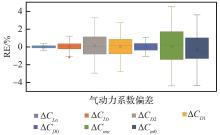
图 21
测试样本预测相对误差的箱型图
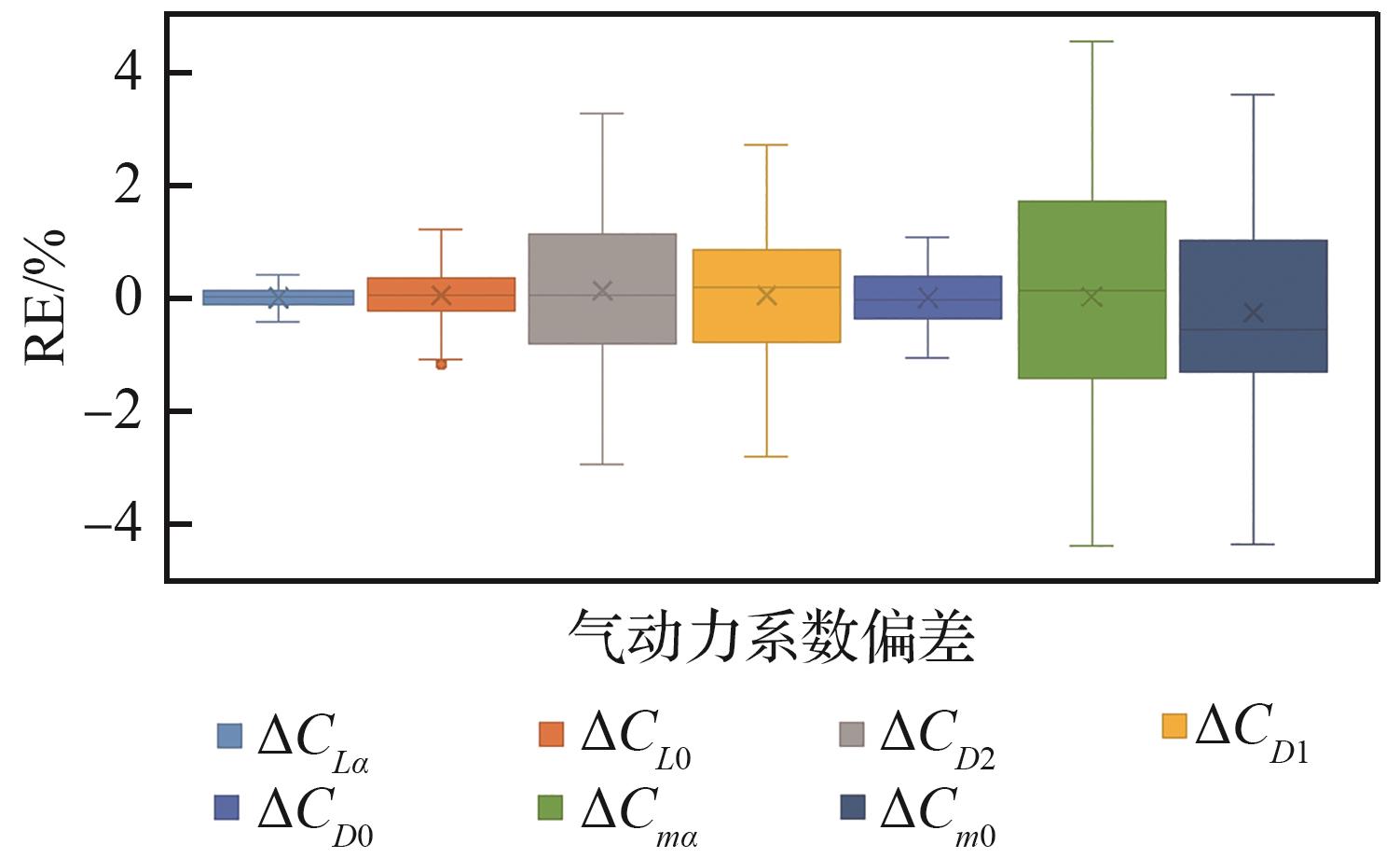
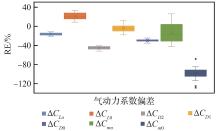
图 22
测试样本低保真VLM结果相对误差的箱型图
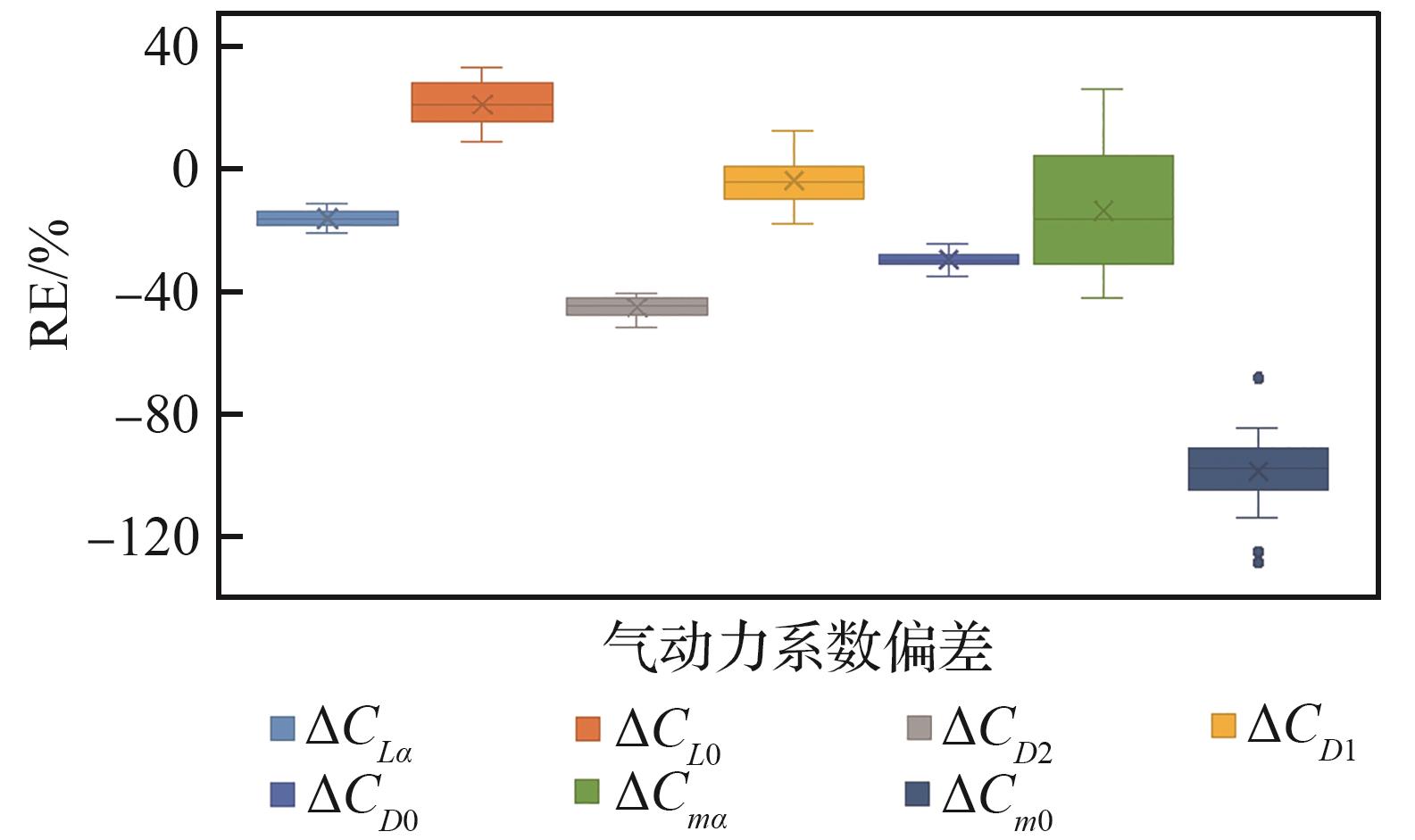
表 5
计算时间成本
| 方法 | 每个算例的计算时长 | 准备用时 |
|---|---|---|
| VLM | 4 s | |
| CFD | 35 min | 12 min/算例 (几何处理、绘制网格) |
| MF | 5 s | 17.5 h(训练总用时,30×4个算例,4组并行计算) |
表 6
不同几何模型的预测平均RMSE对比
| 参数 | 翼面模型 | 带机身模型 | 低保真数据 |
|---|---|---|---|
| CLα /10-3 | 14.5 | 12.0 | 363 |
| CL0/10-3 | 0.737 | 1.01 | 24.4 |
| CD2/10-3 | 23.4 | 28.0 | 383 |
| CD1/10-3 | 1.46 | 1.37 | 33.8 |
| CD0/10-3 | 0.124 | 0.079 8 | 2.07 |
| Cmα /10-3 | 9.63 | 13.6 | 113 |
| Cm0/10-3 | 0.537 | 1.00 | 2.20 |
表 7
数据处理与计算设置对比
| 对比项 | SF | CO-KR | MF |
|---|---|---|---|
| 初始输入 | 归一化设计变量 | 归一化设计变量与低保真数据 | 归一化设计变量与低保真数据 |
| 中间输入 | 归一化高保真数据 | ||
| 预测输出 | 归一化高保真预测结果 | 结果 归一化高保真预测 | 多保真比值/差值 |
| 核函数 | RBF核 | RBF核 | RBF核 |
| 超参数 | 人为设置 | MLE寻优 | 人为设置 |
表 8
3种方法的测试集平均RMSE对比
| 参数 | MF | SM | CO-KR |
|---|---|---|---|
| CLα /10-3 | 12.0 | 37.9 | 13.2 |
| CL0/10-3 | 1.01 | 3.35 | 1.92 |
| CD2/10-3 | 28.0 | 34.4 | 17.8 |
| CD1/10-3 | 1.37 | 1.90 | 1.57 |
| CD0/10-3 | 0.079 8 | 0.126 | 0.469 |
| Cmα /10-3 | 13.6 | 32.2 | 12.8 |
| Cm0/10-3 | 1.00 | 2.36 | 0.837 |
表 9
3种方法的训练集平均RMSE对比
| 参数 | MF/10-14 | SM/10-16 | CO-KR/10-4 |
|---|---|---|---|
| CLα | 43.9 | 19.0 | 10.8 |
| CL0 | 3.06 | 1.04 | 4.79 |
| CD2 | 124 | 8.81 | 2.55 |
| CD1 | 8.04 | 0.480 | 5.05 |
| CD0 | 0.442 | 0.052 0 | 4.38 |
| Cmα | 41.5 | 5.26 | 13.7 |
| Cm0 | 2.67 | 0.333 | 3.99 |
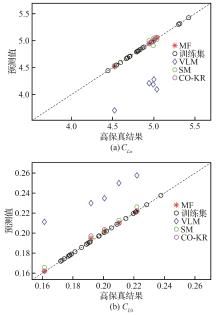
图 23
升力参数预测结果
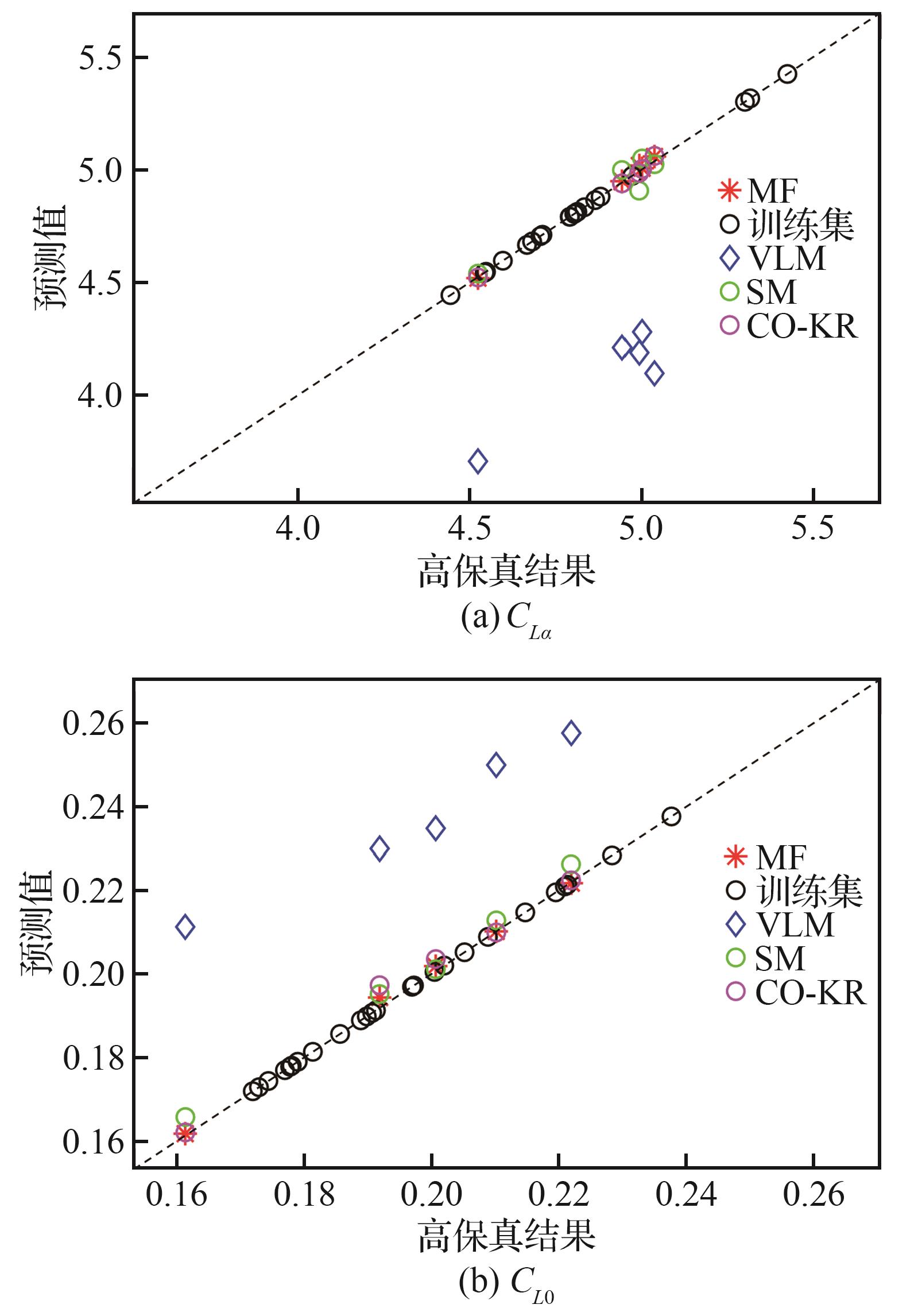
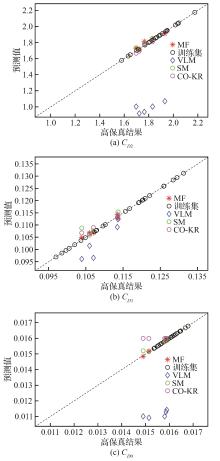
图 24
阻力参数预测结果
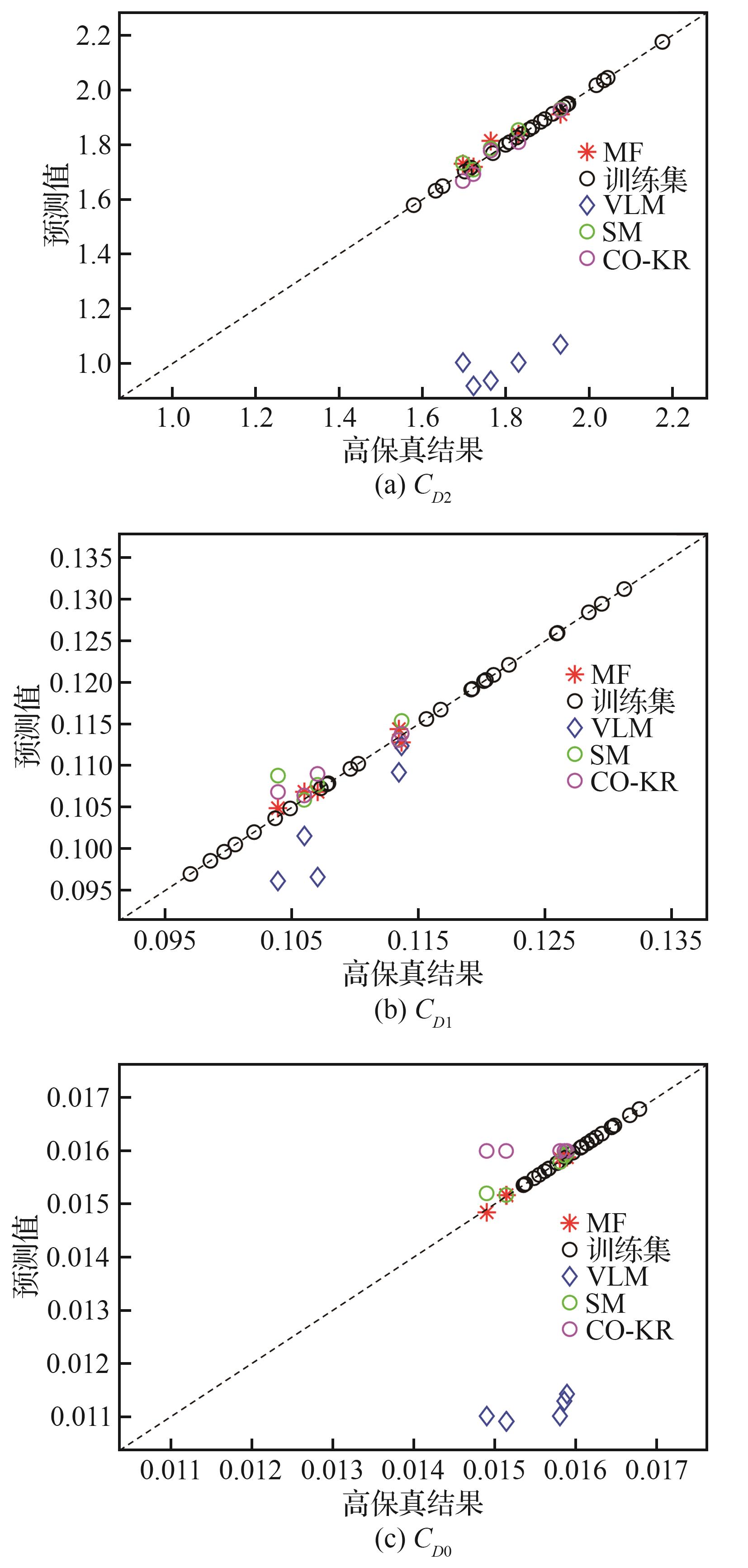
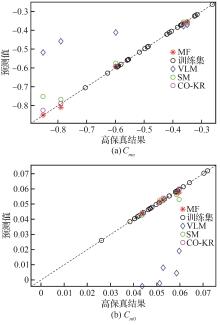
图 25
俯仰力矩参数预测结果
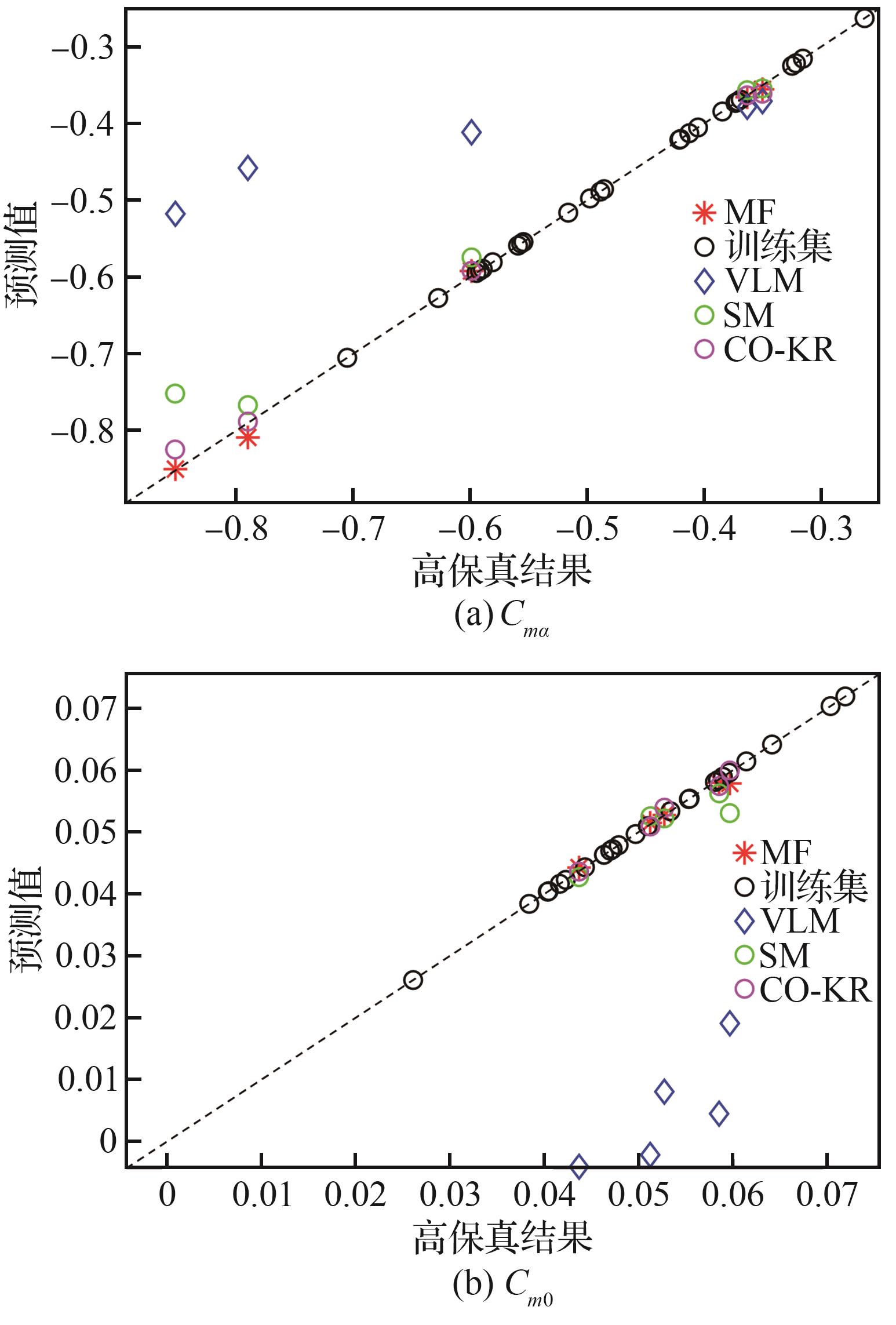
表 10
新测试样本的设计参数
| 编号 | b/m | Λ1/(°) | kc | xf/m | Ma |
|---|---|---|---|---|---|
| 1 | 9.1 | 30 | 0.5 | 10.7 | 0.55 |
| 2 | 8.5 | 33 | 0.44 | 10.2 | 0.45 |
| 3 | 9.5 | 26 | 0.36 | 9.5 | 0.35 |
| 4 | 9.5 | 26 | 0.36 | 10.0 | 0.35 |
| 5 | 9.5 | 26 | 0.36 | 10.5 | 0.35 |
| 6 | 8.5 | 33 | 0.44 | 10.2 | 0.35 |
| 7 | 8.5 | 33 | 0.44 | 10.2 | 0.55 |
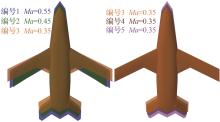
图 26
测试样本几何外形
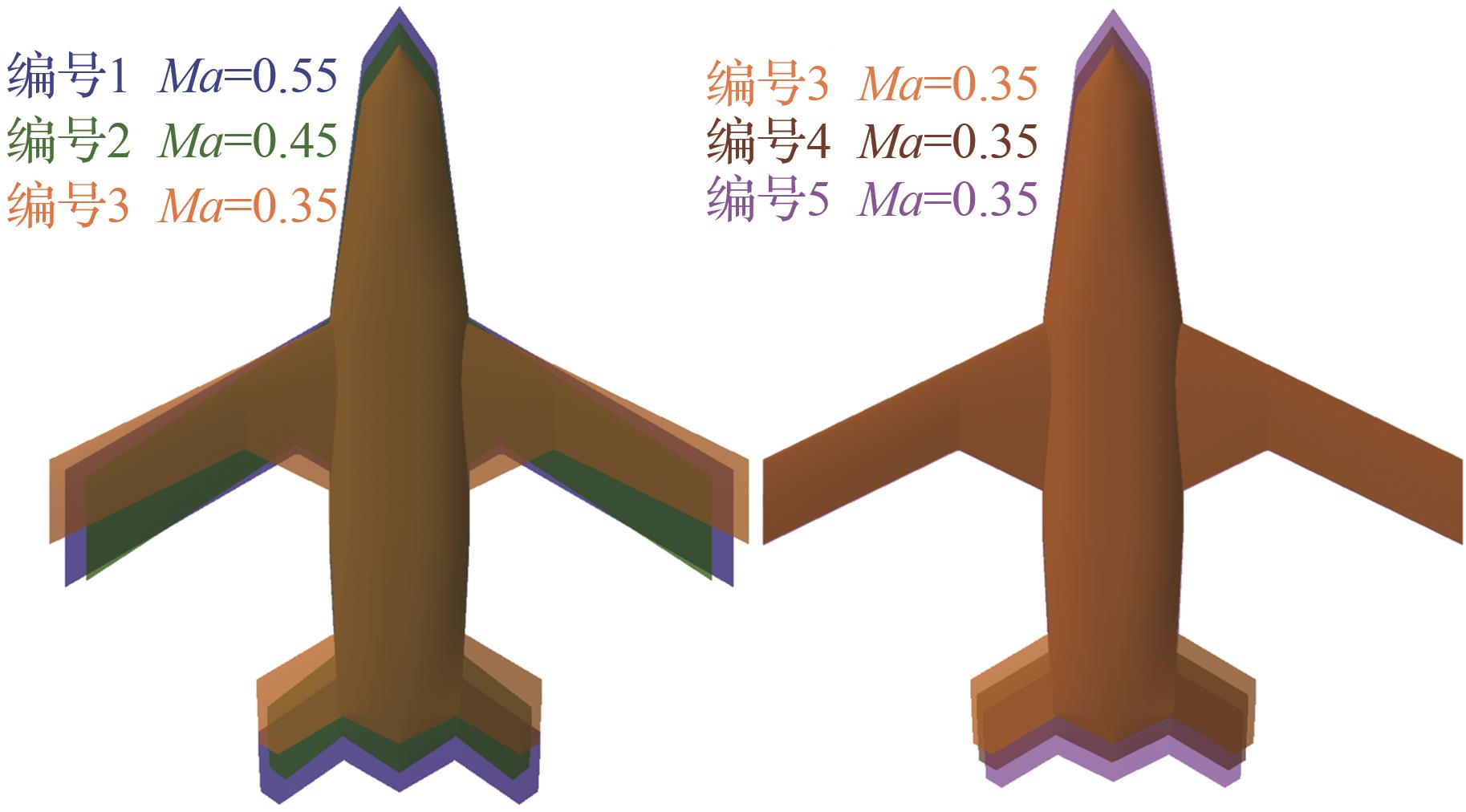
表 11
新测试样本的平均RMSE
| 参数 | 平均RMSE/10-3 | 参数 | 平均RMSE/10-3 |
|---|---|---|---|
| CLα | 5.10 | CD2 | 21.0 |
| CL0 | 0840 | CD1 | 0.580 |
| Cmα | 2.50 | CD0 | 0.075 0 |
| Cm0 | 0.580 |
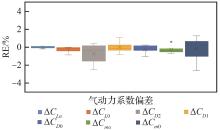
图 27
测试样本预测相对误差箱型图
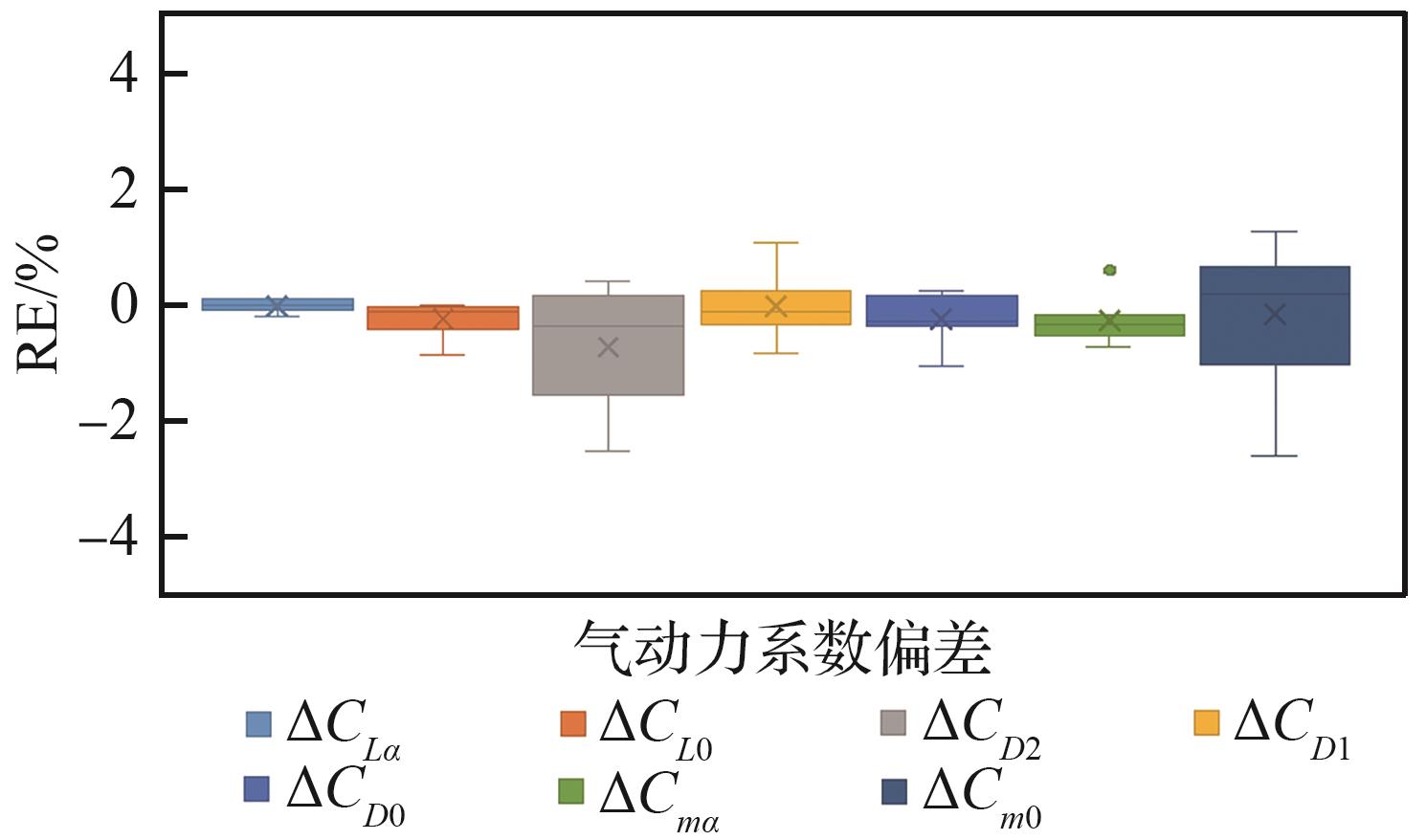
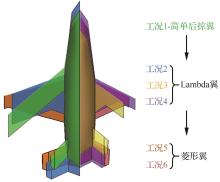
图 28
外推测试样本外形布局
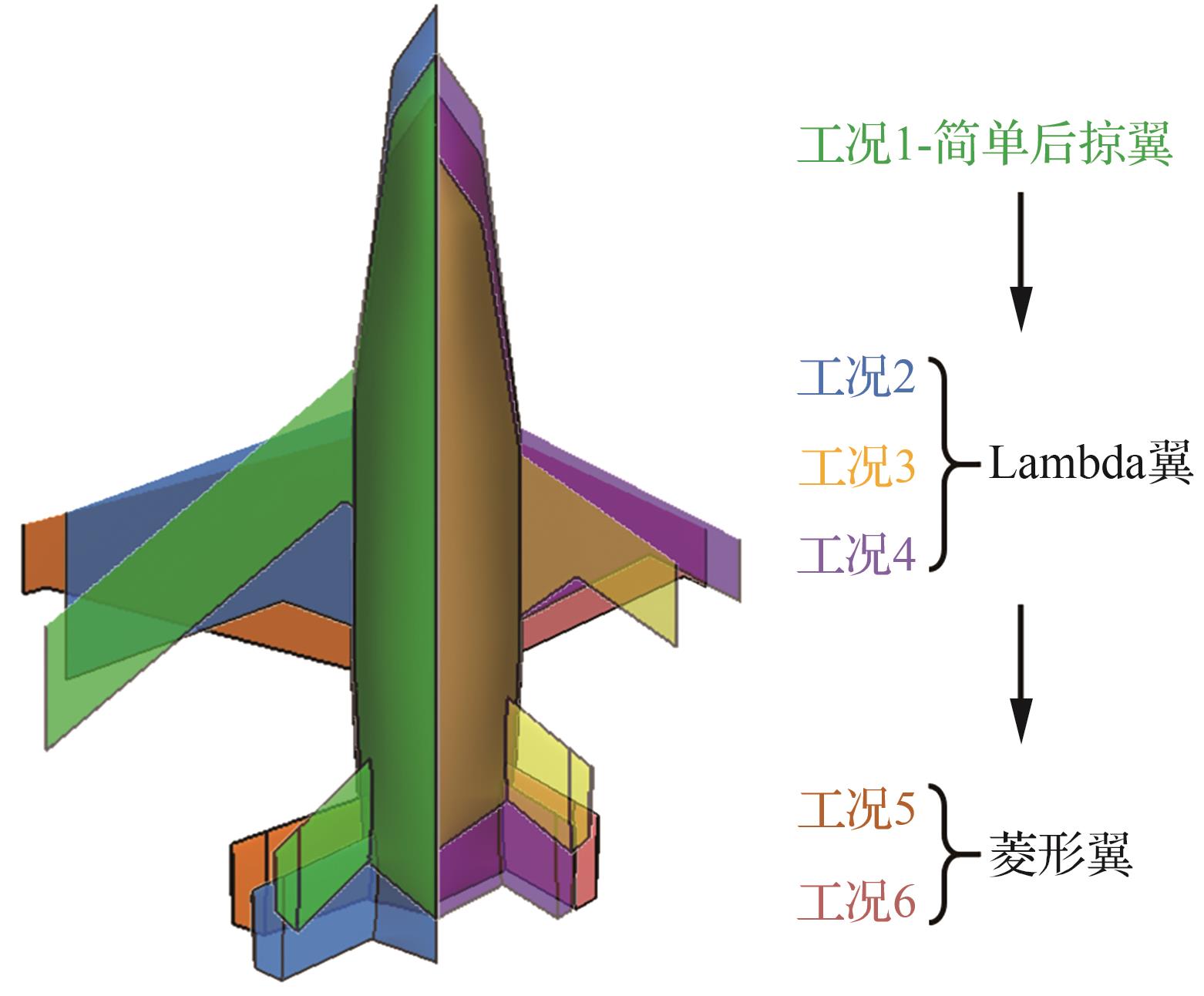
表 12
新外推样本的设计参数
| 编号及边界 | b/m | Λ1/(°) | kc | xf/m |
|---|---|---|---|---|
| 1 | 9.0 | 40 | 0.45 | 10.0 |
| 2 | 9.5 | 15 | 0.25 | 9.5 |
| 3 | 5.5 | 35 | 0.30 | 8.0 |
| 4 | 7.0 | 27 | 0.22 | 10.0 |
| 5 | 8.5 | 20 | 0.60 | 11.0 |
| 6 | 6.0 | 25 | 0.20 | 9.0 |
| 参数下界 | 7.0 | 25 | 0.30 | 9.0 |
| 参数上界 | 10.0 | 35 | 0.50 | 11.0 |
表 13
外推样本的平均RMSE对比
| 参数 | MF | SM | CO-KR |
|---|---|---|---|
| CLα /10-2 | 7.94 | 26.0 | 43.2 |
| CL0/10-2 | 1.11 | 3.69 | 5.51 |
| CD2/10-2 | 21.6 | 15.5 | 22.5 |
| CD1/10-2 | 1.46 | 2.03 | 2.34 |
| CD0/10-2 | 0.095 2 | 0.082 0 | 0.067 6 |
| Cmα /10-2 | 16.0 | 23.8 | 14.0 |
| Cm0/10-2 | 0.905 | 2.52 | 2.21 |
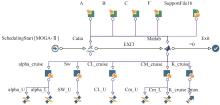
图 29
无人机气动优化框架
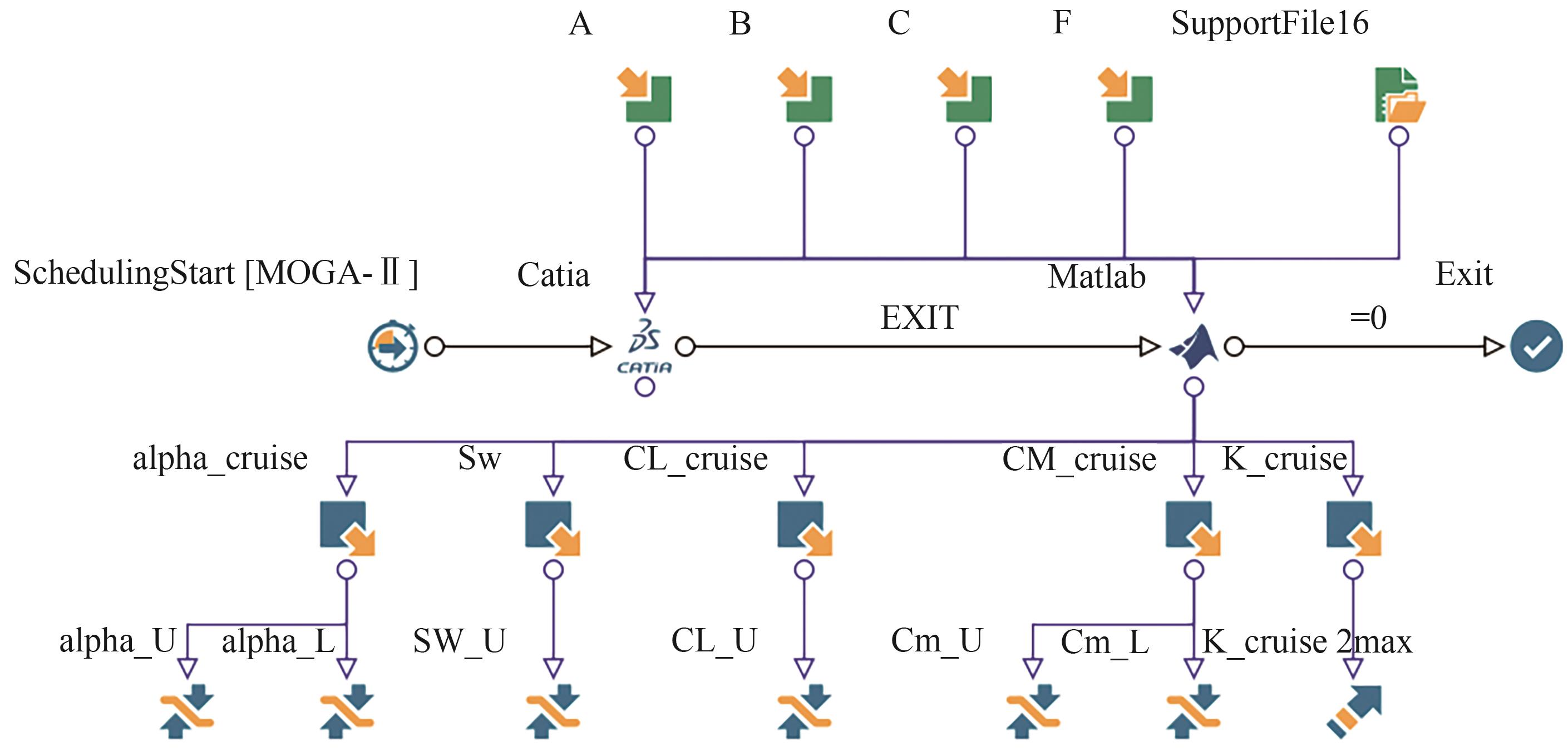
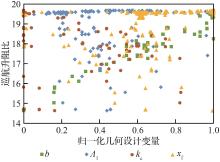
图 30
优化算例几何设计变量与巡航升阻比的关系
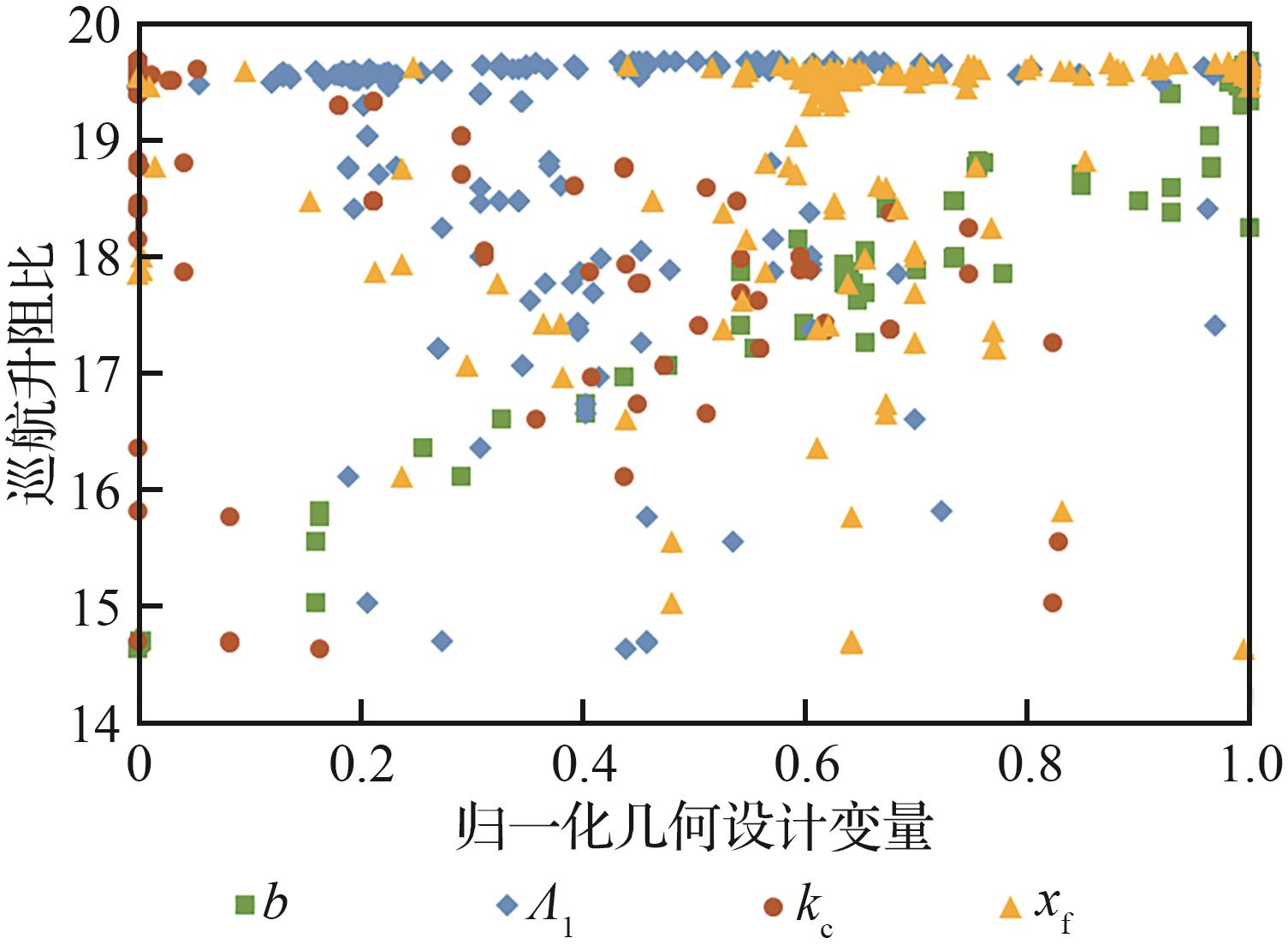
图 31
归一化几何设计变量随迭代步数的变化
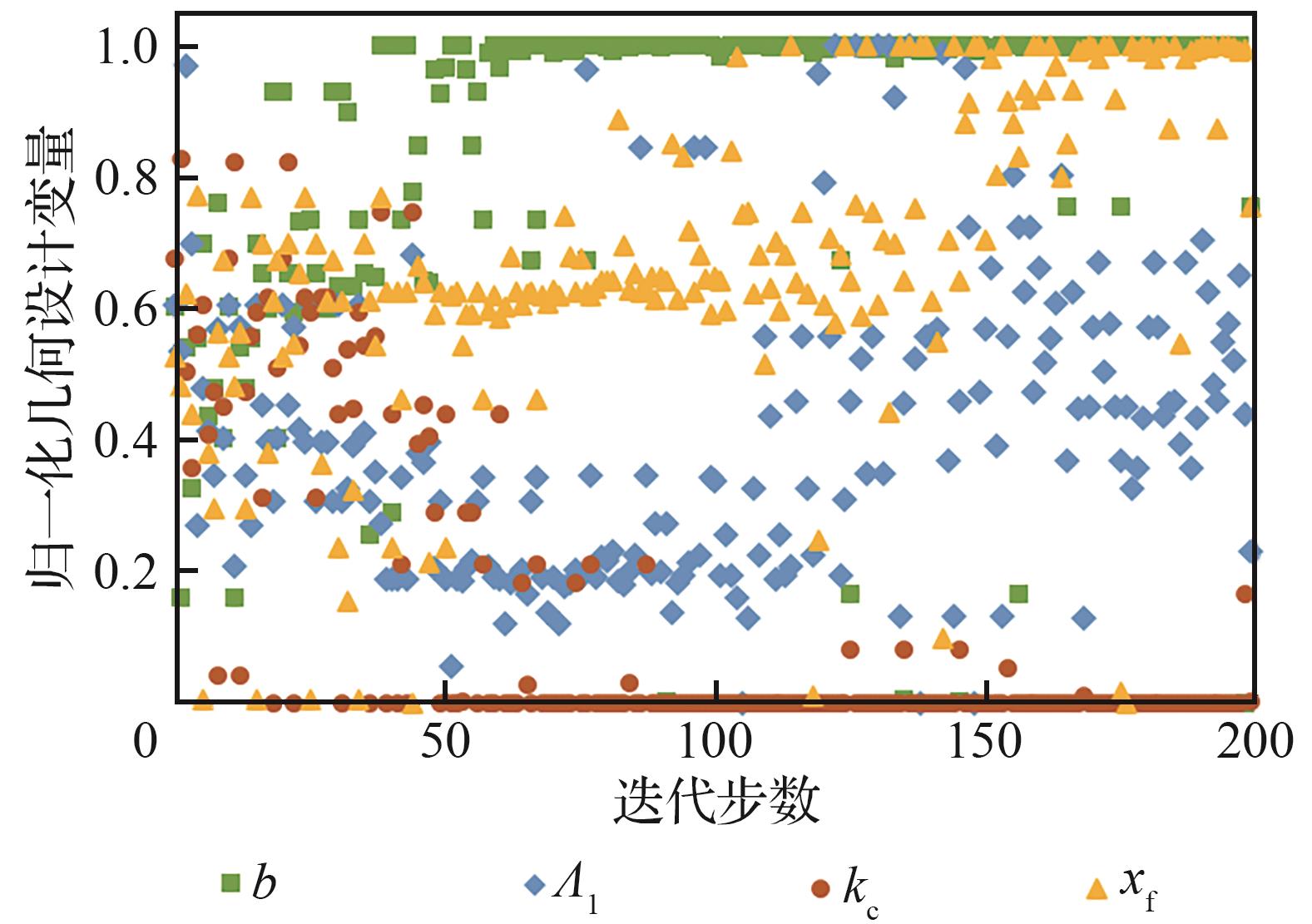
表 14
最优方案与原方案的气动参数
| 参数 | 最优方案(预测) | 最优方案(CFD) | 原方案 |
|---|---|---|---|
| CLα | 5.204 1 | 5.203 6 | 5.040 2 |
| CL0 | 0.243 5 | 0.245 4 | 0.209 2 |
| CD2 | 1.726 9 | 1.752 2 | 1.943 1 |
| CD1 | 0.111 8 | 0.112 | 0.123 5 |
| CD0 | 0.015 6 | 0.015 6 | 0.015 5 |
| Cmα | -0.358 1 | -0.356 9 | -0.588 5 |
| Cm0 | 0.030 9 | 0.029 5 | 0.051 7 |
表 15
最优方案与原方案的巡航气动参数
| 参数 | 最优方案(预测) | 最优方案(CFD) | 原方案 |
|---|---|---|---|
| CL | 0.420 | 0.422 | 0.388 |
| CD | 0.021 3 | 0.021 4 | 0.022 3 |
| Cm | 0.018 8 | 0.017 4 | 0.030 8 |
| Kcruise | 19.7 | 19.7 | 17.4 |
| α/(°) | 1.94 | 2.04 | |
| SW/m2 | 13.86 | 14.98 | |
| b/m | 10 | 8.8 | |
| Λ1/(°) | 30.5 | 31 | |
| kc | 0.3 | 0.44 | |
| xf/m | 11 | 10 |
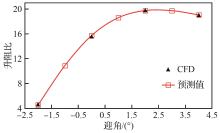
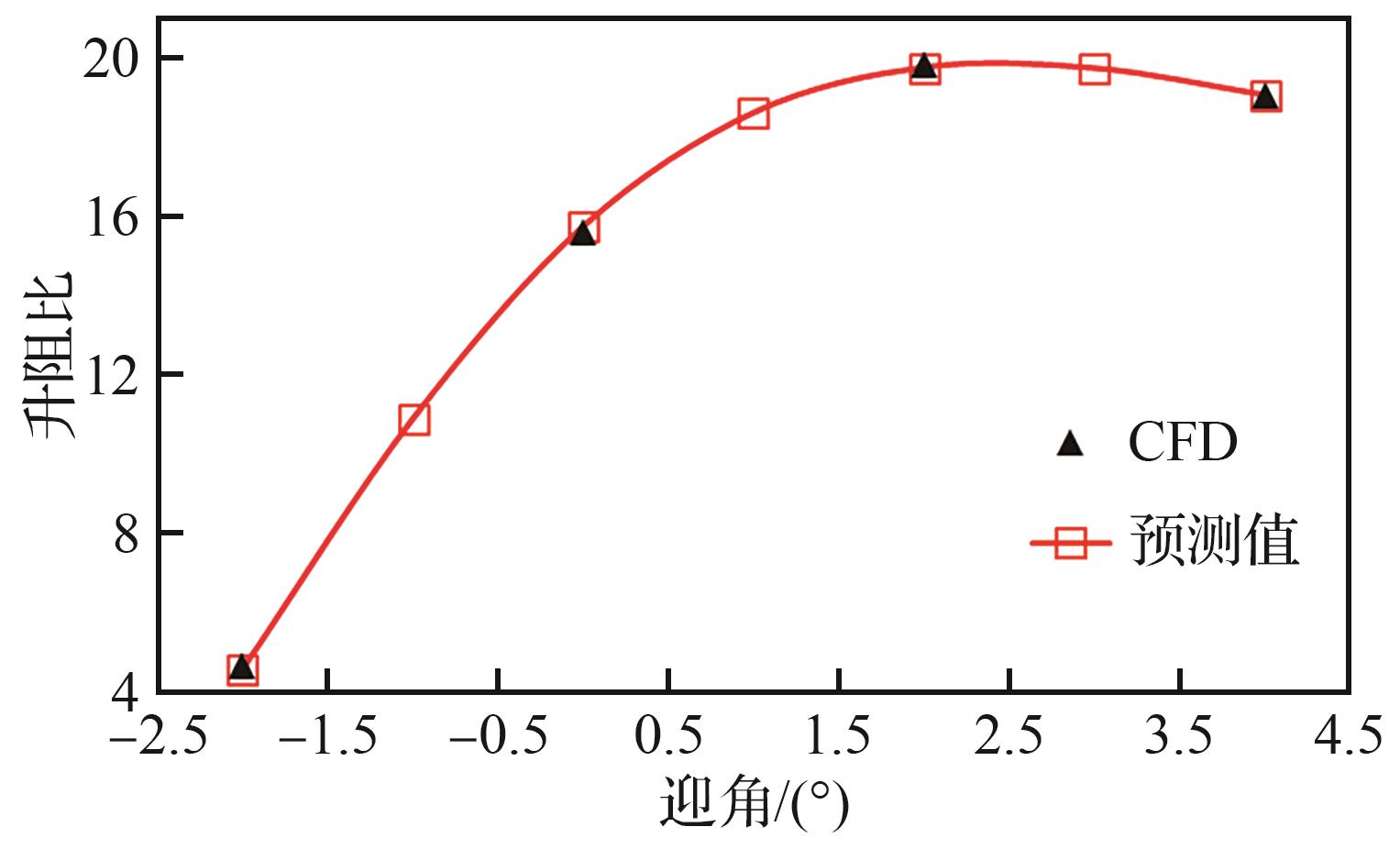
图 32
升阻比的CFD结果与MF预测结果对比
| [1] | SADRAEY M H. Aircraft design: A systems engineering approach[M]. Hoboken: John Wiley & Sons, 2013: 4-8. |
| [2] | CHEN X J, QIU Z P, WANG X J, et al. Uncertain reduced-order modeling for unsteady aerodynamics with interval parameters and its application on robust flutter boundary prediction[J]. Aerospace Science and Technology, 2017, 71: 214-230. |
| [3] | JOSHI H, THOMAS P. Review of vortex lattice method for supersonic aircraft design[J]. The Aeronautical Journal, 2023, 127(1317): 1869-1903. |
| [4] | ERICKSON L L. Panel methods: An introduction: NASA-TP-2995[R]. Washington, D.C.: NASA, 1990. |
| [5] | 李霓, 布树辉, 尚柏林, 等. 飞行器智能设计愿景与关键问题[J]. 航空学报, 2021, 42(4): 524752. |
| LI N, BU S H, SHANG B L, et al. Aircraft intelligent design: Visions and key technologies[J]. Acta Aeronautica et Astronautica Sinica, 2021, 42(4): 524752 (in Chinese). | |
| [6] | ZHANG W W, XIA M K, KOU J Q. A scientometric investigation of artificial intelligence for fluid mechanics: Emerging topics and active groups[J]. Progress in Aerospace Sciences, 2025, 157: 101130. |
| [7] | SLOTNICK J P, KHODADOUST A, ALONSO J, et al. CFD vision 2030 study: A path to revolutionary computational aerosciences: NASA/CR-2014-218178[R]. Washington, D.C.: NASA, 2014. |
| [8] | WANG S, LIU Y, ZHOU Q, et al. A multi-fidelity surrogate model based on moving least squares: Fusing different fidelity data for engineering design[J]. Structural and Multidisciplinary Optimization, 2021, 64(6): 3637-3652. |
| [9] | FORRESTER A I J, SÓBESTER A, KEANE A J. Multi-fidelity optimization via surrogate modelling[J]. Proceedings of the Royal Society A: Mathematical, Physical and Engineering Sciences, 2007, 463(2088): 3251-3269. |
| [10] | KEANE A J. Wing optimization using design of experiment, response surface, and data fusion methods[J]. Journal of Aircraft, 2003, 40(4): 741-750. |
| [11] | NAGAWKAR J, LEIFSSON L. Multifidelity aerodynamic flow field prediction using random forest-based machine learning[J]. Aerospace Science and Technology, 2022, 123: 107449. |
| [12] | ZHAO S L, ZHANG W W. Euler equation embedded machine learning method for wall pressure and skin friction distribution[J]. Engineering Applications of Computational Fluid Mechanics, 2025, 19: 2556450. |
| [13] | ZHANG X S, XIE F F, JI T W, et al. Multi-fidelity deep neural network surrogate model for aerodynamic shape optimization[J]. Computer Methods in Applied Mechanics and Engineering, 2021, 373: 113485. |
| [14] | WANG Y T, LI K P, LI Q Y, et al. Multi-fidelity information fusion with hierarchical surrogate guided by feature mapping[J]. Knowledge-Based Systems, 2023, 275: 110693. |
| [15] | 张俊杰, 黄俊, 刘志勤, 等. 基于迁移学习的变可信度气动力建模方法[J]. 实验流体力学, 2025, 39(4): 93-103. |
| ZHANG J J, HUANG J, LIU Z Q, et al. Variable fidelity aerodynamic modeling method based on transfer learning[J]. Journal of Experiments in Fluid Mechanics, 2025, 39(4): 93-103 (in Chinese). | |
| [16] | 王雨桐, 罗骁, 刘红阳, 等. 基于多保真深度神经网络的超声速客机声爆预测[J]. 航空学报, 2025, 46(20): 531936. |
| WANG Y T, LUO X, LIU H Y, et al. Sonic boom prediction of supersonic passenger aircraft based on multi-fidelity deep neural network[J]. Acta Aeronautica et Astronautica Sinica,2025,46(20):531936 (in Chinese). | |
| [17] | LE J L, YANG M T, GUO M M, et al. Progress and prospects of artificial intelligence development and applications in supersonic flow and combustion[J]. Progress in Aerospace Sciences, 2024, 151: 101046. |
| [18] | KOU J Q, ZHANG W W. Multi-fidelity modeling framework for nonlinear unsteady aerodynamics of airfoils[J]. Applied Mathematical Modelling, 2019, 76: 832-855. |
| [19] | KOU J Q, ZHANG W W. Multi-kernel neural networks for nonlinear unsteady aerodynamic reduced-order modeling[J]. Aerospace Science and Technology, 2017, 67: 309-326. |
| [20] | 王晓军. 基于大数据的风洞马赫数集成建模方法的研究[M]. 大连: 东北财经大学出版社, 2024: 40-63. |
| WANG X J. The research of ensemble methods based on big data for the Mach number prediction in wind tunnel[M]. Dalian: Dongbei University of Finance & Economics Press, 2024: 40-63 (in Chinese). | |
| [21] | ZOU Z C, XIE C C, AN C, et al. Development of accelerated CFD/CSD coupling nonlinear static aeroelastic algorithm using vortex lattice method[J]. AIAA Journal, 2025, 63(6): 2568-2573. |
| [22] | 施英杰, 刘斌超, 鲁嵩嵩, 等. 融合试验-仿真标定数据的机翼应变载荷关系神经网络模型[J]. 航空学报, 2025, 46(19): 530921. |
| SHI Y J, LIU B C, LU S S, et al. Neural network model for wing strain-load relationship based on fusion of real and virtual data[J]. Acta Aeronautica et Astronautica Sinica, 2025, 46(19): 530921 (in Chinese). | |
| [23] | WANG X, HUANG R Q, KOU J Q, et al. Goal-oriented feature extraction: A novel approach to enhance data-driven surrogate models[J]. AIAA Journal, 2026, 64(1): 303-317. |
| [24] | HAI C L, WANG J Z, GUO S M, et al. Online multi-fidelity data aggregation via hierarchical neural network[J]. Computer Methods in Applied Mechanics and Engineering, 2025, 437: 117795. |
| [25] | SUN G Y, LI G Y, GONG Z H, et al. Radial basis functional model for multi-objective sheet metal forming optimization[J]. Engineering Optimization, 2011, 43(12): 1351-1366. |
| [26] | ZHOU Q, JIANG P, SHAO X Y, et al. A variable fidelity information fusion method based on radial basis function[J]. Advanced Engineering Informatics, 2017, 32: 26-39. |
| [27] | JIN R, CHEN W, SIMPSON T W. Comparative studies of metamodelling techniques under multiple modelling criteria[J]. Structural and Multidisciplinary Optimization, 2001, 23(1): 1-13. |
| [28] | FANG H B, HORSTEMEYER M F. Global response approximation with radial basis functions[J]. Engineering Optimization, 2006, 38(4): 407-424. |
| [29] | 武泽平, 王志祥, 张为华. 数据驱动的近似建模方法及应用[M]. 北京: 国防工业出版社, 2023: 31-35. |
| WU Z P, WANG Z X, ZHANG W H. Data-driven metamodeling methods and applications[M]. Beijing: National Defense Industry Press, 2023: 31-35 (in Chinese). | |
| [30] | SONG L, YANG H, XIE J F, et al. Method for improving the natural lateral-directional stability of flying wings[J]. Journal of Aerospace Engineering, 2016, 29(5): 06016003. |
| [31] | 宋磊. 涡格法计算软件VLM513[EB/OL]. (2018-08-01)[2026-01-14]. . |
| SONG L. Vortex-lattice method calculation software VLM513[EB/OL]. (2018-08-01)[2026-01-14]. (in Chinese). | |
| [32] | RAYMER D P. Aircraft design: A conceptual approach[M]. Reston: AIAA, 1989: 280-282. |
| [33] | CHN-F 1飞翼亚跨声速标模[EB/OL]. 国家空间科学数据中心. [2026-01-14]. . |
| CHN-F1 flying wing subsonic scale module data[EB/OL]. National Space Science Data Center. [2026-01-14]. (in Chinese). |
| [1] | 赵良瑾, 仝昊楠, 苑子杨, 李昀镀, 张晓典, 成培瑞. 无人机集群的干扰管理:机理、技术与挑战[J]. 航空学报, 2025, 46(23): 632022-632022. |
| [2] | 安朝, 霍贵玺, 孟杨, 谢长川, 杨超. 翼尖铰接组合式无人机气动建模方法及布局参数影响[J]. 航空学报, 2024, 45(6): 629587-629587. |
| [3] | 王科雷, 周洲, 祝小平. 耦合多螺旋桨滑流影响的低雷诺数机翼设计[J]. 航空学报, 2017, 38(6): 120813-120813. |
| [4] | 贺红林;周翔. 柔性扑翼非定常涡格法气动计算的改进与实现[J]. 航空学报, 2010, 31(6): 1121-1126. |
| [5] | 刘燕斌;陆宇平. 非线性自适应控制在无尾飞控系统中的应用[J]. 航空学报, 2006, 27(5): 903-907. |
| [6] | 吉州;尹协远. 非定常前侧缘分离流的研究[J]. 航空学报, 1995, 16(6): 641-646. |
| [7] | 陈明岩. 壁压法在非矩形风洞中的应用[J]. 航空学报, 1988, 10(10): 499-501. |
| 阅读次数 | ||||||
|
全文 |
|
|||||
|
摘要 |
|
|||||
版权所有 © 航空学报编辑部
版权所有 © 2011航空学报杂志社
主管单位:中国科学技术协会 主办单位:中国航空学会 北京航空航天大学

 CJA

