张俊1( ), 蒋亦凡1, 陈松2, 李帅辉3
收稿日期:2023-10-30
修回日期:2023-11-17
接受日期:2023-12-05
出版日期:2024-11-15
发布日期:2023-12-18
通讯作者:
张俊
E-mail:jun.zhang@buaa.edu.cn
基金资助:
Jun ZHANG1(), Yifan JIANG1, Song CHEN2, Shuaihui LI3
Received:2023-10-30
Revised:2023-11-17
Accepted:2023-12-05
Online:2024-11-15
Published:2023-12-18
Contact:
Jun ZHANG
E-mail:jun.zhang@buaa.edu.cn
Supported by:摘要:
超低地球轨道(VLEO)卫星相较于传统卫星,在对地观测分辨率、数据传输速度、通信容量等方面具有显著优势,近年来成为空间技术领域的研究热点。在超低轨道环境下,大气分子与卫星表面之间碰撞所引起的大气阻力不可忽略,成为影响卫星姿态控制、轨道预测、使用寿命的关键因素。从卫星气动阻力的基本原理出发,讨论了决定气动阻力的主要因素,重点关注阻力系数的计算分析。超低地球轨道环境下的气体流动属于自由分子流,气体分子之间的碰撞可以忽略不计,气体分子与卫星表面之间的气固相互作用模型对阻力系数的评估至关重要。总结、评估了自由分子流领域的基本特性、常用计算方法,重点综述了典型的气固相互作用模型;基于超低轨卫星气动阻力特性的计算分析,着重从增大长细比、外形优化、侧面光滑3个方面对卫星减阻构型设计的研究进展进行了综述分析;对该领域未来需重点关注的关键问题进行了展望。
中图分类号:
张俊, 蒋亦凡, 陈松, 李帅辉. 超低轨卫星气动阻力计算与减阻设计研究综述[J]. 航空学报, 2024, 45(21): 29796.
Jun ZHANG, Yifan JIANG, Song CHEN, Shuaihui LI. Overview of aerodynamic drag calculation and reduction design for very low Earth orbit satellites[J]. Acta Aeronautica et Astronautica Sinica, 2024, 45(21): 29796.

图 1
典型超低轨道卫星


图 2
NRLMSISE-00模型计算的大气密度、组分随太阳活动水平、轨道高度变化的情况[2]


图 3
4颗紧凑形状低轨卫星的阻力系数[38]


图 4
超低轨卫星气动阻力示意图


图 5
不同 Kn 下的流场及控制方程


图 6
NRLMSISE-00模型计算的在不同太阳活动水平下Kn随高度变化情况(特征长度取1 m)


图 7
极高热力学流动与低热力学流动示意图


图 8
自由分子流气动力数值计算方法的比较[28]

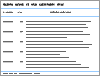
表 1
自由分子流数值计算方法特点
| 方法 | Panel | RTP | TPMC | DSMC |
|---|---|---|---|---|
| 分子与物面碰撞 | √ | √ | √ | √ |
| 分子间碰撞 | √ | |||
| 表面遮挡 | √ | √ | √ | |
| 多次反射 | √ | √ | √ | |
| 计算效率 | 高 | 高 | 较高 | 低 |

图 9
镜面反射、漫反射、Maxwell模型示意图


图 10
CLL模型示意图


图 11
超低轨卫星气动阻力特性研究框架

表 2
超低轨道卫星外形优化研究总结
| 研究 | Park等[ | Walsh和 Berthoud[ | Yu和Fan[ | Walsh等[ | Hild等[ |
|---|---|---|---|---|---|
| 头部形状优化 | √ | √ | √ | √ | √ |
| 尾部形状优化 | √ | √ | √ | ||
| 固定体积 | √ | ||||
| 轨道高度/km | 200,300 | 250 | 200 | 200 | 350 |
| 年份 | 2014 | 2017 | 2020 | 2021 | 2022 |

图 12
卫星头部形状优化示例[93]


图 13
圆柱体卫星头部形状优化构型[91]


图 14
不同长细比卫星对应的帕累托最优前沿示意图(据文献[95]修改)

表 3
超长细比为1∶2、1∶6的卫星在帕累托最优前沿不同点的最佳构型[95]
| 1∶2 shape | Volume | CD | 1∶6 shape | Volume | CD | ||||
|---|---|---|---|---|---|---|---|---|---|
| Value/m3 | Precentage reduction/% | Value | Precentage reduction/% | Value/m3 | Precentage reduction/% | Value | Precentage reduction/% | ||
 | 0.50 | 0 | 2.446 | 0 |  | 0.38 | 0 | 2.954 | 0 |
| 0.45 | 10 | 2.168 | 11.4 | 0.34 | 10 | 2.480 | 16.0 | ||
| 0.40 | 20 | 2.060 | 15.8 | 0.30 | 20 | 2.269 | 23.2 | ||
| 0.35 | 30 | 1.992 | 18.6 | 0.26 | 30 | 2.114 | 28.4 | ||
| 0.30 | 40 | 1.945 | 20.5 | 0.23 | 40 | 1.985 | 32.8 | ||
| 0.25 | 50 | 1.926 | 21.2 | 0.19 | 50 | 1.933 | 34.6 | ||

图 15
不同表面适应系数对应的最佳卫星构型[96]


图 16
简化的超低轨道卫星示意图[79]


图 17
不同轨道高度下光滑处理后卫星阻力系数[79]


图 18
应用增大长细比、侧面光滑减阻2种策略的正棱柱卫星的气动阻力[79]

| 1 | ASLANOV V S. Chaotic attitude dynamics of a LEO satellite with flexible panels[J]. Acta Astronautica, 2021, 180: 538-544. |
| 2 | CRISP N H, ROBERTS P C E, ROMANO F, et al. System modelling of very low Earth orbit satellites for Earth observation[J]. Acta Astronautica, 2021, 187: 475-491. |
| 3 | MCCREARY L. A satellite mission concept for high drag environments[J]. Aerospace Science and Technology, 2019, 92: 972-989. |
| 4 | LLOP J V, ROBERTS P C E, HAO Z, et al. Very low earth orbit mission concepts for earth observation: Benefits and challenges[C]∥Reinventing Space Conference 2014. Reston: AIAA, 2014. |
| 5 | LIVADIOTTI S, CRISP N H, ROBERTS P C E, et al. A review of gas-surface interaction models for orbital aerodynamics applications[J]. Progress in Aerospace Sciences, 2020, 119: 100675. |
| 6 | HAIGH S J, LYONS R E, OIKO V T A, et al. Discoverer-radical redesign of earth observation satellites for sustained operation at significantly lower altitudes[C]∥Proceedings of the International Astronautical Congress. Pairs: Discoverer Publications, 2017, 68: 9254-9262. |
| 7 | ZHANG S Y, YANG J Y, LI C, et al. Mechanism of capture section affecting an intake for atmosphere-breathing electric propulsion[J]. Chinese Journal of Aeronautics, 2024, 37(1): 51-63. |
| 8 | ROBERTS P, CRISP N, OIKO V T A, et al. Keynote: DISCOVERER-Making commercial satellite operations in very low earth orbit a reality[C]∥70th International Astronautical Congress. Pairs: IAF, 2019. |
| 9 | CRISP N H, ROBERTS P C E, LIVADIOTTI S, et al. The benefits of very low earth orbit for earth observation missions[J]. Progress in Aerospace Sciences, 2020, 117: 100619. |
| 10 | HU Y D, LU Z L, LING K V, et al. Multiplexed MPC attitude control of a moving mass satellite using dual-rate piecewise affine model[J]. Aerospace Science and Technology, 2022, 128: 107778. |
| 11 | ROBERTS P C E, CRISP N H, OIKO V T A, et al. DISCOVERER-Making Commercial Satellite Operations in Very Low Earth Orbit a Reality[C]∥70th International Astronautical Congress. Washington, D.C.: IAF, 2019. |
| 12 | SHAO A, WERTZ J R, KOLTZ E A. Quantifying the cost reduction potential for earth observation satellites[C]∥HATTON S. Proceedings of the 12th Reinventing Space Conference. Cham: Springer, 2017: 199-210. |
| 13 | 魏德宾, 操昱, 杨力, 等. 一种基于时空等级的LEO卫星网络路由策略[J]. 航空学报, 2023, 44(16): 327994. |
| WEI D B, CAO Y, YANG L, et al. A routing strategy for LEO satellite network based on space-time-level[J]. Acta Aeronautica et Astronautica Sinica, 2023, 44(16): 327994 (in Chinese). | |
| 14 | WOOD M, CHEN W H. Attitude control of magnetically actuated satellites with an uneven inertia distribution[J]. Aerospace Science and Technology, 2013, 25(1): 29-39. |
| 15 | 何慧东. 日本 “超低轨道技术试验卫星” 任务及应用[J]. 国际太空, 2018(9): 50-53. |
| HE H D. Japan’s super low altitude test satellite mission and application[J]. Space International, 2018(9): 50-53 (in Chinese). | |
| 16 | CRISP N H, ROBERTS P C E, LIVADIOTTI S, et al. In-orbit aerodynamic coefficient measurements using SOAR (Satellite for Orbital Aerodynamics Research)[J]. Acta Astronautica, 2021, 180: 85-99. |
| 17 | OLIVEIRA D M, ZESTA E, MEHTA P M, et al. The current state and future directions of modeling thermosphere density enhancements during extreme magnetic storms[J]. Frontiers in Astronomy and Space Sciences, 2021, 8: 764144. |
| 18 | 雷亚珂, 张楠, 高铭阳, 等. SLATS超低轨卫星飞行任务及启示[C]∥第八届中国(国际)商业航天高峰论坛. 北京: 中国宇航学会, 2022: 16-22. |
| LEI Y K, ZHANG N, GAO M Y, et al. Very low Earth orbit satellite SLATS mission and its inspiration[C]∥Proceedings of the 8th China (International) Commercial Space Forum. Beijing: Chinese Society of Astronautic, 2022: 16-22 (in Chinese). | |
| 19 | 王娟. “长二丁” 一箭三星成功发射世界首颗量子科学实验卫星[J]. 中国航天, 2016(9): 13. |
| WANG J. “Changerding”has successfully launched the world’s first quantum science experiment satellite with three stars[J]. Aerospace China, 2016(9): 13 (in Chinese). | |
| 20 | FEARN D G. Economical remote sensing from a low altitude with continuous drag compensation[J]. Acta Astronautica, 2005, 56(5): 555-572. |
| 21 | ROMANO F, ESPINOSA-OROZCO J, PFEIFFER M, et al. Intake design for an Atmosphere-Breathing Electric Propulsion System (ABEP)[J]. Acta Astronautica, 2021, 187: 225-235. |
| 22 | HE C Y, YANG Y, CARTER B, et al. Review and comparison of empirical thermospheric mass density models[J]. Progress in Aerospace Sciences, 2018, 103: 31-51. |
| 23 | CALABIA A, JIN S G. Assessment of conservative force models from GRACE accelerometers and precise orbit determination[J]. Aerospace Science and Technology, 2016, 49: 80-87. |
| 24 | AVANZINI G, DE ANGELIS E L, GIULIETTI F. Two-timescale magnetic attitude control of Low-Earth-Orbit spacecraft[J]. Aerospace Science and Technology, 2021, 116: 106884. |
| 25 | WANG E Y, QIU S, LIU M, et al. Event-triggered adaptive terminal sliding mode tracking control for drag-free spacecraft inner-formation with full state constraints[J]. Aerospace Science and Technology, 2022, 124: 107524. |
| 26 | GUILHERME M S, LEITE FILHO W C, THEIL S. Strategies for in-orbit calibration of drag-free control systems[J]. Aerospace Science and Technology, 2008, 12(5): 365-375. |
| 27 | JIN X H, HUANG F, CHENG X L, et al. Monte Carlo simulation for aerodynamic coefficients of satellites in Low-Earth Orbit[J]. Acta Astronautica, 2019, 160: 222-229. |
| 28 | MOSTAZA PRIETO D, GRAZIANO B P, ROBERTS P C E. Spacecraft drag modelling[J]. Progress in Aerospace Sciences, 2014, 64: 56-65. |
| 29 | LI Z H, PENG A P, MA Q, et al. Gas-kinetic unified algorithm for computable modeling of Boltzmann equation and application to aerothermodynamics for falling disintegration of uncontrolled Tiangong-No.1 spacecraft[J]. Advances in Aerodynamics, 2019, 1(1): 4. |
| 30 | QU Q Y, XU M, LUO T. Design concept for In-Drag Sail with individually controllable elements[J]. Aerospace Science and Technology, 2019, 89: 382-391. |
| 31 | VALLADO D A, FINKLEMAN D. A critical assessment of satellite drag and atmospheric density modeling[J]. Acta Astronautica, 2014, 95: 141-165. |
| 32 | ANDREUSSI T, FERRATO E, GIANNETTI V. A review of air-breathing electric propulsion: from mission studies to technology verification[J]. Journal of Electric Propulsion, 2022, 1(1): 31. |
| 33 | MARCOS F, BURKE W, LAI S. Thermospheric space weather modeling[C]∥Proceedings of the 38th Plasmadynamics and Lasers Conference. Reston: AIAA, 2007. |
| 34 | MARCOS F, BOWMAN B, SHEEHAN R. Accuracy of earth’s thermospheric neutral density models[C]∥AIAA/AAS Astrodynamics Specialist Conference and Exhibit. Reston: AIAA, 2006. |
| 35 | DOORNBOS E, KLINKRAD H. Modelling of space weather effects on satellite drag[J]. Advances in Space Research, 2006, 37(6): 1229-1239. |
| 36 | MOE K, MOE M M. Gas-surface interactions in low-earth orbit[C]∥AIP Conference Proceedings. Melville: AIP, 2011, 1333: 1313-1318. |
| 37 | COOK G E. Satellite drag coefficients[J]. Planetary and Space Science, 1965, 13(10): 929-946. |
| 38 | MOE K, MOE M M. Gas-surface interactions and satellite drag coefficients[J]. Planetary and Space Science, 2005, 53(8): 793-801. |
| 39 | DAVID M P. Characterisation and applications of aerodynamic torques on satellites[D]. Manchester: University of Manchester, 2017 |
| 40 | JOSEP V L. Spacecraft flight in the atmosphere[D]. Cranfield: Cranfield University, 2014. |
| 41 | STORCH J A. Aerodynamic disturbances on spacecraft in free-molecular flow: SMC-TR-03-06[R]. El Segundo: The Aerospace Corporation, 2002. |
| 42 | BIRD G A. Collisionless flows[M]∥Molecular Gas Dynamics and the Direct Simulation of Gas Flows. Oxford: Oxford University Press, 1994: 148-182. |
| 43 | ZHENG P, WU J J, ZHANG Y, et al. An atmosphere-breathing propulsion system using inductively coupled plasma source[J]. Chinese Journal of Aeronautics, 2023, 36(5): 223-238. |
| 44 | TISAEV M, FERRATO E, GIANNETTI V, et al. Air-breathing electric propulsion: Flight envelope identification and development of control for long-term orbital stability[J]. Acta Astronautica, 2022, 191: 374-393. |
| 45 | SENTMAN L H. Comparison of the exact and approximate methods for predicting free molecule aerodynamic coefficients[J]. ARS Journal, 1961, 31(11): 1576-1579. |
| 46 | SENTMAN L H. Free molecule flow theory and its application to the determination of aerodynamic forces[M]. Sunnyvale: Lockheed Missiles & Space Company, 1961. |
| 47 | CHAMBRE P A, SCHAAF S A. Flow of rarefied gases[M]. Princeton: Princeton University Press, 1961. |
| 48 | 沈青. 稀薄气体动力学[M]. 北京: 国防工业出版社, 2003: 148-50. |
| SHEN Q. Rarefied gas dynamics[M]. Beijing: National Defense Industry Press, 2003: 148-150 (in Chinese). | |
| 49 | FULLER J D, TOLSON R H. Improved method for the estimation of spacecraft free-molecular aerodynamic properties[J]. Journal of Spacecraft and Rockets, 2009, 46(5): 938-948. |
| 50 | FULLER J, TOLSON R. Program for the estimation of spacecraft aerodynamic properties[C]∥47th AIAA Aerospace Sciences Meeting including The New Horizons Forum and Aerospace Exposition. Reston: AIAA, 2009:728. |
| 51 | REGAN F J, ANANDAKRISHNAN S M. Dynamics of Atmospheric re-Entry[M]. Reston: AIAA Inc., 1993. |
| 52 | GRAZIANO BENJAMIN P. Computational modelling of aerodynamic disturbances on spacecraft within a concurrent engineering framework[D]. Cranfield: Cranfield University, 2007. |
| 53 | DAVIS D H. Monte Carlo calculation of molecular flow rates through a cylindrical elbow and pipes of other shapes[J]. Journal of Applied Physics, 1960, 31(7): 1169-1176. |
| 54 | TUER T W, SPRINGER G S. A test particle Monte Carlo method[J]. Computers & Fluids, 1973, 1(4): 399-417. |
| 55 | 靳旭红, 黄飞, 程晓丽, 等. 超低轨航天器气动特性快速预测的试验粒子Monte Carlo方法 [J].航空学报, 2017, 38(5): 120625. |
| JIN X H, HUANG F, CHENG X L, et al. Test particle Monte Carlo method for rapid prediction of aerodynamic properties of spacecraft in lower LEO [J].Acta Aeronautica et Astronautica Sinica, 2017, 38(5): 120625 (in Chinese). | |
| 56 | BIRD G A. Monte Carlo simulation of gas flows[J]. Annual Review of Fluid Mechanics, 1978, 10: 11-31. |
| 57 | BIRD G A. Molecular gas dynamics [R]. Washington, D.C.: NASA, 1976. |
| 58 | BIRD G A. Forty years of DSMC, and now?[C]∥AIP Conference Proceedings. College Park: AIP, 2001, 585: 372-380. |
| 59 | PLIMPTON S J, MOORE S G, BORNER A, et al. Direct simulation Monte Carlo on petaflop supercomputers and beyond[J]. Physics of Fluids, 2019, 31(8): 086101. |
| 60 | PALHARINI R C. Atmospheric reentry modelling using an open-source DSMC code[D]. Strathclyde: University Of Strathclyde, 2014. |
| 61 | 黄飞, 沈清, 程晓丽, 等. 一种DSMC分子仿真下的权因子预定义方法[J]. 航空学报, 2014, 35(8): 2174-2181. |
| HUANG F, SHEN Q, CHENG X L, et al. A new predefined method of particle weight in DSMC molecular simulation[J]. Acta Aeronautica et Astronautica Sinica, 2014, 35(8): 2174-2181 (in Chinese). | |
| 62 | MUNGIGUERRA S, ZUPPARDI G, SAVINO R. Rarefied aerodynamics of a deployable re-entry capsule[J]. Aerospace Science and Technology, 2017, 69: 395-403. |
| 63 | VOTTA R, SCHETTINO A, BONFIGLIOLI A. Hypersonic high altitude aerothermodynamics of a space re-entry vehicle[J]. Aerospace Science and Technology, 2013, 25(1): 253-265. |
| 64 | ANDREWS S, BERTHOUD L. Characterising satellite aerodynamics in Very Low Earth Orbit inclusive of ion thruster plume-thermosphere/ionosphere interactions[J]. Acta Astronautica, 2020, 170: 386-396. |
| 65 | MA Q H, YANG C X, BRUNO D, et al. Molecular simulation of Rayleigh-Brillouin scattering in binary gas mixtures and extraction of the rotational relaxation numbers[J]. Physical Review E, 2021, 104(3): 035109. |
| 66 | LIU W B, ZHANG J B, JIANG Y Z, et al. DSMC study of hypersonic rarefied flow using the Cercignani-Lampis-Lord model and a molecular-dynamics-based scattering database[J]. Physics of Fluids, 2021, 33(7): 072003. |
| 67 | DENG J C, ZHANG J, LIANG T F, et al. A modified Cercignani-Lampis model with independent momentum and thermal accommodation coefficients for gas molecules scattering on surfaces[J]. Physics of Fluids, 2022, 34(10): 107108. |
| 68 | ANDRIC N, JENNY P. Molecular dynamics investigation of energy transfer during gas-surface collisions[J]. Physics of Fluids, 2018, 30(7): 077104. |
| 69 | REINHOLD J, VELTZKE T, WELLS B, et al. Molecular dynamics simulations on scattering of single Ar, N2, and CO2 molecules on realistic surfaces[J]. Computers & Fluids, 2014, 97: 31-39. |
| 70 | KNUDSEN M. Die molekulare Wärmeleitung der gase und der akkommodationskoeffizient[J]. Annalen Der Physik, 1911, 339(4): 593-656. |
| 71 | MAXWELL J C. On stresses in rarified gases arising from inequalities of temperature[J]. Philosophical Transactions of the Royal Society of London Series I, 1879, 170: 231-256. |
| 72 | ZHANG J, LUAN P, DENG J C, et al. Theoretical derivation of slip boundary conditions for single-species gas and binary gas mixture[J]. Physical Review E, 2021, 104(5): 055103. |
| 73 | CERCIGNANI C, LAMPIS M. Kinetic models for gas-surface interactions[J]. Transport Theory and Statistical Physics, 1971, 1(2): 101-114. |
| 74 | LORD R G. Some further extensions of the Cercignani-Lampis gas-surface interaction model[J]. Physics of Fluids, 1995, 7(5): 1159-1161. |
| 75 | LORD R G. Application of the Cercignani-Lampis scattering kernel to direct simulation Monte Carlo calculations[C]∥Rarefied Gas Dynamics: Proceedings of the 17th International Symposium on Rarefied Gas Dynamics, 1990. Washington, D.C.: NASA/ADS, 1991: 1427-1433. |
| 76 | LORD R G. Some extensions to the Cercignani-Lampis gas-surface scattering kernel[J]. Physics of Fluids A: Fluid Dynamics, 1991, 3(4): 706-710. |
| 77 | WALKER A, MEHTA P, KOLLER J. Drag coefficient model using the cercignani-lampis-lord gas-surface interaction model[J]. Journal of Spacecraft and Rockets, 2014, 51(5): 1544-1563. |
| 78 | LIANG T F, NIE K Y, LI Q, et al. Advanced analytical model for orbital aerodynamic prediction in LEO[J]. Advances in Space Research, 2023, 71(1): 507-524. |
| 79 | JIANG Y F, ZHANG J, TIAN P, et al. Aerodynamic drag analysis and reduction strategy for satellites in Very Low Earth Orbit[J]. Aerospace Science and Technology, 2023, 132: 108077. |
| 80 | 李志辉, 吴俊林, 彭傲平, 等. 天宫飞行器低轨控空气动力特性一体化建模与计算研究[J]. 载人航天, 2015, 21(2): 106-114. |
| LI Z H, WU J L, PENG A P, et al. Unified modeling and calculation of aerodynamics characteristics during low-orbit flying control of the TG vehicle[J]. Manned Spaceflight, 2015, 21(2): 106-114 (in Chinese). | |
| 81 | 靳旭红, 黄飞, 程晓丽, 等. 超低地球轨道卫星大气阻力预测与影响因素分析 [J].清华大学学报(自然科学版), 2020, 60(3): 219-226. |
| JIN X H, HUANG F, CHENG X L, et al. Atmospheric drag on satellites flying in lower low-earth orbit [J].Journal of Tsinghua University, 2020, 60(3): 219-226 (in Chinese). | |
| 82 | 王晓亮, 姚小松, 高爽, 等. 超低轨卫星气动阻力特性[J]. 上海交通大学学报, 2022, 56(8): 1089-1100. |
| WANG X L, YAO X S, GAO S, et al. Aerodynamic drag characteristics of ultra-low orbit satellites[J]. Journal of Shanghai Jiao Tong University, 2022, 56(8): 1089-1100 (in Chinese). | |
| 83 | KOPPENWALLNER G. Satellite aerodynamics and determination of thermospheric density and wind[C]∥AIP Conference Proceedings. College Park: AIP, 2011: 1307-12.10.1063/1.3562824. |
| 84 | JIN X H, CHENG X L, WANG B, et al. Predict aerodynamic drag of spacecraft in Very Low Earth Orbit using different gas-surface interaction models[J]. Aerospace China, 2021, 22(4): 35-41. |
| 85 | 胡凌云, 张立华, 程晓丽, 等. 超低轨航天器气动设计与计算方法探讨[J]. 航天器工程, 2016, 25(1): 10-18. |
| HU L Y, ZHANG L H, CHENG X L, et al. Method of aerodynamic design and calculation for ultra-LEO spacecraft[J]. Spacecraft Engineering, 2016, 25(1): 10-18 (in Chinese). | |
| 86 | MARCH G, DOORNBOS E N, VISSER P N A M. High-fidelity geometry models for improving the consistency of CHAMP, GRACE, GOCE and Swarm thermospheric density data sets[J]. Advances in Space Research, 2019, 63(1): 213-238. |
| 87 | MARÍN C A, SEBASTIÃO I B, TAMRAZIAN S, et al. DSMC-SPARTA aerodynamic characterization of a deorbiting CubeSat[C]∥AIP Conference Proceedings-31st International Symposium on Rarefied Gas Dynamics: RGD31. College Park: AIP Publishing, 2019, 2132(1): 070024. |
| 88 | 郭晨林, 陈方, 赵艳彬, 等. 跨流区超低轨航天器快速气动力计算方法[J].上海航天(中英文), 2022, 39(5): 124-33. |
| GUO C L, CHEN F, ZHAO Y B, et al. Fast aerodynamic calculation method for ultra-low orbit spacecrafts in multi-flow regions[J].Aerospace Shanghai, 2022, 39(5): 124-33 (in Chinese). | |
| 89 | 黄飞, 赵波, 程晓丽, 等. 低轨卫星的气动特性预测与分析[J]. 空间科学学报, 2015, 35(1): 69-76. |
| HUANG F, ZHAO B, CHENG X L, et al. Numerical investigation of aerodynamics on low earth orbit satellite[J]. Chinese Journal of Space Science, 2015, 35(1): 69-76 (in Chinese). | |
| 90 | FUJITA K, NODA A. Rarefied aerodynamics of a super low altitude test satellite[C]∥41st AIAA Thermophysics Conference. Reston: AIAA, 2009: 3606. |
| 91 | YU S T, FAN C Z. Aerodynamic analysis and drag-reduction design for ultra-low-orbit satellite[J]. IOP Conference Series: Materials Science and Engineering, 2020, 887(1): 012013. |
| 92 | 周伟勇, 张育林, 刘昆. 超低轨航天器气动力分析与减阻设计[J]. 宇航学报, 2010, 31(2): 342-348. |
| ZHOU W Y, ZHANG Y L, LIU K. Aerodynamics analysis and reduced drag design for the lower LEO spacecraft[J]. Journal of Astronautics, 2010, 31(2): 342-348 (in Chinese). | |
| 93 | PARK J H, MYONG R S, KIM D H, et al. Aerodynamic shape optimization of space vehicle in very-low-earth-orbit[C]∥Proceedings of the 29th International Symposium on Rarefied Gas Dynamics. College Park: AIP Publishing, 2014, 1628(1): 1331-1336. |
| 94 | WALSH J A, BERTHOUD L. Reducing spacecraft drag in Very Low Earth Orbit through shape optimisation[C]∥7th European Conference for Aeronautics and Aerospace Sciences. 2017. |
| 95 | WALSH J, BERTHOUD L, ALLEN C. Drag reduction through shape optimisation for satellites in Very Low Earth Orbit[J]. Acta Astronautica, 2021, 179: 105-121. |
| 96 | HILD F, TRAUB C, PFEIFFER M, et al. Optimisation of satellite geometries in Very Low Earth Orbits for drag minimisation and lifetime extension[J]. Acta Astronautica, 2022, 201: 340-352. |
| 97 | 胡鑫, 傅丹膺, 陈罗婧. 超低轨道细长体卫星减阻分析[C]∥北京力学会第21届学术年会暨北京振动工程学会第22届学术年会论文集. 北京: 北京力学会, 2015: 190-197. |
| HU X, FU D Y, CHEN L J. Drag reduction analysis of very-low orbit slender body satellite[C]∥Proceedings of the 21st Academic Annual Meeting of Beijing Society of Mechanics and Dynamics and the 22nd Academic Annual Meeting of Beijing Society of Vibration Engineering. Beijing: Beijing Society of Mechanics and Dynamics, 2015: 190-7 (in Chinese). | |
| 98 | 靳旭红, 黄飞, 程晓丽, 等. 内外流一体化航天器气动特性分析与减阻设计[J]. 宇航学报, 2017, 38(1): 10-17. |
| JIN X H, HUANG F, CHENG X L, et al. Analysis of aerodynamic properties and drag-reduction design for spacecraft with an open orifice [J].Journal of Astronautics, 2017, 38(1): 10-17 (in Chinese). | |
| 99 | 沈清, 黄飞, 程晓丽, 等. 飞行器上层大气层空气动力特性探讨 [J]. 气体物理, 2021, 6(1): 1-9. |
| SHEN Q, HUANG F, CHENG X L, et al. On characteristics of upper atmosphere aerodynamics of flying vehicles[J]. Physics of Gases, 2021, 6(1): 1-9 (in Chinese). |
| [1] | 苏鹏辉, 刘奕豪, 靳旭红, 程晓丽. 吸气式电推进系统进气道性能数值研究与可行性分析[J]. 航空学报, 2025, 46(16): 131569-131569. |
| [2] | 靳旭红, 黄飞, 张俊, 王学德, 程晓丽, 沈清. 上层大气层飞行器研究进展及气动技术挑战[J]. 航空学报, 2024, 45(22): 30254-030254. |
| [3] | 宁铠, 吴宝林. 基于事件驱动的航天器星下点轨迹维持控制[J]. 航空学报, 2024, 45(10): 329412-329412. |
| [4] | 靳旭红, 黄飞, 程晓丽, 苏鹏辉. Maxwell气固相互作用模型对稀薄高超声速凹腔绕流流动特征和热环境的影响[J]. 航空学报, 2021, 42(3): 124118-124118. |
| 阅读次数 | ||||||
|
全文 |
|
|||||
|
摘要 |
|
|||||
版权所有 © 航空学报编辑部
版权所有 © 2011航空学报杂志社
主管单位:中国科学技术协会 主办单位:中国航空学会 北京航空航天大学

 CJA
CJA
