

 CJA

无线通信网络的安全与隐私保护,是现代信息社会赖以稳定运行的重要基石,也是6G系统向空天地一体化演进过程中难以回避的关键挑战[1]。为突破传统地面网络的覆盖局限,未来6G将深度融合卫星与空中平台,旨在构建全域覆盖、多域协同的立体连接网络架构[2]。然而,网络拓扑的高度动态性与无线信道的广播特性,使得通信链路,尤其是由地面至空中的上行传输,面临前所未有的安全威胁[3]。在指令上注、应急救援等敏感场景中,确保上行信息不被非法截获,具有至关重要的战略意义。
为应对上述挑战,不依赖于高复杂度加密算法的物理层安全技术,因其与生俱来的抗量子计算攻击潜力,近年来一直备受关注[4]。其中,利用无人机(Unmanned Aerial Vehicle, UAV)作为空中灵活节点以增强通信安全的范式,已成为一项重要研究内容。现有工作主要围绕两大路径展开:① 将UAV作为合法中继,通过优化其轨迹来规避窃听者,从而提升合法链路信道质量[5-11]。例如,在不确定信道条件下联合优化UAV轨迹与多节点波束成形以最大化最坏情况的安全速率[5];建立双层Stackelberg博弈以激励UAV间协作并抵抗复合攻击[10];为大规模天线中继设计高效传输方案并推导UAV辅助的安全容量闭式表达式[6];或通过系统建模对比验证UAV“空中桥梁”相对于传统方案的效能优势[7]。② 将UAV作为主动干扰源,通过发射人工噪声来动态压制窃听者接收效果[12-16]。例如,利用数据驱动的生成对抗网络在UAV协同干扰中权衡系统安全性能[12];或通过交替优化联合设计干扰与基站资源以最小化拦截概率[13-14]。当然,更为理想的趋势是发展“中继-干扰一体化”模式,使UAV同时承担信号转发与辅助干扰的双重职责,通过联合优化UAV收发波束成形、功率分配与轨迹,可以在复杂任务场景下实现安全性能的系统性提升[9,15]。与此同时,将UAV与新兴使能技术深度融合,构建多维协同的增强路径,同样是未来重要演进方向。这包括与可重构智能表面结合,形成“动态反射-动态部署”的协同增益,并引入深度学习以实时优化轨迹与相移[16-18];与非正交多址接入技术融合,设计鲁棒安全预编码以应对多用户广播带来的新挑战[19-20];或与通信感知一体化技术结合,利用感知能力主动发现、跟踪威胁并动态调整资源,实现从被动防护到主动对抗的安全范式跨越[21-22]。
值得注意的是,尽管现有工作已取得一定的研究成果,但面对动态化的对抗环境,当前方案仍存在若干局限。首先,多数工作常基于下行传输场景且以窃听者位置固定为基础假设,未能充分考量上行传输场景中多节点的特殊性以及UAV作为非法窃听者在空间中的主动巡航行为所带来的严峻挑战。其次,合法UAV飞行轨迹规划、功率分配与波束成形等多个自由度紧密耦合,其联合优化问题通常呈现非凸性和高度复杂性,求解极为困难。再次,友好干扰源位置分布人为意愿化严重,干扰效果假设往往过于理想且难以在实际场景中得到保证。最后,在追求系统整体安全性能的同时,如何确保多个地面用户间的公平性,避免形成安全性能的短板效应,是一个常被忽视却至关重要的问题。
综上所述,为克服现有研究不足,探索了一种面向动态对抗环境的空天地网络上行安全传输方案。研究构建了一个包含卫星、合法中继无人机(Relay Unmanned Aerial Vehicle, R-UAV)、非法窃听无人机(Eavesdropping Unmanned Aerial Vehicle, E-UAV)与地面多用户的三维动态对抗场景。在此场景下,研究基于公平性准则,构建了一个以系统安全传输速率最大化为目标的联合优化问题。为有效求解这一高度复杂非凸问题,提出了一种联合块坐标下降法(Block Coordinate Descent, BCD)、半正定松弛(Semi-definite Relaxation, SDR)、序贯凸近似(Successive Convex Approximation, SCA)与双深度Q网络(Dual Deep Q-Network, DDQN),旨在协同设计UAV飞行轨迹、机载资源和波束成形策略。数值仿真结果验证了本文方案在动态对抗环境下的灵活性与安全优势,并揭示了R-UAV有限能量约束、天线搭载数量与系统性能之间的内在关系,可以为空天地网络的安全传输设计提供潜在的参考价值。
1 空天地网络上行传输场景与问题建模
1.1 系统模型
空天地网络上行安全传输系统模型如图1所示,包含4类核心节点:卫星、R-UAV、E-UAV与地面多用户。该场景旨在刻画空天地网络上行传输过程,并用以研究动态对抗行为所引发的安全挑战。
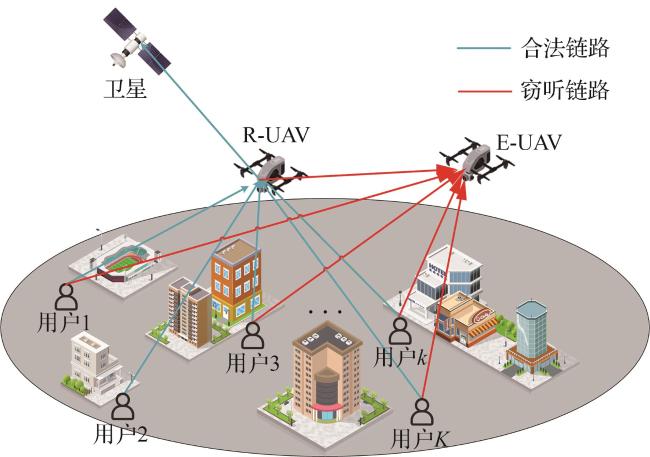
具体而言,系统包含 个地面用户,负责上传敏感数据指令或传感信息。每个用户均配备单天线,并采用全向辐射模式。该假设适用于物联网终端等低复杂度、低功耗场景,有助于聚焦节点间联合优化设计并不失一般性。R-UAV充当合法中继,配备一组由 根天线所组成的线性阵列,在半双工模式下以时序交替的方式执行信号的接收与转发:在接收时隙,捕获地面用户的上行信号;在发送时隙,将所接收到的地面用户信号转发至卫星。作为信息汇集的终点,卫星仅接收来自R-UAV的中继信号,以模拟协同传输需求或恶劣信道环境下的多跳通信架构。E-UAV配备 根天线,在通信空域内主动巡航,试图对抗来自地面用户的机密信息和R-UAV的转发信号,其行为对空天地上行传输构成动态且不确定的安全威胁。
为刻画系统的动态性,将通信时间离散为 个长度为 的等长时隙,则R-UAV在第 个时隙内的空间位置坐标可以表示为 ,其飞行高度固定为 。相应地,E-UAV的空间位置坐标记为 ,其飞行高度固定为 。 表示第k个用户,其位置固定为 ,且卫星在任务周期内相对静止,坐标为 。此外,R-UAV的运动受到最大飞行速度 和总能量预算 的约束。E-UAV的巡航路径独立于系统优化,以模拟真实对抗环境。在此期间,UAV在每个时隙内的飞行速度和推进能量消耗可分别表示为
式中: 和 分别为悬停状态下旋翼的恒定功率和诱导功率; 为旋翼叶片的叶尖速度; 是悬停时旋翼的平均诱导速度; 和 分别代表机身阻力比和旋翼实度; 和 分别表示空气密度和桨盘面积。
1.2 信道模型
基于空中节点的特殊性,所有空空、空地链路均采用Rician信道模型,则以R-UAV为中心的链路可表示为
式中: 为链路索引; 为参考距离处的路径损耗常数; 为各节点与R-UAV的瞬时相对距离; 为路径损耗指数; 为Rician因子; 和 分别为确定性的视距(Line-of-Sight,LoS)和瑞利衰落非视距(non-Line-of-Sight,NLoS)分量。类似地,对于E-UAV所涉及的对抗链路,包括地面用户 至E-UAV的 以及R-UAV至E-UAV的 ,均采用相同信道建模方式。
1.3 信号模型
在第 个时隙,地面第 个用户以功率 发送单位功率信号 满足 。此时,R-UAV接收到的第 个用户的信号表示为
式中: 为归一化接收波束成形向量,用于定向增强对目标信号的接收能力并抑制潜在干扰; 为R-UAV处的噪声。
随后,R-UAV基于透明转发协议对所接收到的信号进行转发: 。该过程中的放大因子 由转发功率 决定,且满足 以符合硬件物理限制。因此,卫星接收来自R-UAV转发第 个用户的信号可表示为
式中: 为归一化发射波束成形向量; 为卫星处的噪声。则第 个用户的上行传输信号在卫星处的信噪比可表示为
针对窃听过程,E-UAV获取地面用户的上行传输信息可来自两方面:① 直连链路窃听,② 中继链路窃听,则接收到来自第 个用户的信号分别表示为
式中: 为E-UAV处的噪声; 和 分别为两个窃听过程所对应的接收波束成形向量。假设E-UAV执行最大比合并以最大化接收信号的功率,并考虑环境噪声是唯一干扰这一最坏假设。则E-UAV对于所接收第 个用户信号的直连和中继窃听信噪比可分别表示为
由此,合法通信链路的可达通信速率为 。相应的,窃听通信链路的可达通信速率为 ,则安全通信速率可表示为
1.4 问题模型
基于第1节研究意图及场景建模,构建一个以最大化多用户最小安全速率为核心的优化问题。该设计旨在确保安全通信的同时,保障用户间资源调度的公平性,避免通信资源向信道条件较好的用户过度倾斜,从而提升系统整体服务质量:
式中:C1为R-UAV的起始和终止位置约束;C2为R-UAV的最大飞行速度约束;C3为R-UAV在整个通信周期内的总能量消耗约束;C4和C5为R-UAV和地面用户的发送功率约束;C6和C7为R-UAV接收和发射波束成形向量的单位模约束;C8为安全传输速率非负约束。
该优化问题是一个高度耦合且非凸的非线性规划问题。其求解涉及R-UAV的轨迹、发射功率 、接收波束成形 以及发射波束成形 等多个变量的联合设计。由于目标函数包含对数项、分式结构以及变量间的复杂耦合关系,且同时存在动态环境的不确定性,使得该问题的求解极具挑战。
2 协同优化算法
针对第1节所提出的高度复杂且非凸的优化问题,第2节提出一种联合BCD、SDR、SCA与DDQN的协同优化算法。该算法的核心思想是将原问题解耦为波束成形、功率分配与UAV轨迹优化3个相对独立但又彼此关联的子问题,并针对各子问题的特性采取相应的技术进行求解,旨在得到使系统性能最优的配置方案。其主要流程可概括为外层循环、内层子问题求解以及实时决策与协同3个层次。
首先,外层循环在BCD框架下运行,其针对确定时隙下的节点间相对位置关系,将优化变量划分为接收波束成形 和发射波束成形与功率 两个部分,并通过迭代优化直至收敛。其次,内层子问题求解采用SDR技术将波束成形向量优化提升至矩阵空间,并结合SCA方法处理由此产生的非凸约束,从而将子问题转化为一系列可高效求解的半定规划问题。最后,实时决策与协同基于马尔可夫决策过程(Markov Decision Process, MDP)建模R-UAV动态特性,并利用DDQN算法进行学习优化,使智能体可根据波束成形与功率分配原则并结合实时环境状态快速给出轨迹决策,从而实现三者的动态协同。
2.1 接收波束成形优化
对于信号接收过程,假设R-UAV在时隙 的空间位置坐标 、发射波束成形向量 以及发射功率 均已知且固定。此时,优化任务的核心是设计最优的接收波束成形向量 ,以最大化当前时隙的最小安全速率。为便于推导,引入辅助变量:
据此,合法链路的信噪比式(6) 可简化为
类似地,中继链路窃听的信噪比式(10) 亦可重新表示为
式中: 。
为了将接收过程转化为易于处理的标准形式,进一步引入辅助变量 作为当前时隙最小安全速率的下界,此时所要优化的子问题可表示为
通过代数变换,式(16) 安全速率约束C2可等价替换为
然而,式(17) 中所隐含的非凸约束将导致式(16) 难以直接求解。但一个关键的结构特性是,波束成形向量 在所有信噪比表达式中均以二次型出现,这使得利用SDR技术将该变量提升到矩阵空间来处理这种非凸性成为可能。基于此,依次对 和 采取矩阵替换,则有 , ,并暂时忽略其秩一约束,从而可将式(16) 转化为
式中:
但是,考虑到分式结构约束,故此时需要进一步利用SCA来构建凸近似,从而将原求解问题转化为凸优化问题。具体来说,在SCA的第 次迭代中,将式(18) C2中的非凸约束根源项 在其当前点进行一阶泰勒展开,并忽略二阶及以上高阶项:
从而得到严格的凸约束近似。由此,优化问题最终可被表示为
由于该问题此时的形式为标准的凸优化问题,所以可以直接通过CVX等工具实现高效求解,并通过迭代优化直至收敛,从而得到最优的半正定矩阵解 。但值得注意的是,SDR所引入的秩松弛问题通常使得 为非秩一矩阵,而实际的波束成形向量需要从其中恢复出满足原始约束的秩一解。因此,进一步采用高斯随机化方法,对 进行特征值分解 ,然后选取最大特征值对应的特征向量 作为最终解,即 。
2.2 发射波束成形和发射功率优化
对于信号中继转发过程,考虑到接收波束成形向量 在此阶段保持固定,因此卫星处所接收信号的信噪比 以及E-UAV处窃听信号的信噪比 均退化为关于发射功率 和发射波束成形 的函数。具体而言,中继信号的能量增益由 直接决定,而信号的空间辐射方向以及对E-UAV的泄露程度则由 调控。两者在数学形式上以乘积项 共同作用于信噪比表达式,且分别受到最大功率约束 与单位模约束 的限制。所以,此时需要优化的子问题可表示为
为了从根本上消除 与 之间的耦合,引入复合矩阵变量 。根据半正定矩阵的性质, 必须满足半正定性 以及秩一约束 。此时,式(22) 中的功率约束与模值约束可利用矩阵迹的性质转化为统一的线性约束:
为简化表达,定义4个关于 的函数,用于分别代表合法链路与窃听链路的等效信号能量项和等效干扰能量项:
式中: 均为常数项。此时,合法通信速率与窃听通信速率可分别表示为 与 。根据对数函数的单调递增性质,最大化安全通信速率 等价于最大化目标函数:
然而,式(25) 非凸的分式规划使其通常难以被直接求解。为此,利用对数运算性质,可将目标函数重构为易于处理的差分凸形式:
同理, 的线性近似结果即可表示为 。进一步,将式(27) 线性近似结果代入原目标函数,并在引入辅助变量 的同时暂时松弛非凸的秩一约束,则第 次迭代的半正定规划问题可表示为
由于此时式(28) 是一个标准的凸优化问题形式,故可利用CVX工具箱实现高效求解,且通过迭代更新 直至收敛。若最终解 的秩大于1,则进一步使用第2.1节中高斯随机化的方法还原出原始解。
2.3 R-UAV轨迹优化
基于固定时隙内节点间确定位置关系所得到的传输优化策略,重点解决R-UAV轨迹规划问题,其可建模为
不同于传统静态优化问题,R-UAV的轨迹规划是一个实时动态决策过程,其核心挑战源自于E-UAV未知的、非预设的运动模式。因此,R-UAV必须能够根据自身所感知到的实时环境信息动态调整其飞行路径,从而确保通信全链路的安全可靠。为此,可将R-UAV的轨迹优化继而建模为一个MDP,并利用DDQN进行求解。基于此,对智能体R-UAV相关参数进行定义。状态空间 :当前 时隙内,R-UAV、E-UAV及地面用户 所分别对应的位置坐标 、 及 和所有即时信道条件,以及R-UAV的自身剩余能量。动作空间 :当前 时隙内,R-UAV所可以选取的飞行方向和速度组合,这决定了下一时隙内其自身的飞行位置 。此外,为满足算法运行要求,R-UAV的飞行空间需采取离散化处理,且其运动方向应限制在预定义的有限集合中,即每个动作 对应一个位移向量 ,使得 。而动作的选取必须同时满足C2所给出的最大飞行速度约束。奖励函数 :当前 时隙内,R-UAV在选择执行动作 后所能得到的即时回报,其核心奖励要素为系统所能实现的最小安全传输速率 。但是,为引导智能体行为符合系统预期约束,故需在奖励函数中进一步引入惩罚项r penalty和r boundary以限制其飞行速度和飞行区域。综合以上内容,奖励函数最终可表示为
式中: 、 为权重系数,用于平衡各惩罚项对智能体行为的影响。
进一步,DDQN算法结构主要包含两个形式相同但参数不同的深度神经网络,即主网络 和目标网络 。具体来说,主网络负责动作选择,目标网络则用于价值评估,从而提高训练收敛性。采用经验回放机制,将R-UAV与环境交互所得到的经验元组 存入回放缓冲区,在训练时随机选取小批量样本以提升数据效率同时降低内部相关性。此外, 和 均由多个全连接层构成,并使用ReLU作为激活函数,输出层为各动作的Q值。网络参数通过最小化时序差分误差进行迭代更新,损失函数构建为
式中: 为折扣因子。在每个训练回合中,R-UAV从初始位置 出发,基于 -greedy策略平衡探索与利用,依次执行动作并收集经验,并在 个时隙后抵达飞行终止位置点 。通过不断迭代训练,R-UAV最终能够学习到在面对动态E-UAV时,如何规划其飞行轨迹以最大化系统最小安全通信速率,从而在复杂空天地环境中实现安全通信的有效保障。
2.4 算法复杂度分析
协同优化算法的计算复杂度主要来源于波束成形与功率优化、R-UAV轨迹优化两方面。对于波束成形与功率优化过程,其主要采用SDR与SCA联合求解,并最终通过BCD框架迭代收敛,该过程执行复杂度约为 ,其中 和 为相应操作的迭代次数。对于R-UAV轨迹优化过程,其基于DDQN实现智能决策,训练阶段的复杂度取决于神经网络规模与环境交互步长,而在线部署阶段仅涉及神经网络的前向传播,单次执行复杂度约为 ,其中 为神经网络层数, 为神经元数量。综上,通过整合BCD、SDR、SCA与DDQN技术,空天地一体化网络中上行安全通信所面临的波束成形、功率分配与复杂轨迹之间的联合优化问题将可以被有效解决,这为在动态对抗环境下的安全传输提供了可行的设计方案。
3 仿真分析
为系统验证本文方案综合性能,开展全面的数值仿真分析。仿真环境依据第1节所给出的系统模型进行构建。
通信服务区域设定为一个大小为100 m×100 m的方形空域,R-UAV的初始位置坐标为[-50,0,50],任务终止位置坐标为[50,0,50]。在该区域内,部署4个地面用户,其位置坐标分别为[-25,25]、[0,-15]、[25,40]以及[45,30]。E-UAV在该空域内沿起始点[-50,23,50]到目的点[50,23,50]的路径进行自主巡航,以此模拟动态的窃听威胁场景。设定通信总服务时长为10 s,并将其离散为100个时隙,每个时隙长度0.1 s。R-UAV配备4根天线,其最大飞行速度为25 m/s。E-UAV配备4根天线,并遵从相同飞行速度约束。信道模型采用Rician衰落,其参考距离处的路径损耗常数为-50 dB和-100 dB,路径损耗指数2.2。此外,接收端噪声功率统一设为-80 dBm。对于DDQN算法,其训练轮次设置为200,神经网络结构采用两层全连接层,每层包含64个神经元。优化器学习率设为0.001,折扣因子为0.99,经验回放缓冲区容量为10 000,训练批次大小为32。
进一步,为客观评估本文方案的性能优势,同时源自R-UAV以用户为中心和以自身任务为中心的极端考量,选择设定3种基准方案作为对比:① 固定轨迹方案,即R-UAV按照预定顺序依次飞近每个地面用户上空;② 直线轨迹方案,即R-UAV从起点到终点以恒定速度沿直线飞行;③ 传统优化方案,即R-UAV基于遗传算法控制自身状态并规划飞行路径。所有对比方案均在相同信道条件下运行,并采用与本文方案一致的波束成形与功率分配优化方法,以确保性能差异仅源于轨迹规划策略的不同。此外,E-UAV的起降时机将根据R-UAV的起降状态动态确定,以符合实际监视任务中的一般操作逻辑。
不同方案的R-UAV飞行轨迹对比如图2所示。本文方案所得R-UAV飞行轨迹展现出显著的动态自适应能力,其能够依据地面用户的空间分布、E-UAV的实时位置以及信道条件的变化,自主调整飞行路径。从轨迹形态来看,本文方案得到的飞行路径近似介于固定轨迹方案、直线轨迹方案这两种静态基准方案的折中带并与遗传算法这一动态基准方案类似,轨迹平滑且呈现出明确的策略性特征,具体表现为适时靠近合法用户以试图增强通信质量,同时通过主动迂回尽可能规避E-UAV巡航区域,从而系统性提升网络整体性能。另一方面,从轨迹点位密集度可以看出,本文方案根据用户与E-UAV之间的相对位置关系表现出差异化的飞行速度特征,这从侧面说明算法能够根据网络拓扑与通信需求自主调整运动策略,反映出良好的环境感知与自主决策能力,进一步验证了本文方案在复杂空天地场景下的实用性与鲁棒性。
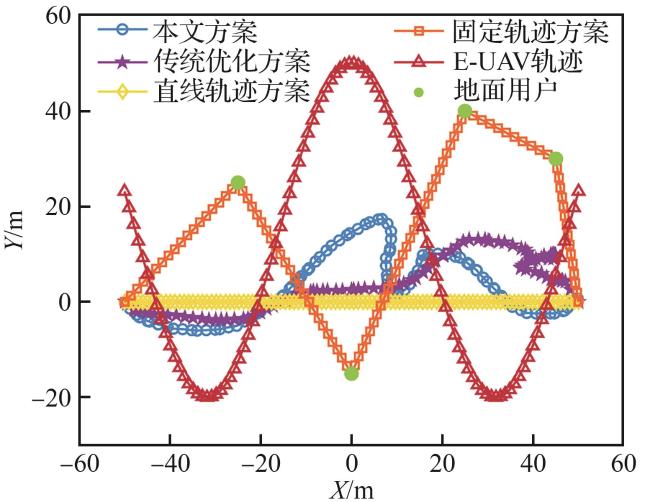
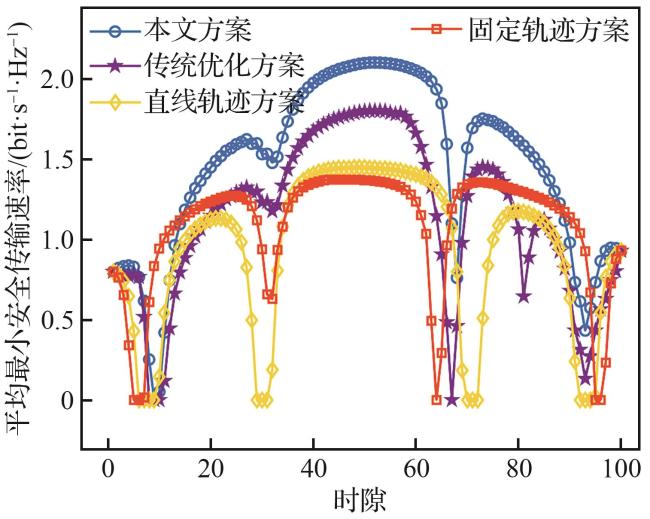
图3给出了本文方案与3种基准方案在各通信时隙的最小安全传输速率对比结果。可以看出,除通信初始阶段与临近结束的少数时隙外,本文方案在绝大部分服务时段内所实现的最小安全速率均显著优于3种基准方案,且其在各时隙间的性能波动相对较小,表现出更为稳定的安全传输特性,这主要归因于静态资源分配机制融入动态轨迹的联合优化。相比之下,3种基准方案由于路径规划缺乏灵活性或全局性,无法根据动态变化的通信环境做出响应或准确预判,导致其安全速率起伏显著且存在多次中断,尤其在窃听威胁加剧或用户信道条件恶化时表现更为明显。
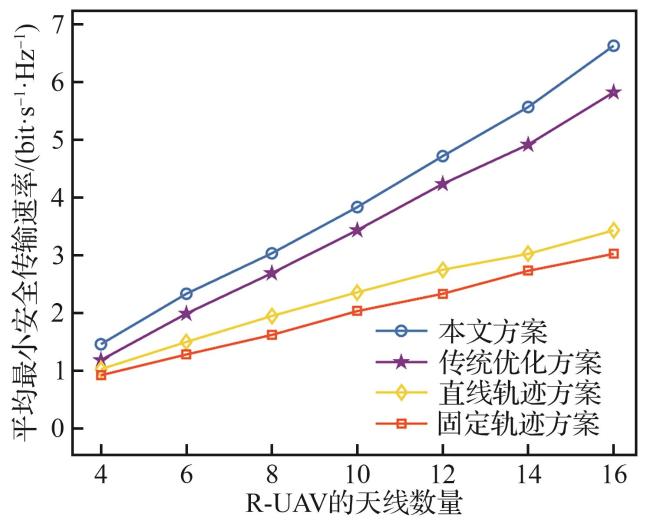
不同方案下R-UAV天线数量对平均最小安全传输速率的影响如图4所示。随着R-UAV天线数量的增加,所有方案的性能均呈现出显著上升趋势。这一现象可从信息论与信号处理角度得到解释:天线数量的增加为系统提供了更多的空间自由度,从而增强了波束成形的灵活性与精度,使得信号能量能够更集中地指向合法接收端,同时有效抑制向窃听者的信号泄露。但是,在相同天线配置下,本文方案始终展现出最优的性能表现。具体而言,当R-UAV配备4根天线时,本文方案的平均最小安全传输速率约为1.44 bit/(s·Hz),而传统优化、直线轨迹与固定轨迹方案分别为1.18 bit/(s·Hz)、1.02 bit/(s·Hz)与0.92 bit/(s·Hz)。随着天线数量增至16根,本文方案的性能进一步提升至约6.68 bit/(s·Hz),高于传统优化方案的5.83 bit/(s·Hz)、直线轨迹方案的3.45 bit/(s·Hz)与固定轨迹方案的3.04 bit/(s·Hz)。这一结果充分说明,本文方案能够更充分地利用多天线系统提供的空间自由度,通过轨迹与波束成形的协同优化,实现对信道状态的动态适应与对窃听威胁的有效规避,从而在各类天线配置下均能保持稳定的性能优势。但要指出的是,R-UAV实际所搭载的天线数并非能够无限扩大,这需要结合实际约束进行合理权衡。
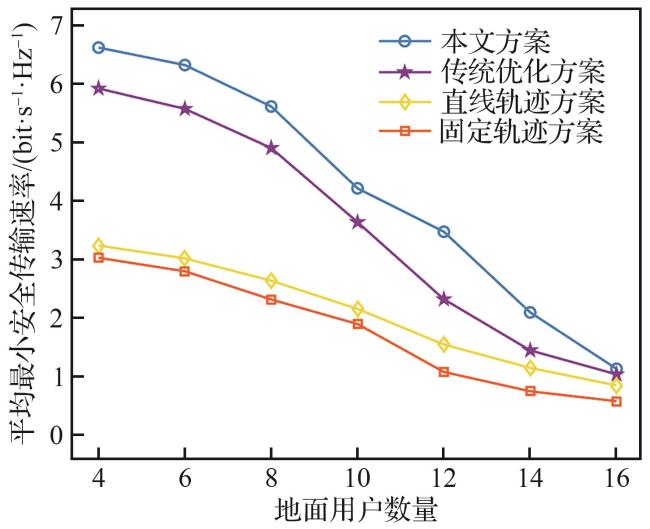
不同方案下地面用户数量对平均最小安全传输速率的影响如图5所示。仿真结果表明,随着地面用户数量的增加,所有方案的系统最小安全速率均呈现下降趋势。除了用户与天线配置比外,这一现象还可能潜在归因于网络拓扑的复杂度加剧。具体来说,随着用户规模扩大,其在地理空间上的分布更为分散,这使得R-UAV难以规划出一条能同时兼顾所有用户信道质量的理想路径,系统最小安全传输速率受限于信道条件最差的用户,从而产生明显的性能瓶颈。但即便如此,本文方案在不同用户规模下均保持了最优的性能表现。从具体数据来看,当用户数量由4个增加到16个时,本文方案的平均最小安全传输速率从7.66 bit/(s·Hz)下降至1.24 bit/(s·Hz),而传统优化方案从5.94 bit/(s·Hz)降至1.05 bit/(s·Hz),直线轨迹方案从3.23 bit/(s·Hz)降至0.92 bit/(s·Hz),固定轨迹方案则从3.03 bit/(s·Hz)下降至0.61 bit/(s·Hz)。这一对比结果充分证明了本文方案在保障多用户公平性方面的优势,其通过动态调整传输策略与飞行轨迹,有效平衡了不同用户间的服务质量需求。但值得注意的是,随着用户数量的进一步增加,各方案间的性能差异预计会逐渐缩小,这一现象主要源于系统资源分配的基本限制。当服务用户数量超过一定阈值时,有限的通信资源与空间自由度难以满足所有用户的需求,导致系统性能主要受限于资源约束而非具体的优化策略。
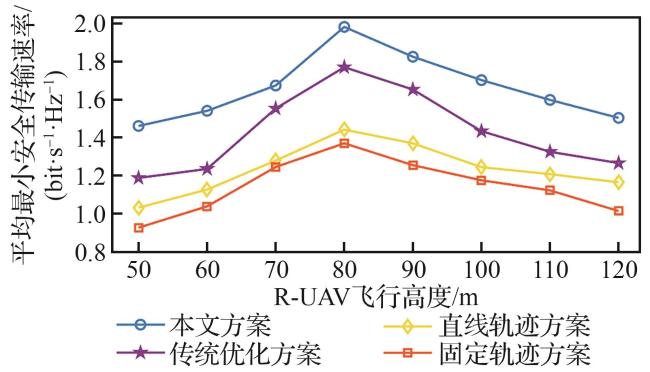
不同方案下飞行高度对平均最小安全传输速率的影响如图6所示。仿真结果表明,随着R-UAV飞行高度从50 m增加至120 m,系统平均最小安全传输速率呈现先上升后下降的趋势,在约80 m高度左右达到最优值,相较于最低点实现了约38.89%的性能提升。这一现象源于飞行高度对通信的综合影响。当飞行高度较低时,R-UAV与E-UAV之间的相对距离缩短,导致窃听链路质量增强,安全性能受到制约。随着高度增加,虽然窃听威胁得以缓解,但过高的飞行高度会加剧路径损耗,致使地面用户至R-UAV的上行链路容量下降。因此,存在一个使安全性能最大化的最优飞行高度。此外,本文方案均表现出优于基准方案的性能。特别是在75 m~90 m的最优高度区间内,其性能优势最为显著。
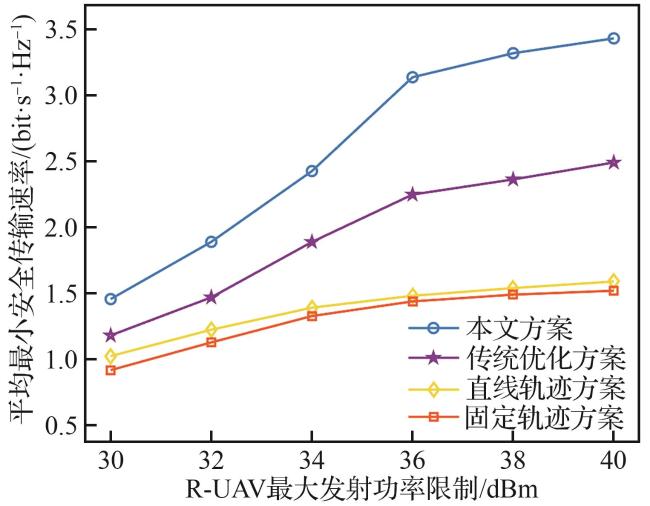
不同方案下最大发射功率限制对平均最小安全传输速率的影响如图7所示。结果表明,随着R-UAV最大发射功率上限的提升,所有方案的传输性能均呈现增长趋势,但其增长速率逐渐减缓并最终近似趋于饱和。这是因为,发送功率的增加虽然能够提升合法链路的信号质量,但同时也会增强被窃听者截获的信号强度。因此,安全传输速率的提升效益随功率增加而递减,这符合系统安全性能存在理论上限的约束。然而,在所考虑的全部功率配置范围内,本文方案始终保持着最优的性能表现。以30 dBm的发送上限为例,本文方案实现的平均最小安全传输速率约为1.44 bit/(s·Hz),高于传统优化方案的1.18 bit/(s·Hz)、直线轨迹方案的1.02 bit/(s·Hz)和固定轨迹方案的0.92 bit/(s·Hz),这侧面反映出本文方案能够更有效地利用有限的功率预算,在增强合法链路的同时最大限度地抑制窃听链路的性能提升。


4 总结展望
围绕空天地一体化网络上行传输所面临的动态窃听威胁,开展了系统性研究。首先,构建了三维动态对抗系统模型,并基于最大最小公平准则,建立了以最大化系统最小安全传输速率为目标的联合优化问题。其次,针对该问题的高度非凸性与多变量耦合特性,提出了一种融合BCD、SDR、SCA与DDQN的协同优化算法,实现了对UAV轨迹、发射功率与波束成形参数的动态联合优化。最后,通过仿真验证了本文方案的有效性,结果表明其在动态对抗环境下具有显著的安全性能优势,并揭示了UAV飞行高度、发射功率及天线数量等因素对系统性能的影响规律,为空天地网络安全传输的实际部署提供了理论参考。
基于此研究,未来工作可从4个方面进一步展开:① 考虑由多个协同E-UAV构成的智能对抗场景,设计更具鲁棒性的安全传输机制;② 将UAV的二维轨迹规划扩展至三维空间,以充分挖掘空间维度对系统性能的提升潜力;③ 在算法层面,研究低复杂度、高效率的实时优化策略,以更好地满足动态环境的决策需求;④ 探索透明转发与译码转发混合的中继模式,进一步优化系统在复杂信道条件下的安全传输性能。