

 CJA
CJA
在现代作战飞机的设计中,隐身性能、机动性[1]是影响飞机在战场上生存率的2个核心要素[2-3]。随着现代作战飞机对隐身性能的要求日益增加,异形进气道能够有效遮挡发动机风扇叶片的正面强反射源,显著减小雷达散射面积,从而提高飞行器的隐身能力[4-5],已成为高隐身飞行器的标志性设计之一。
然而,针对这种高隐身飞机的异形进气道,其口面不仅需要与机翼高度融合,而且通常采用复杂的三维弯曲内管道。相比常规进气道,曲率、截面形状变化更加剧烈,气流在沿程逆压梯度、离心力、横向压差的作用下,产生流动分离,进气道出口不均匀,总压损失较大[6-7],这对发动机下游部件的正常工作十分不利,造成的直接后果就是压气机稳定裕度下降,增压比、效率减小[8]。此外,异形进气道需要适应宽广且变化剧烈的亚声速飞行马赫数、飞行姿态、发动机工况,设计难度远超常规进气道。
国内外学者对异形进气道开展了大量研究和探索。在隐身特性、气动特性方面,李岳锋等[9]、闫紫光等[10]、高翔等[11]不同进口形状的异形进气道进行电磁散射特性研究分析。黄浩然和王宏伟[12]的研究表明,异形进气道的弯度对于隐身特性、气动特性的影响规律相反。在流动机制、性能规律方面,Brear等[13]对长径比2.6异形进气道的研究发现,顶部壁面会发生大规模分离,形成的涡系结构可向下游延伸至风扇界面。Sun和Guo[14]通过实验验证了此类分离流动会导致进气道/发动机匹配不当,进而引发发动机喘振。Rademakers等[15]的研究揭示了由进气道内型面扭曲在压气机上下游诱发的3种非定常流动现象。此外,诸多研究探讨了几何参数的影响,如翁小侪和郭荣伟[16]对腹下异形进气道开展低速大迎角实验研究,赵庆伟和谢文忠[17]对三维亚声速斜切口面角度的影响研究,Wang等[18-19]对边界层吸入式进气道气动特性的研究,结果均表明进气道几何构型对内部分离涡结构、出口畸变特性具有决定性影响。
以上研究表明,异形进气道在提升飞机隐身性能方面效果显著,但总压畸变、旋涡变形[20]是亟需解决的关键技术问题。然而,现有工作多集中于设计点稳定流动状态,对于非设计工况,特别是发动机在小流量状态下的流动失稳机制,研究尚不充分。
笔者团队在长期型号研制过程中发现,为保证发动机在整个工作包线内稳定工作,对异形进气道的性能稳定性要求极高,尤其是在高马赫数、大迎角大侧滑角飞行姿态、发动机小流量状态下,进气道内流场可能发生流动失稳,性能急剧恶化,直接威胁飞行安全。因此,本文聚焦异形进气道在小流量状态下的流动、失稳特性,采用数值模拟方法,揭示进气道内部流动机制、性能变化规律,以期为工程上异形进气道的小流量内流机制认识、战机进气道的研制提供参考。
1 异形进气道物理模型与仿真方法
1.1 物理模型
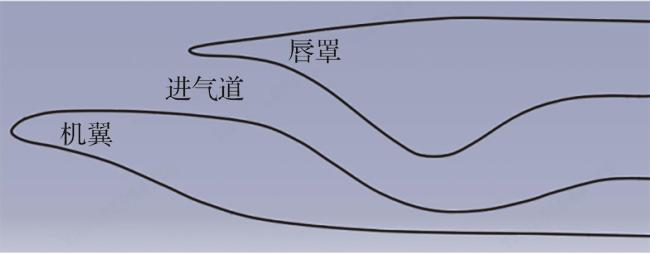
研究对象为与飞行器机翼高度融合的异形进气道,其气动型面如图1所示。该进气道的进口口面与机翼前缘紧密融合,采用非轴对称的D形截面设计,以满足隐身特性、气动布局的要求。不同于传统的二元蛇形进气道,本文异形进气道不仅在口面形状上存在显著差异,其内部流道同样具有复杂的三维弯曲,以适应上下游机体结构与发动机安装位置的空间需求。该进气道的扩压器面积扩张比为1.12,在最大流量状态下,AIP(Aerodynamic Interface Plane)马赫数Ma AIP可达0.60以上,而在发动机慢车状态下,Ma AIP 约为0.40。研究重点关注发动机小流量状态下异形进气道的内部流动特性、失稳机制。
1.2 仿真方法及网格划分
采用计算体力学商用软件ANSYS Fluent求解RANS(Reynolds-Averaged Navier-Stokes)方程,湍流模型选择k-ω SST(Shear Stress Transport),无黏对流通量采用基于MUSCL(Monotonic Upstream-centered Scheme for Conservation Laws)插值的Roe迎风格式进行离散,黏性通量采用二阶迎风格式进行离散,离散梯度采用Green-Gauss网格基,湍动能、湍流耗散率采用一阶迎风格式进行差分,时间推进采用基于密度基的隐式方法。
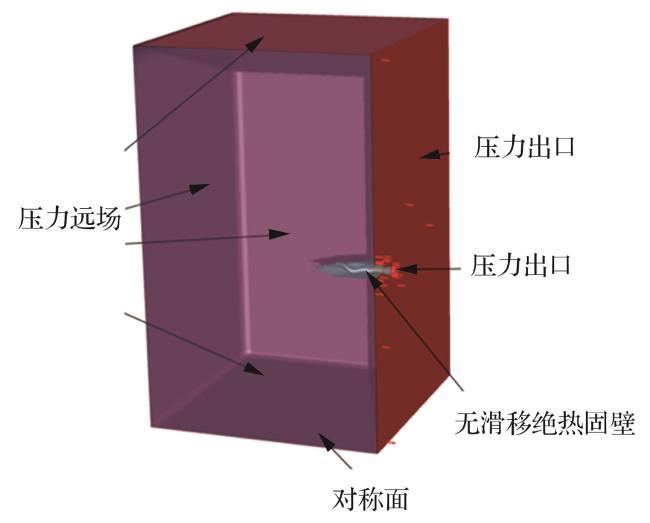
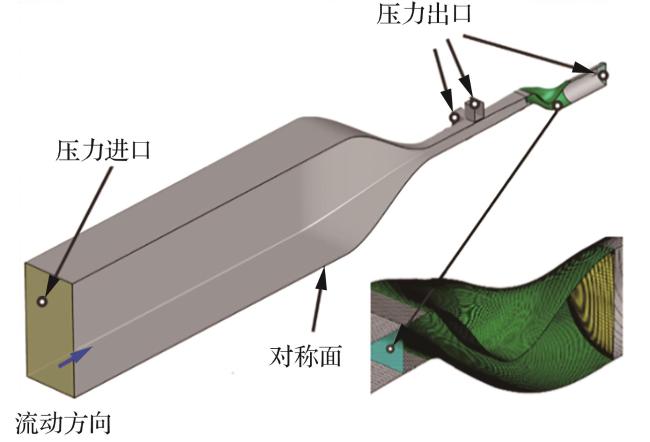
鉴于研究对象几何形状、流动条件的对称性,选取的计算域仅为实际流域的1/2。采用六面体网格填充计算域,网格单元总量约为1 570万。数值仿真中的边界条件设置如图2所示。图中,计算域外侧设定为压力远场边界,来流马赫数Ma=0.75。计算域出口、进气道出口设定为压力出口边界条件,通过改变进气道出口的静压值,改变进气道的流量;计算域对称面设定为对称面边界,其他边界均为无滑移绝热固壁边界。考虑到研究的飞行状态为亚声速,扰动可以向上游传播,因此将来流远场的计算域放大,计算域从前体向四周延伸,并扩展20倍的进气道长度距离。
1.3 算例验证
2 结果与分析
为了获得异形进气道的内部流动特性、失稳机制,基于上述仿真方法,对异形进气道在节流过程中的流动特性、性能变化规律、失稳机制、失稳边界进行分析。
2.1 节流过程流动特性
图5展示了进气道不同流量比(流量与其最小流量比Q/Q min)下的马赫数分布云图、流线图,可知随着进气道的流量比由2.63减至1.16,进气道的截面流态出现较大的变化。在较大的流量比(Q/Q min>2.16)下,进口壁面附近的流线没有发生偏转、回流,说明此时进气道能够正常工作;但当Q/Q min=1.84时,进口外侧出现回流;当Q/Q min进一步减至1.68、1.16时,回流范围进一步增大,占据了整个进口截面。
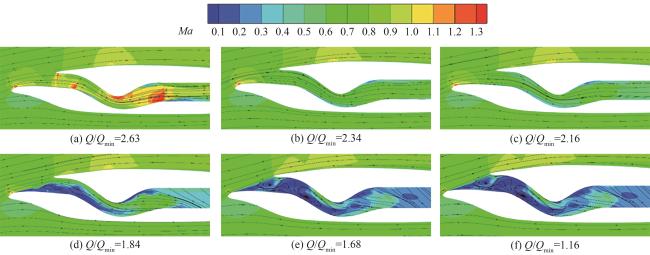
图6展示了不同流量比下AIP总压恢复系数(σ)云图及流线图,AIP低总压区主要分布在漩涡结构区域,这是进气道入口处的强逆压力梯度、三维弯曲管道造成的周向压力梯度,导致边界层、低能流产生横向运动并脱离壁面,流动损失增大。随着流量比减小,截面上的3个旋涡融合为1个整涡。
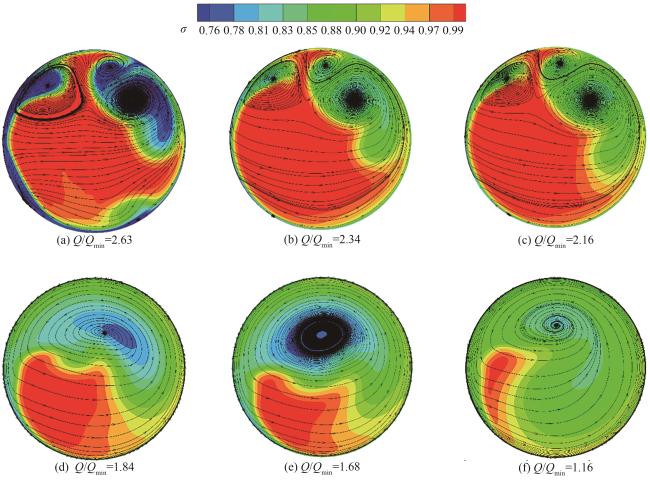
结合图7可以得出,进气道的总压恢复系数、稳态周向畸变指数随流量的变化规律。图中,σ/σ max为进气道总压恢复系数与其最大值的比值;Δσ/Δσ min为稳态周向畸变指数与其最小值的比值。随着流量比Q/Q min减小,总压恢复系数呈现出先增后减的趋势,在中等流量状态保持相对较高水平,而在小流量(Q/Q min=1.16)、大流量(Q/Q min=2.63)状态下明显下降。结合图5可知,在大流量Q/Q min=2.63状态下,流道存在局部的跨声速区域,导致总压损失增大,而在小流量Q/Q min=1.16状态下,进气道进口存在大面积分离区,入口大面积低能流进入流道,进气道难以组织稳定的流动,最终引起总压恢复系数显著下降,进气道发生失稳。相比之下,稳态周向畸变指数随流量减小而单调减小。
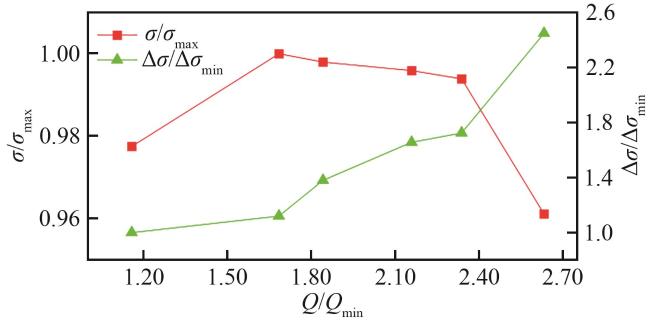
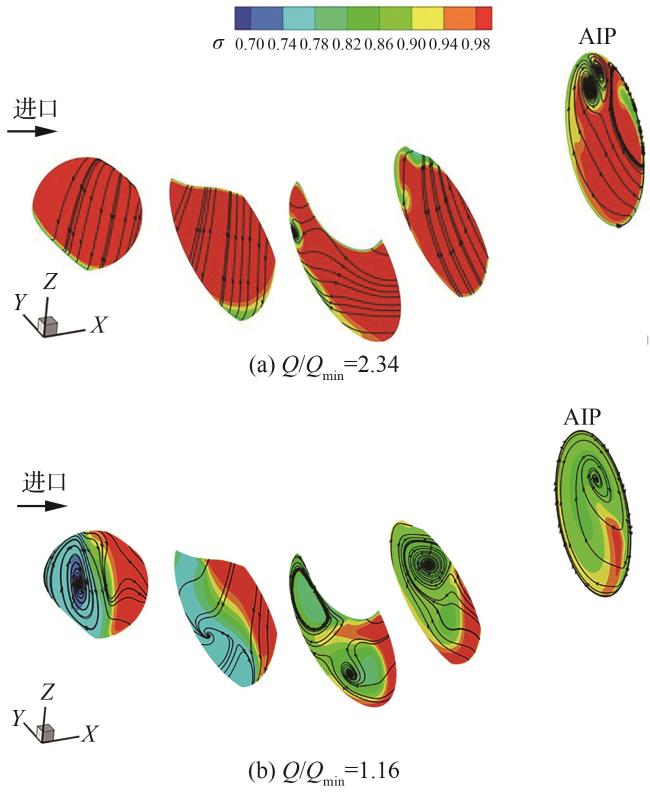
图8展示了2种流量工况下进气道截面局部总压恢复系数、二次流分布图谱。对于Q/Q min= 2.34的大流量工况,截面内可见多个局部低总压区,与二次流涡旋结构相对应。在二次流与主流之间的剪切、卷吸作用下,诱导出多涡结构并导致低能流呈离散分布。随着流动沿程发展,二次流不断与主流发生掺混,局部低总压区逐渐被扩散和稀释。相比之下,在Q/Q min=1.16的小流量工况下,二次流作用更为强烈,截面内原本分散的多涡结构在掺混作用下逐渐融合,最终演化为整体性的整涡结构,对应的低总压区也由分散斑块转变为集中分布。
2.2 节流过程小流量失稳机制
进气道下游过度节流会显著抬高进气道的下游背压,导致进气道的内流失稳,发生性能突降。为了明确失稳机制,图9给出了Ma=0.75、Q/Q min=1.68工况下进气道对称面的流线分布,可以看到,回流区占据了整个进气道进口截面。在该状态下,来自远前方的气流绕过机翼前缘后,从进气口外缘卷入流道,携带显著动能损失的低速流体,使边界层动量厚度显著增大。当下游节流程度加剧,进而导致背压抬升时,进口区域形成剧烈的逆压力梯度,部分动量亏损区域的流体无法维持附着状态,从而发生流动分离。
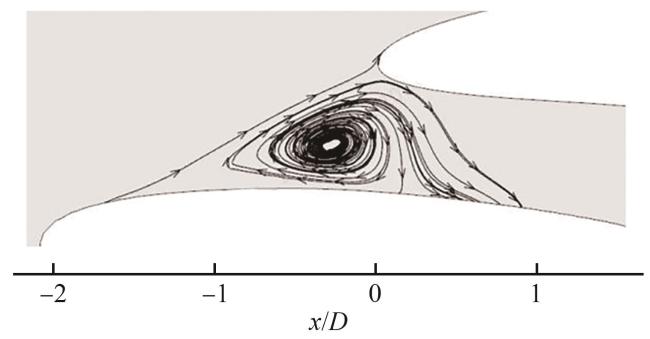
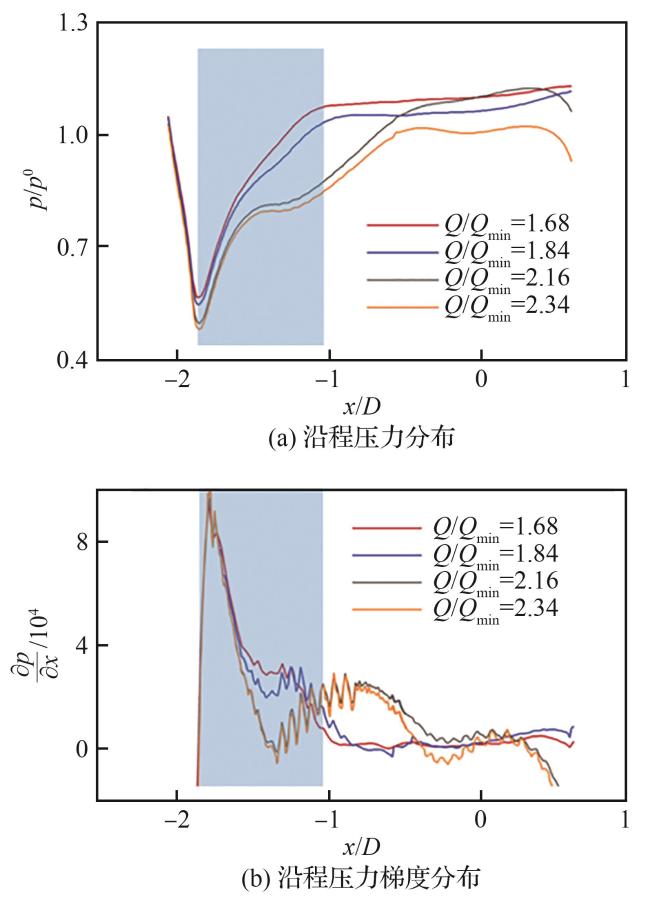
综上所述,该失稳过程可概括为:入口气流绕过机翼前缘后,动能损失增大,边界层厚度增加,降低了抗逆压能力;随节流增强而形成的强逆压梯度促使局部分离发生;倒流的出现进一步加剧了背压水平,最终导致流动失稳。上述失稳并非仅由节流导致的分离包扩大所致,而是多种因素耦合作用的结果。非轴对称构型通道曲率与角区几何诱导了显著的二次流结构,在小流量状态下,角区低能流与主流涡系相互作用,使得分离呈现由对称向偏置的转变趋势;由于采用边界层摄入式布局,入口低能流占比随流量降低显著上升,使流动的有效扩压能力下降,进而提前触发分离。与常规轴对称或直通型进气道相比,本文构型在小流量下更容易受到二次流与角区分离的共同影响;与典型S形进气道相比,本文构型失稳出现更早、失稳裕度更低。
2.3 攻角对小流量失稳边界的影响
为了进一步分析不同攻角对进气道小流量失稳边界的影响,选取Ma=0.75、4个攻角(α=-5°,3°,6°,9°)状态工况,分析进气道的流动情况和性能结果。图11展示了Ma=0.75不同攻角状态下马赫数分布云图、流线,可知从负攻角开始,随着攻角增大,前缘局部加速越明显,这导致气流压力减小,抵抗逆压梯度的能力下降。流道内低能流分布区域越来越大,这说明攻角增大,分离现象加剧。由于该进气道为背负式的异形进气道,而且进气道入口流道向下偏转。在负攻角状态下,进气道处于迎风面,入口正对来流,减缓了气流在一弯下壁面处的分离程度,因此在负攻角下的总压恢复性能较好。随着攻角进一步增大,进气道入口的一弯下壁面、鼓包下游的上壁面的流动分离越来越严重。
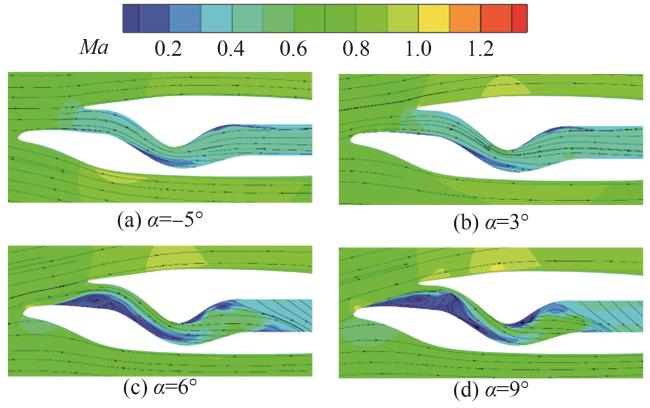
当来流攻角α=-5°,3°时,进口壁面附近的流线没有发生偏转、回流,进气道能够正常工作。但在大攻角α=6°,9°的状态下,进气道入口下壁面有明显的回流,回流区的范围随着攻角的增大而增大,α=9°下回流区甚至延伸至机翼前缘侧棱。原因在于攻角越大,来流在绕过机翼前缘过程中损耗的能量越多,抵抗面积扩张产生的逆压梯度能力下降,发生倒流的面积增大。
图12所示为不同攻角状态下AIP总压恢复系数云图、流线。可以看出,随着攻角增大,AIP的高总压区不断减小。低总压区分布在漩涡结构区域,攻角增大,旋涡由3个变为1个,但漩涡尺度增大。
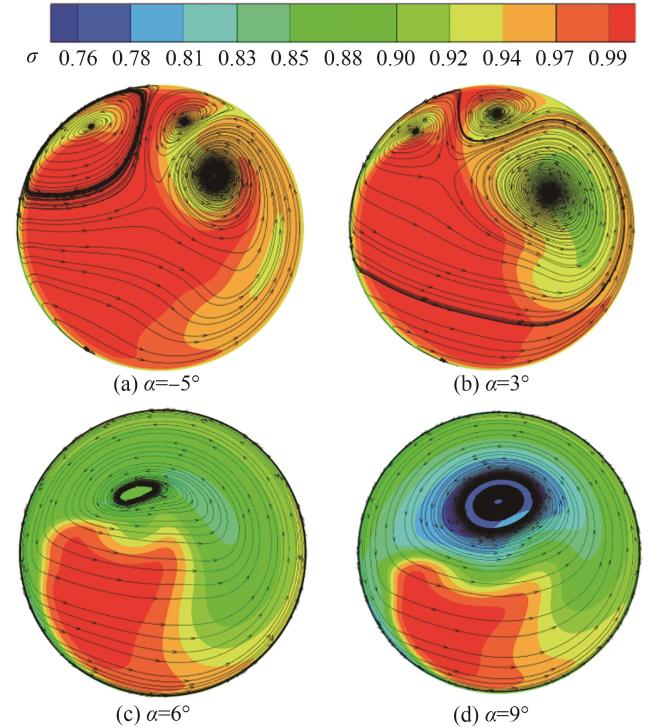
图13给出了进气道总压恢复系数随Ma AIP、流量的变化。图13(a)以黑色虚线标出了静态性能判据得到的失稳边界(当σ相对该攻角的σ min首次减小超过1.5%,且随Ma AIP减小而持续减小时,记为失稳起点)。总体来看,4种来流攻角下σ AIP随Ma AIP先增后减,峰值大多出现在Ma AIP≈0.40~0.55;随着攻角增大,σ AIP峰值水平下降、失稳边界左移并提前出现,表明小流量条件下更易进入失稳区。在同一流量下,随着攻角增大,总压恢复性能减弱(见图13(b)),不同攻角下发生性能衰减的流量点不相同,通过图13(b)可初步判断在大正攻角状态下,进气道的性能对流量的减小更敏感,更容易发生流动失稳。
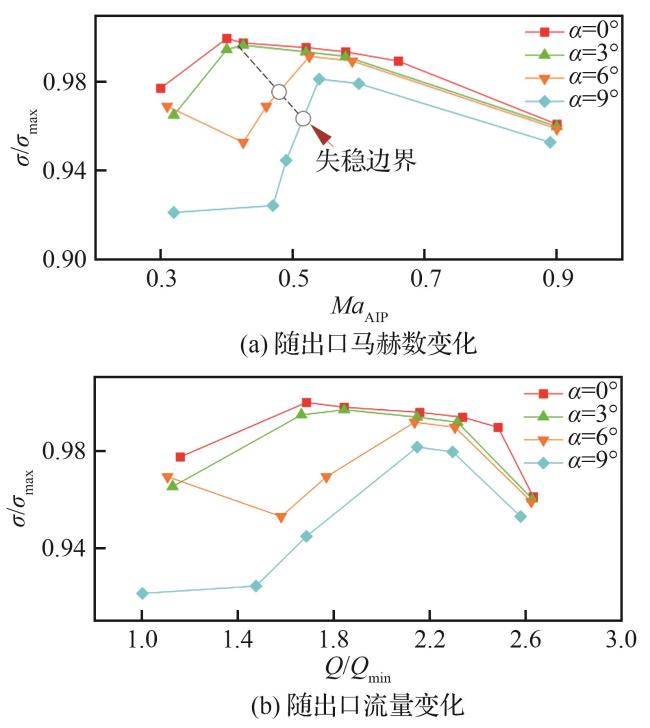
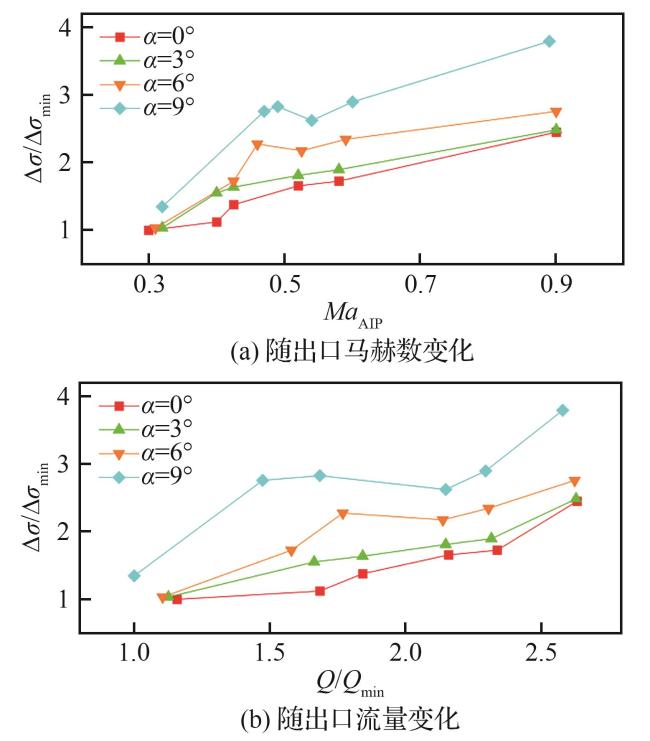
图14展示了进气道出口截面的稳态周向畸变指数 σ/ σ min随出口马赫数、流量的变化规律。整体来说,在同一攻角下,出口截面的总压畸变随流量增大而增大,在小流量、大流量状态下增长率较高。而随着正攻角的增大,稳态周向畸变指数进一步增大。


3 结论
1) 大流量、小流量下进气道呈现出不同的性能变化规律。在大流量状态下,流道内存在局部跨声速区域,进气道出口总压恢复系数降低;而在小流量状态下,流道的回流、分离加剧,大面积的分离损失、掺混损失造成总压恢复系数显著下降,表现出典型的失稳特征。
2) 随着流量降低,流道内部多处旋涡融合,出口截面由3个旋涡状态融合为1个大范围整涡结构,造成出口截面低压区域集中化,畸变指数整体呈下降趋势,但低能流主导区域扩大,均匀性下降,仍对发动机匹配带来挑战。
3) 入口气流绕过机翼前缘后,动能损失增大,边界层厚度增大,降低了抗逆压能力;随节流增强而形成的强逆压梯度促使局部分离发生;倒流的出现进一步加剧了背压水平,最终导致流动失稳。
4) 攻角增大增强了前缘局部加速效应,削弱气流对逆压梯度的抵抗力,导致低能流与分离区显著扩展,使总压恢复性能下降,畸变指数增大,大攻角状态下,进气道对流量扰动更敏感。