Acta Aeronautica et Astronautica Sinica ›› 2025, Vol. 46 ›› Issue (15): 131104.doi: 10.7527/S1000-6893.2024.31104
• Fluid Mechanics and Flight Mechanics • Previous Articles
Haipeng DING1,2,3, Zheng LYU1,2,3( ), Ke TIAN2,4, Tao YE1,2,3, Kuangshi CHEN1,2,3, Jinglei XU1,2,3
Received:2024-08-27
Revised:2024-09-13
Accepted:2024-10-15
Online:2024-11-06
Published:2024-10-29
Contact:
Zheng LYU
E-mail:hypersonic_lv@126.com
Supported by:CLC Number:
Haipeng DING, Zheng LYU, Ke TIAN, Tao YE, Kuangshi CHEN, Jinglei XU. Design and performance analysis of a three-dimensional TBCC exhaust system[J]. Acta Aeronautica et Astronautica Sinica, 2025, 46(15): 131104.
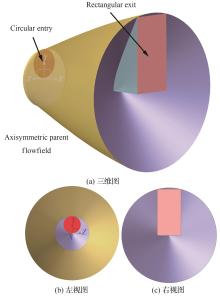
Fig.1
Locations of entry and exit of three-dimensional nozzle within a parent flowfield
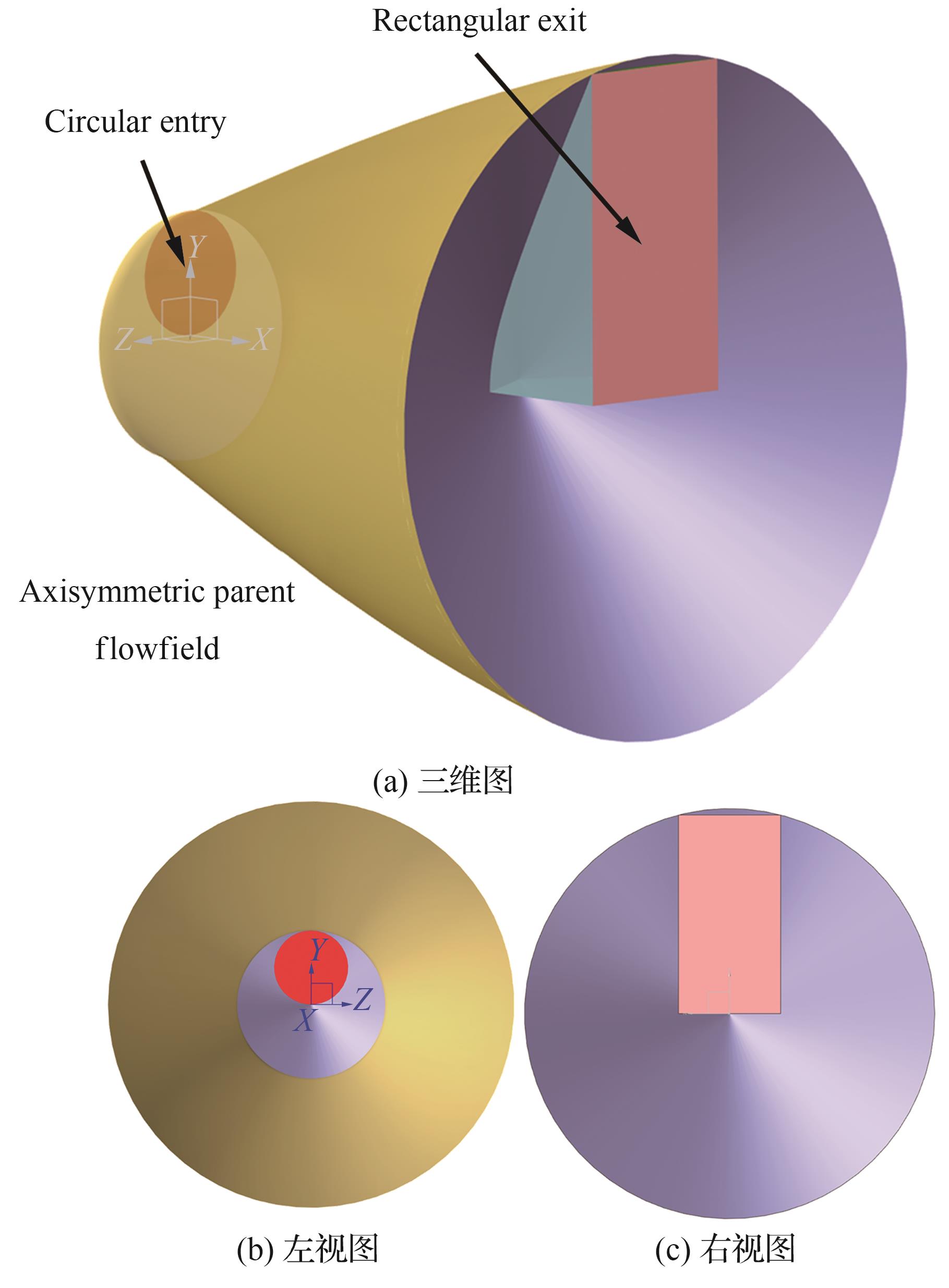
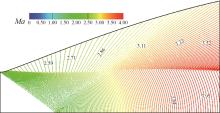
Fig.2
Mach number contour plots of axisymmetric maximum thrust parent flowfield
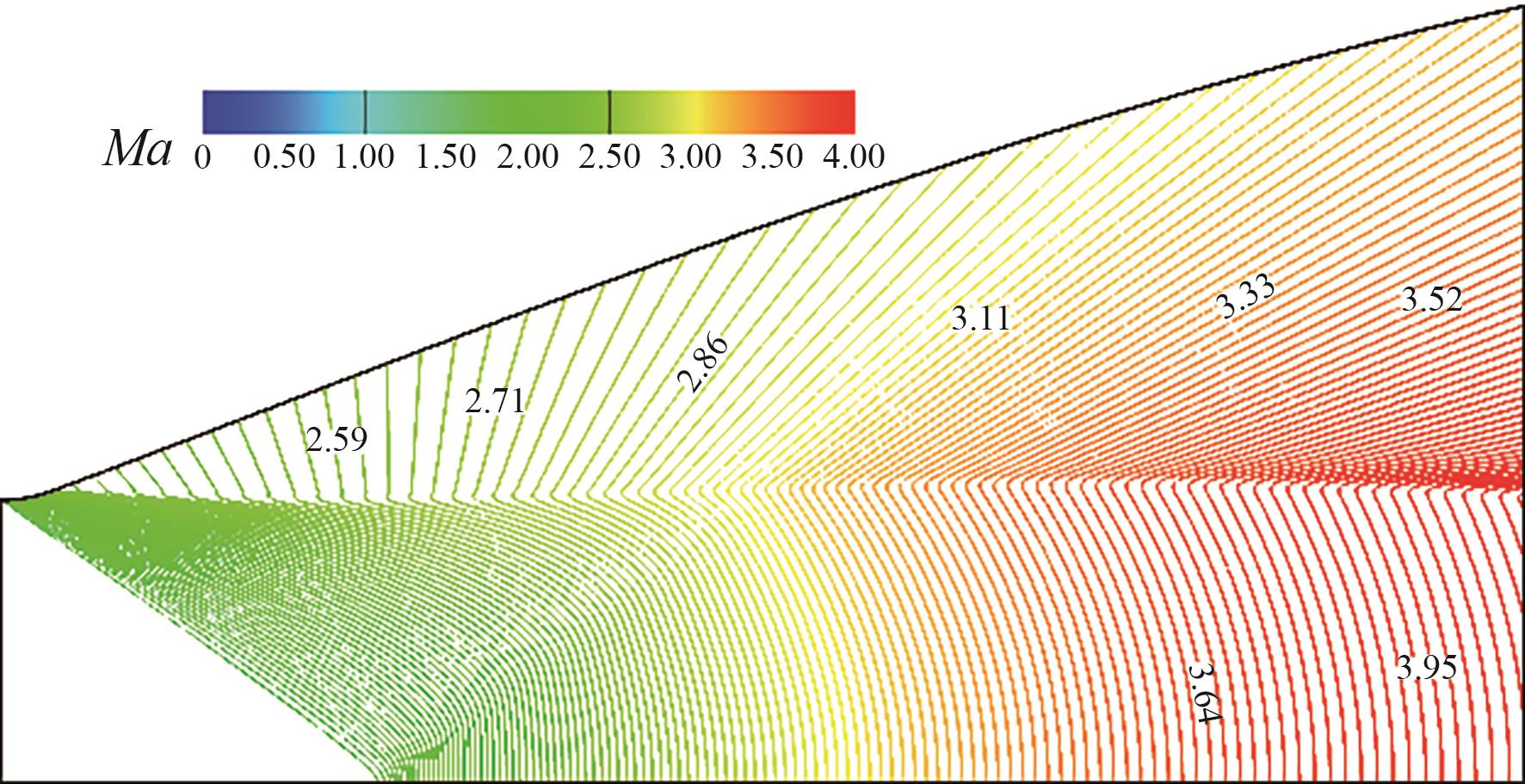
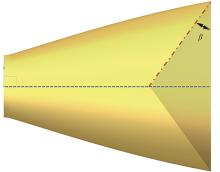
Fig.3
Bevelling angle definition method of three-dimensional single expansion ramp nozzle
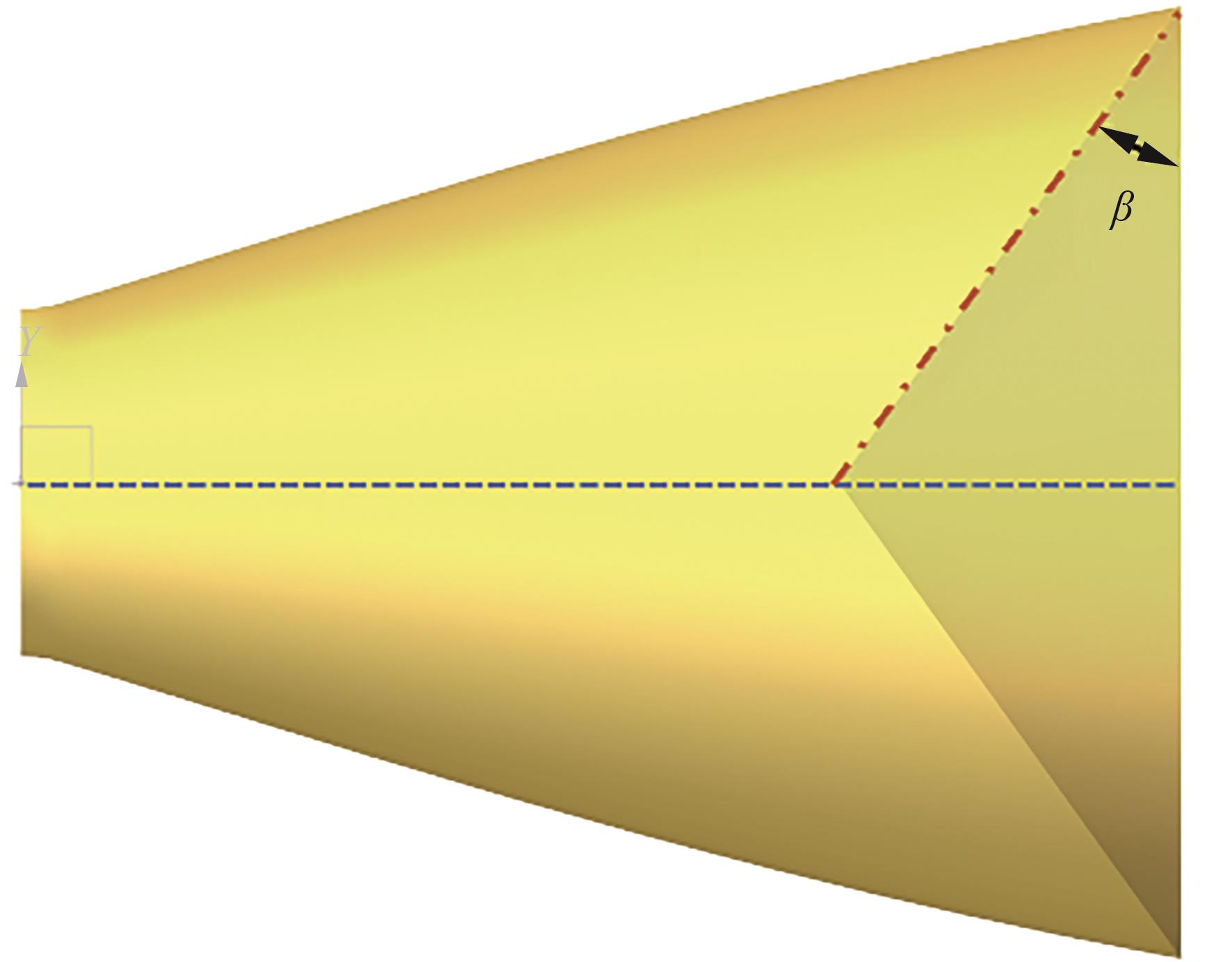
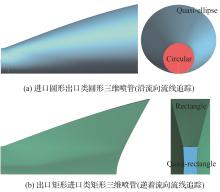
Fig.4
Three-dimensional nozzles generated by connecting streamlines
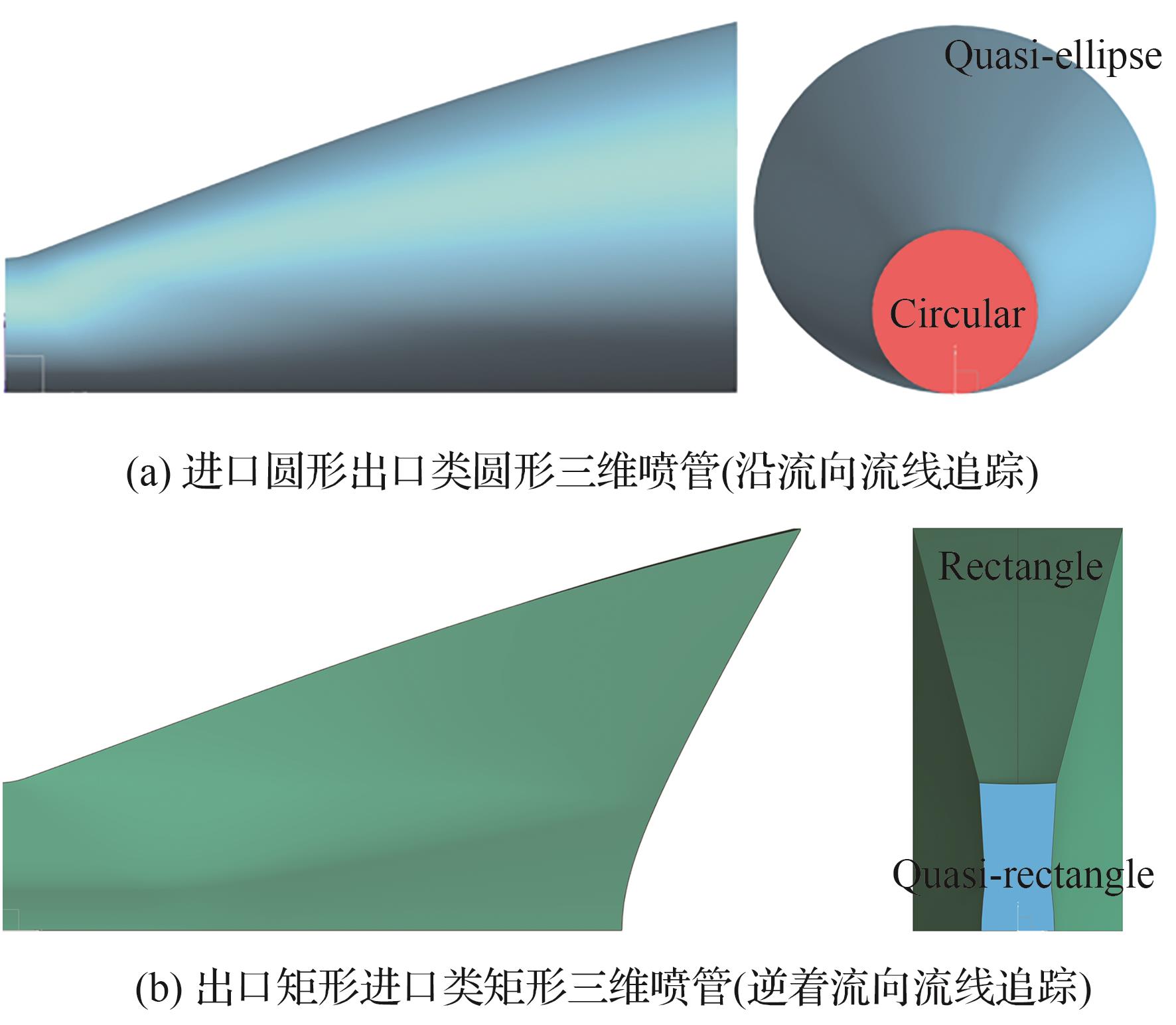
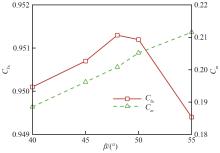
Fig.5
Performance curves of nozzle corresponding to different bevel angles
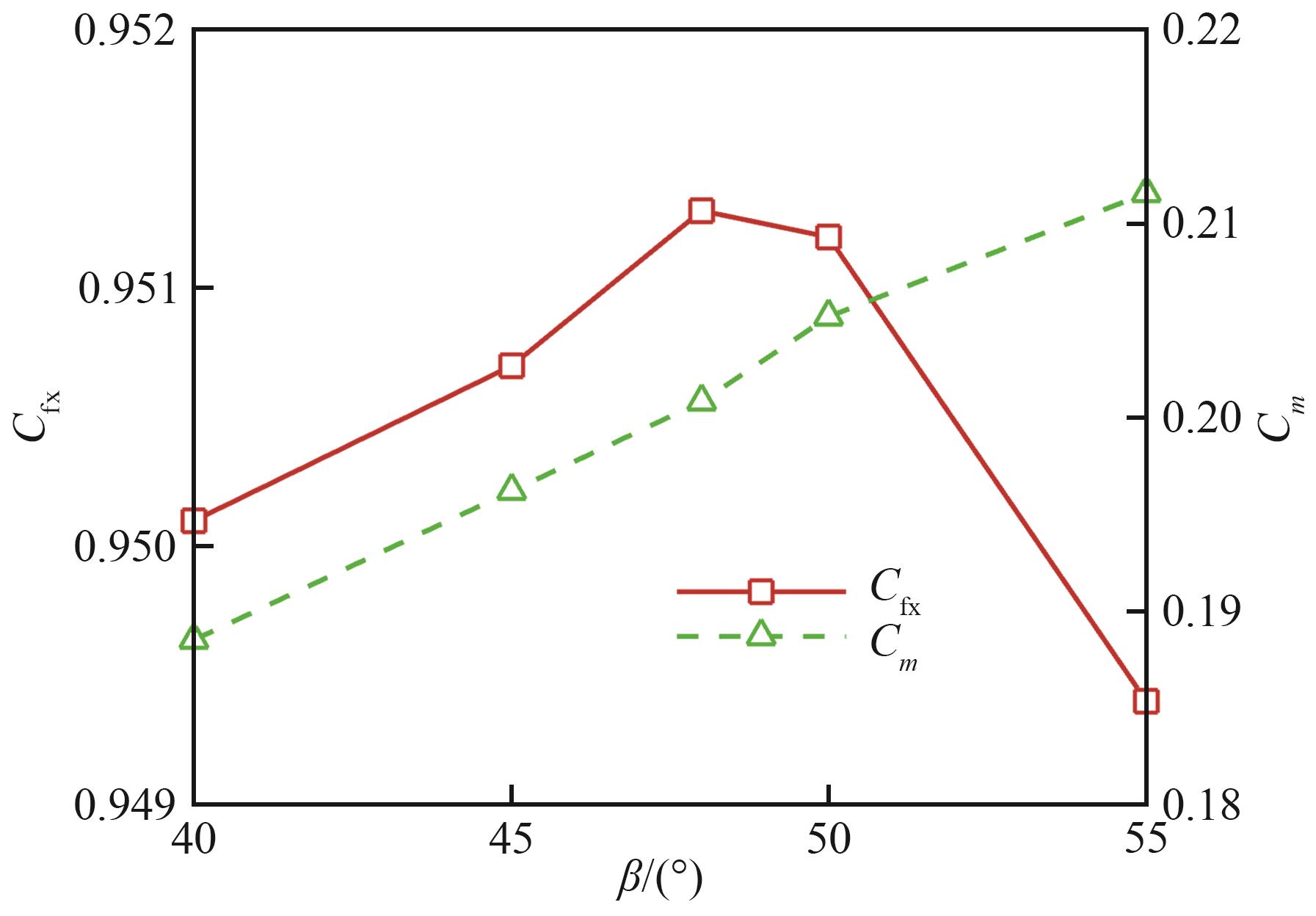
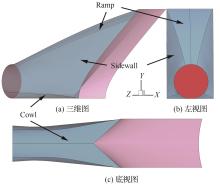
Fig.6
Three-dimensional nozzle with circular-to-rectangular shape transition
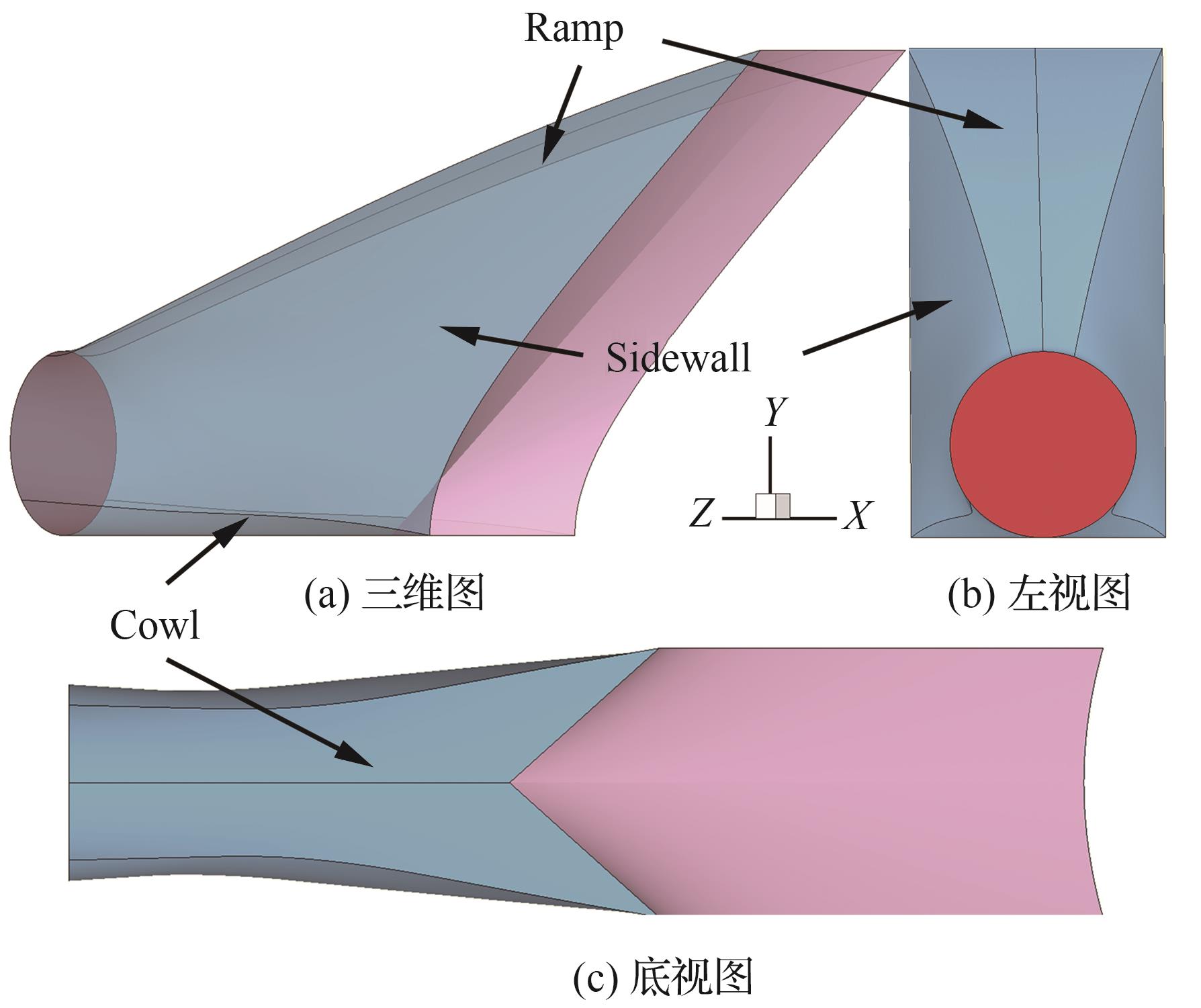
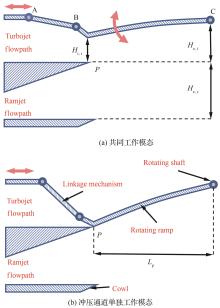
Fig.7
Sketch of over-under TBCC exhaust system
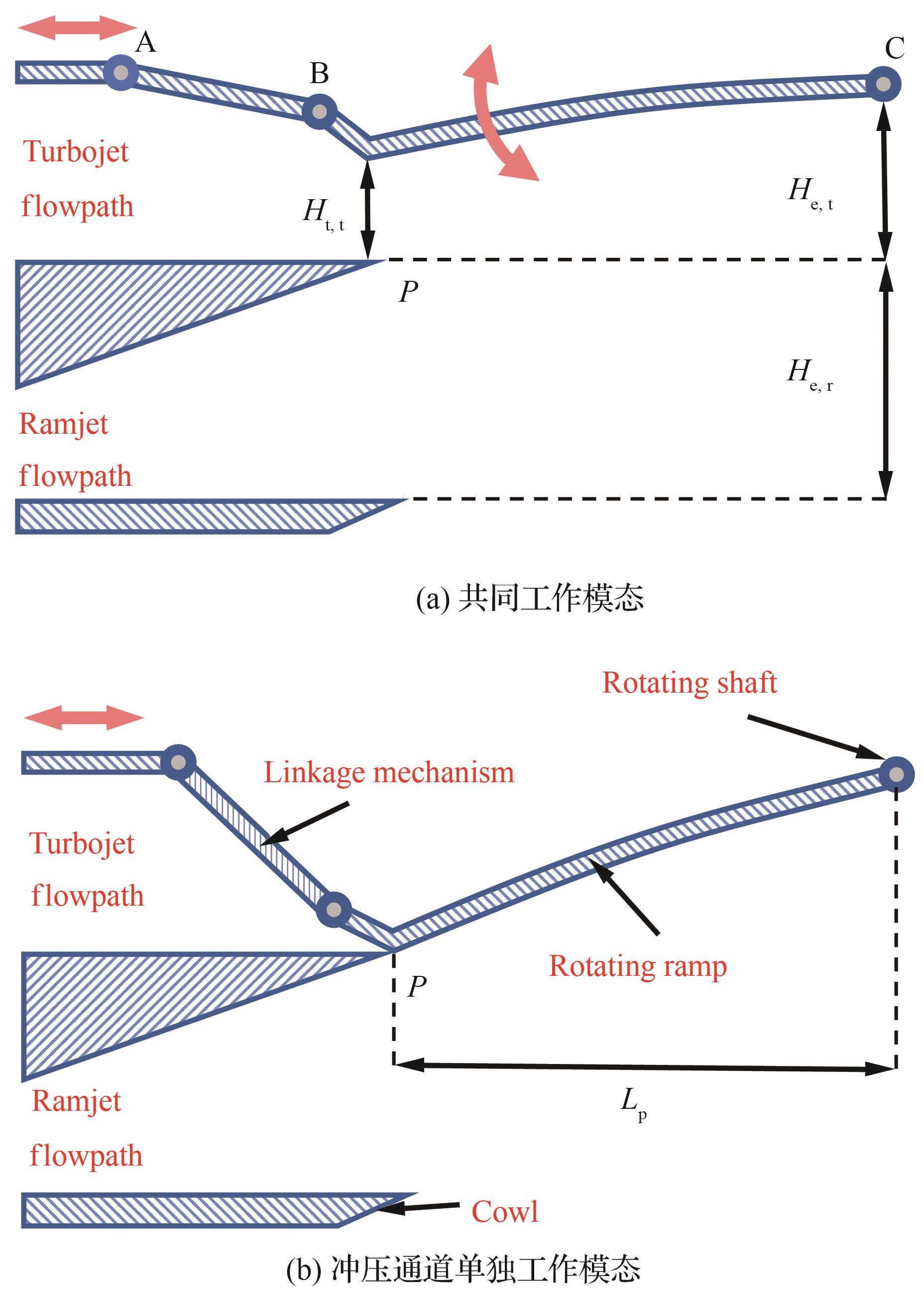
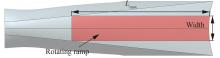
Fig.8
Sketch of rotating ramp
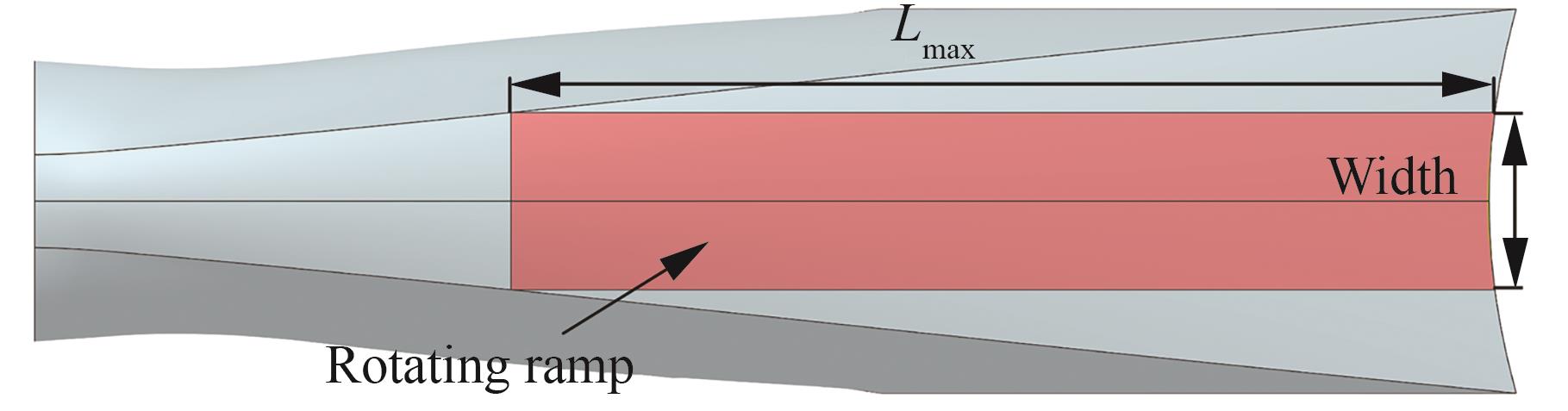
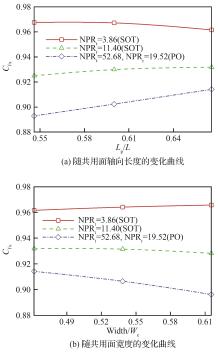
Fig.9
Thrust performance of exhaust system varies with geometric parameters of rotating ramp
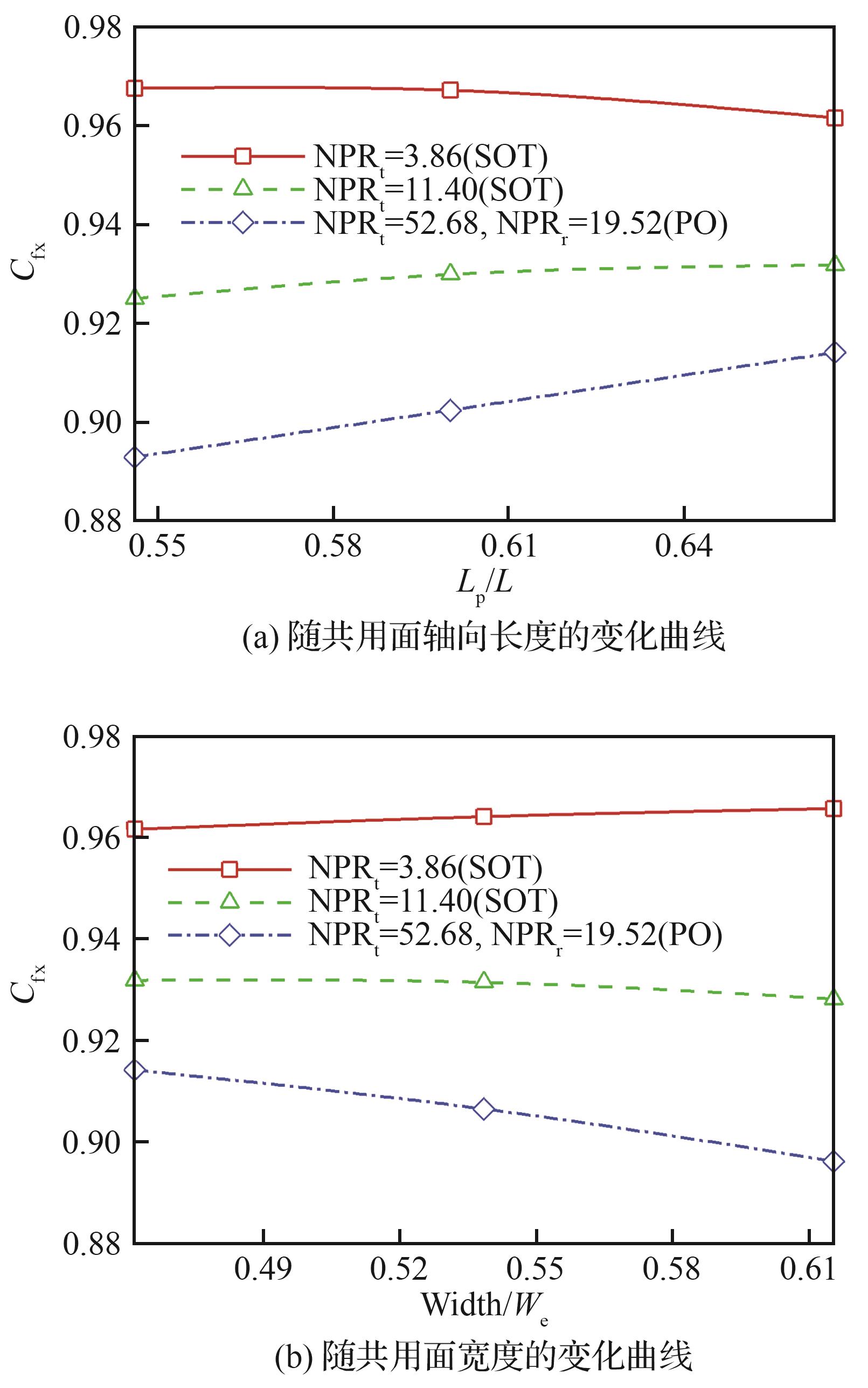
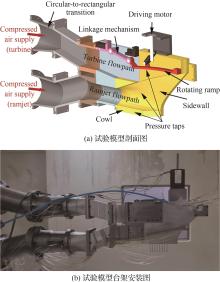
Fig.10
Dual-flowpath adjustable exhaust system model
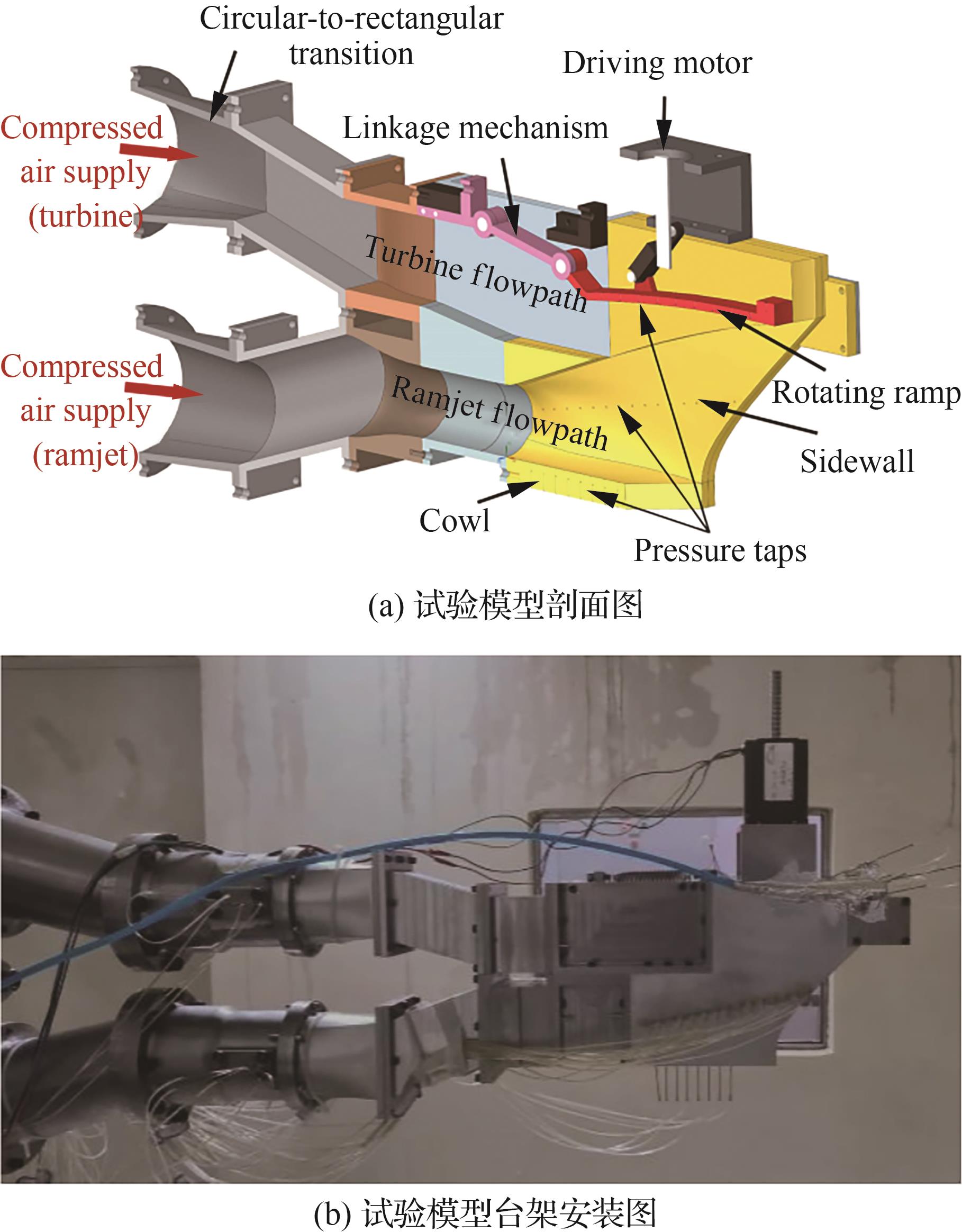
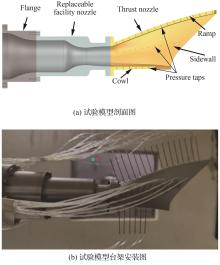
Fig.11
Exhaust system model of separate operation of ramjet
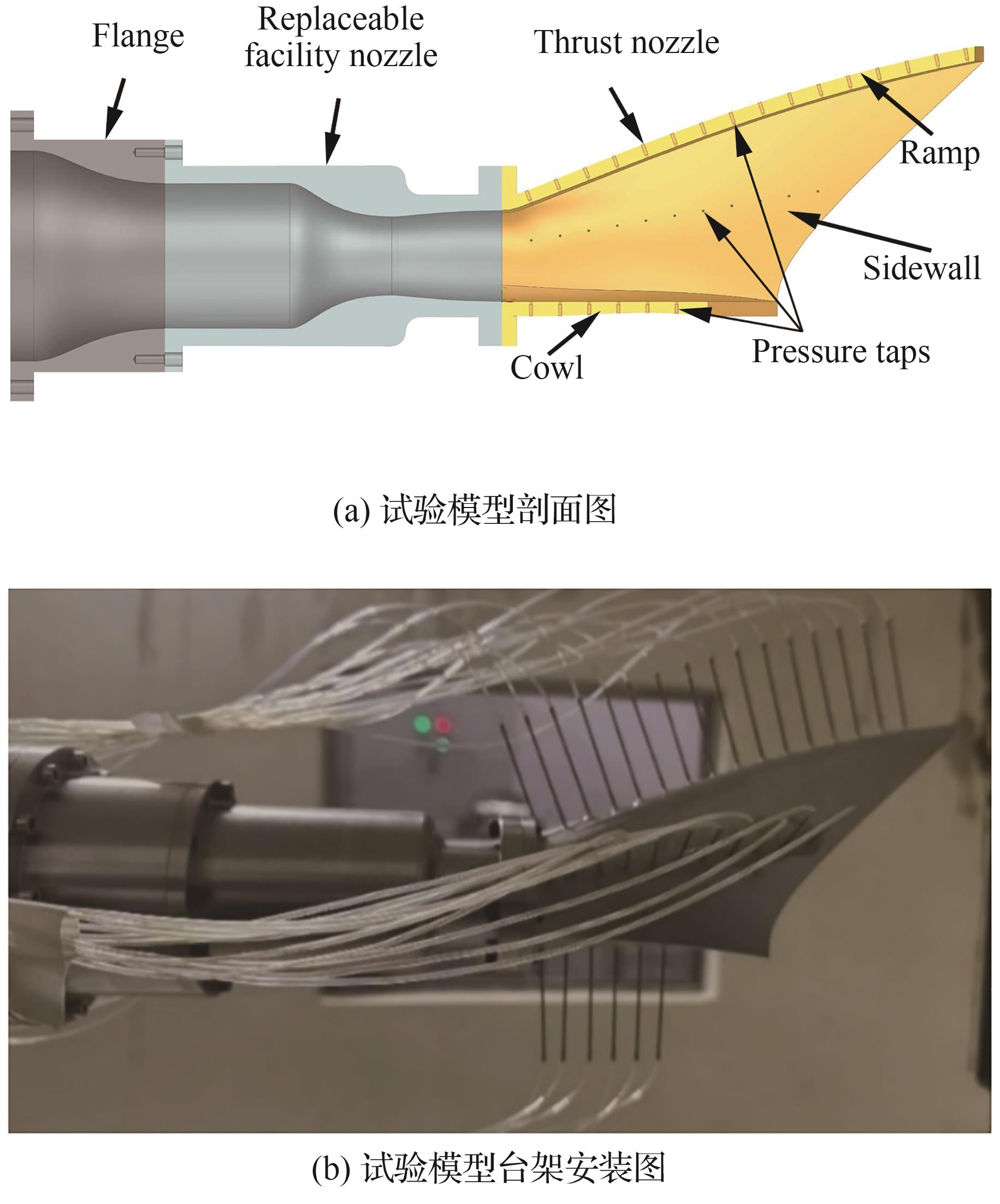

Table 1
Test condition parameters for typical operating points
| 工况点 | 飞行马赫数Ma∞ | 工作模态 | 涡轮通道压比NPRt | 冲压通道压比NPRr | 涡轮通道喉道高度Ht,t/He | 冲压通道进口 马赫数 |
|---|---|---|---|---|---|---|
| 1 | 0.8 | SOT | 5.42 | 0.275 2 | ||
| 2 | 1.5 | SOT | 11.40 | 0.250 0 | ||
| 3 | 2.5 | PO | 27.11 | 14.88 | 0.294 7 | 1.15 |
| 4 | 3.0 | PO | 44.49 | 12.65 | 0.293 3 | 1.22 |
| 5 | 3.5 | PO | 29.07 | 32.22 | 0.201 0 | 1.28 |
| 6 | 4.0 | SOR | 57.68 | 1.34 | ||
| 7 | 5.0 | SOR | 112.59 | 1.46 | ||
| 8 | 6.0 | SOR | 175.00 | 1.58 |
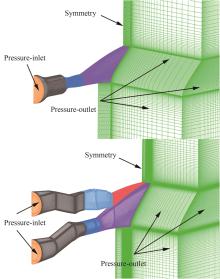
Fig.12
Computational grid and boundary conditions
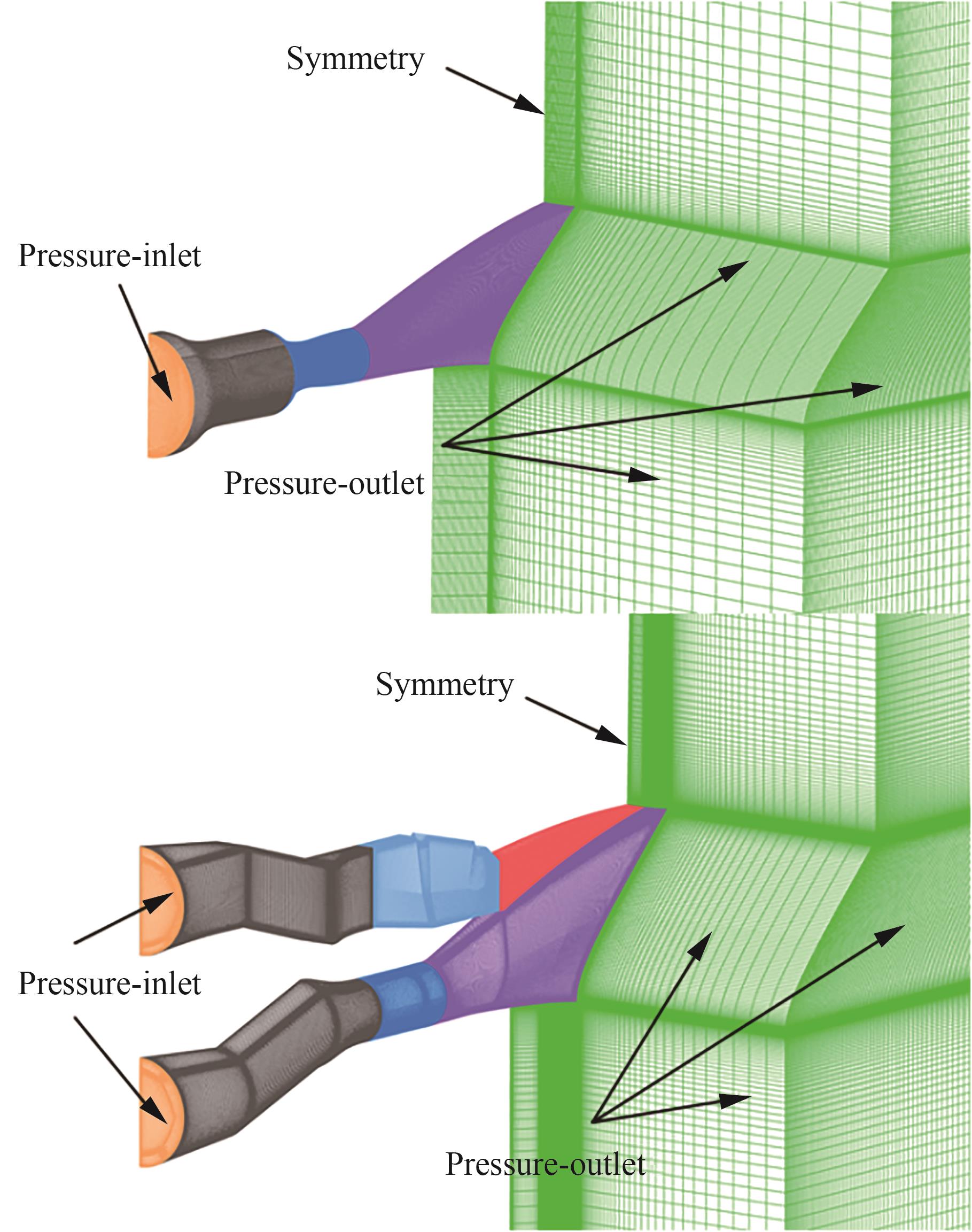
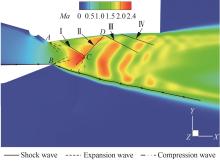
Fig.13
Mach number contours of symmetry plane at test point 1
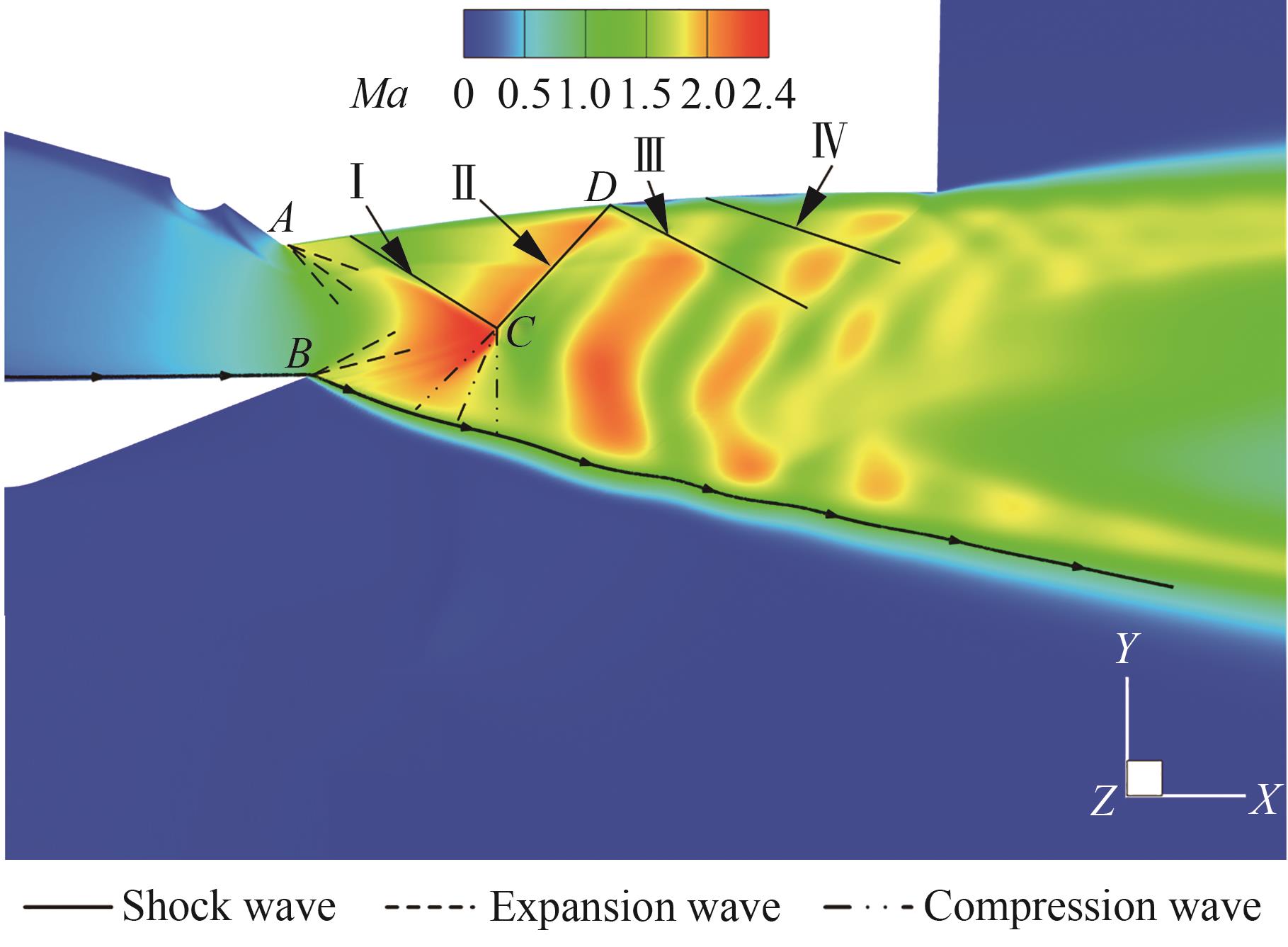
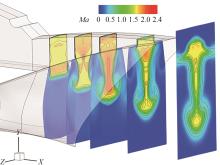
Fig.14
Mach number contours of 3D flow field at test point 1
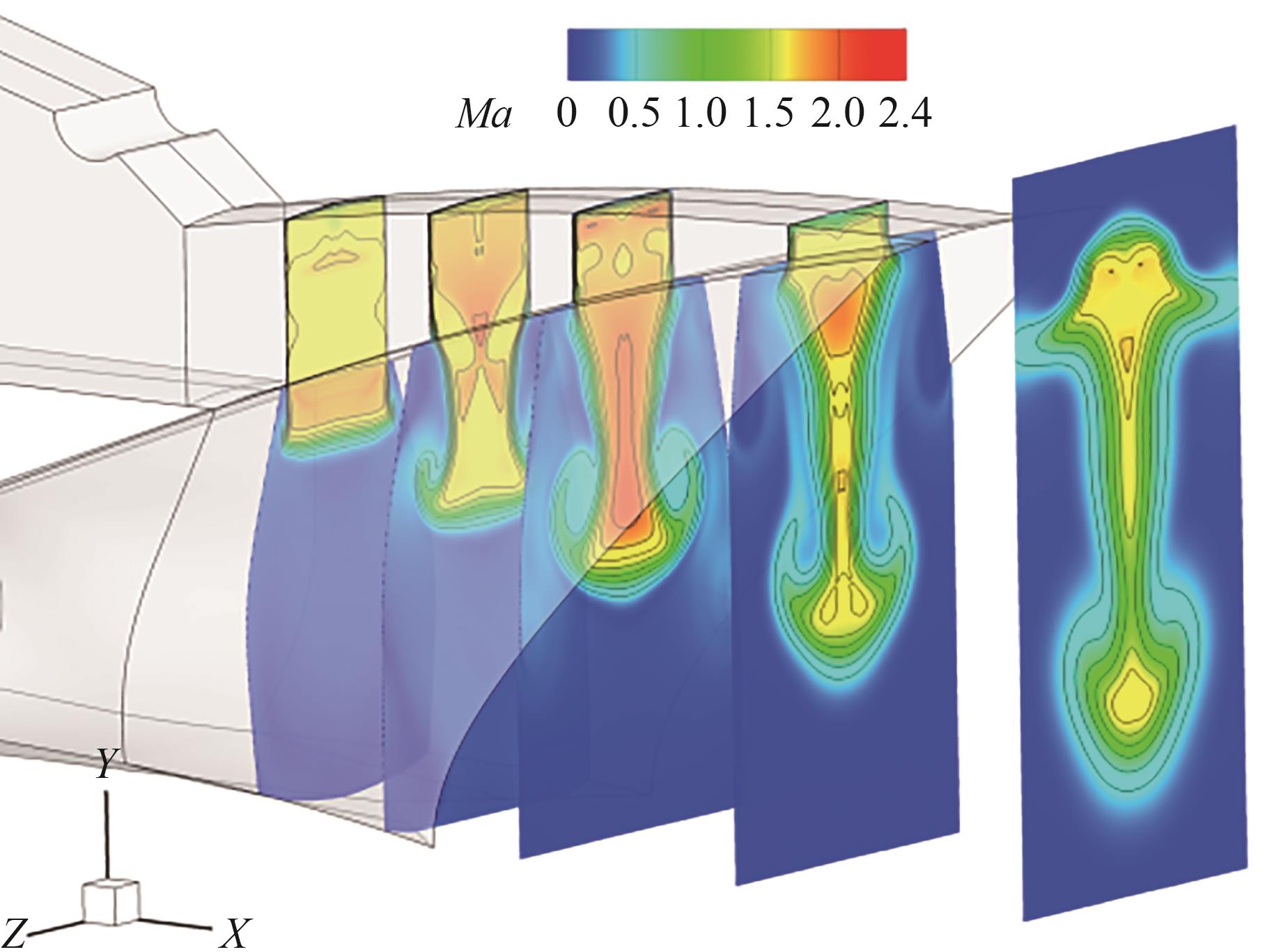
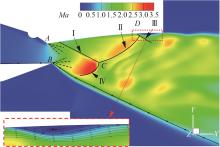
Fig.15
Mach number contours of symmetry plane at test point 2
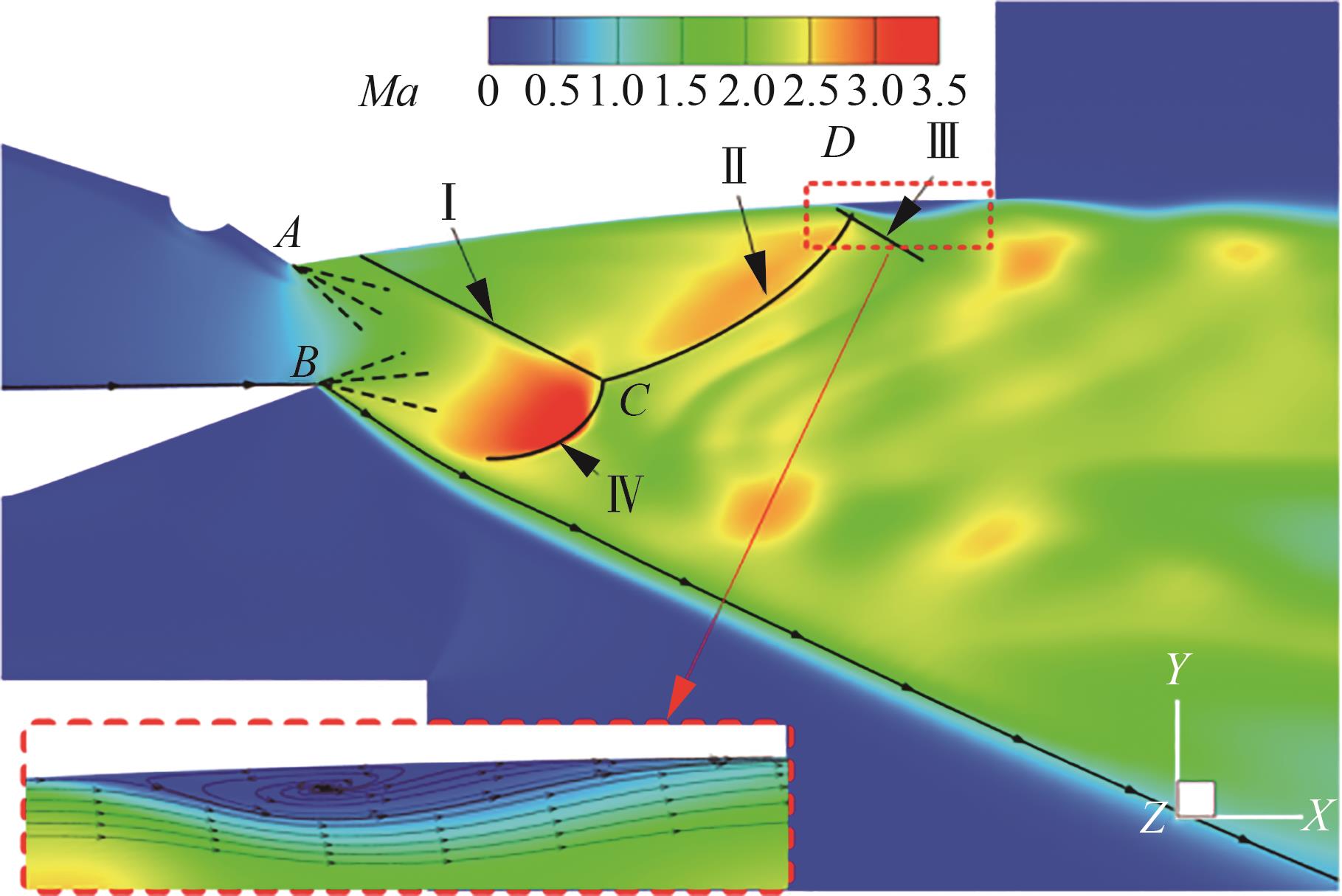
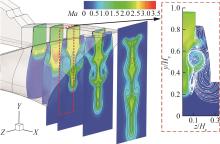
Fig.16
Mach number contours of 3D flow field at test point 2
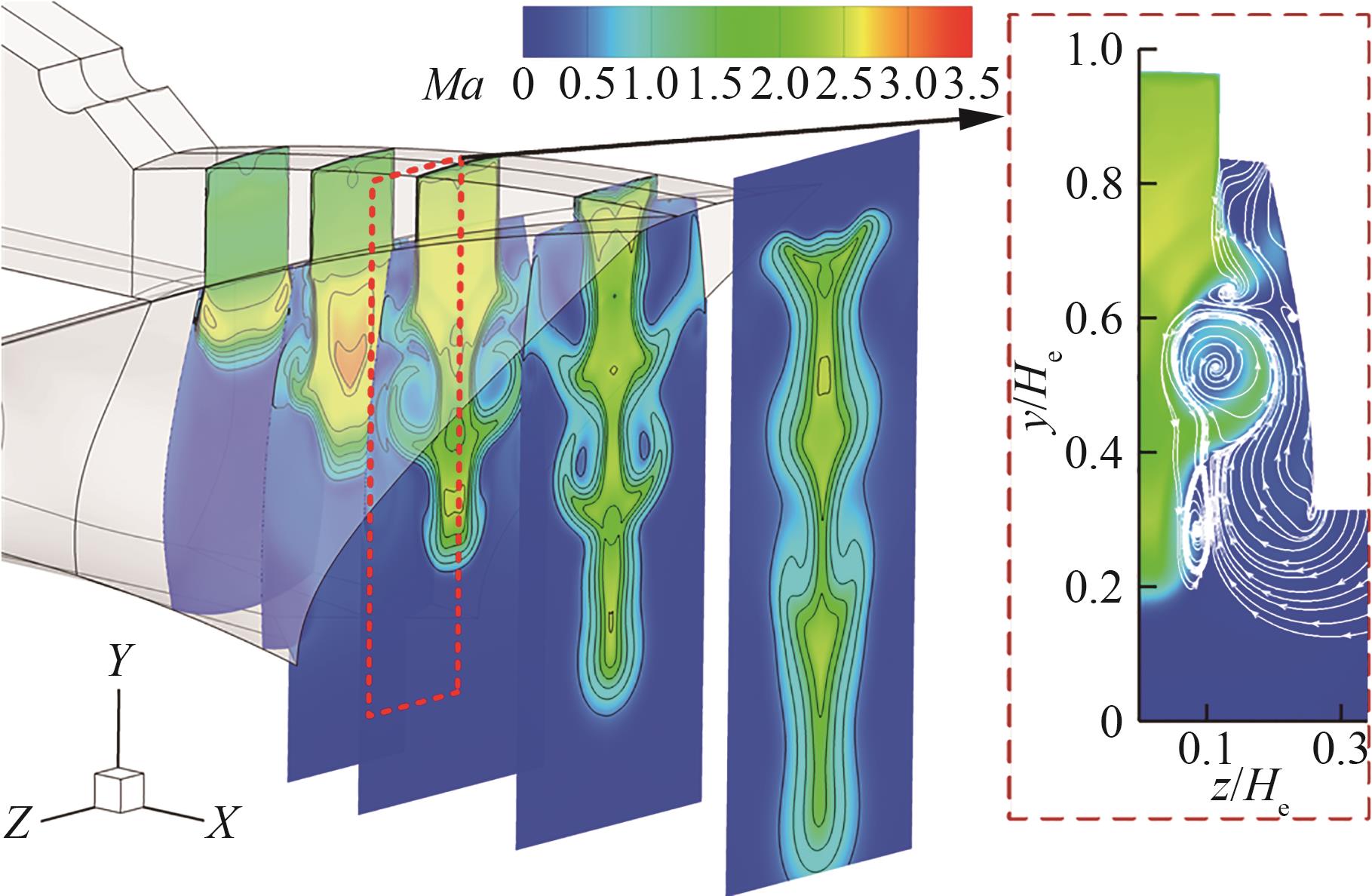
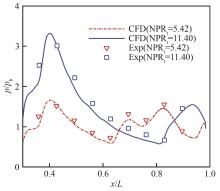
Fig.17
Comparison of experimental static pressure data with CFD prediction at test point 1 and 2
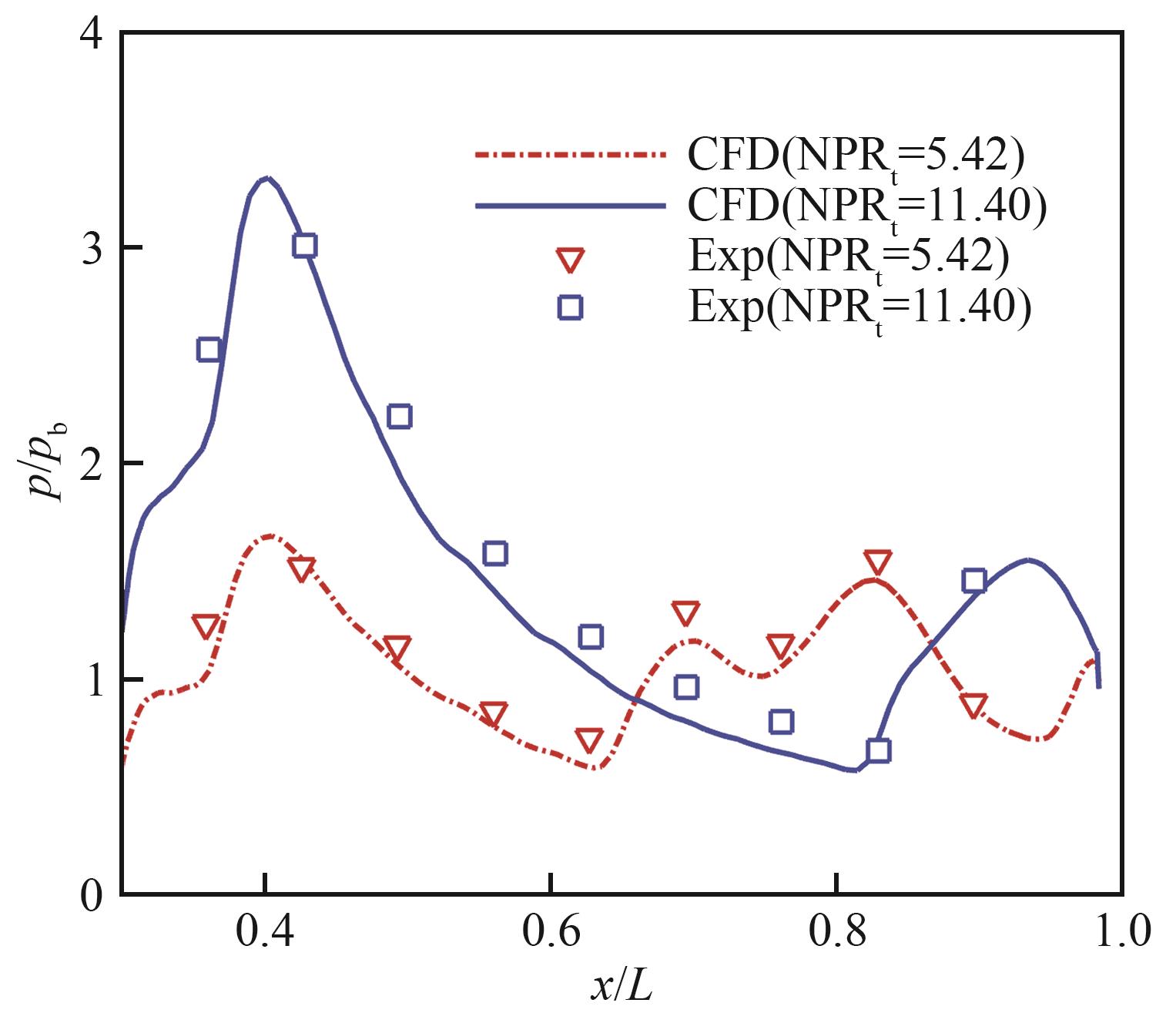
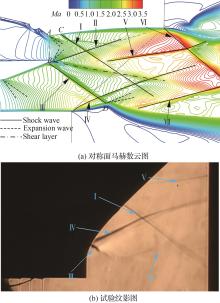
Fig.18
Mach number contours of symmetry plane and experimental schlieren image at test point 3
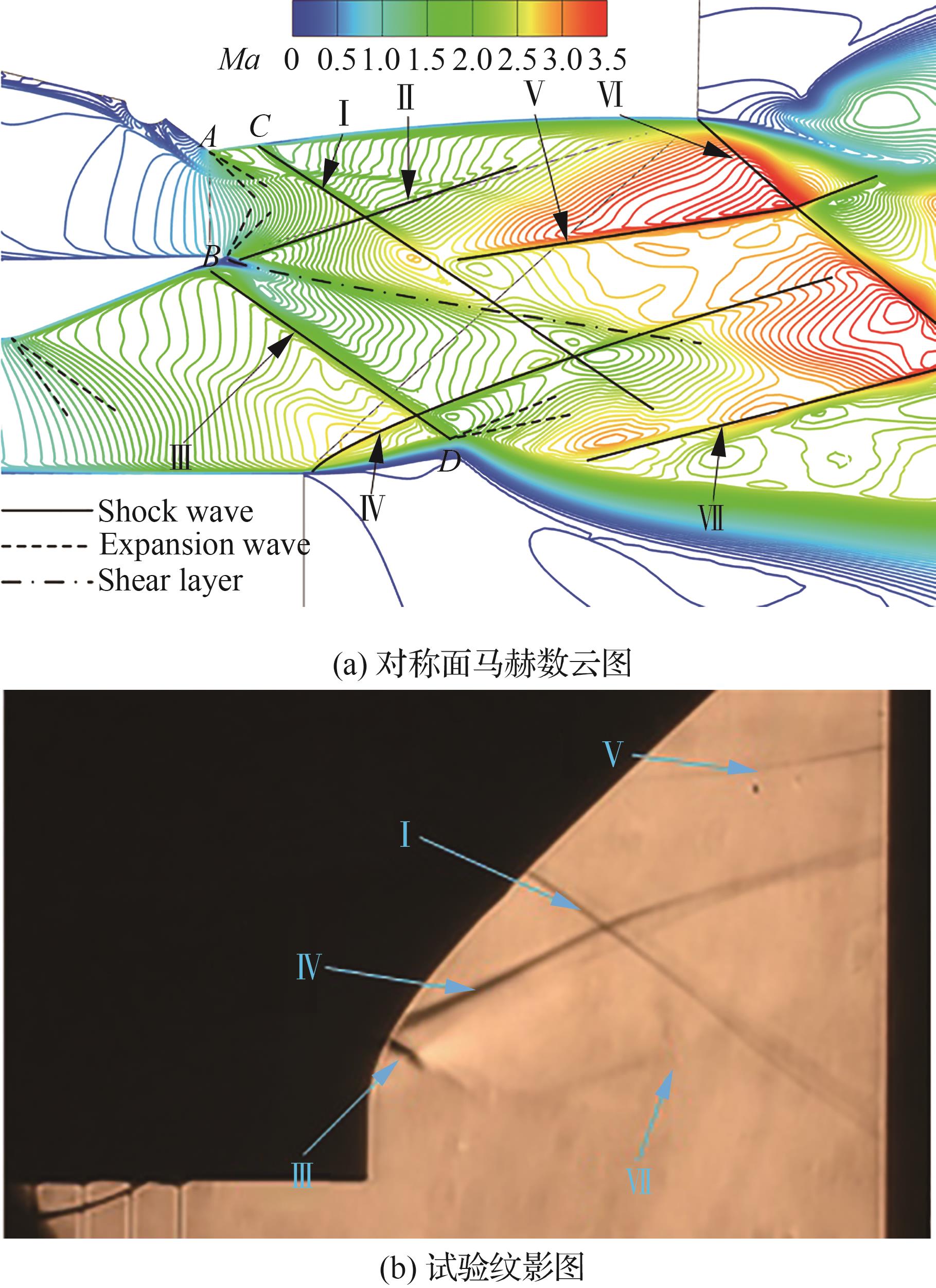
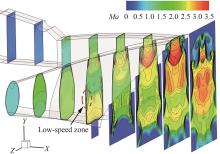
Fig.19
Mach number contours of 3D flow field at test point 3
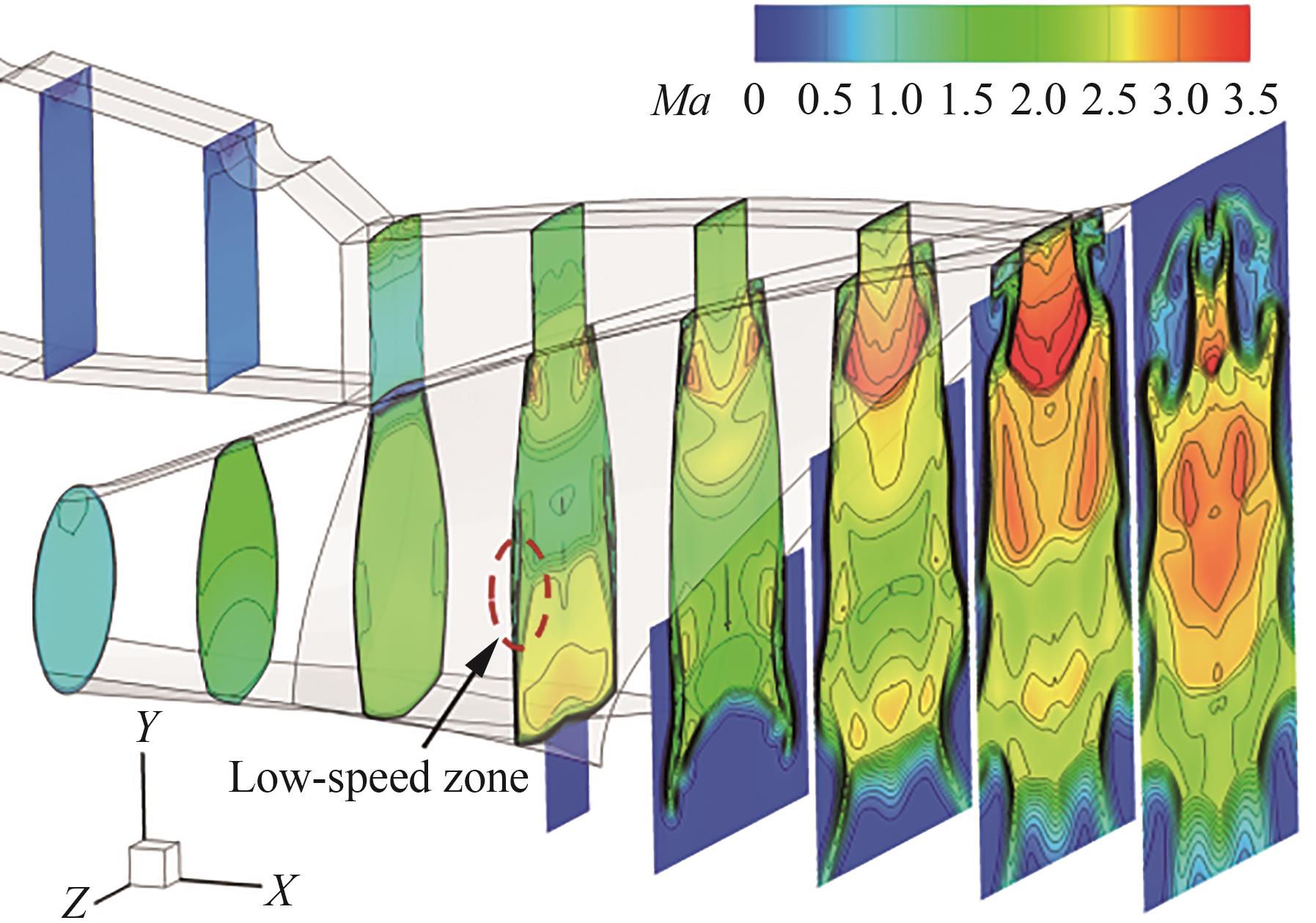
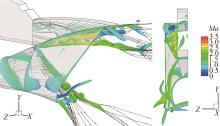
Fig.20
Flow structure in the exhaust system at test point 3 (based on Q criterion and Q=1×10⁹ s-2)
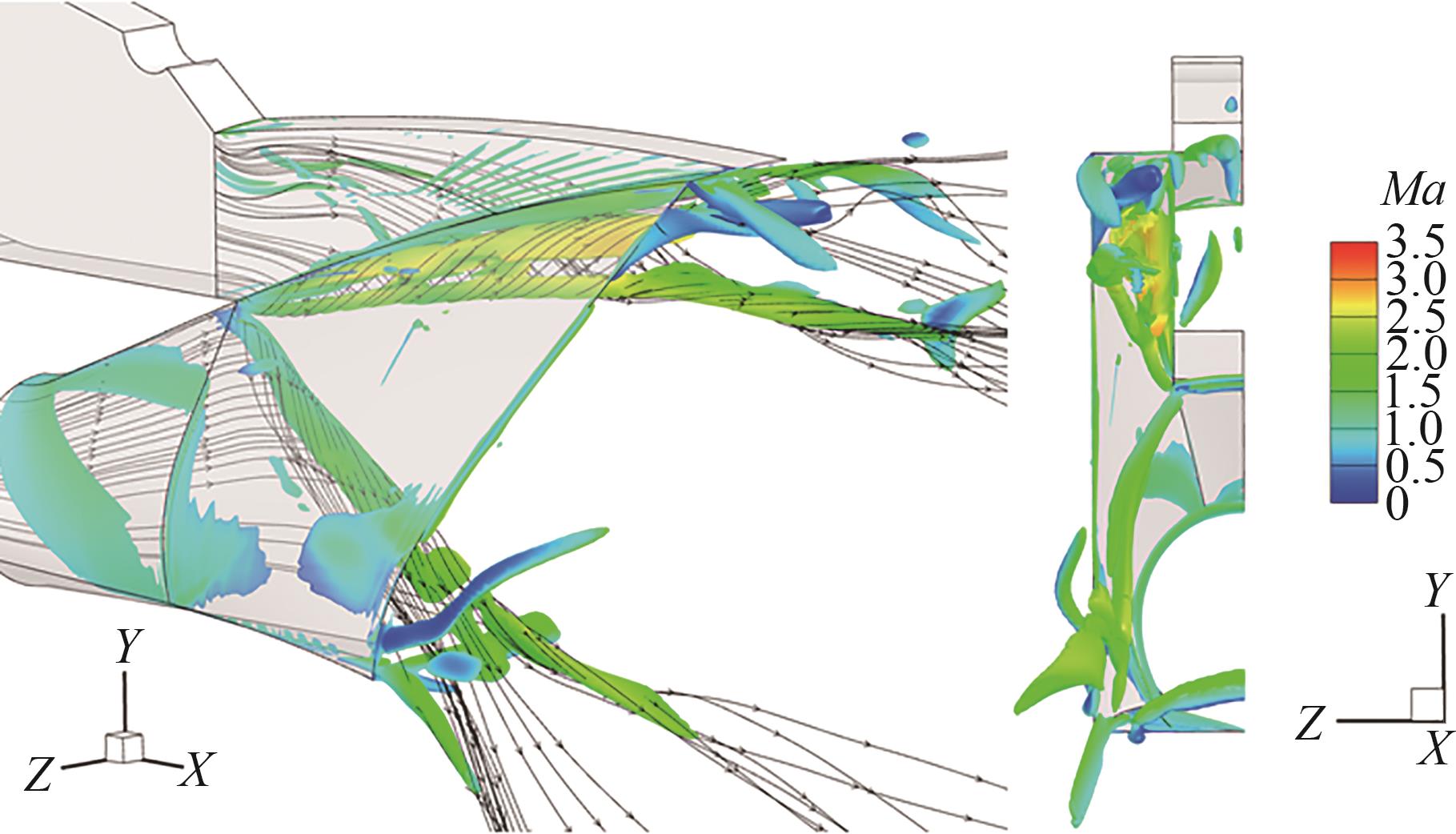
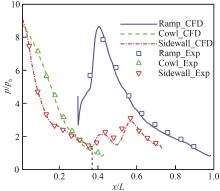
Fig.21
pressure distribution of test point 3
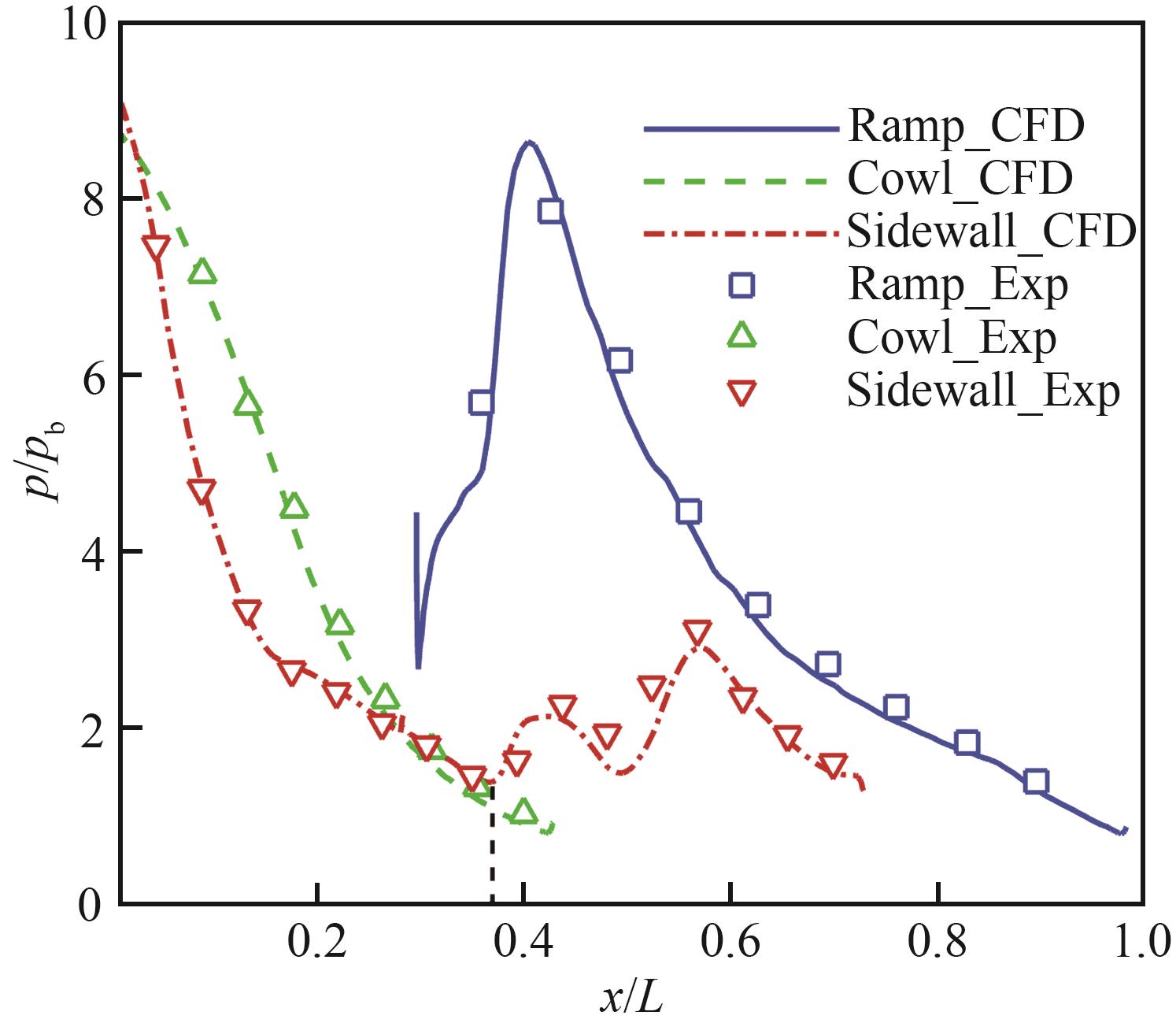
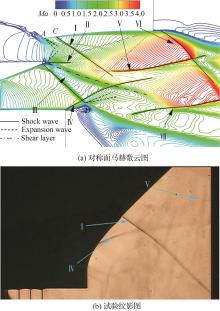
Fig.22
Mach number contours of symmetry plane and Experimental schlieren image at test point 4
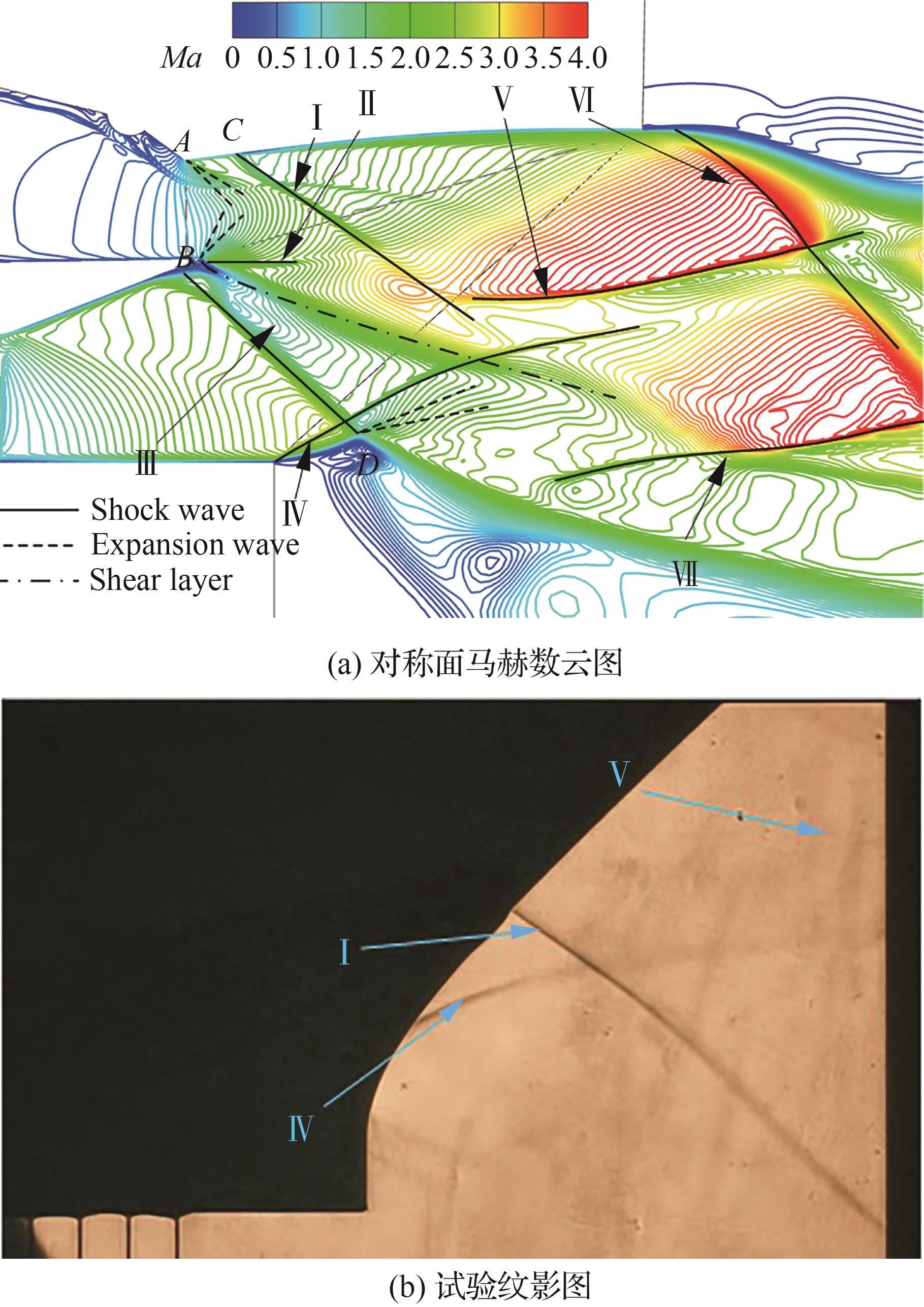
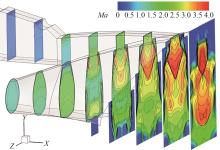
Fig.23
Mach number contours of 3D flow field at test point 4
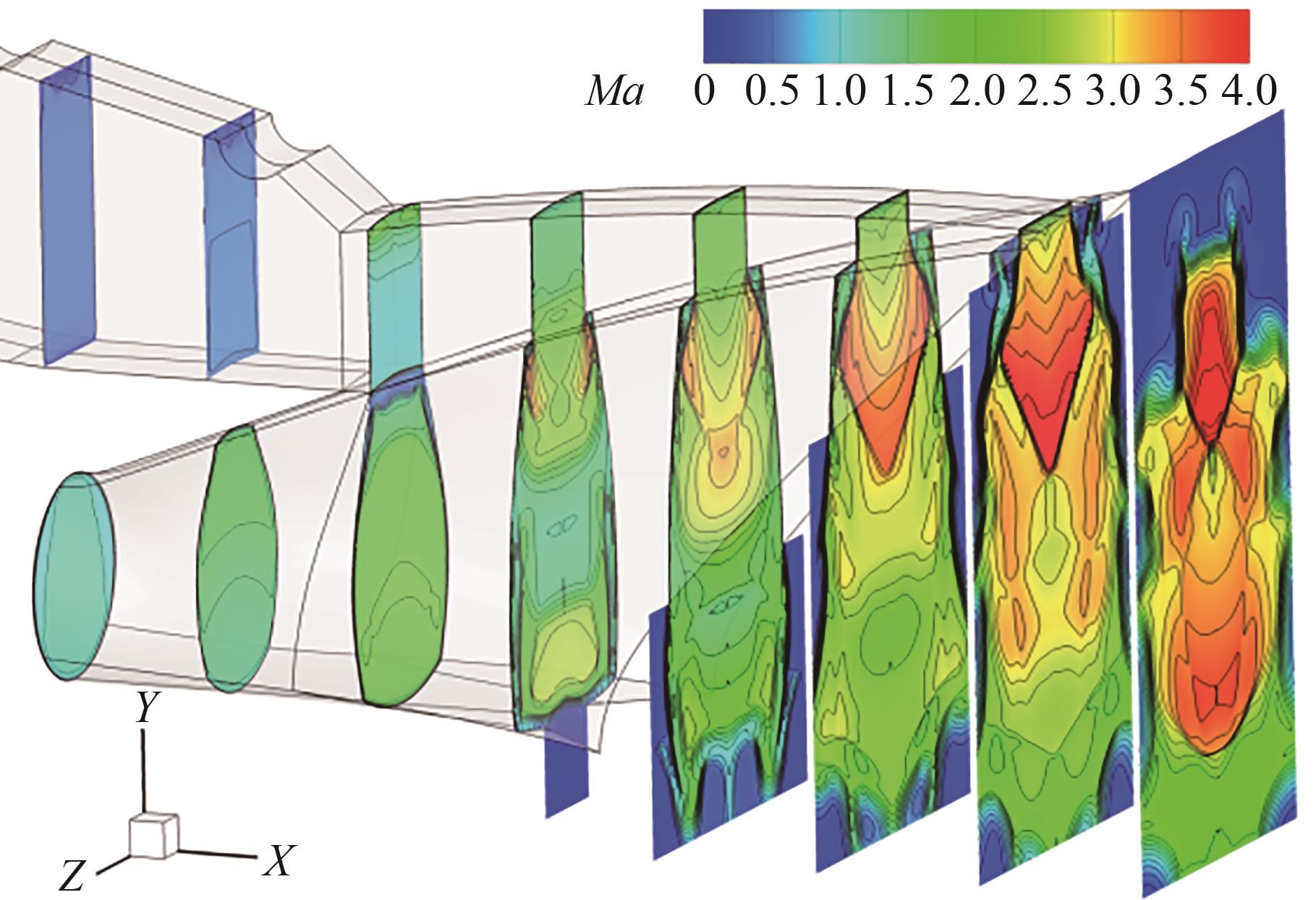
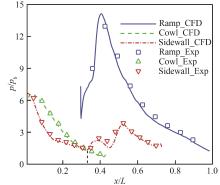
Fig.24
pressure distribution of test point 4
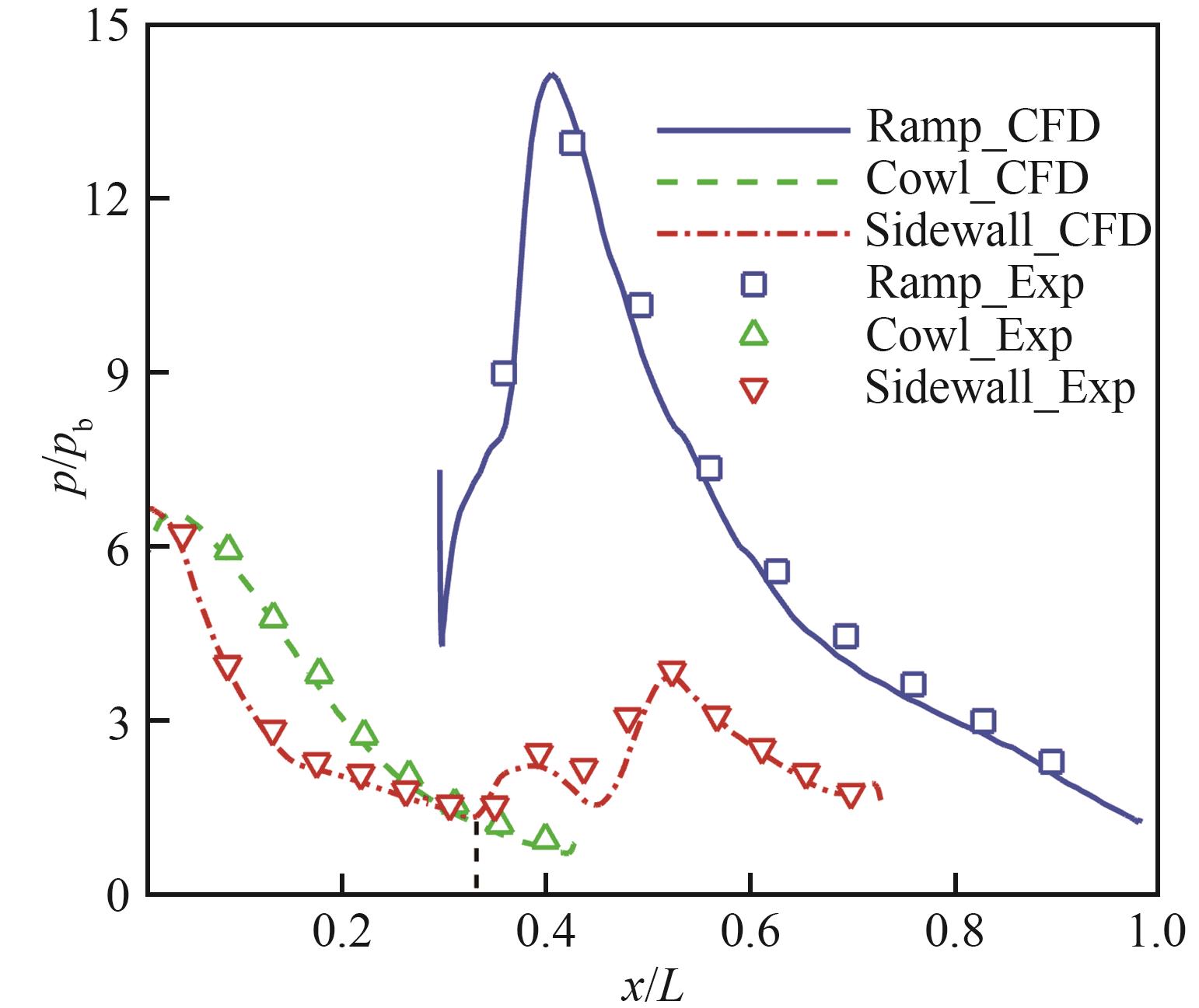
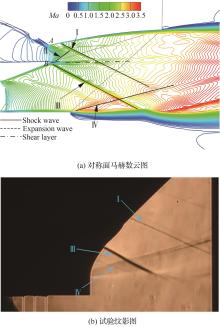
Fig.25
Mach number contours of symmetry plane and experimental schlieren image at test point 5
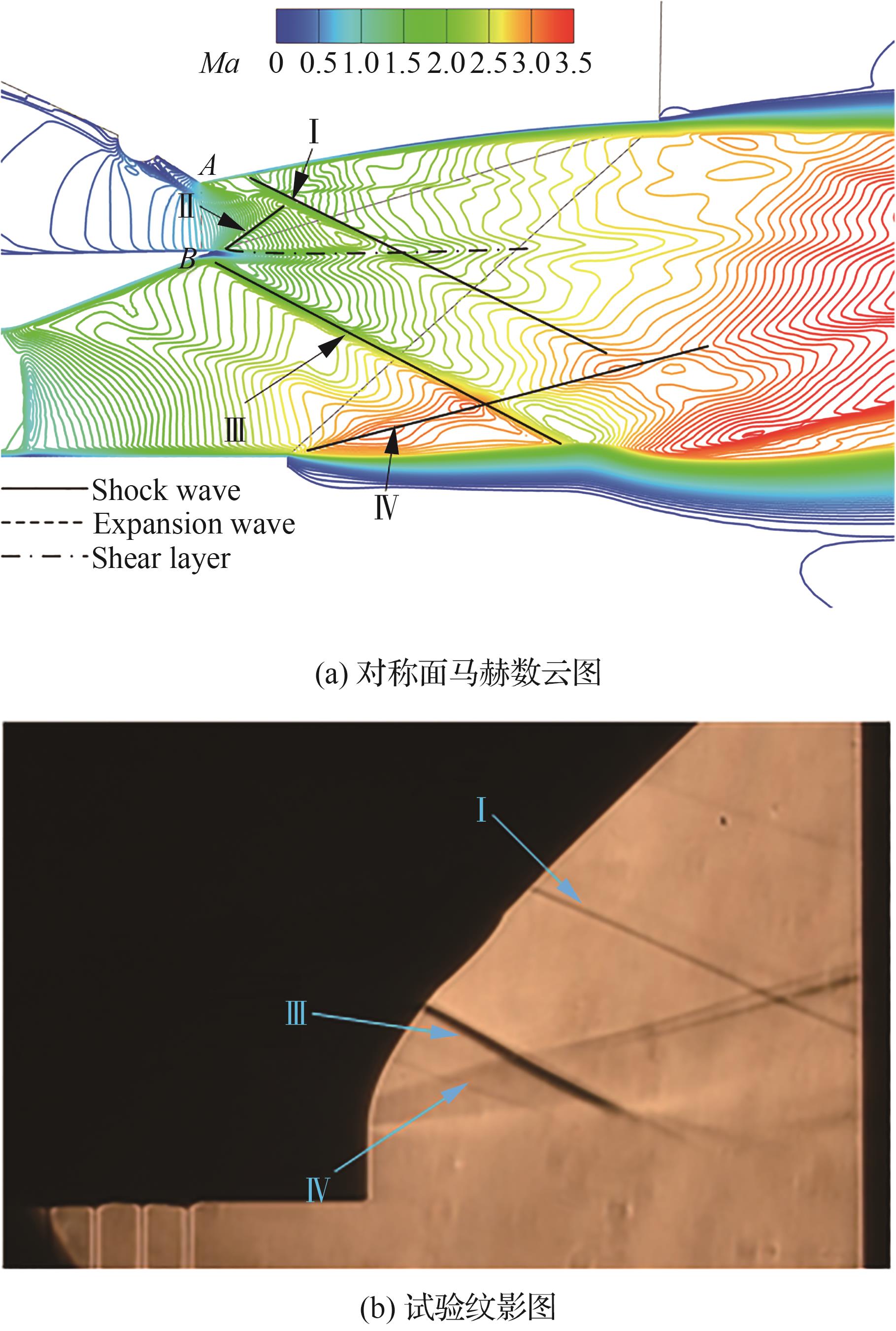
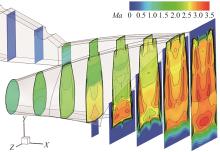
Fig.26
Mach number contours of 3D flow field at test point 5
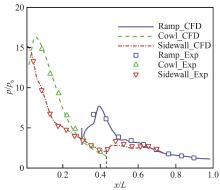
Fig.27
Pressure distribution of test point 5
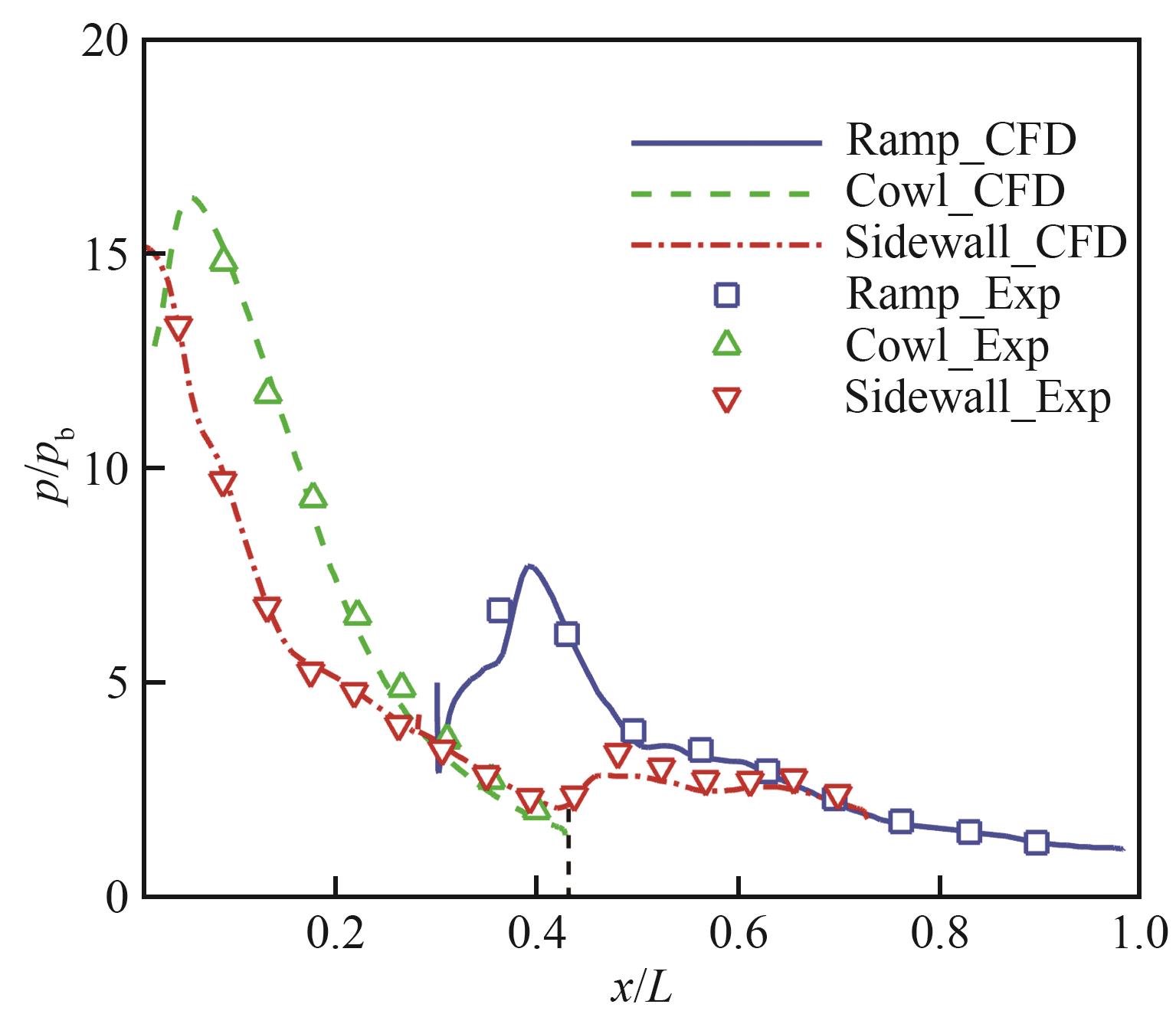
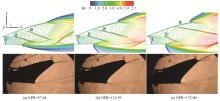
Fig.28
Mach number contours of symmetry plane and 3D flow field at test point 6-8
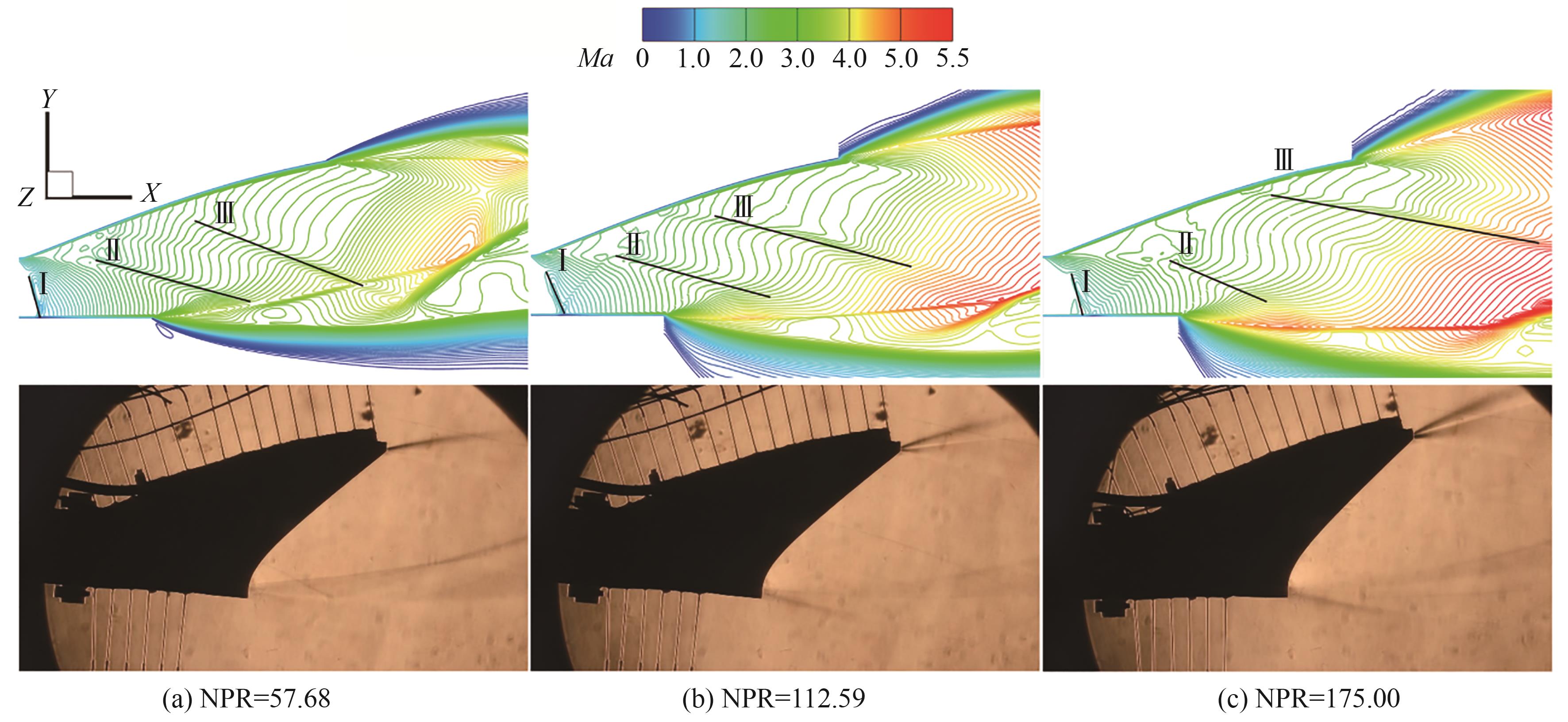
Fig.29
Experimental schlieren image at test point 6-8
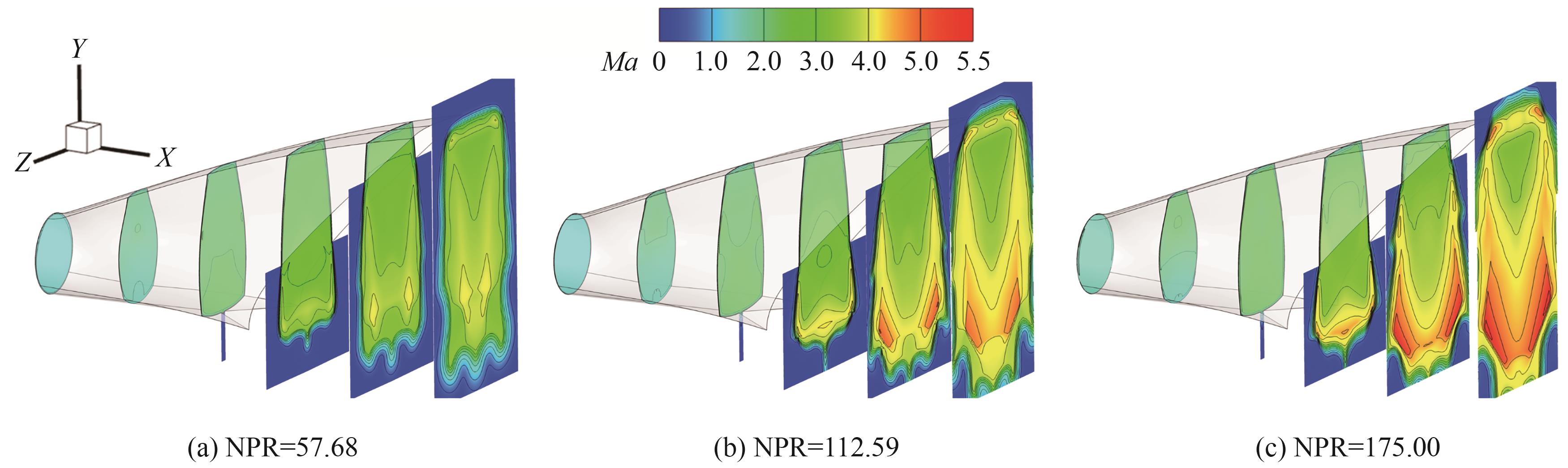
Fig.30
Pressure distribution of test point 6-8
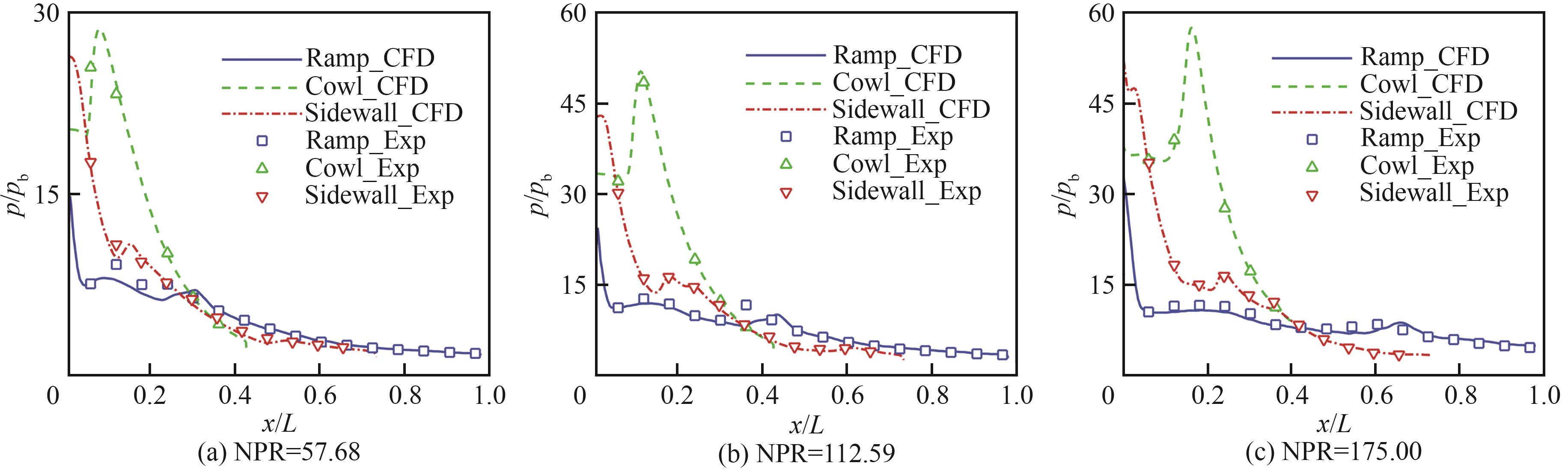
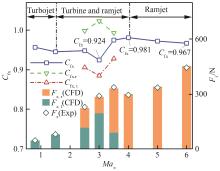
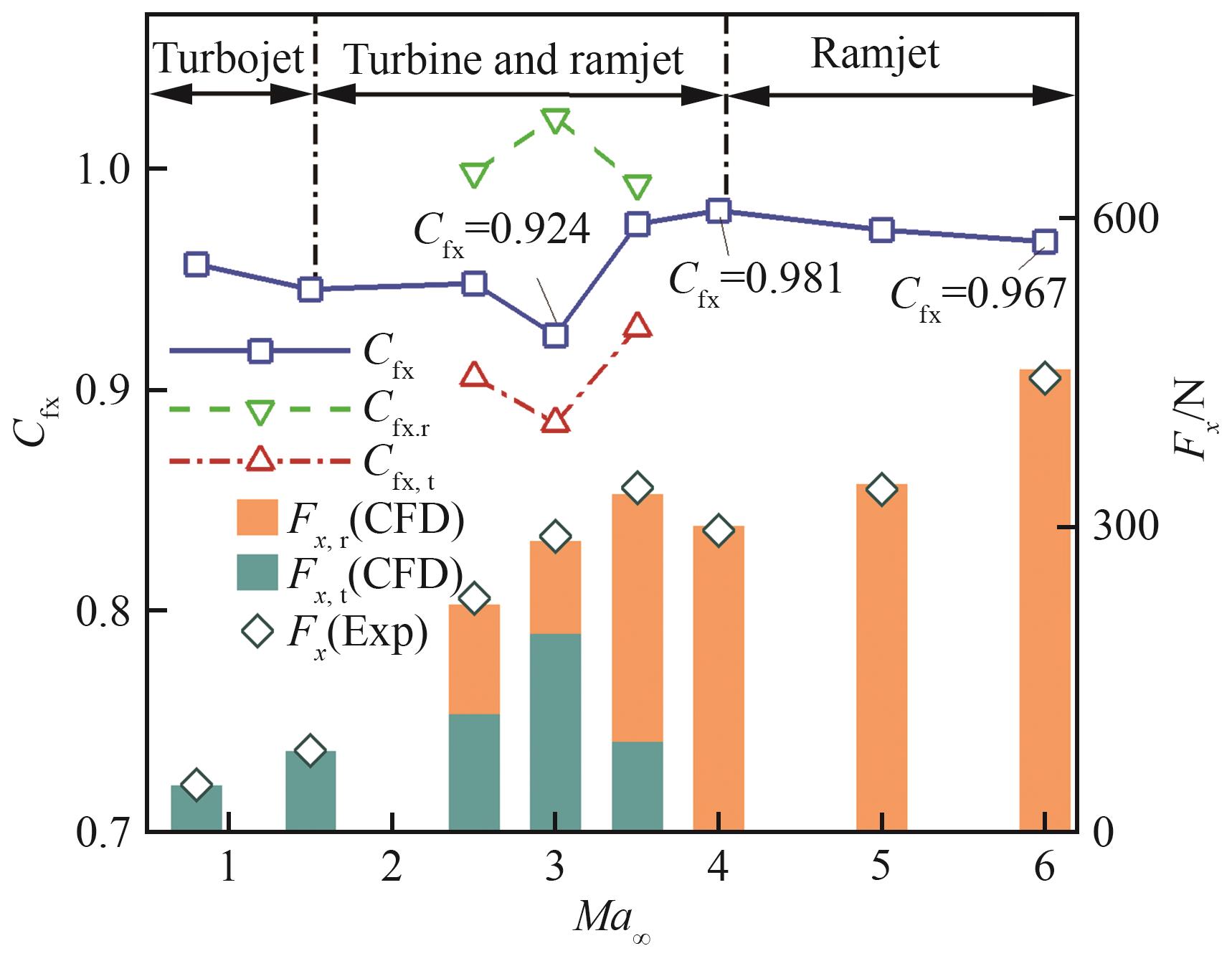
Fig.31
Thrust coefficient over flight envelop
| [1] | 徐惊雷. 超燃冲压及TBCC组合循环发动机尾喷管设计方法研究进展[J]. 推进技术, 2018, 39(10): 2236-2251. |
| XU J L. Research progress of nozzle design method for scramjet and turbine based combined cycle[J]. Journal of Propulsion Technology, 2018, 39(10): 2236-2251 (in Chinese). | |
| [2] | 左林玄, 张辰琳, 王霄, 等. 高超声速飞机动力需求探讨[J]. 航空学报, 2021, 42(8): 525798. |
| ZUO L X, ZHANG C L, WANG X, et al. Requirement of hypersonic aircraft power[J]. Acta Aeronautica et Astronautica Sinica, 2021, 42(8): 525798 (in Chinese). | |
| [3] | 林鹏, 庄福建, 曲林锋, 等. 高超声速飞机尾喷管设计-制造与验证技术发展综述[J]. 航空学报, 2022, 43(6): 526160. |
| LIN P, ZHUANG F J, QU L F, et al. Technological development in hypersonic nozzle design, manufacture and validation: A review[J]. Acta Aeronautica et Astronautica Sinica, 2022, 43(6): 526160 (in Chinese). | |
| [4] | 马松, 林鹏, 左林玄, 等. 并联TBCC动力对高超声速飞行器性能的影响[J]. 国防科技大学学报, 2019, 41(2): 1-7. |
| MA S, LIN P, ZUO L X, et al. Influence of over-under TBCC on the performance of hypersonic aircraft[J]. Journal of National University of Defense Technology, 2019, 41(2): 1-7 (in Chinese). | |
| [5] | SIEBENHAAR A, BOGAR T. Integration and vehicle performance assessment of the aerojet “TriJet” combined-cycle engine[C]∥16th AIAA/DLR/DGLR International Space Planes and Hypersonic Systems and Technologies Conference. Reston: AIAA, 2009. |
| [6] | 莫建伟. TBCC排气系统设计方法及流场特性研究[D]. 南京: 南京航空航天大学, 2015: 107-131. |
| MO JIANWEI. Research on design method and flow characteristics of TBCC exhaust system[D]. Nanjing: Nanjing University of Aeronautics and Astronautics, 2015: 107-131 (in Chinese). | |
| [7] | MO J W, XU J L, ZHANG L H, et al. The experimental and numerical study of the over-under TBCC exhaust system[C]∥17th AIAA International Space Planes and Hypersonic Systems and Technologies Conference. Reston: AIAA, 2011: 2234. |
| [8] | 牛彦沣. 并联式 TBCC 排气系统设计方法及性能研究[D]. 南京: 南京航空航天大学, 2016: 15-28. |
| NIU YANFENG. Research on design and performance study of over-under TBCC exhaust system flow structure[D]. Nanjing: Nanjing University of Aeronautics and Astronautics, 2016: 15-28 (in Chinese). | |
| [9] | 牛彦沣, 徐惊雷, 许保成, 等. 并联TBCC排气系统流场结构数值模拟及实验研究[J]. 推进技术, 2017, 38(12): 2686-2691. |
| NIU Y F, XU J L, XU B C, et al. Numerical and experimental study of over-under TBCC exhaust system flow structure[J]. Journal of Propulsion Technology, 2017, 38(12): 2686-2691 (in Chinese). | |
| [10] | XU B C, XU J L, WANG X, et al. Flowfield and performance analysis of a three-dimensional TBCC exhaust nozzle[J]. Journal of Engineering for Gas Turbines and Power, 2017, 139(11): 112602. |
| [11] | 花文达, 徐惊雷. 三维并联式TBCC发动机排气系统设计与实验[J]. 航空动力学报, 2018, 33(9): 2268-2277. |
| HUA W D, XU J L. Design approach and experiment of three-dimensional over/under TBCC exhaust system[J]. Journal of Aerospace Power, 2018, 33(9): 2268-2277 (in Chinese). | |
| [12] | 吕郑. Ma0-6并联式TBCC排气系统的设计及性能研究[D]. 南京: 南京航空航天大学, 2019: 38-149. |
| LVZ. Design and performance study of Ma0-6 parallel TBCC exhaust system[D]. Nanjing: Nanjing University of Aeronautics and Astronautics, 2019: 38-149 (in Chinese). | |
| [13] | OGAWA H, BOYCE R R. Nozzle design optimization for axisymmetric scramjets by using surrogate-assisted evolutionary algorithms[J]. Journal of Propulsion and Power, 2012, 28(6): 1324-1338. |
| [14] | TANIMIZU K, MEE D J, STALKER R J, et al. Nozzle design study for a quasi-axisymmetric scramjet-powered vehicle at Mach 7.9 flight conditions[J]. Shock Waves, 2013, 23(5): 453-460. |
| [15] | 魏仁敏, 杜刚, 金捷. 基于Kriging代理模型的单边膨胀喷管尾缘切角优化[J]. 航空动力学报, 2018, 33(4): 874-881. |
| WEI R M, DU G, JIN J. Optimization of trailing edge angles of single expansion ramp nozzle based on Kriging method[J]. Journal of Aerospace Power, 2018, 33(4): 874-881 (in Chinese). | |
| [16] | 卢鑫, 岳连捷, 肖雅彬, 等. 超燃冲压发动机三维变截面尾喷管设计[C]∥第三届高超声速科技学术会议会议文集. 北京: 中国力学学会, 2010: 254-259. |
| LU X, YUE L J, XIAO Y B, et al. Design of three-dimensional section controllable scramjet nozzle[C]∥Proceedings of the 3rd International Conference on Hypersonic Technology. Beijing: Chinese Society of Theoretical and Applied Mechanics, 2010: 254-259. | |
| [17] | 卢鑫, 岳连捷, 肖雅彬, 等. 超燃冲压发动机尾喷管流线追踪设计[J]. 推进技术, 2011, 32(1): 91-96. |
| LU X, YUE L J, XIAO Y B, et al. Design of scramjet nozzle based on streamline tracing technique[J]. Journal of Propulsion Technology, 2011, 32(1): 91-96 (in Chinese). | |
| [18] | MO J W, XU J L, GU R, et al. Design of an asymmetric scramjet nozzle with circular to rectangular shape transition[J]. Journal of Propulsion and Power, 2014, 30(3): 812-819. |
| [19] | MO J W, XU J L, GU R, et al. Design of a circular to rectangular transition scramjet nozzle with streamline tracing technique[C]∥18th AIAA/3AF International Space Planes and Hypersonic Systems and Technologies Conference. Reston: AIAA, 2012. |
| [20] | LV Z, XU J L, MO J W. Design and analysis on three-dimensional scramjet nozzles with shape transition[J]. Aerospace Science and Technology, 2017, 71: 189-200. |
| [1] | Yongzhou LI, Di SUN, Renhua WANG, Kunyuan ZHANG. Design of inward turning inlet with controlled Mach number under non-uniform inflow [J]. ACTA AERONAUTICAET ASTRONAUTICA SINICA, 2023, 44(12): 127857-127857. |
| [2] | LUO Jiamao, YANG Shunhua, ZHANG Jianqiang, LI Ji, LIU Yu, ZHANG Wanzhou. Numerical investigation of pre-cooling characteristics of heat exchange pre-cooling engine and engine performance [J]. ACTA AERONAUTICAET ASTRONAUTICA SINICA, 2019, 40(5): 122652-122652. |
| [3] | LI Yongzhou, SUN Di, ZHANG Kunyuan, GUO Shiliang. Design on variable section inward turning inlet with controlled horizontal projection of intake curve [J]. ACTA AERONAUTICAET ASTRONAUTICA SINICA, 2017, 38(5): 120640-120640. |
| [4] | LI Yongzhou, SUN Di, ZHANG Kunyuan. Waverider design for controlled leading and trailing edge [J]. ACTA AERONAUTICAET ASTRONAUTICA SINICA, 2017, 38(1): 120153-120153. |
| [5] | LIU Jun, YUAN Huacheng, GE Ning. Design and flow characteristics analysis of mode transition simulator for tandem type TBCC inlet [J]. ACTA AERONAUTICAET ASTRONAUTICA SINICA, 2016, 37(12): 3675-3684. |
| [6] | NAN Xiangjun, ZHANG Kunyuan, JIN Zhiguang. Integrated Design of Waverider Forebody and Lateral Hypersonic Inward Turning Inlets [J]. ACTA AERONAUTICAET ASTRONAUTICA SINICA, 2012, 33(8): 1417-1426. |
| Viewed | ||||||
|
Full text |
|
|||||
|
Abstract |
|
|||||
Address: No.238, Baiyan Buiding, Beisihuan Zhonglu Road, Haidian District, Beijing, China
Postal code : 100083
E-mail:hkxb@buaa.edu.cn
Total visits: 6658907 Today visits: 1341All copyright © editorial office of Chinese Journal of Aeronautics
All copyright © editorial office of Chinese Journal of Aeronautics
Total visits: 6658907 Today visits: 1341

 CJA
CJA
