


2. 中国航发四川燃气涡轮研究院,成都 610599;
3. 北京航空航天大学 航空发动机研究院,北京 100191;
4. 贵阳航发精密铸造有限公司,贵阳 550000
2. AECC Sichuan Gas Turbine Research Institute, Chengdu 610599, China;
3. Research Institute of Aero-Engine, Beihang University, Beijing 100191, China;
4. Guiyang Aero-engine Precision Casting Co. LTD, Guiyang 550000, China
解决航空发动机热端部件与防护涂层在设计、生产、服役和维护中存在的质量评估和失效分析问题是进一步提高航空发动机性能和可靠性的关键保障。准确获得高温结构材料与涂层在制备、服役过程中的组织结构、细观缺陷、应力分布和剩余寿命等关键信息将极大提高航空发动机材料与结构的设计效率和性能指标。材料组织演变、损伤积累、失效方式和性能优化等基础性研究成果对航空发动机质量问题和性能提高能起到良好的反向推动作用[1]。然而,如何有效获得上述关键信息成为各国航空制造领域研究人员重点关注的首要问题。无论是航空发动机热端部件材料与涂层的基础科学研究,还是用于生产制造过程中的实际应用,都需要一种可靠的检测手段对具有密度高、结构复杂、环境恶劣、载荷复杂特征的热端部件材料组织演变、应力分布和本征性能进行表征。先通过跨尺度、跨时域方法对材料的服役行为进行原位监测,进而可对材料开展寿命评估与失效分析[2]。然而,采取传统的检测手段如扫描电子显微镜(SEM)、透射电子显微镜(TEM)、X射线衍射(XRD)、X射线成像(XCT)、红外检测等方法对高温结构材料与防护涂层进行研究的过程中仍存在巨大挑战[1]。本文主要对近年来同步辐射和中子衍射技术在航空发动机热端部件及防护涂层中的基础研究与工程应用的进展与成果进行重点介绍。
1 同步辐射技术同步辐射光源具有宽频谱范围、高光谱亮度等优越特征,已成为材料科学等领域基础和应用研究中一种最先进的、不可替代的工具[3]。X射线的穿透性与其能量(波长和亮度)正相关,且同步辐射X射线具有宽波长范围、超高亮度、高精度等特点,适用于研究航空发动机高温结构材料及防护涂层显微结构演变及应力分布的表征[2]。
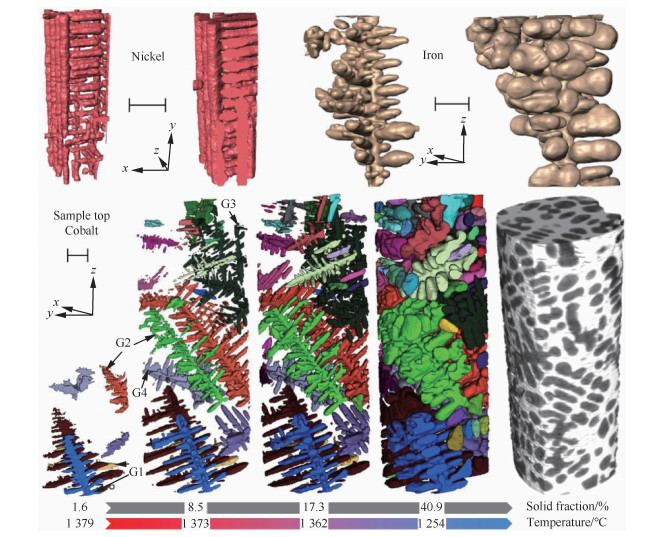
1.1 同步辐射的微观组织研究镍基高温合金由于其优异的高温强度,良好的抗氧化、抗腐蚀及抗疲劳和蠕变等性能,主要应用于航空发动机热端部件(如涡轮盘、叶片、燃烧室等)。由于高温合金中富含多种合金元素,在凝固过程中会出现如偏析、孔洞、取向偏离、杂晶等铸造缺陷,对航空发动机安全性和可靠性产生了极大威胁。利用同步辐射X衍射成像(XDI)技术可原位观察这些缺陷,并对缺陷的形成机制进行深入分析。Husseini等[4]利用原位同步辐射XDI技术首次对Rene N5合金镶嵌性小角度晶界的枝晶进行了定量化测量,深入地剖析了凝固过程中枝晶生长行为与小角度晶界之间的内在关联。Aveson等[5]利用XDI技术研究了CMSX-4合金在凝固过程中的晶体演化,直观地解释了合金中亚晶及晶体取向的形成机制。Azeem等[6]开发了一种采用原位同步辐射X射线断层扫描成像(s-CT)技术在高温定向凝固炉上研究CMSX-4合金在凝固过程中树枝晶形成(如图 1[6]所示)的方法,通过原位监测方法对枝晶尖端速度、固体分数、比表面积和粗化随时间/温度的变化进行了定量分析,阐明了合金凝固过程中枝晶竞争生长和粗化机制。Reinhart等[7]通过原位同步辐射XDI技术研究了CMSX-4合金在3种不同冷却速度下的凝固过程中,合金液流动性对枝晶生长速度的影响。上述研究通过直观地对高温合金的凝固过程进行原位监测获得了合金的形核过程、枝晶生长和偏析行为等关键信息,进而为优化合金凝固工艺参数提供理论指导。
沉淀析出强化作为高温合金的主要强化机制,其中析出相(γ′相、γ"相、碳化物、拓扑密排相等)的形貌、尺寸、体积分数及其晶格错配等特征与合金的力学性能密切相关[8]。因此在制备和热处理过程中,必须严格控制析出相特征以优化合金的力学性能。但这些相的析出温度较高、反应动力学较快且化学成分复杂,难以采用传统表征方法对其进行详细分析,而同步辐射技术高时间分辨率和高空间分辨率的特点使其能有效地对析出相进行精准分析。
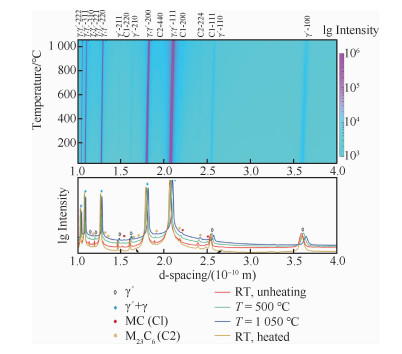
γ′相为镍基高温合金中的主要强化相。北京科技大学新金属材料国家重点实验室王沿东教授团队[8]利用原位同步辐射高能X射线衍射(HE-XRD)技术观察了不同温度下Waspaloy合金中相(包括γ相、γ′相、碳化物等)的演化(如图 2[8]所示),原位观测到了γ′相和M23C6碳化物在加热过程中的回溶和降温过程中的再析出行为。Diologent等[9]利用HE-XRD技术表征了MC-NG合金在20~1 325 ℃温度范围内的应变分布,确定了γ′相体积分数随温度的变化;结果表明内部残余应力源于合金凝固过程中Re元素的偏析和γ相的共同作用,在293~1 198 K温度范围内晶格错配度为-0.41%~-0.05%。Chen等[10]利用同步辐射XRD技术研究了RR1000合金在热处理后γ′相的异常粗化行为,结果表明局部成分扩散产生的弹性应变能影响析出相形貌。以上结果为研究高温合金中γ′相的特征提供了准确、可靠、原位的实验数据,为高温合金的强化机理提供了重要支撑。
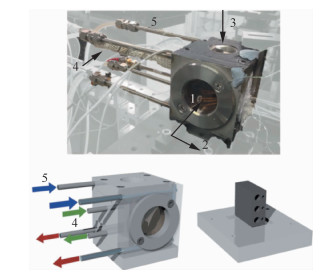
晶格错配是决定高温合金力学性能另一个重要参数。一般来说,γ/γ′相错配度(一般镍基高温合金为负,钴基高温合金为正)的绝对值越小,越有利于微观结构的高温稳定性,即降低组织粗化驱动力。错配度是由晶格常数的差异性引起的,采用常规表征方法很难对其进行精确测量。Robinson等[11]开发了如图 3[11]所示的新型高温炉,该技术能在高温下对晶体结构进行准确原位分析,阐明温度对晶格常数的影响,有望在材料科学和工程领域中具备广泛的适用性。
析出相的演变及分布会影响γ/γ′相错配度和热膨胀行为[12]。中国科学院沈阳金属研究所张健研究员团队[13]采用上海同步辐射装置的BL14B1光源,通过同步辐射XRD技术研究了Mo元素对镍基单晶高温合金高温蠕变性能的影响,发现Mo元素的加入有效降低了γ/γ′相错配度,并增加了γ相的晶格畸变程度。王沿东教授团队[8]、Diologent[9]、Bruno[14-15]等采用同步辐射XRD技术研究了Waspaloy合金、MC-NG合金和SC16合金在不同温度下γ/γ′相的错配度;结果表明随温度升高,元素偏析及γ相与γ′相热膨胀系数的差异引起γ/γ′相绝对错配度增大。可看出采用同步辐射技术对γ/γ′相的晶体结构进行分析能在不同温度下获得高精度的实验结果,有利于深入了解高温合金高温强化机制,进而实现更加优异的合金化设计。
航空发动机热端部件的服役环境极其复杂,特别是涡轮叶片除承受高温(叶身温度高于1 300 K,叶根温度高于1 000 K)外,还存在高应力(叶片承受拉应力约100 MPa以上,而叶根附近承受的平均应力为280~560 MPa)。在持续高温、高应力作用下,高温合金内部相结构会发生改变,影响叶片服役寿命[1-2]。利用同步辐射技术可原位观察合金内部相结构在服役过程中的演变过程。Jacques和Bastie[16]应用原位同步辐射技术首次测量了AM1合金在高温蠕变过程中的(002)和(200)衍射峰,进而计算得到了该合金在蠕变过程中的晶格错配度。Dirand等[17]采用原位同步辐射XRD、TEM和高分辨SEM 3种不同技术研究了γ/γ′相错配度与温度、外加应力和服役过程之间的内在关联,在考虑精度、时间演变和空间分布的标准下这3种测量技术具有互补性。Dirand等[18]还采用原位同步辐射HE-XRD技术研究了AM1合金在高温蠕变过程中筏排组织的错配度,定量化地分析了γ′相筏排塑性与横向应力大小之间的内在关联。le Graverend等[19-20]利用原位同步辐射XRD技术研究了AM1合金在非等温蠕变过程中γ′相的体积分数和位错密度的演化及γ/γ′相的错配度,揭示了以上因素对蠕变速率的影响,指出高温合金在变温条件下的蠕变寿命显著低于等温条件。上述相关研究有利于深入分析航空发动机热端部件在复杂服役环境下的蠕变变形机制,进而指导合金设计与性能优化。
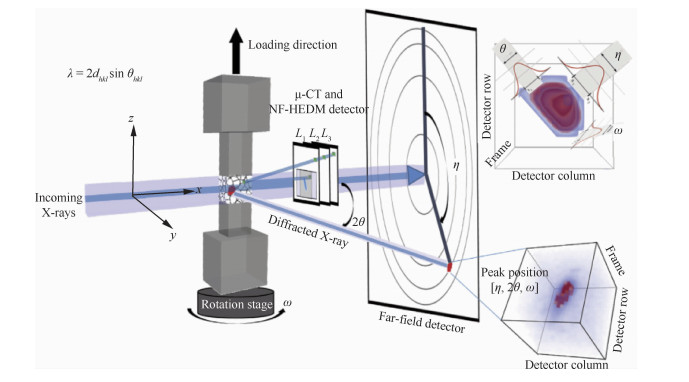
除蠕变失效外,疲劳失效也是航空发动机热端部件失效的主要原因之一[21]。Jiménez等[22]采用原位同步辐射XRD和相衬层析成像技术研究了IN718合金在高周疲劳条件下裂纹的萌生和扩展,结果表明裂纹优先在试样表面上的孪晶界萌生。Naragani等[23-24]采用如图 4[24]所示的试验装置、利用原位同步辐射HE-XRD技术研究了RR1000合金在拉伸过程中夹杂物与局部应力场的不均匀性对裂纹萌生的影响; 结果表明夹杂物的存在会促使裂纹萌生,且裂纹前端的微塑性有助于确定裂纹扩展或终止的潜在方向。上述研究为深入分析疲劳裂纹萌生及扩展提供了新思路,为发动机服役可靠性提供了理论依据。
新型γ′相强化的钴基变形高温合金由于具有优异的抗氧化和力学性能有望成为新一代耐更高温度(850 ℃左右)的涡轮盘材料,吸引了越来越多研究人员的关注[25]。Freund等[26-27]利用同步辐射HE-XRD技术研究了不同温度下添加不同含量(0和1.0at%)的Mo元素和Al/W元素原子比(1.8~3.7)对钴基高温合金的影响(如图 5[27]所示);结果表明Mo元素可通过形成细小的μ相(Co, Ni, Cr)7(W, Mo)6和增加γ′相的错配度提升高温强度,提高Al/W比可降低合金密度、改善合金的抗氧化性。Wang等[28]利用HE-XRD技术和能量色散X射线光谱在钴基高温合金中发现了ZrCo2和HfCo2等Laves相。上述结果对新型γ′相强化钴基变形高温合金的设计及强化机制的分析具有重要指导意义。
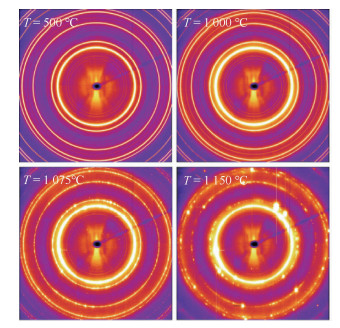
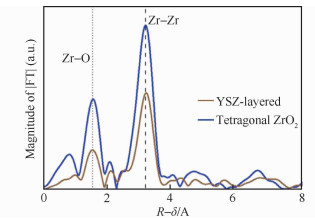
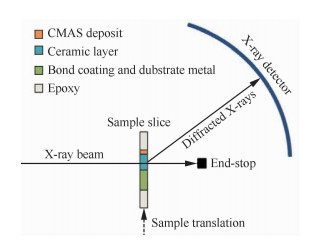
近年来,由于新一代航空发动机涡轮前进口温度不断提高,仅仅依靠单晶高温合金和气冷技术已无法满足涡轮叶片的要求。热障涂层技术被广泛地应用到航空发动机热端部件上,可显著降低叶片表面温度,大幅延长叶片工作寿命,提高发动机的推力和效率。热障涂层与叶片冷却设计、单晶高温合金材料技术并列,是先进航空发动机叶片的3大核心技术之一[29]。然而热障涂层在服役过程中的失效原因主要与热生长氧化物(TGO)的生长,陶瓷层的烧结、相变和腐蚀等有关,因此有必要对热障涂层在服役过程中的相组成及TGO的演化进行分析。而常规光谱检测(如XRD、拉曼光谱等)只能对试样表面进行表征,同时先进的电子显微技术(如SEM、TEM等)无法对试样进行无损检测。大量研究者利用同步辐射技术对热障涂层喷涂态[30]和热暴露[31]、热冲击[32](如图 6[32]所示)及受CaO-MgO-Al2O3-SiO2(CMAS)侵蚀[33]后的陶瓷层内部相组成进行无损分析(如图 7[33]所示)。还可利用同步辐射技术分析预氧化和氧化过程中粘结层的氧化行为[34-36]。上述研究表明同步辐射技术突破了常规检测方法的壁垒,可对喷涂态、服役态以服役过程中的陶瓷层内部及TGO成分进行无损检测,进而对热障涂层进行更为深入的失效分析及寿命评估。
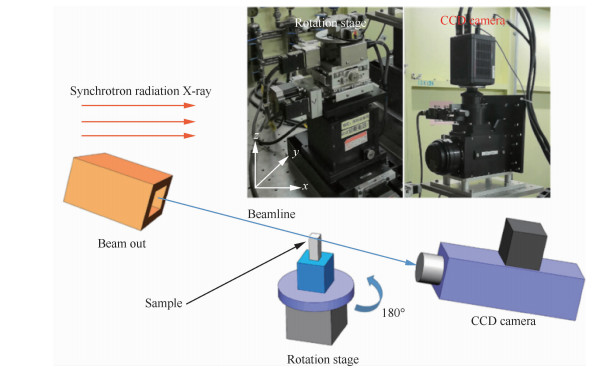
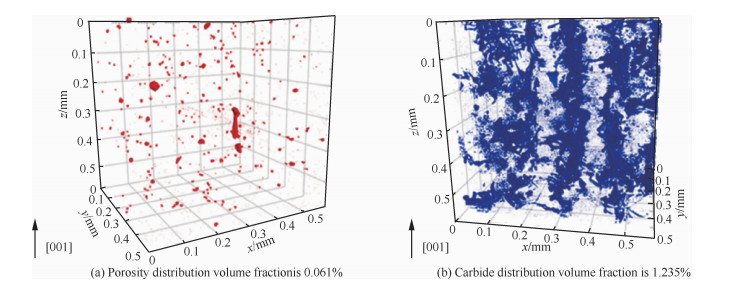
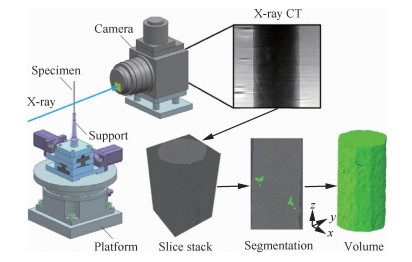
航空发动机热端部件服役过程中,内部的介观缺陷(孔洞和裂纹)会对合金力学性能产生巨大影响,利用同步辐射成像技术可通过直观观察对这一过程进行详细分析。Plancher等[37]利用同步辐射s-CT技术研究了镍基高温合金凝固过程中孔隙的形核和生长,对合金内部介观缺陷的几何形状和定量结果进行了准确分析。哈尔滨工业大学张鹏教授团队与北京钢铁研究总院[38-40]采用上海同步辐射装置的BL13 W1光源(装置如图 8[38]所示)、利用原位同步辐射XDI技术对GH4169合金进行拉伸试验研究,揭示了碳化物或碳化物/γ相的相界面位置缺陷及裂纹萌生机制。
Link等[41]采用同步辐射成像技术定量分析了SRR99、CMSX-4、CMSX-6和CMSX-10合金蠕变过程中孔洞的形貌和大小随载荷及时间的演化;研究发现合金中微孔的长大与变形有关,且孔隙率随合金中难溶元素含量的增加而增大。Bai[42]、Tan[43]和Liu[44]等通过同步辐射s-CT技术分别对FGH96、CM247LC和CMSX-4合金内部疲劳裂纹的萌生和扩展进行了跟踪分析;结果表明疲劳初期碳化物的存在会诱导裂纹萌生,且孔洞的萌生及长大是引起合金疲劳断裂的主要原因(如图 9[43]所示)。上海交通大学王俊教授团队[45-46]采用上海同步辐射装置的BL13 W1光源(装置如图 10[46]所示)、利用同步辐射成像技术获得了高温合金的微孔特征,并基于3D重构技术获得了该合金的三维数字化模型,基于这种数字化模型进行了有限元模拟,对合金的拉伸、疲劳性能进行了理论分析;研究结果表明合金的断裂行为主要与微孔的分布、取向和间距有关,而与微孔的尺寸关系较小。综上,采用同步辐射技术可更直观、清晰地了解合金缺陷对其力学性能的影响,能深入地对合金的损伤积累和失效行为进行准确分析。
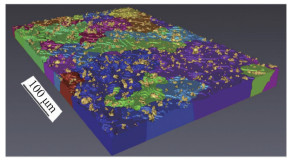
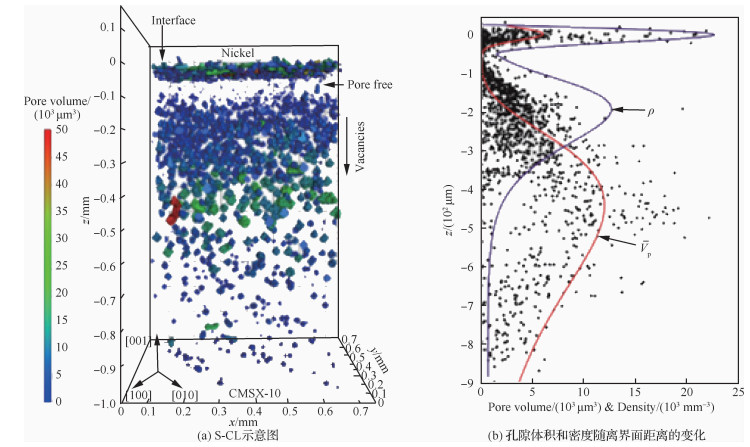
热障涂层在服役过程中TGO的生长、粘结层/基体的互扩散会严重降低涡轮叶片的服役寿命。Maurel等[47]利用同步辐射X射线分层扫描成像(s-CL)技术对热障涂层3D微观结构进行了准确重构,提供了一种新的、可靠的热障涂层内部结构演变分析方法。Soulignac等[48]采用s-CL技术表征了热循环后热障涂层粘结层界面的3D形貌(如图 11[48]所示)与演变过程;结果表明粘结层和陶瓷层结合强度的降低与界面孔隙率的上升正相关。Epishin等[49]采用s-CL技术研究了CMSX-10合金与纯镍在互扩散过程中形成的柯肯达尔孔洞(如图 12[49]所示);结果表明孔隙率的增长动力学与γ′相的溶解有关。Khoshkhou等[50]利用s-CT结合数字体积相关(DVC)技术以近原位的方式研究了热障涂层在循环氧化过程中氧化诱导位移场的演化,证明了s-CT和DVC技术相结合可量化热障涂层系统在循环热暴露下的位移。上述研究成果通过建立热障涂层的失效模型预测了TGO生长和粘结层的氧化行为,进而更为准确地阐明了热障涂层损伤失效机制。
航空发动机高温结构材料的残余应力源于材料不同区域之间应变的不匹配,这种不匹配是由整个部件中应变场、温度场或两者共同作用引起的。通常情况下,部件中的残余应力是在材料制备和服役过程中产生的[51],对材料服役性能产生关键影响。同步辐射技术具有高纯净度、高精度、高平行度和高穿透深度,可有效研究部件内部的应力分布。
焊接作为航空发动机热端部件的连接工艺,残余应力分布和大小取决于焊接过程的材料参数(如与温度相关的热膨胀系数和力学性能)和工艺参数(如热输入、热源、焊接速度等)[51-52],其数值的大小直接影响焊接位置服役性能。Jun等[53]利用同步辐射XRD技术对焊后IN718和RR1000合金进行了残余应力测量;研究表明异种材料焊接在强度较低的材料中会产生拉应力,在强度较高的材料中会产生压应力,进而影响构件的疲劳寿命,这对航空异种合金焊接接头的强度设计具有重要意义。上述关于焊接残余应力的研究为航空发动机热端部件的连接提供质量、寿命和工程安全保障。
热障涂层在制备和服役过程中产生的残余应力对其服役寿命产生重要影响。利用穿透深度大的同步辐射HE-XRD技术表征了制备态及服役态陶瓷层(如图 13[54-55]所示)随深度变化的残余应力分布[30, 54, 56-59]。同步辐射技术解决了曲率法、拉曼光谱和压痕法无法原位或无损地测量陶瓷层内部残余应力的问题,为长寿命热障涂层材料研发、涂层的结构设计和工艺优化提供了至关重要的理论基础[55, 60-62]。
1.4 同步辐射的工程应用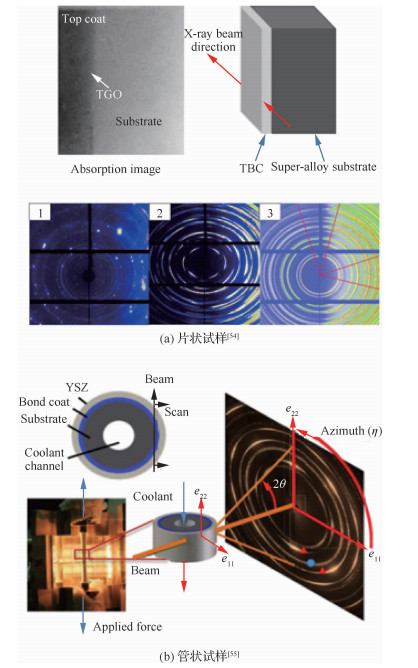
航空发动机热端部件在制造过程中通常涉及一系列加工工艺以实现部件所需的成形和微观结构,其中锻造、淬火、焊接和表面处理等工序会产生高水平的残余应力[63]。因此对焊接件残余应力的准确测量与评估是量化构件制备质量的关键评价依据。
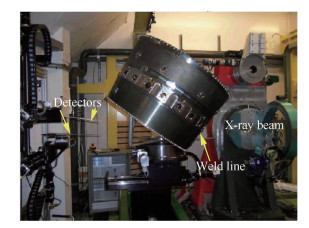
英国Rolls-Royce公司利用同步辐射HE-XRD技术对燃烧室进行分析[64],基于同步辐射技术的测试结果,通过多种技术(如sin2ψ法)对部件进行应力测量,如图 14[64]所示。
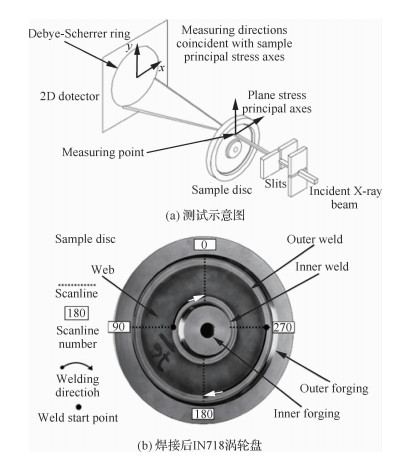
Jensen等[52]采用如图 15(a)[52]所示的测试方法通过同步辐射技术研究了电子束焊接后IN718合金部件(如图 15(b)[52]所示)的残余应力;结果表明实验数据与模型计算结果基本一致,残余应变/应力场受到部件几何形状约束(即内部和外部锻件)的影响。
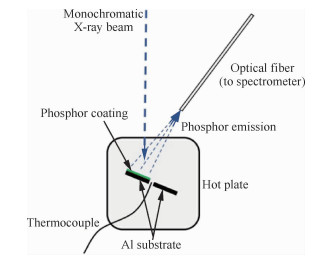
增材制造技术作为一种集制造信息化、智能化、个性化于一体的快速制造技术,突破了传统加工技术对部件设计和成型的限制,可实现复杂几何结构高温合金部件(如涡轮盘和叶片)的一体化制造。Wahlmann等[65]利用同步辐射XRD技术定量研究了CMSX-4合金在增材制造过程中γ′相的析出、溶解、粗化和形貌演化行为,这将有助于优化增材制造高温合金工艺参数。Aminforoughi[66]、Song[67]等利用该技术测量了增材制造高温合金的残余应力,提出了一种新型线性回归计算残余应力的方法,并通过模拟和原位拉伸试验对残余应力结果进行了验证。Matuszewski等[68]利用同步辐射XRD、工业CT和TEM技术研究了CMSX-4合金涡轮叶片的微观结构,分析了微观结构对工艺参数和抽拉速率的依赖性,为优化叶片的微观结构及力学性能提供了理论指导。Biermann等[69-70]利用同步辐射XRD技术分析试车后的CMSX-6合金涡轮叶片,根据化学成分和残余应力确定复杂高温结构合金微观结构的变化;结果表明试车过程中涂层中的Al元素扩散到基体,增加了γ′相的晶格常数和体积分数;此外,服役过程中的蠕变变形将引起叶片内部产生残余应力,进一步降低了叶片表面γ/γ′相错配度。Westphal等[71]采用如图 16[71]所示的装置、通过同步辐射X射线作为激发光源测量YAG: Dy等一系列荧光粉随温度变化的光谱响应,发现采用X射线激发这些荧光粉的电子能级跃迁与采用紫外激发相同,出现了类似的光谱响应位移,证明了同步辐射X射线作为荧光测温激发光源的可行性。
同步辐射由于其本身的局限性导致测试结果存在难以避免的误差(如X射线衍射难以精确测定物质中较轻原子的位置;X射线能量过高,难以研究物质中的动态特征等)[72-73]。中子衍射及其探针凭借中子不带电、穿透性强等特点成为目前唯一真正意义上的体探针,可无损地从原子、分子尺度观察物质的内部微结构,特别有利于开展航空发动机上大样品、大部件的常规无损分析测量[2, 72, 74-76],在新材料研发、工艺优化、质量检测和寿命评估中发挥着越来越重要的作用[77-78]。
2.1 中子衍射的微观组织研究航空发动机热端部件在制造加工过程中需进行一系列热加工,不同析出相特别是轻质元素的扩散将导致材料性能的剧烈改变。因此有必要利用中子衍射技术研究制备、服役过程中析出相的演变行为[73, 75, 79]。
Zrník等[80-81]为阐明镍基高温合金热暴露过程中γ相演变对蠕变的影响,利用小角中子衍射(SANS)技术对γ相形态和尺寸分布进行了表征,并结合SEM和TEM将长期热暴露后合金的蠕变寿命与微观组织演变联系起来。此外,大量研究者采用SANS技术研究了不同高温合金(如IN706[82]、Allvac® 718PlusTM[83]、IN738[84]、IN792-5A[85]、SC16[86-88]、SCA425[89]、RR1000[90]和AM3[91]合金)经不同处理后γ′相的演变行为,结果表明γ′相的最终形态取决于处理过程中的温度和冷却速率。Solís等[92]采用原位中子衍射技术研究了VDM-780合金不同时效热处理态、试样在高温下不同析出相的回溶情况及晶格常数随温度的演变(如图 17[92]所示)。Strunz等[93]采用原位SANS技术对富Re高温合金中析出γ′相的回溶温度进行了研究,明确了γ′相的析出/回溶过程与关键温度区间。上述研究结果对高温合金在制备和服役过程中的组织演变过程进行了表征和分析,为航空发动机热端部件制备工艺和性能优化提供了重要理论依据。
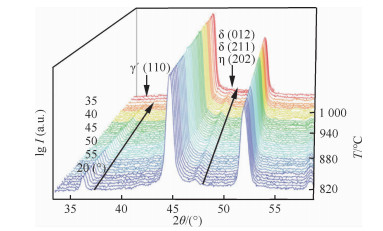
此外,张健研究员团队[94]利用原位中子衍射技术研究了DD10合金不同热处理态的晶格错配度,证明了γ/γ′相界面存在晶格错配,这与γ/γ′相界面的位错间距有关。Huang等[95]在不同温度下利用中子衍射技术对Rene N4合金、Rene N5合金、CMSX-4合金和PWA1484合金的晶格错配度进行了原位研究, 结果(如图 18[95]所示)表明合金错配度的各向异性源于铸造过程中枝晶和枝晶间化学偏析引起的内应力。以上研究成果表明利用中子衍射技术能对高温合金不同状态下的错配度进行高精度的原位表征,为高温合金长时组织稳定性的设计提供新的解决思路。
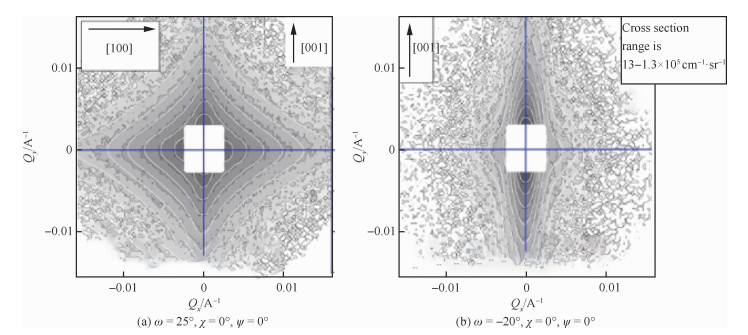
由于航空发动机热端部件在服役过程中析出相的演变将极大影响高温合金服役性能。Huang等[96]利用SANS技术研究了镍基高温合金变形过程中析出相的演变行为并提出了理论模型,通过TEM实验验证了该模型的准确性,为研究高温合金中纳米析出相的微观结构提供了解决方案。Zrník等[97-98]利用SANS技术结合SEM研究了CMSX-4合金蠕变过程中γ′相的特征演变(如图 19[97]所示),研究发现在低温、高应力条件下,[001]和[111]方向的试样在蠕变过程中γ′相形态演变无明显差异。Petrenec等[99]通过原位高温SANS技术研究了IN738LC合金低周疲劳过程中γ′相的形态,结果表明在低周疲劳过程中析出的细小的γ′相通过钉扎位错改善了合金的抗疲劳性能。Huang等[100-101]利用原位中子衍射技术研究了高温合金的低周疲劳行为,发现疲劳过程中的循环硬化与位错密度呈正相关映射关系。Grant等[102]利用SANS技术开发了具有单峰γ′相分布的微观结构模型,结合SEM明确了镍基高温合金在室温拉伸载荷下的变形机制。上述结果表明中子衍射技术能通过间接地表征合金的变形行为与纳米级的电子显微镜技术结合,从而为更深入地分析高温合金变形机制提供可靠解决方案[102-104]。
IN718合金作为航空发动机涡轮盘用材料,其采用“直接时效工艺”进行热加工提高涡轮盘的高温强度。直接时效工艺与传统热加工工艺不同,要求锻造后直接进行水淬,淬火产生的析出相γ′-Ni3(Al, Ti)相和γ"-Ni3(Nb, Ti)相通过钉扎位错作为后续退火处理中形成强化沉淀相的潜在形核位置[105]。
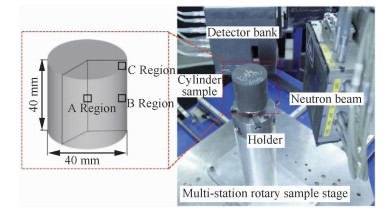
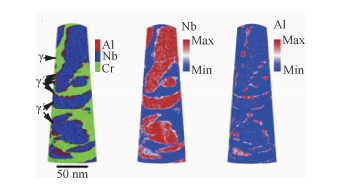
γ"相的强化效果在很大程度上取决于它的特征。北京钢铁研究总院毕中南团队[106-107]采用如图 20[106]所示的装置、利用中子衍射技术结合TEM提出了一种通过IN718合金内部残余应力控制γ"相析出的方法;结果表明残余应力决定了γ"相的生长和粗化,但γ"相的粗化会增强材料微观结构的不均匀性和各向异性,进而降低材料的力学性能,因此需要调控局部传热系数降低残余应力。其次,由于γ′和γ"相拥有相似的化学成分,难以精确测量其体积分数,Lawitzki等[108]提出了一种通过SANS技术测量IN718合金中γ′和γ"相体积分数的方法,并结合TEM和三维原子探针(Atom Probe Tomography,APT)建立了结构模型(如图 21[108]所示)。毕中南团队[109]利用原位中子衍射技术揭示了IN718合金在时效过程中γ"相的成分和形貌演变,其晶格间距演化具有3个阶段。通过上述工作可精准分析IN718合金析出相的特征,进而可揭示其强化机制。
同样,晶格错配在IN718合金中也很重要。毕中南团队[106-107, 110]利用原位中子衍射技术研究了IN718合金时效热处理期间γ、γ′和γ"相晶格间距的演化及相应的错配应变。这些研究为IN718合金中γ"相的微观结构特征提供了补充。
由于X衍射和数据处理固有的局限性,利用XRD技术分析热障涂层中的陶瓷层时大量的立方相会被忽略或低估,影响涂层的寿命预测。大量研究人员[111-114]利用中子衍射技术分析了制备态和处理态陶瓷层中四方相的组成及四方相中的Y元素含量。这些研究有利于在发动机维护期间检查涂层的相变,研究涂层的长时稳定性,从而评估涂层因相变失稳导致的潜在故障。
2.2 中子衍射的细观缺陷研究研究表明,热障涂层的性能与其微观结构密切相关[115]。除利用同步辐射技术外,还可利用穿透能力更强的中子衍射技术对试样进行表征。Kulkarni[116]、Saruhan[117-119]等利用SANS技术定量分析了不同制备工艺涂层的微观结构,根据孔隙率、孔隙形状(包括开放孔隙和封闭孔隙,如图 22[119]所示)、孔径分布及涂层厚度等对孔隙进行了量化,并对涂层进行性能测试,得到了涂层的热导率和弹性模量与其微观结构的相关性。此外,通过对孔隙进行表征确定了其对涂层热物理性能(热导率)和力学性能的影响,建立了涂层成分-工艺-结构-性能关系,为通过控制工艺参数和成分设计综合性能优异的涂层提供了解决方案[116, 119-121]。
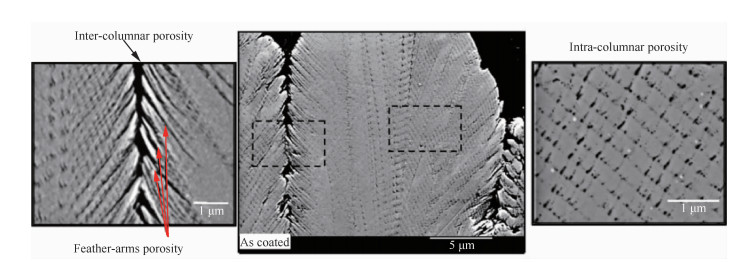
Saruhan[117-119, 122-124]、Wang[120]、Allen[121]、Strunz[125]、Kulkarni[126]、Tejero-Martin[127]、Petorak[128]等利用SANS技术研究了热障涂层热暴露后的微观组织演变,分析了涂层内孔隙各向异性的特征(如图 23[128]所示)。由于烧结和应力的作用,孔隙形貌和尺寸发生演变导致涂层热导率增加。其次,热导率主要受孔隙尺寸的影响,而孔隙的形貌对其影响不大,且长孔隙涂层具有更好的抗烧结能力。上述工作表明涂层结构的各向异性演变对性能有很大的影响,这为涂层性能的结构和工艺优化提供了参考[118, 129]。
2.3 中子衍射的残余应力研究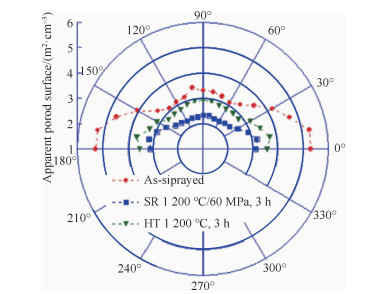
中子衍射技术空间分辨范围宽、普适性强,适合分析航空发动机热端部件应力分布问题[74, 130]。Preuss[131]、Wang[132]、Smith[133]、Pang[134]、Iqbal[135]、Stone[136]和Korsunsky[137]等采用中子衍射技术研究了RR1000、Udimet 720LI和IN718合金焊后及焊后热处理对焊缝残余应力的影响;结果表明在焊缝和热影响区产生了较大的残余应力,焊缝的微观结构及焊材相关高温性能影响了该处应力分布,并且由于焊接导致材料发生微观结构和局部塑性的变化,焊缝界面附近的拉伸应力升高;同时由于组织结构的变化,焊后热处理应比常规热处理温度提高50 ℃左右。上述工作可通过残余应力在成型过程中的演变规律确定较为合理的低残余应力制备方案,进而优化航空发动机热端部件的成型工艺参数。
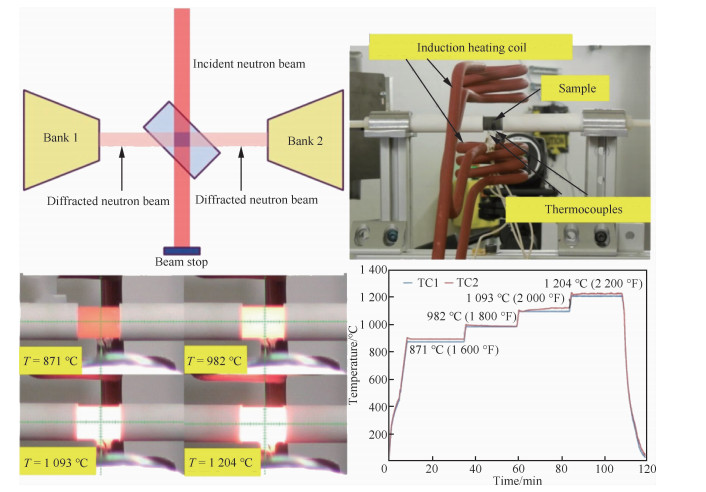
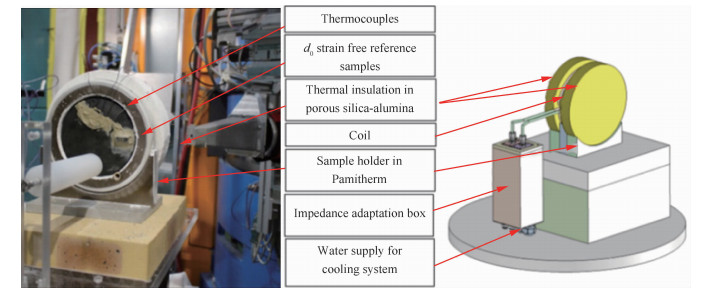
航空发动机热端部件在制备过程中,由于温度或相变导致体积变化产生的残余应力[51]对材料的高温性能产生较大影响。Aba-Perea等[63]开发了如图 24[63]所示的新型高温炉,利用中子衍射技术原位监测合金热处理过程中残余应力演化。Cihak[138-139]、Aba-Perea[140]等利用中子衍射技术研究了涡轮盘用IN718合金和Udimet 720LI合金热处理后的残余应力,获得了涡轮盘深度方向的应力分布,为涡轮盘的制备工艺提供了理论指导。哈尔滨工业大学与北京钢铁研究总院[141]利用中子衍射技术研究了动态应变时效对镍基高温合金热处理过程中残余应力的影响;结果表明由于动态应变时效引起的应变敏感性和温度依赖性效应,预测的残余应力比实际测量的高约10%。上述研究表明通过优化应力模拟模型可更准确地获得加工步骤对热端部件应力分布的影响,进而优化相关工艺参数。
静态和动态机械加载产生的残余拉应力会促进材料内部裂纹的扩展,进而导致热端部件发生失效[51]。中国工程物理研究院与张健研究员团队[142]利用中子衍射技术研究了DD10合金蠕变后的显微组织缺陷和残余应力,详细地研究了高温合金在蠕变初期、稳态阶段和末期的宏观残余应力、晶格畸变、位错密度之间的内在关联与演变规律。Lu等[143]利用原位中子衍射技术表征了定向凝固PWA1422合金和单晶PWA1484合金在变形过程中的弹性微应变,得到在拉伸过程中γ相的临界分切应力与Orowan弯曲应力一致。通过对高温合金服役过程中应力演化进行研究可掌握合金的变形机制,这有助于分析高温合金微观结构与性能之间的关系,进而为材料设计和应用提供理论支撑。
掌握涂层及界面处直至基体材料位置的残余应力分布对评估涂层的结构完整性和可靠性至关重要。研究者们[144-146]利用中子衍射技术研究了试样全厚度(包括涂层和基体)制备态和热处理态的残余应力分布,并用钻孔等方法验证了利用中子衍射技术测量全厚度涂层残余应力的可行性,如图 25[144]所示。为研究热障涂层的微观结构、应力分布与服役性能之间的映射关系提供了新的解决思路。
2.4 中子衍射的工程应用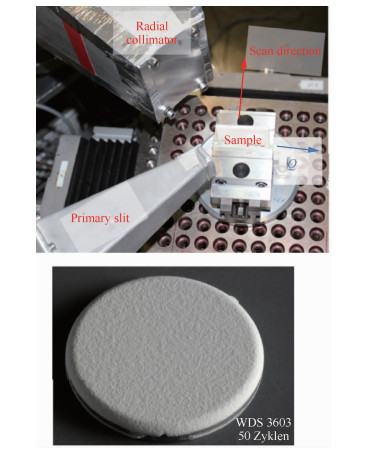
明确残余应力的分布是提高工程材料和部件完整性、可靠性的关键因素之一,然而航空发动机热端部件具有密度高、尺寸大的特点,难以用传统方法获得其内部应力分布,中子衍射技术的自身优势使其在航空工业中发挥的作用日益提升。飞机制造商Bohler Forging公司研究了商用锻造涡轮圆盘中的残余应力,发现锻件直接水淬后产生的残余应力可能导致工件在机加工成型过程中变形[147],为后处理工艺优化提供了至关重要的理论指导,极大地降低了工件的畸变与形变。
涡轮盘锻造后的残余应力一般可通过退火消除,但若在退火处理过程中无法完全消除,则涡轮盘在加工成形时可能会出现尺寸超差、裂纹等问题,更为严重的是过高的残余应力引起涡轮盘转动过程中发生变形,从而存在重大的安全隐患,因此明确涡轮盘加工过程中产生残余应力的大小与分布对航空发动机的可靠性至关重要。比如在车削前得知涡轮盘内的残余应力状态,则可通过调整工艺参数减小变形进行调控[105]。
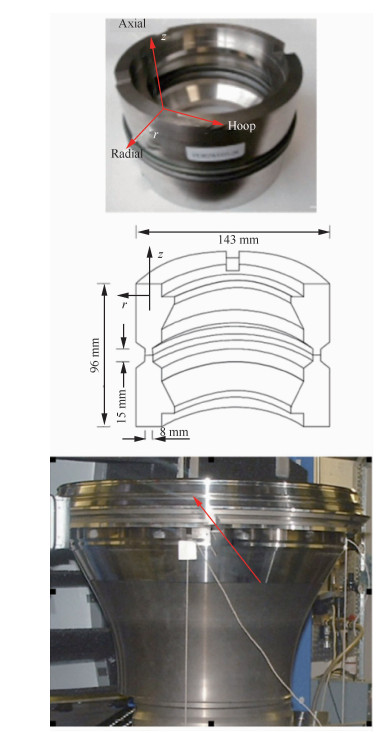
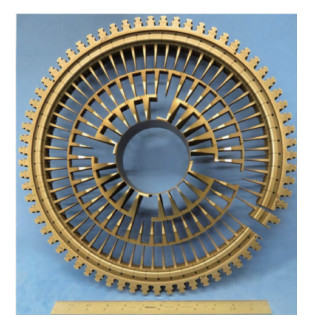
此外,英国Rolls-Royce公司利用中子衍射技术对焊后航空发动机压缩机转毂(如图 26[148]所示)的应力进行测试;结果表明对焊件进行8 h后处理后,轴向应力松弛了近70%[148]。加拿大蒙特利尔航空航天产业利用相同的技术对IN718涡轮盘(如图 27[133]所示)焊接残余应力进行定量分析;结果表明焊缝界面附近的拉应力略高,这可能是由材料微观结构和机械变化产生的严重局部塑性效应导致的[133]。
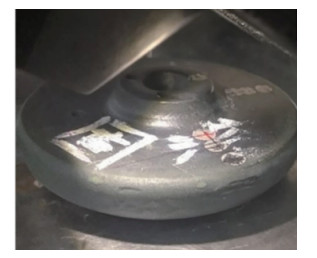
粉末冶金高温合金由于其合金成分均匀、制件性能稳定、热加工变形性能较好及合金化程度高等特点,吸引了越来越多的关注。王沿东教授团队与中国航发北京航空材料研究院、中国工程物理研究院[149]合作对粉末高温合金涡轮盘残余应力进行测量,利用中国工程物理研究院残余应力中子衍射仪结合修正相变潜热的热-结构耦合有限元分析确定了涡轮盘(如图 28[149]所示)在等温锻造、固溶处理和时效处理后的3D宏观残余应力演变及影响因素,有限元模拟结果与实测结果差值小于40 MPa,为优化粉末涡轮盘的制备工艺和评价其服役损伤行为奠定了基础。
增材制造高温合金除具有沉积效率高、成本低和制造工艺灵活等优点外,在制备过程中会产生残余应力和微观缺陷,使其难以投入到工程应用中[150]。An[151]、Goel[152]、Phan[153]、Nadammal[154-155]和Pant[156]等利用中子衍射技术研究了不同增材制造工艺制备的IN625(如图 29[151]所示)和IN718合金制备态及后处理态的残余应力;结果表明制备工艺会影响合金的残余应力,后处理会降低制备过程中产生的残余应力。Pant等[156]利用中子衍射技术研究了不同工艺参数下激光粉末床融合IN718合金的微观结构(如图 30[156]所示)。上述研究证明了中子衍射技术是一种有效、可靠地无损测量金属构件残余应力和微观缺陷的技术,这为增材制造工艺的发展奠定了基础。
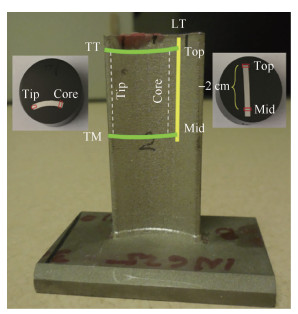
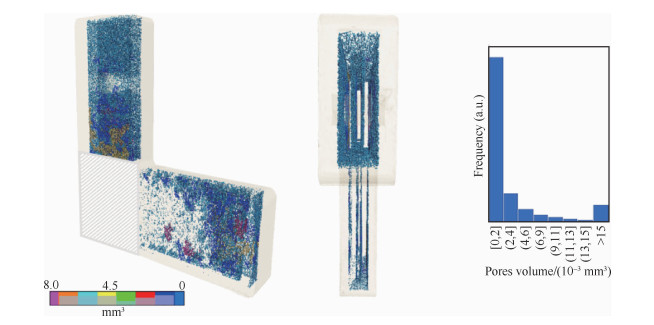
涡轮叶片结构复杂,相关测量表征具有很大的挑战性。瑞士ALSTOM公司利用中子衍射结合中子成像技术测量了单晶镍基高温合金涡轮叶片(如图 31[157]所示)的残余应力[157]。通过基于简化的逐层有限元数值模型预测了整个零件在制造过程中和冷却后的应力,模拟结果和实测结果基本一致。因此经验证的简化模拟方法将允许评估更复杂结构中的残余应力,并显著缩短制造周期。
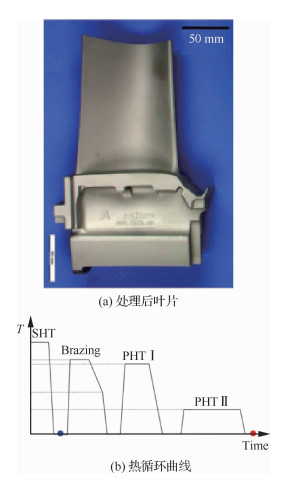
单晶涡轮叶片在制备过程中先通过精密铸造工艺成型,再结合热处理及后续加工获得一定形状的构件。而热处理是其中最为重要的环节之一(如图 32[158]所示),包括固溶热处理(SHT)、钎焊循环和两次时效热处理(PHT I和II)。Pierret等[158]发现经完全热处理后的叶片在靠近冷却通道及叶根处出现筏排现象,中子衍射技术研究表明这种现象是由SHT后快速冷却时叶片表面和内部之间的温度差造成塑性应变导致的。
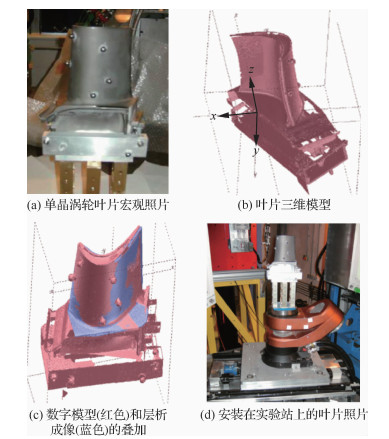
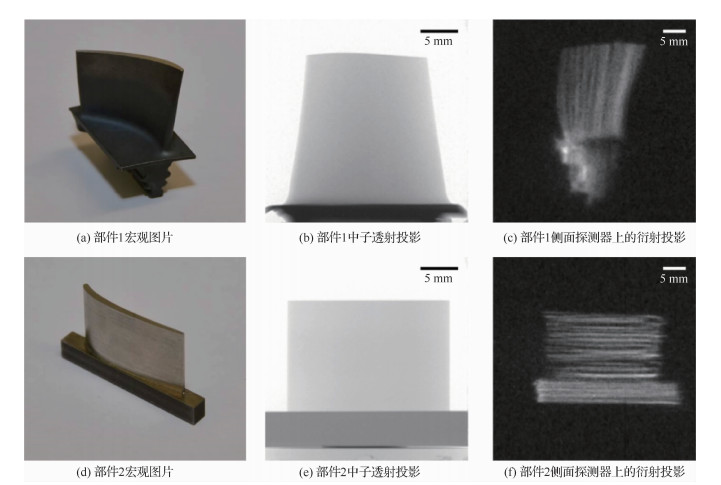
中子衍射成像技术可用于检测工业涡轮叶片(如图 33(a)[159]和图 33(d)[159]所示)中的枝晶生长方向(如图 33(b)[159]和图 33(e)[159]所示),并结合透射层析成像技术对叶片内部(如冷却通道、裂纹和残余型芯)进行表征(如图 33(c)[159]和图 33(f)[159]所示,这为未来叶片生产的质量评估提供了一项具有潜力的检测手段。
近年来,中国在航空发动机的研发和制造方面取得了重大进展,研发的适用于商业和军用飞机的航空发动机性能与国际先进发动机差距逐渐减小。然而在其性能日益提高的同时,对其安全性、可靠性也提出了更苛刻的要求。采用传统检测方法仍存在大量的检测盲区,无法针对航空发动机的热端部件与防护涂层在研发、制造、服役和维修等过程进行有效分析和评估。同步辐射与中子衍射技术具备的高穿透、高通量、高分辨率等特点,极其适用于航空发动机内大型件、复杂件和高温件的检测与分析。上述2种技术在国外已逐渐面向航空工业进行工程应用,而中国仍处于起步阶段,存在着测量经验不足、应用范围有限、相关判定方法匮乏等问题,大型科学装置为中国航空工业服务仍存在巨大发展潜力。因此需进一步开展大型科学装置在航空高温结构材料与涂层方面的基础与应用研究,使其高穿透、高通量、高分辨率的优势得到充分发挥,在航空航天等领域发挥出更加重要的作用。
| [1] |
刘昌奎, 李楠, 赵文侠, 等. 航空材料组织与残余应力评价对中子散射与同步辐射技术的需求[J]. 失效分析与预防, 2019, 14(2): 133-140. LIU C K, LI N, ZHAO W X, et al. Requirements of microstructure and residual stress evaluation of aeronautical materials for neutron scattering and synchrotron radiation techniques[J]. Failure Analysis and Prevention, 2019, 14(2): 133-140. (in Chinese) |
| Cited By in Cnki (12) | Click to display the text | |
| [2] | KAYSSER W, ESSLINGER J, ABETZ V, et al. Research with neutron and synchrotron radiation on aerospace and automotive materials and components[J]. Advanced Engineering Materials, 2011, 13(8): 637-657. |
| Click to display the text | |
| [3] |
麦振洪, 刘祖平, 高琛, 等. 同步辐射光源及其应用上[M]. 北京: 科学出版社, 2013: 169-172. MAI Z H, LIU Z P, GAO C, et al. Synchrotron radiation source and its application[M]. Beijing: Science Press, 2013: 169-172. (in Chinese) |
| [4] | HUSSEINI N S, KUMAH D P, YI J Z, et al. Mapping single-crystal dendritic microstructure and defects in nickel-base superalloys with synchrotron radiation[J]. Acta Materialia, 2008, 56(17): 4715-4723. |
| Click to display the text | |
| [5] | AVESON J W, REINHART G, NGUYEN-THI H, et al. Dendrite bending during directional solidification[M]// Superalloys 2012. Hoboken: John Wiley & Sons, Inc., 2012: 615-624. |
| [6] | AZEEM M A, LEE P D, PHILLION A B, et al. Revealing dendritic pattern formation in Ni, Fe and Co alloys using synchrotron tomography[J]. Acta Materialia, 2017, 128: 241-248. |
| Click to display the text | |
| [7] | REINHART G, GRANGE D'ABOU-KHALIL L, et al. Impact of solute flow during directional solidification of a Ni-based alloy: In-situ and real-time X-radiography[J]. Acta Materialia, 2020, 194: 68-79. |
| Click to display the text | |
| [8] | YAN Z R, TAN Q, HUANG H, et al. Phase evolution and thermal expansion behavior of a γ' precipitated Ni-based superalloy by synchrotron X-ray diffraction[J]. Acta Metallurgica Sinica (English Letters), 2022, 35(1): 93-102. |
| Click to display the text | |
| [9] | DIOLOGENT F, CARON P, D'ALMEIDA T, et al. Temperature dependence of lattice mismatch and γ' volume fraction of a fourth-generation monocrystalline nickel-based superalloy[J]. International Journal of Materials Research, 2006, 97(8): 1136-1142. |
| [10] | CHEN Y Q, PRASATH BABU R, SLATER T J A, et al. An investigation of diffusion-mediated cyclic coarsening and reversal coarsening in an advanced Ni-based superalloy[J]. Acta Materialia, 2016, 110: 295-305. |
| Click to display the text | |
| [11] | ROBINSON J B, BROWN L D, JERVIS R, et al. A novel high-temperature furnace for combined in situ synchrotron X-ray diffraction and infrared thermal imaging to investigate the effects of thermal gradients upon the structure of ceramic materials[J]. Journal of Synchrotron Radiation, 2014, 21(5): 1134-1139. |
| Click to display the text | |
| [12] |
王沿东, 李润光, 聂志华, 等. 中子/同步辐射衍射表征技术及其在工程材料研究中的应用[J]. 工程科学学报, 2022, 44(4): 676-689. WANG Y D, LI R G, NIE Z H, et al. A review on the application of neutron and high-energy X-ray diffraction characterization methods in engineering materials[J]. Chinese Journal of Engineering, 2022, 44(4): 676-689. (in Chinese) |
| Cited By in Cnki | Click to display the text | |
| [13] | LIU X G, WANG L, LOU L H, et al. Effect of Mo addition on microstructural characteristics in a Re-containing single crystal superalloy[J]. Journal of Materials Science & Technology, 2015, 31(2): 143-147. |
| [14] | BRUNO G, SCHUMACHER G, PINTO H C, et al. Measurement of the lattice misfit of the nickel-base superalloy SC16 by high-energy synchrotron radiation[J]. Metallurgical and Materials Transactions A, 2003, 34(2): 193-197. |
| Click to display the text | |
| [15] | PINTO H C, BRUNO G. Formation and relaxation of coherency strain in the nickel-base superalloy SC16[J]. Journal of Synchrotron Radiation, 2003, 10(2): 148-153. |
| Click to display the text | |
| [16] | JACQUES A, BASTIE P. The evolution of the lattice parameter mismatch of a nickel-based superalloy during a high-temperature creep test[J]. Philosophical Magazine, 2003, 83(26): 3005-3027. |
| Click to display the text | |
| [17] | DIRAND L, CORMIER J, JACQUES A, et al. Measurement of the effective γ/γ' lattice mismatch during high temperature creep of Ni-based single crystal superalloy[J]. Materials Characterization, 2013, 77: 32-46. |
| Click to display the text | |
| [18] | DIRAND L, JACQUES A, CHATEAU-CORNU J P, et al. Phase-specific high temperature creep behaviour of a pre-rafted Ni-based superalloy studied by X-ray synchrotron diffraction[J]. Philosophical Magazine, 2013, 93(10-12): 1384-1412. |
| Click to display the text | |
| [19] | LE GRAVEREND J B, DIRAND L, JACQUES A, et al. In situ measurement of the γ/γ' lattice mismatch evolution of a nickel-based single-crystal superalloy during non-isothermal very high-temperature creep experiments[J]. Metallurgical and Materials Transactions A, 2012, 43A(11): 3946-3951. |
| [20] | LE GRAVEREND J B, JACQUES A, CORMIER J, et al. Creep of a nickel-based single-crystal superalloy during very high-temperature jumps followed by synchrotron X-ray diffraction[J]. Acta Materialia, 2015, 84: 65-79. |
| Click to display the text | |
| [21] |
李嘉荣, 谢洪吉, 韩梅, 等. 第二代单晶高温合金高周疲劳行为研究[J]. 金属学报, 2019, 55(9): 1195-1203. LI J R, XIE H J, HAN M, et al. High cycle fatigue behavior of second generation single crystal superalloy[J]. Acta Metallurgica Sinica, 2019, 55(9): 1195-1203. (in Chinese) |
| Cited By in Cnki (4) | Click to display the text | |
| [22] | JIMÉNEZ M, LUDWIG W, GONZALEZ D, et al. The role of slip transfer at grain boundaries in the propagation of microstructurally short fatigue cracks in Ni-based superalloys[J]. Scripta Materialia, 2019, 162: 261-265. |
| Click to display the text | |
| [23] | NARAGANI D, SANGID M D, SHADE P A, et al. Investigation of fatigue crack initiation from a non-metallic inclusion via high energy x-ray diffraction microscopy[J]. Acta Materialia, 2017, 137: 71-84. |
| Click to display the text | |
| [24] | NARAGANI D P, SHADE P A, KENESEI P, et al. X-ray characterization of the micromechanical response ahead of a propagating small fatigue crack in a Ni-based superalloy[J]. Acta Materialia, 2019, 179: 342-359. |
| Click to display the text | |
| [25] | LI H W, ZHUANG X L, LU S, et al. Hot deformation behavior and flow stress modeling of a novel CoNi-based wrought superalloy[J]. Journal of Alloys and Compounds, 2022, 894: 162489. |
| Click to display the text | |
| [26] | FREUND L P, STARK A, PYCZAK F, et al. The grain boundary pinning effect of the μ phase in an advanced polycrystalline γ/γ' Co-base superalloy[J]. Journal of Alloys and Compounds, 2018, 753: 333-342. |
| Click to display the text | |
| [27] | FREUND L P, STARK A, KIRCHMAYER A, et al. The effect of a grain boundary pinning B2 phase on polycrystalline Co-based superalloys with reduced density[J]. Metallurgical and Materials Transactions A, 2018, 49A(9): 4070-4078. |
| [28] | WANG L, SONG L, STARK A, et al. Identification of Laves phases in a Zr or Hf containing γ-γ' Co-base superalloy[J]. Journal of Alloys and Compounds, 2019, 805: 880-886. |
| Click to display the text | |
| [29] | FENG Y, DONG T S, LI G L, et al. The roles of stress in the thermal shock failure of YSZ TBCs before and after laser remelting[J]. Journal of Alloys and Compounds, 2020, 828: 154417. |
| Click to display the text | |
| [30] | WEYANT C M, ALMER J, FABER K T. Through-thickness determination of phase composition and residual stresses in thermal barrier coatings using high-energy X-rays[J]. Acta Materialia, 2010, 58(3): 943-951. |
| Click to display the text | |
| [31] | LEONI M, JONES R L, SCARDI P. Phase stability of scandia-yttria-stabilized zirconia TBCs[J]. Surface and Coatings Technology, 1998, 108-109: 107-113. |
| Click to display the text | |
| [32] | STATHOPOULOS V, SADYKOV V, PAVLOVA S, et al. Design of functionally graded multilayer thermal barrier coatings for gas turbine application[J]. Surface & Coatings Technology, 2016, 295: 20-28. |
| [33] | THORNTON J, WOOD C, KIMPTON J A, et al. Failure mechanisms of calcium magnesium aluminum silicate affected thermal barrier coatings[J]. Journal of the American Ceramic Society, 2017, 100(6): 2679-2689. |
| Click to display the text | |
| [34] | NEGAMI M, HIBINO S, KAWANO A, et al. Development of highly durable thermal barrier coating by suppression of thermally grown oxide[J]. Journal of Engineering for Gas Turbines and Power, 2018, 140(8): 082101. |
| Click to display the text | |
| [35] | REDDY A, HOVIS D B, HEUER A H, et al. In situ study of oxidation-induced growth strains in a model NiCrAlY bond-coat alloy[J]. Oxidation of Metals, 2007, 67(3-4): 153-177. |
| Click to display the text | |
| [36] | HAYASHI S, FORD S I, YOUNG D J, et al. α-NiPt(Al) and phase equilibria in the Ni-Al-Pt system at 1150 ℃[J]. Acta Materialia, 2005, 53(11): 3319-3328. |
| Click to display the text | |
| [37] | PLANCHER E, GRAVIER P, CHAUVET E, et al. Tracking pores during solidification of a Ni-based superalloy using 4D synchrotron microtomography[J]. Acta Materialia, 2019, 181: 1-9. |
| Click to display the text | |
| [38] | ZHU Q, CHEN G, WANG C J, et al. Tensile deformation and fracture behaviors of a nickel-based superalloy via in situ digital image correlation and synchrotron radiation X-ray tomography[J]. Materials, 2019, 12(15): 2461. |
| Click to display the text | |
| [39] | ZHU Q, WANG C J, QIN H Y, et al. Effect of the grain size on the microtensile deformation and fracture behaviors of a nickel-based superalloy via EBSD and in situ synchrotron radiation X-ray tomography[J]. Materials Characterization, 2019, 156: 109875. |
| Click to display the text | |
| [40] | ZHU Q, ZHANG L F, WANG C J, et al. Multi-dimensional revealing the influence mechanism of the δ phase on the tensile fracture behavior of a nickel-based superalloy on the mesoscopic scale[J]. Materials, 2022, 15(2): 610. |
| Click to display the text | |
| [41] | LINK T, ZABLER S, EPISHIN A, et al. Synchrotron tomography of porosity in single-crystal nickel-base superalloys[J]. Materials Science and Engineering: A, 2006, 425(1-2): 47-54. |
| Click to display the text | |
| [42] | BAI Y S, YANG S L, ZHU M Q, et al. Study on microstructure and fatigue properties of FGH96 nickel-based superalloy[J]. Materials, 2021, 14(21): 6298. |
| Click to display the text | |
| [43] | TAN Y G, BULL D J, JIANG R, et al. Data rich imaging approaches assessing fatigue crack initiation and early propagation in a DS superalloy at room temperature[J]. Materials Science and Engineering: A, 2021, 805: 140592. |
| Click to display the text | |
| [44] | LIU L, HUSSEINI N S, TORBET C J, et al. In situ synchrotron X-ray imaging of high-cycle fatigue crack propagation in single-crystal nickel-base alloys[J]. Acta Materialia, 2011, 59(13): 5103-5115. |
| Click to display the text | |
| [45] | LIU Y H, KANG M D, WU Y, et al. Effects of microporosity and precipitates on the cracking behavior in polycrystalline superalloy Inconel 718[J]. Materials Characterization, 2017, 132: 175-186. |
| Click to display the text | |
| [46] | LIU Y H, KANG M D, WU Y, et al. Crack formation and microstructure-sensitive propagation in low cycle fatigue of a polycrystalline nickel-based superalloy with different heat treatments[J]. International Journal of Fatigue, 2018, 108: 79-89. |
| Click to display the text | |
| [47] | MAUREL V, HELFEN L, N'GUYEN F, et al. Three-dimensional investigation of thermal barrier coatings by synchrotron-radiation computed laminography[J]. Scripta Materialia, 2012, 66(7): 471-474. |
| Click to display the text | |
| [48] | SOULIGNAC R, MAUREL V, RÉMY L, et al. Cohesive zone modelling of thermal barrier coatings interfacial properties based on three-dimensional observations and mechanical testing[J]. Surface & Coatings Technology, 2013, 237: 95-104. |
| [49] | EPISHIN A, CAMIN B, HANSEN L, et al. Synchrotron sub-μ X-ray tomography of kirkendall porosity in a diffusion couple of nickel-base superalloy and nickel after annealing at 1250 ℃[J]. Advanced Engineering Materials, 2021, 23(4): 2001220. |
| Click to display the text | |
| [50] | KHOSHKHOU D, MOSTAFAVI M, REINHARD C, et al. Three-dimensional displacement mapping of diffused Pt thermal barrier coatings via synchrotron X-ray computed tomography and digital volume correlation[J]. Scripta Materialia, 2016, 115: 100-103. |
| Click to display the text | |
| [51] |
REIMERS W, PYZALLA A R, SCHREYER A, 等. 中子和同步辐射在工程材料科学中的应用[M]. 姜晓明, 丁洪, 孙冬柏, 译. 北京: 科学出版社, 2014: 129-134. REIMERS W, PYZALLA A, SCHREYER A, et al. Neutrons and synchrotron radiation in engineering materials science[M]. JIANG X M, DING H, SUN D B, translated. Beijing: Science Press, 2014: 129-134 (in Chinese). |
| [52] | JENSEN M V R S, DYE D, JAMES K E, et al. Residual stresses in a welded superalloy disc: Characterization using synchrotron diffraction and numerical process modeling[J]. Metallurgical and Materials Transactions A, 2002, 33(9): 2921-2931. |
| Click to display the text | |
| [53] | JUN T S, ZHANG S Y, GOLSHAN M, et al. Synchrotron energy-dispersive X-ray diffraction analysis of residual strains around friction welds between dissimilar aluminium and nickel alloys[J]. Materials Science Forum, 2008, 571-572: 407-412. |
| Click to display the text | |
| [54] | LI C, JACQUES S D M, CHEN Y, et al. Precise strain profile measurement as a function of depth in thermal barrier coatings using high energy synchrotron X-rays[J]. Scripta Materialia, 2016, 113: 122-126. |
| Click to display the text | |
| [55] | KNIPE K, MANERO A, SIDDIQUI S F, et al. Strain response of thermal barrier coatings captured under extreme engine environments through synchrotron X-ray diffraction[J]. Nature Communications, 2014, 5: 4559. |
| Click to display the text | |
| [56] | SUZUKI K, TANAKA K, AKINIWA Y. Estimation of spalling stress in thermal barrier coatings using hard synchrotron X-rays[J]. JSME International Journal Series A, 2004, 47(3): 318-323. |
| Click to display the text | |
| [57] | SUZUKI K, SHOBU T. Internal stress in EB-PVD thermal barrier coatings under thermal cycle[J]. Journal of the Society of Materials Science, 2009, 58(7): 562-567. |
| Click to display the text | |
| [58] | SUZUKI K, TANAKA K, SHOBU T. Residual stress in EB-PVD thermal barrier coatings[M]//Materials Science Forum. Stafa: Trans Tech Publications Ltd., 2006: 879-884. |
| [59] | LI C, JACQUES S D M, CHEN Y, et al. A synchrotron X-ray diffraction deconvolution method for the measurement of residual stress in thermal barrier coatings as a function of depth[J]. Journal of Applied Crystallography, 2016, 49(Pt 6): 1904-1911. |
| [60] | LI C, ZHANG X, CHEN Y, et al. Understanding the residual stress distribution through the thickness of atmosphere plasma sprayed (APS) thermal barrier coatings (TBCs) by high energy synchrotron XRD: Digital image correlation (DIC) and image based modelling[J]. Acta Materialia, 2017, 132: 1-12. |
| Click to display the text | |
| [61] | THORNTON J, COOKSON D, PESCOTT E. The measurement of strains within the bulk of aged and as-sprayed thermal barrier coatings using synchrotron radiation[J]. Surface & Coatings Technology, 1999, 120-121: 96-102. |
| [62] | THORNTON J, SLATER S, ALMER J. The measurement of residual strains within thermal barrier coatings using high-energy X-ray diffraction[J]. Journal of the American Ceramic Society, 2005, 88(10): 2817-2825. |
| Click to display the text | |
| [63] | ABA-PEREA P E, PIRLING T, PREUSS M. In-situ residual stress analysis during annealing treatments using neutron diffraction in combination with a novel furnace design[J]. Materials & Design, 2016, 110: 925-931. |
| Click to display the text | |
| [64] | ZHANG S Y, VORSTER W, JUN T S, et al. High energy white beam x-ray diffraction studies of residual strains in engineering components[J]. AIP Conference Proceedings, 2008, 1045(1): 41-50. |
| [65] | WAHLMANN B, GALGON F, STARK A, et al. Growth and coarsening kinetics of gamma prime precipitates in CMSX-4 under simulated additive manufacturing conditions[J]. Acta Materialia, 2019, 180: 84-96. |
| Click to display the text | |
| [66] | AMINFOROUGHI B, DEGENER S, RICHTER J, et al. A novel approach to robustly determine residual stress in additively manufactured microstructures using synchrotron radiation[J]. Advanced Engineering Materials, 2021, 23(11): 2100184. |
| Click to display the text | |
| [67] | SONG X, XIE M, HOFMANN F, et al. Residual stresses and microstructure in powder bed direct laser deposition (PB DLD) samples[J]. International Journal of Material Forming, 2015, 8(2): 245-254. |
| Click to display the text | |
| [68] | MATUSZEWSKI K, MATYSIAK H, JAROSZEWICZ J, et al. Influence of Bridgman process conditions on microstructure and porosity of single crystal Ni-base superalloy CMSX-4[J]. International Journal of Cast Metals Research, 2014, 27(6): 329-335. |
| Click to display the text | |
| [69] | BIERMANN H, UNGÁR T, VON GROSSMANN B, et al. Microbeam synchrotron radiation diffraction study of local strains in a monocrystalline nickel-base turbine blade[J]. Materials Science and Engineering: A, 2004, 387-389: 918-922. |
| Click to display the text | |
| [70] | UNGÁR T, BIERMANN H, VON GROSSMANN B. Synchrotron microbeam diffraction study of the microstructure and the chemical composition in a monocrystalline Ni-base turbine blade after a thermomechanical mission test[J]. Structural Chemistry, 2003, 14(1): 49-56. |
| Click to display the text | |
| [71] | WESTPHAL E R, BROWN A D, QUINTANA E C, et al. Visible emission spectra of thermographic phosphors under x-ray excitation[J]. Measurement Science and Technology, 2021, 32(9): 094008. |
| Click to display the text | |
| [72] |
王芳卫, 严启伟, 梁天骄, 等. 中子散射与散裂中子源[J]. 物理, 2005, 34(10): 731-738. WANG F W, YAN Q W, LIANG T J, et al. Neutron scattering and spallation neutron sources[J]. Physics, 2005, 34(10): 731-738. (in Chinese) |
| Cited By in Cnki | Click to display the text | |
| [73] |
叶春堂. 我国的热中子散射工作现况和展望[J]. 核技术, 1993, 16(8): 505-510. YE C T. Present condition and prospects of thermal neutron scattering work in China[J]. Nuclear Techniques, 1993, 16(8): 505-510. (in Chinese) |
| Cited By in Cnki (4) | Click to display the text | |
| [74] |
刘蕴韬, 陈东风. 中国先进研究堆中子散射科学平台介绍[J]. 物理, 2013, 42(8): 534-543. LIU Y T, CHEN D F. The neutron scattering platform of China's advanced research reactor[J]. Physics, 2013, 42(8): 534-543. (in Chinese) |
| Cited By in Cnki (17) | Click to display the text | |
| [75] |
陈东风, 勾成, 叶春堂. 中国先进研究堆(CARR)上的中子散射工程[J]. 核技术, 2005, 28(2): 127-129. CHEN D F, GOU C, YE C T. Neutron scattering project on CARR[J]. Nuclear Techniques, 2005, 28(2): 127-129. (in Chinese) |
| Cited By in Cnki (25) | Click to display the text | |
| [76] |
张昌盛, 彭梅, 孙光爱. 中子散射: 理解工程材料的必要工具[J]. 物理, 2015, 44(3): 169-178. ZHANG C S, PENG M, SUN G A. Neutron scattering: A necessary tool for understanding engineering materials[J]. Physics, 2015, 44(3): 169-178. (in Chinese) |
| Cited By in Cnki (7) | Click to display the text | |
| [77] | FAISAL N H, AHMED R, PRATHURU A K, et al. Measuring residual strain and stress in thermal spray coatings using neutron diffractometers[J]. Experimental Mechanics, 2022, 62(3): 369-392. |
| Click to display the text | |
| [78] |
李峻宏, 高建波, 李际周, 等. 中子衍射残余应力无损测量技术及应用[J]. 中国材料进展, 2009, 28(12): 10-14, 25. LI J H, GAO J B, LI J Z, et al. Technology and application of nondestructive residual stress measurement by neutron diffraction[J]. Materials China, 2009, 28(12): 10-14, 25. (in Chinese) |
| Cited By in Cnki (35) | Click to display the text | |
| [79] |
孙凯, 李天富, 陈东风. 中子散射及相关技术的发展与应用[J]. 原子能科学技术, 2020, 54(S1): 35-46. SUN K, LI T F, CHEN D F. Development and application of neutron scattering and related technique[J]. Atomic Energy Science and Technology, 2020, 54(S1): 35-46. (in Chinese) |
| Cited By in Cnki (11) | Click to display the text | |
| [80] | ZRNÍK J, STRUNZ P, VRCHOVINSKY V, et al. Creep deformation and microstructural examination of a prior thermally exposed nickel base superalloy[J]. Key Engineering Materials, 2004, 274-276: 925-930. |
| Click to display the text | |
| [81] | ZRNÍK J, STRUNZ P, VRCHOVINSKY V, et al. Degradation of creep properties in a long-term thermally exposed nickel base superalloy[J]. Materials Science and Engineering: A, 2004, 387-389: 728-733. |
| Click to display the text | |
| [82] | MUKHERJI D, STRUNZ P, DEL GENOVESE D, et al. Investigation of microstructural changes in INCONEL 706 at high temperatures by in-situ small-angle neutron scattering[J]. Metallurgical and Materials Transactions A, 2003, 34A(12): 2781-2792. |
| [83] | ZICKLER G A, SCHNITZER R, RADIS R, et al. Microstructure and mechanical properties of the superalloy ATI Allvac® 718PlusTM[J]. Materials Science and Engineering: A, 2009, 523(1-2): 295-303. |
| Click to display the text | |
| [84] | ROGANTE M, LEBEDEV V T. Small angle neutron scattering comparative investigation of Inconel 738 samples submitted to different ageing treatments[J]. Materials & Design, 2008, 29(5): 1060-1065. |
| [85] | STRUNZ P, PETRENEC M, POLÁK J, et al. Formation and dissolution of γ' precipitates in IN792 superalloy at elevated temperatures[J]. Metals, 2016, 6(2): 37. |
| Click to display the text | |
| [86] | RATEL N, BRUNO G, DEMÉ B. In situ small-angle neutron scattering investigation of the γ' precipitation and growth in the nickel-based single-crystal alloy SC16[J]. Journal of Physics: Condensed Matter, 2005, 17(43): 7061-7075. |
| Click to display the text | |
| [87] | GILLES R, MUKHERJI D, STRUNZ P, et al. Investigation of γ' precipitates in nickel-base single-crystal superalloy (SC 16) by SANS[J]. Physica B: Condensed Matter, 1997, 234-236: 1008-1010. |
| Click to display the text | |
| [88] | STRUNZ P, SCHUMACHER G, CHEN W, et al. SANS examination of precipitate microstructure in the creep-exposed single-crystal Ni-base superalloy SC16[J]. Applied Physics A, 2002, 74(S1): S1083-S1085. |
| [89] | STRUNZ P, SCHUMACHER G, KLINGELHÖFFER H, et al. In situ observation of morphological changes of γ' precipitates in a pre-deformed single-crystal Ni-base superalloy[J]. Journal of Applied Crystallography, 2011, 44(5): 935-944. |
| Click to display the text | |
| [90] | COLLINS D M, HEENAN R K, STONE H J. Characterization of gamma prime (γ') precipitates in a polycrystalline nickel-base superalloy using small-angle neutron scattering[J]. Metallurgical and Materials Transactions A, 2011, 42A(1): 49-59. |
| [91] | BRASS A M, CHÊNE J. SANS analysis of γ' precipitation in the γ matrix of Ni base superalloy single crystals[J]. Scripta Materialia, 2000, 43(10): 913-918. |
| Click to display the text | |
| [92] | SOLÍS C, MUNKE J, BERGNER M, et al. In situ characterization at elevated temperatures of a new Ni-based superalloy VDM-780 premium[J]. Metallurgical and Materials Transactions A, 2018, 49A(9): 4373-4381. |
| [93] | STRUNZ P, MUKHERJI D, GILLES R, et al. Determination of γ' solution temperature in Re-rich Ni-base superalloy by small-angle neutron scattering[J]. Journal of Applied Crystallography, 2001, 34: 541-548. |
| Click to display the text | |
| [94] | WU E D, SUN G A, CHEN B, et al. A neutron diffraction study of lattice distortion, mismatch and misorientation in a single-crystal superalloy after different heat treatments[J]. Acta Materialia, 2013, 61(7): 2308-2319. |
| Click to display the text | |
| [95] | HUANG S Y, AN K, GAO Y, et al. Determination of γ/γ' lattice misfit in Ni-based single-crystal superalloys at high temperatures by neutron diffraction[J]. Metallurgical and Materials Transactions A, 2018, 49A(3): 740-751. |
| [96] | HUANG E W, LIAW P K, PORCAR L, et al. Study of nanoprecipitates in a nickel-based superalloy using small-angle neutron scattering and transmission electron microscopy[J]. Applied Physics Letters, 2008, 93(16): 161904. |
| Click to display the text | |
| [97] | ZRNÍK J, STRUNZ P, MALDINI M, et al. Small-angle neutron scattering investigation of γ' precipitate morphology evolution in creep-exposed single-crystal Ni-base superalloy CMSX-4[J]. Journal of Physics: Condensed Matter, 2008, 20(10): 104261. |
| Click to display the text | |
| [98] | STRUNZ P, ZRNÍK J, EPISHIN A, et al. Microstructure of creep-exposed single crystal nickel base superalloy CSMX4[J]. Journal of Physics: Conference Series, 2010, 247: 012039. |
| Click to display the text | |
| [99] | PETRENEC M, STRUNZ P, GASSER U, et al. Nanostructure characterization of IN738LC superalloy fatigued at high temperature[C]//NANOCON 2013. Brno: [s. n. ], 2013: 16-18. |
| [100] | HUANG E W, CLAUSEN B, WANG Y D, et al. A neutron-diffraction study of the low-cycle fatigue behavior of HASTELLOY® C-22HSTM alloy[J]. International Journal of Fatigue, 2007, 29(9-11): 1812-1819. |
| Click to display the text | |
| [101] | HUANG E W, BARABASH R I, CLAUSEN B, et al. Fatigue-induced reversible/irreversible structural-transformations in a Ni-based superalloy[J]. International Journal of Plasticity, 2010, 26(8): 1124-1137. |
| Click to display the text | |
| [102] | GRANT B M B, FRANCIS E M, DA FONSECA Q J, et al. Deformation behaviour of an advanced nickel-based superalloy studied by neutron diffraction and electron microscopy[J]. Acta Materialia, 2012, 60(19): 6829-6841. |
| Click to display the text | |
| [103] | KVMMEL F, KIRCHMAYER A, SOLÍS C, et al. Deformation mechanisms in Ni-based superalloys at room and elevated temperatures studied by in situ neutron diffraction and electron microscopy[J]. Metals, 2021, 11(5): 719. |
| Click to display the text | |
| [104] | BENSON M L, LIAW P K, SALEH T A, et al. Deformation-induced phase development in a cobalt-based superalloy during monotonic and cyclic deformation[J]. Physica B: Condensed Matter, 2006, 385-386: 523-525. |
| Click to display the text | |
| [105] | STARON P, CIHAK U, CLEMENS H, et al. Diffraction-based residual stress analysis applied to problems in the aircraft industry[J]. Advanced Engineering Materials, 2007, 9(8): 627-638. |
| Click to display the text | |
| [106] | QIN H L, BI Z N, YU H Y, et al. Assessment of the stress-oriented precipitation hardening designed by interior residual stress during ageing in IN718 superalloy[J]. Materials Science and Engineering: A, 2018, 728: 183-195. |
| Click to display the text | |
| [107] | QIN H L, BI Z N, ZHANG R Y, et al. Influence of residual stresses on ageing precipitation behavior of alloy 718[M]. Cham: Springer International Publishing, 2018: 579-593. |
| [108] | LAWITZKI R, HASSAN S, KARGE L, et al. Differentiation of γ'- and γ"- precipitates in Inconel 718 by a complementary study with small-angle neutron scattering and analytical microscopy[J]. Acta Materialia, 2019, 163: 28-39. |
| Click to display the text | |
| [109] | ZHANG R Y, QIN H L, BI Z N, et al. Evolution of lattice spacing of gamma double prime precipitates during aging of polycrystalline Ni-base superalloys: An in situ investigation[J]. Metallurgical and Materials Transactions A, 2020, 51(2): 574-585. |
| Click to display the text | |
| [110] | ZHANG R Y, BI Z N, QIN H L, et al. Constrained lattice misfit measurement in bulk inconel 718 using high resolution neutron diffraction[M]//The Minerals, Metals & Materials Series. Cham: Springer International Publishing, 2018: 439-448. |
| [111] | ILAVSKY J, STALICK J K. Phase composition and its changes during annealing of plasma-sprayed YSZ[J]. Surface & Coatings Technology, 2000, 127(2-3): 120-129. |
| [112] | VOGT T, HUNTER B A, THORNTON J. Structural evolution of thermal-sprayed yttria-stabilized ZrO2 thermal barrier coatings with annealing—A neutron diffraction study[J]. Journal of the American Ceramic Society, 2001, 84(3): 678-680. |
| Click to display the text | |
| [113] | ILAVSKY J, WALLACE J, STALICK J K. Thermal spray yttria-stabilized zirconia phase changes during annealing[J]. Journal of Thermal Spray Technology, 2001, 10(3): 497-501. |
| Click to display the text | |
| [114] | SAVIN A, CRAUS M L, TURCHENKO V, et al. Complementary methods for evaluation of yttria stabilized zirconia coatings used as thermal barrier coating[J]. Strojniški Vestnik—Journal of Mechanical Engineering, 2018, 64(11): 706-715. |
| [115] | FENG Y, DONG T S, LI G L, et al. High temperature oxidation resistance and TGO growth mechanism of laser remelted thermal barrier coatings[J]. Journal of Alloys and Compounds, 2020, 828: 154266. |
| Click to display the text | |
| [116] | KULKARNI A, GOLAND A, HERMAN H, et al. Advanced neutron and X-ray techniques for insights into the microstructure of EB-PVD thermal barrier coatings[J]. Materials Science and Engineering: A, 2006, 426(1-2): 43-52. |
| Click to display the text | |
| [117] | SARUHAN B, RYUKHTIN V, KELM K. Correlation of thermal conductivity changes with anisotropic nano-pores of EB-PVD deposited FYSZ-coatings[J]. Surface & Coatings Technology, 2011, 205(23-24): 5369-5378. |
| [118] | RENTERIA A F, SARUHAN B, SCHULZ U, et al. Effect of morphology on thermal conductivity of EB-PVD PYSZ TBCs[J]. Surface & Coatings Technology, 2006, 201(6): 2611-2620. |
| [119] | RENTERIA A F, SARUHAN B. Effect of ageing on microstructure changes in EB-PVD manufactured standard PYSZ top coat of thermal barrier coatings[J]. Journal of the European Ceramic Society, 2006, 26(12): 2249-2255. |
| Click to display the text | |
| [120] | WANG Z, KULKARNI A, DESHPANDE S, et al. Effects of pores and interfaces on effective properties of plasma sprayed zirconia coatings[J]. Acta Materialia, 2003, 51(18): 5319-5334. |
| Click to display the text | |
| [121] | ALLEN A J, ILAVSKY J, LONG G G, et al. Microstructural characterization of yttria-stabilized zirconia plasma-sprayed deposits using multiple small-angle neutron scattering[J]. Acta Materialia, 2001, 49(9): 1661-1675. |
| Click to display the text | |
| [122] | SARUHAN B, OCHROMBEL R, RYUKHTIN V, et al. Analysis of anisotropic void system in electron-beam physical-vapour-deposited (EB-PVD) thermal-barrier coatings[J]. Advanced Engineering Materials, 2009, 11(6): 488-494. |
| Click to display the text | |
| [123] | RYUKHTIN V, SARUHAN B, OCHROMBEL R, et al. Studying of PYSZ and FYSZ turbine blade coatings by small-angle neutron scattering[J]. Journal of Physics Conference Series, 2012, 340(1): 012097. |
| [124] | RENTERIA A F, SARUHAN B, ILAVSKY J, et al. Application of USAXS analysis and non-interacting approximation to determine the influence of process parameters and ageing on the thermal conductivity of electron-beam physical vapor deposited thermal barrier coatings[J]. Surface & Coatings Technology, 2007, 201(8): 4781-4788. |
| [125] | STRUNZ P, SCHUMACHER G, VAßEN R, et al. In situ small-angle neutron scattering study of La2Zr2O7 and SrZrO3 ceramics for thermal barrier coatings[J]. Scripta Materialia, 2006, 55(6): 545-548. |
| Click to display the text | |
| [126] | KULKARNI A A, GOLAND A, HERMAN H, et al. Advanced microstructural characterization of plasma-sprayed zirconia coatings over extended length scales[J]. Journal of Thermal Spray Technology, 2005, 14(2): 239-250. |
| Click to display the text | |
| [127] | TEJERO-MARTIN D, BAI M W, MATA J, et al. Evolution of porosity in suspension thermal sprayed YSZ thermal barrier coatings through neutron scattering and image analysis techniques[J]. Journal of the European Ceramic Society, 2021, 41(12): 6035-6048. |
| Click to display the text | |
| [128] | PETORAK C, ILAVSKY J, WANG H, et al. Microstructural evolution of 7 wt. % Y2O3-ZrO2 thermal barrier coatings due to stress relaxation at elevated temperatures and the concomitant changes in thermal conductivity[J]. Surface & Coatings Technology, 2010, 205(1): 57-65. |
| [129] | ALLEN A J, BERK N F, ILAVSKY J, et al. Multiple small-angle neutron scattering studies of anisotropic materials[J]. Applied Physics A, 2002, 74(S1): 937-939. |
| [130] |
韩松柏, 刘蕴韬, 陈东风. 中国先进研究堆中子散射大科学装置[J]. 科学通报, 2015, 60(22): 2068-2078. HAN S B, LIU Y T, CHEN D F. Large-scale scientific facility at China Advanced Research Reactor for neutron scattering[J]. Chinese Science Bulletin, 2015, 60(22): 2068-2078. (in Chinese) |
| Cited By in Cnki (18) | Click to display the text | |
| [131] | PREUSS M, WITHERS P J, PANG J W L, et al. Inertia welding nickel-based superalloy: Part Ⅱ[J]. Metallurgical and Materials Transactions A, 2002, 33(10): 3227-3234. |
| Click to display the text | |
| [132] | WANG L, PREUSS M, WITHERS P J, et al. Energy-input-based finite-element process modeling of inertia welding[J]. Metallurgical and Materials Transactions B, 2005, 36(4): 513-523. |
| Click to display the text | |
| [133] | SMITH M, LEVESQUE J B, BICHLER L, et al. Residual stress analysis in linear friction welded in-service Inconel 718 superalloy via neutron diffraction and contour method approaches[J]. Materials Science and Engineering: A, 2017, 691: 168-179. |
| Click to display the text | |
| [134] | PANG J W L, PREUSS M, WITHERS P J, et al. Effects of tooling on the residual stress distribution in an inertia weld[J]. Materials Science and Engineering: A, 2003, 356(1-2): 405-413. |
| Click to display the text | |
| [135] | IQBAL N, ROLPH J, MOAT R, et al. A comparison of residual stress development in inertia friction welded fine grain and coarse grain nickel-base superalloy[J]. Metallurgical and Materials Transactions A, 2011, 42A(13): 4056-4063. |
| [136] | STONE H J, ROBERTS S M, REED R C. A process model for the distortion induced by the electron-beam welding of a nickel-based superalloy[J]. Metallurgical and Materials Transactions A, 2000, 31(9): 2261-2273. |
| Click to display the text | |
| [137] | KORSUNSKY A M, REGINO G M, NOWELL D, et al. Inertia friction welds between nickel superalloy components: Analysis of residual stress by eigenstrain distributions[J]. The Journal of Strain Analysis for Engineering Design, 2009, 44(2): 159-170. |
| Click to display the text | |
| [138] | CIHAK U, STARON P, CLEMENS H, et al. Characterization of residual stresses in turbine discs by neutron and high-energy X-ray diffraction and comparison to finite element modeling[J]. Materials Science and Engineering: A, 2006, 437(1): 75-82. |
| Click to display the text | |
| [139] | CIHAK U, STARON P, MARKETZ W, et al. Residual stresses in forged IN718 turbine discs[J]. Zeitschrift für Metallkunde, 2004, 95(7): 663-667. |
| Click to display the text | |
| [140] | ABA-PEREA P E, WITHERS P J, PIRLING T, et al. In situ study of the stress relaxation during aging of nickel-base superalloy forgings[J]. Metallurgical and Materials Transactions A, 2019, 50A(8): 3555-3565. |
| [141] | SONG R H, QIN H L, LI D F, et al. An experimental and numerical study of quenching-induced residual stresses under the effect of dynamic strain aging in an IN718 superalloy disc[J]. Journal of Engineering Materials and Technology, 2022, 144(1): 011002. |
| Click to display the text | |
| [142] | MO F J, WU E D, ZHANG C S, et al. Correlation between the microstructural defects and residual stress in a single crystal nickel-based superalloy during different creep stages[J]. Metals and Materials International, 2018, 24(5): 1002-1011. |
| Click to display the text | |
| [143] | LU Y, MA S, MAJUMDAR B S. Elastic microstrains during tension and creep of superalloys: Results from in situ neutron diffraction[C]// Superalloys 2008 (Eleventh International Symposium). Pittsburgh: The Minerals, Metals & Materials Society (TMS), 2008: 553-562. |
| [144] | GIBMEIER J, BACK H C, MUTTER M, et al. Study of stability of microstructure and residual strain after thermal loading of plasma sprayed YSZ by through surface neutron scanning[J]. Physica B: Condensed Matter, 2018, 551: 69-78. |
| Click to display the text | |
| [145] | SCARDI P, LEONI M, BERTINI L, et al. Strain gradients in plasma-sprayed zirconia thermal barrier coatings[J]. Surface & Coatings Technology, 1998, 108-109: 93-98. |
| [146] | OWOSENI T, BAI M, HUSSAIN T, et al. Neutron diffraction residual stress measurements in suspension HVOF sprayed Al2O3 and YSZ coatings[C]// International Thermal Spray Conference. Materials Park: American Society for Metals (ASM International), 2018: 490-495. |
| [147] | STARON P, CIHAK U, STOCKINGER M, et al. Characterization of residual stresses in IN 718 turbine discs by neutron diffraction and finite element modeling[J]. Journal of Neutron Research, 2007, 15(3): 185-192. |
| Click to display the text | |
| [148] | KARADGE M, GRANT B, WITHERS P J, et al. Thermal relaxation of residual stresses in nickel-based superalloy inertia friction welds[J]. Metallurgical and Materials Transactions A, 2011, 42A(8): 2301-2311. |
| [149] | ZHANG Z W, FENG Y F, TAN Q, et al. Residual stress distribution in Ni-based superalloy turbine discs during fabrication evaluated by neutron/X-ray diffraction measurement and thermomechanical simulation[J]. Materials & Design, 2019, 166: 107603. |
| [150] | TANG Y T, PANWISAWAS C, GHOUSSOUB J N, et al. Alloys-by-design: Application to new superalloys for additive manufacturing[J]. Acta Materialia, 2021, 202: 417-436. |
| Click to display the text | |
| [151] | AN K, YUAN L, DIAL L, et al. Neutron residual stress measurement and numerical modeling in a curved thin-walled structure by laser powder bed fusion additive manufacturing[J]. Materials & Design, 2017, 135: 122-132. |
| [152] | GOEL S, NEIKTER M, CAPEK J, et al. Residual stress determination by neutron diffraction in powder bed fusion-built Alloy 718: Influence of process parameters and post-treatment[J]. Materials & Design, 2020, 195: 109045. |
| [153] | PHAN T Q, STRANTZA M, HILL M R, et al. Elastic residual strain and stress measurements and corresponding part deflections of 3D additive manufacturing builds of IN625 AM-Bench artifacts using neutron diffraction, synchrotron X-ray diffraction, and contour method[J]. Integrating Materials and Manufacturing Innovation, 2019, 8(3): 318-334. |
| Click to display the text | |
| [154] | NADAMMAL N, MISHUROVA T, FRITSCH T, et al. Critical role of scan strategies on the development of microstructure, texture, and residual stresses during laser powder bed fusion additive manufacturing[J]. Additive Manufacturing, 2021, 38: 101792. |
| Click to display the text | |
| [155] | NADAMMAL N, CABEZA S, MISHUROVA T, et al. Effect of hatch length on the development of microstructure, texture and residual stresses in selective laser melted superalloy Inconel 718[J]. Materials & Design, 2017, 134: 139-150. |
| [156] | PANT P, SALVEMINI F, PROPER S, et al. A study of the influence of novel scan strategies on residual stress and microstructure of L-shaped LPBF IN718 samples[J]. Materials & Design, 2022, 214: 110386. |
| [157] | PIERRET S, EVANS A, PARADOWSKA A M, et al. Combining neutron diffraction and imaging for residual strain measurements in a single crystal turbine blade[J]. NDT & E International, 2012, 45(1): 39-45. |
| [158] | PIERRET S, ETTER T, EVANS A, et al. Origin of localized rafting in Ni-based single crystal turbine blades before service and its influence on the mechanical properties[J]. Acta Materialia, 2013, 61(5): 1478-1488. |
| Click to display the text | |
| [159] | PEETERMANS S, LEHMANN E H. Simultaneous neutron transmission and diffraction imaging investigations of single crystal nickel-based superalloy turbine blades[J]. NDT & E International, 2016, 79: 109-113. |