


进入21世纪以来,基于高可信度计算流体力学(CFD,如Navier-Stokes方程数值模拟)的气动分析与优化设计方法,已广泛应用于现代飞行器设计,在提高飞行器的气动与综合性能、降低设计成本方面正发挥着越来越重要的作用[1-6]。然而,未来飞行器设计将面临越来越多的设计约束和越来越严苛的设计要求,设计变量规模也在不断扩大,要想进一步应用更高可信度CFD,并在现有方案的基础上进一步提高设计质量,亟待发展更高效的全局气动优化设计方法[6-7]。
目前常用的气动优化设计方法主要包括梯度优化方法和启发式优化方法两大类[3]。梯度优化方法[5, 8-9]从给定起始点出发,利用目标函数和约束函数关于设计变量的梯度信息来构造有利的搜索方向,并寻找最优的下降步长,不断迭代直到收敛至离起始点最近的局部最优点。常用的梯度优化方法包括BFGS拟牛顿算法[10]、共轭梯度法[11]、序列二次规划算法(Sequential Quadratic Programming, SQP)[12]等。在气动优化设计领域,当采用Jameson教授发展的Adjoint(伴随)方法[13-14]来计算梯度时,其计算量与设计变量数基本无关,可以有效处理高维非线性约束优化问题[15-18]。虽然基于伴随方法的梯度优化方法在复杂外形气动优化设计方面取得了极大成功,但对于多极值问题,该方法容易陷入局部最优[6]。研究表明,即使采用多起点的梯度优化策略,其优化效果也可能难以与全局优化算法相媲美[19]。启发式优化方法[20-21]一般通过模拟自然界中的生物进化或生物群体行为等现象,设定某种标准来获得全局最优解。常用的启发式优化方法包括遗传算法(Genetic Algorithm, GA)[22-24]、粒子群优化算法(Particle Swarm Optimization, PSO)[25]等。这类算法虽然具有非常良好的全局搜索能力,但由于在优化过程中需要成千上万次(甚至更多)地调用计算代价昂贵的高可信度CFD分析,使得整个优化过程的计算成本巨大。更严重的是,随着设计变量数和约束个数的增多,计算量剧增,出现了所谓的维数灾难(Curse of Dimensionality)现象[26-27],大大限制了其在复杂外形气动优化设计中的应用[28]。于是,为了提高优化效率,同时兼顾全局搜索能力,一种基于代理模型的优化方法(Surrogate-Based Optimization, SBO)应运而生(文献[7]首次称之为“代理优化算法”)[29-32],并逐渐成为气动优化设计领域的前沿研究热点之一[33]。
所谓代理模型,是指在分析和优化设计中可以代替那些计算复杂且费时的数值分析模型的数学模型,又被称为“近似模型”“响应面模型”或“元模型”[34-38]。代理模型方法不但可以大幅提高优化设计效率,降低工程系统的复杂度,而且有利于滤除数值噪声和实现并行优化设计[7]。目前,在代理模型研究方面,已经发展了包括多项式响应面(PRSM)[30, 39]、径向基函数(RBFs)[40-41]、Kriging模型[7, 34-35]、人工神经网络(ANN)[42-43]、空间映射(SM)[44-45]、支持向量回归(SVR)[46-47]、多变量插值与回归(MIR)[48-49]、混沌多项式展开(PCE)[50-51]等多种代理模型方法。这些模型最初被作为简单的替代模型来避免大量调用代价昂贵的数值分析模型,降低计算成本。但随着研究的不断深入,代理模型的作用发生了转变,构成了一种可以基于历史数据来驱动新样本的加入,并逼近局部或全局最优解的优化算法[7],即“代理优化算法”。通过建立目标函数和约束函数的代理模型,求解由优化加点准则[52-55]定义的子优化问题,得到新的样本点并加入样本数据集中,循环更新代理模型,直到所产生的样本点序列逼近局部或全局最优解[7]。具体来说,对于一个m维通用优化问题:
| $ \begin{array}{l} \begin{array}{*{20}{l}} {{\rm{min}}{\kern 1pt} {\kern 1pt} {\kern 1pt} {\kern 1pt} {\kern 1pt} {\kern 1pt} {\kern 1pt} {\kern 1pt} {\kern 1pt} {\kern 1pt} {\kern 1pt} {\kern 1pt} {\kern 1pt} {\kern 1pt} \mathit{\boldsymbol{y}}(\mathit{\boldsymbol{x}}) = {{[{f_1}(\mathit{\boldsymbol{x}}),{f_2}(\mathit{\boldsymbol{x}}), \cdots ,{f_p}(\mathit{\boldsymbol{x}})]}^{\rm{T}}}}\\ {{\rm{w}}{\rm{.}}{\kern 1pt} {\kern 1pt} {\kern 1pt} {\kern 1pt} {\rm{r}}{\rm{.}}{\kern 1pt} {\kern 1pt} {\kern 1pt} {\kern 1pt} {\rm{t}}{\rm{.}}{\kern 1pt} {\kern 1pt} {\kern 1pt} {\kern 1pt} {\kern 1pt} {\kern 1pt} {\kern 1pt} {\kern 1pt} {\kern 1pt} {\kern 1pt} {\kern 1pt} {\kern 1pt} {\kern 1pt} {\kern 1pt} {\kern 1pt} {\kern 1pt} {\kern 1pt} {\mathit{\boldsymbol{x}}_1} \le \mathit{\boldsymbol{x}} \le {\mathit{\boldsymbol{x}}_{\rm u}}} \end{array}\\ \ {\rm{s}}{\rm{.}}{\kern 1pt} {\kern 1pt} {\kern 1pt} {\kern 1pt} {\rm{t}}{\rm{.}}{\kern 1pt} {\kern 1pt} {\kern 1pt} {\kern 1pt} {\kern 1pt} {\kern 1pt} {\kern 1pt} {\kern 1pt} {\kern 1pt} {\kern 1pt} {\kern 1pt} {\kern 1pt} {\kern 1pt} {\kern 1pt} {\kern 1pt} {\kern 1pt} {\kern 1pt} {\kern 1pt} \left\{ {\begin{array}{*{20}{l}} {{h_i}(\mathit{\boldsymbol{x}}){\kern 1pt} {\kern 1pt} {\kern 1pt} {\kern 1pt} {\kern 1pt} {\kern 1pt} {\kern 1pt} = 0{\kern 1pt} {\kern 1pt} {\kern 1pt} {\kern 1pt} {\kern 1pt} {\kern 1pt} {\kern 1pt} {\kern 1pt} {\kern 1pt} {\kern 1pt} {\kern 1pt} {\kern 1pt} {\kern 1pt} {\kern 1pt} i = 1,2, \cdots ,{n_{\rm{h}}}}\\ {{g_j}(\mathit{\boldsymbol{x}}){\kern 1pt} {\kern 1pt} {\kern 1pt} {\kern 1pt} \le 0{\kern 1pt} {\kern 1pt} {\kern 1pt} {\kern 1pt} {\kern 1pt} {\kern 1pt} {\kern 1pt} {\kern 1pt} {\kern 1pt} {\kern 1pt} {\kern 1pt} {\kern 1pt} {\kern 1pt} j = 1,2, \cdots ,{n_{\rm{g}}}} \end{array}} \right. \end{array} $ | (1) |
式中:y(x)为目标函数矢量;p为目标个数(p=1为单目标优化问题,p≥2为多目标优化问题);xu和xl分别为设计变量的上下限;h(x)和g(x)分别为等式和不等式约束;nh、ng分别为等式和不等式约束个数。需要说明的是,对于等式约束,一般可以将其转化为不等式约束来处理。图 1[7]给出了代理优化算法求解上述问题的基本框架。具体的求解过程如下:
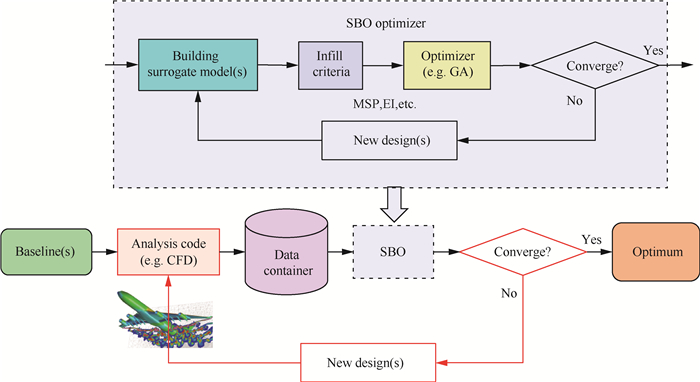
首先,通过试验设计方法在设计空间内选取n个初始样本:S=[x(1), x(2), …, x(n)]T∈Rn×m,并对这些样本点进行数值分析(如CFD分析),得到目标函数y(x)和约束函数h(x)、g(x)响应值; 其次,基于样本数据集(S, yS)建立初始的代理模型
从上述流程中可知,代理优化的核心机制是优化加点准则和子优化。在代理模型的基础上,通过构造适当的学习函数,形成子优化问题的数学模型。采用传统的梯度或进化算法等求解子优化问题,便可以不断生成新的样本点,并驱动主优化过程朝着局部或全局最优解逼近。此外,利用一些具有全局性的优化加点准则,构造在整个设计空间内的学习函数,可以保证优化算法的全局性。例如,改善期望(Expected Improvement, EI)[56]加点准则,可以同时考虑模型预测值的改善量和误差最大处,是一种平衡全局探索和局部发掘的加点方法。文献[57]指出,在某些假设条件下,基于EI准则进行的加点是稠密的,也就是说在加入足够多的样本点情况下,可以找到全局最优解。值得注意的是,子优化的计算量相比于昂贵的CFD计算,基本可以忽略不计。文献[58-59]指出:“代理模型的建模过程,实质上是采用了机器学习技术,从设计空间中的少量样本信息中学习出了目标函数和约束函数随设计变量变化的规律或知识”。事实上,代理模型可以看作是针对小样本的监督式机器学习模型,因而代理优化也被称为智能化的优化算法。实践证明,针对设计空间光滑连续且目标函数和约束函数计算代价昂贵的优化设计问题,代理优化算法的优化效率要比传统进化类方法高出1~2个数量级。文献[60]指出:“作为航空航天领域的研究热点,基于代理模型的优化算法对于提升现代航空航天系统的性能、降低设计成本具有非常重要的意义。”
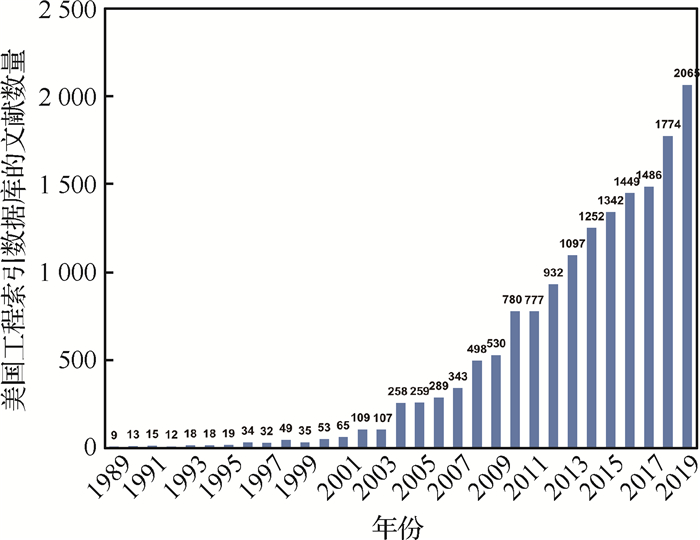
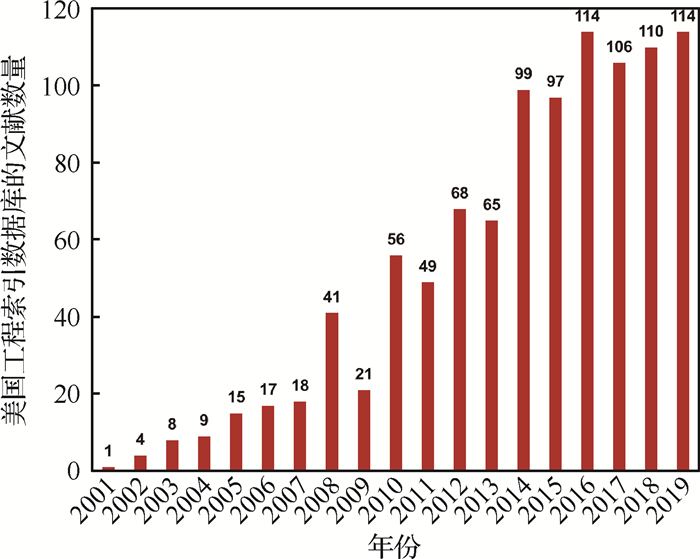
代理优化在航空航天工程设计中的应用可以追溯到20世纪70年代,最初应用于飞行器结构优化设计[29],后来逐渐发展成为多学科优化设计(Multidisciplinary Design Optimization, MDO)[61-62]的关键技术,直到20世纪90年代末才被引入到气动优化设计领域[6, 63]。图 2和图 3分别给出了美国工程索引(Engineering Index)数据库检索的20世纪90年代以来关于代理优化方法及21世纪初以来基于代理模型的气动优化设计的文章数量变化趋势。从图中可以清楚地看出,近年来国内外发表的关于基于代理模型的气动优化设计的论文数量呈快速增长趋势,代理优化方法已经成为气动优化设计领域的研究热点。基于文献调研,表 1列出了相关领域代表性团队及其代表性研究;主要介绍了基于代理模型的研究工作和一部分基于梯度优化和启发式算法的气动优化设计工作。限于本文作者调研水平,可能未能涵盖国内外所有气动优化设计团队的研究工作。此外,代理优化的应用实际上非常广泛,包括航空航天、船舶、汽车、能源、电子、环境、生物等众多领域,由于本文的重点是介绍代理优化在气动优化设计中的应用,在其他学科领域的应用超出了本文讨论范畴,不再赘述。
|
| 图 2 美国工程索引数据库检索的与代理优化方法相关的文章数(自20世纪90年代以来) Fig. 2 Number of published papers in the area of surrogate-based optimization obtained through Engineering Index database (since 1990s) |
|
| 图 3 美国工程索引数据库检索的基于代理模型气动优化设计的文章数(自21世纪初以来) Fig. 3 Number of published papers in the area of surrogate-based aerodynamic shape optimization obtained through Engineering Index database (since 2000s) |
| 序号 | 代表性研究团队 | 研究机构 | 主要文献 | 代表性研究工作 |
| 1 | Haftka R.T. | 美国佛罗里达大学 | [60, 64-68] | 深入研究了灵敏度分析方法、代理模型近似技术、试验设计方法和航空航天飞行器多学科优化设计,发表了多篇与代理模型和代理优化相关的研究综述。 |
| 2 | Martins J.R.R.A. | 美国密歇根州立大学 | [15, 16, 18, 69-76] | 发展了离散伴随方法、气动/结构耦合伴随方法等;开展了基于梯度优化算法的CRM机翼、CRM翼身组合体、飞翼布局、风力机叶片等气动优化设计;发展了基于偏最小二乘的梯度增强Kriging模型,基于多专家学习模型建立了翼型分析与在线快速优化设计数据库。 |
| 3 | Leifsson L. | 美国爱荷华州立大学 | [77-94] | 主要发展了基于变可信度模型的单目标和多目标气动优化设计方法,提出了基于修正和空间映射的变可信度代理模型方法。 |
| 4 | Willcox K.E. | 美国德克萨斯奥斯汀分校 | [95-103] | 主要发展了变可信度代理模型理论与算法、不确定性量化与传播、本征正交分解与降阶模型方法等。 |
| 5 | Keane A.J. Forrester A.I.J. | 英国南安普顿大学 | [27, 38, 52, 104-110] | 主要研究代理模型及代理优化理论与算法,发表了多篇代理优化研究进展综述和专著。 |
| 6 | Qin N. | 英国谢菲尔德大学南京航空航天大学 | [39, 111-114] | 主要发展了基于伴随方程的气动优化设计方法,以及基于代理模型的翼型、机翼单目标及多目标气动优化设计方法。 |
| 7 | Zingg D.W. | 加拿大多伦多大学 | [19, 115-122] | 主要发展了基于伴随方程的气动优化设计方法,开展了自然层流机翼、飞翼及新型气动布局的气动与多学科优化设计研究。 |
| 8 | Wang G.G. | 加拿大西门菲沙大学 | [123-127] | 主要发展了代理模型辅助的智能进化算法,并应用于大型工程系统多学科建模与优化设计,发表了多篇综述介绍代理优化研究进展。 |
| 9 | Obayashi S. | 日本东北大学 | [128-134] | 改进了超体积因子的计算方法,发展了基于代理模型和超体积因子改善期望加点准则的多目标气动优化设计方法。 |
| 10 | 杨国伟 | 中国科学院力学研究所 | [135-137] | 结合Kriging模型和改进的粒子群算法,开展了考虑结构弯曲刚度和扭转刚度的大型飞机减阻优化设计;结合Kriging模型和自适应非劣分类遗传算法,开展了高速列车头型的多目标气动优化设计。 |
| 11 | 张宇飞;陈海昕 | 清华大学 | [59, 138-147] | 发展了基于进化算法的气动优化设计方法,并应用于大型民机超临界机翼气动设计。发展了代理模型辅助的进化算法;在气动优化设计中引入机器学习方法;提出了2.75D方法;发展了基于压力分布约束的大型宽体客机超临界机翼气动优化设计方法。 |
| 12 | 黄江涛;周铸 | 中国空气动力研究与发展中心 | [3, 148-152] | 主要发展了基于伴随方法的气动与多学科优化设计方法。发展了气动/结构耦合伴随方法,发展了气动/声爆、气动/隐身综合优化设计方法。针对翼型、飞翼布局等气动外形,结合主成分分析方法开展了单目标、多目标气动优化设计。 |
| 13 | 招启军 | 南京航空航天大学 | [153-157] | 采用代理优化方法、遗传算法、梯度优化等方法,开展了与直升机旋翼相关的气动与多学科优化设计方法及应用研究。 |
| 14 | 吕宏强 | 南京航空航天大学 | [158-161] | 主要发展了人工智能代理模型方法,并开展了基于差分进化、多输出代理模型的超临界翼型气动优化设计研究。 |
| 15 | 余雄庆 | 南京航空航天大学 | [162-168] | 主要发展了基于代理模型的多学科优化设计方法,并开展了层流翼型、大型民机、无人机以及非常规布局飞行器的气动、结构、操稳等多学科优化设计研究。 |
| 16 | 孙刚 | 复旦大学 | [169-175] | 主要发展了人工神经网络代理模型方法,开展了基于人工神经网络、数据挖掘方法的气动优化设计、气动/噪声综合优化设计方法研究。 |
| 17 | 宋学官 | 大连理工大学 | [176-182] | 主要发展了组合代理模型、组合加点、变可信度代理模型等新型代理模型理论与算法,开展了基于代理模型的智能盾构机、核电阀流固耦合优化、动力电池散热等多学科优化设计研究。 |
| 18 | 龙腾 | 北京理工大学 | [183-194] | 提出了不依赖全局的Maximin拉丁超方试验设计方法、混合RBF代理模型方法、依赖于罚函数的高耗时约束处理方法以及多种基于自适应代理模型的多学科优化设计方法,开发了支持并行计算的代理模型优化工具包,并开展了新型航天器与精确制导武器总体方案以及航空、航天单机装备的优化设计研究。 |
| 19 | 邱浩波;高亮 | 华中科技大学 | [195-201] | 针对高维优化问题,提出了代理模型辅助的高效进化算法,发展了多种优化加点策略,改进了梯度增强代理模型,并将其应用于翼型的气动优化设计中。 |
| 20 | 周奇 | 华中科技大学 | [202-208] | 提出了一套针对变可信度代理模型的试验设计、代理模型建模、模型验证、优化加点方法,并应用于翼型的单目标/多目标气动优化设计。 |
| 21 | 王鹏;宋保维 | 西北工业大学 | [209-217] | 主要发展了变可信度代理模型和多目标、多学科优化设计方法,应用于翼型以及水下航行器的外形优化设计。 |
| 22 | 高正红 | 西北工业大学 | [6, 218-230] | 提出了分层协同优化、设计空间降维方法、多输出代理模型方法以及考虑设计者偏好的多目标优化算法;发展了基于变可信度代理模型的气动优化设计、不确定性与稳健优化设计和无人机气动/隐身综合优化设计方法,以及基于代理模型的高效CFD/CSD耦合飞行器多学科优化设计方法。 |
| 23 | 白俊强 | 西北工业大学 | [5, 231-241] | 主要发展了基于伴随方法的气动与多学科优化设计方法、设计空间降维和本征正交分解方法,开展了翼型、大型民机机翼、翼稍小翼的单点、多点气动优化设计,并发展了机翼气动/结构一体化设计、稳健优化设计方法,应用于多项工程设计中。 |
| 24 | 蔡晋生 | 西北工业大学 | [71, 242-244] | 发展了结合活跃子空间和降维思想的代理优化方法,提出了一种基于代理模型和梯度优化的两步方法,并应用于翼型、机翼的气动优化设计。 |
| 25 | 韩忠华;宋文萍 | 西北工业大学 | [7, 37, 54, 55, 245-261] | 提出了分层Kriging模型、多层Kriging模型、Co-Kriging模型、加权梯度增强Kriging模型以及变可信度改善期望方法(VF-EI);发展了混合反设计/优化设计、大规模约束处理、大规模并行优化加点准则等一系列代理优化理论和算法,自主开发了优化软件SurroOpt;开展了翼型(RAE2822翼型-19维、直升机旋翼翼型-14维)、机翼(自然层流超临界机翼-42维、DLR F4机翼-48维、ONERA M6机翼-108维)、翼身组合体(NASA CRM翼身组合体-67维、飞翼布局-80维)、全机复杂外形(大型宽体客机-109维)的气动与多学科优化设计研究。 |
鉴于目前国内外还没有相关领域的综述性文章,本文以飞行器精细化气动优化设计问题为背景,系统地介绍了基于代理优化方法的高效全局气动优化设计最新研究进展。第1节从代理模型理论和算法的角度,系统地综述了基于变可信度代理模型的气动优化设计方法、结合代理模型和Adjoint方法的气动优化设计方法以及基于一种非生物进化的并行气动优化设计方法的研究现状和最新进展;第2节针对飞行器气动优化设计前沿问题,介绍了基于代理模型的多目标气动优化设计、混合反设计/优化设计、稳健气动优化设计等方法的研究进展;第3节综述了基于代理模型的飞行器多学科优化设计方法研究进展;第4节探讨了基于代理优化的气动模型设计理论和方法目前面临的问题和挑战,并给出了未来的研究方向建议。
1 基于新型代理模型和新优化机制的气动优化设计方法研究进展经过近20年的研究和发展,基于代理模型的优化方法研究目前已取得了长足进步[7, 183]。多种新型代理模型被提出[69, 208, 245-246, 253],优化理论和算法也得到不断完善和发展[54-55, 66, 68, 260-261]。然而,随着飞行器设计指标的不断提升,设计变量规模不断扩大,代理优化算法的发展遇到了瓶颈:由于气动特性对气动外形的变化往往十分敏感,所以气动优化设计需要大量独立设计变量来描述飞行器外形,是一个典型的高维优化问题,面临维数灾难问题[7, 26]。主要体现在:一方面,由于维数(设计变量数)高,利用少量初始样本点建立的代理模型不精确,导致新产生的样本点序列收敛较慢,需要调用更多次CFD分析才能找到设计空间内的最优解;另一方面,精细化气动优化设计对CFD数值模拟可信度的要求不断提升,正问题的计算成本也不断增加。这两方面共同作用,导致代理优化的计算量急剧增加,使其难以在有限的时间内找到全局最优解。
为了缓解飞行器精细化气动优化设计中的维数灾难,进一步提高代理优化的效率,目前一般有两种解决方案:一种方案是引入低可信度样本数据[64-65, 245]或梯度信息[69, 252-253]来辅助建立代理模型,用更少的高可信度样本,实现更高的全局代理模型精度,从而大幅度提高优化效率。另一种方案是从优化机制的角度,将代理优化算法与并行计算技术相结合,发展一种基于代理模型的特殊优化机制——非生物进化,以充分运用高性能计算机的大规模并行计算能力和代理模型对所用历史样本数据的学习和再利用能力。这两种方案都在缓解维数灾难问题方面具有重要作用,相关研究也成为了研究热点之一。
本节将从变可信度代理模型的气动优化、结合代理模型和Adjoint方法的气动优化、基于非生物进化的并行气动优化等3个方面进行综述。
1.1 基于变可信度代理模型的气动优化设计方法变可信度代理模型又称变复杂度模型,其核心思想是使用大量低可信度样本建模来反映函数正确变化趋势,并采用少量高可信度样本来对之进行修正,从而大幅减少构造精确代理模型所需的高可信度样本点数,提高建模和优化效率。
由于变可信度代理模型方法充分挖掘了高低可信度分析的优势,近年来已经在优化设计研究中取得成功应用。现有的基于变可信度代理模型的气动优化设计方法可以分为以下3类:
1) 基于修正的变可信度气动优化设计方法。该方法以低可信度模型为基础,通过乘法标度、加法标度或混合标度的方式引入低可信度样本数据,辅助构建高可信度模型的近似模型。乘法标度方法最早由Chang等提出[262],可以用低可信度模型在局部近似高可信度分析的结果。后来,Alexandrov等[263]将其与置信域方法相结合,应用于翼型和机翼的气动优化设计[264-265],显著提高了优化效率。加法标度方法[266-269]相比于乘法标度方法,能够使低可信度模型全局地逼近高可信度分析函数,精度更高、鲁棒性更好,因而逐渐得到更广泛的使用。这两种方法虽然都能提高精度,但是对于不同的问题适用性不同。为此,人们又提出了混合标度方法[270-271]。最简单的混合标度方法是通过引入常系数对两个修正因子进行加权[272],更一般的方式是采用混合桥函数方法[273]。本文作者等[252]对混合桥函数方法进行了改进,并引入了梯度等信息,提高了预测精度。需要说明的是,基于修正的变可信度代理模型方法要求当前迭代点的高低可信度函数满足一阶一致性条件[274],并且通常要结合置信域方法来保证优化的收敛性。
基于自适应混合桥函数的变可信度代理模型表达式为
| $ \mathit{\boldsymbol{\hat y}}(\mathit{\boldsymbol{x}}) = \omega \hat \phi (\mathit{\boldsymbol{x}}){{\hat y}_{{\rm{1f}}}}(\mathit{\boldsymbol{x}}) + (1 - \omega )\left[ {{{\hat y}_{{\rm{1f}}}}(\mathit{\boldsymbol{x}}) + \mathit{\boldsymbol{\hat \gamma }}(\mathit{\boldsymbol{x}})} \right] $ | (2) |
| $ \hat \phi (\mathit{\boldsymbol{x}}) = \frac{{{{\hat y}_{{\rm{hf}}}}(\mathit{\boldsymbol{x}})}}{{{{\hat y}_{{\rm{If}}}}(\mathit{\boldsymbol{x}})}} $ | (3) |
| $ \mathit{\boldsymbol{\hat \gamma }}(\mathit{\boldsymbol{x}}) = {{\hat y}_{{\rm{hf}}}}(\mathit{\boldsymbol{x}}) - {{\hat y}_{{\rm{1f}}}}(\mathit{\boldsymbol{x}}) $ | (4) |
式(2)右边第1项表示乘法标度部分;第2项表示加法标度部分;ω为自适应权重系数。具体的建模思路可参见文献[252]。
2) 基于空间映射(Space Mapping, SM)的变可信度气动优化设计方法。通过改变低可信度函数的设计空间,使得低可信度函数的最优解能够逼近高可信度函数的最优解。这样只需在低可信度模型上进行优化,再通过高、低可信度函数的空间映射关系便可得到高可信度函数的近似最优解。该方法最早由Bandler等[44]在1994年提出,给出了用于优化的线性映射算法,后来又有人提出了渐进空间映射(ASM)[275]、神经网络空间映射(NSM)[276]、隐式空间映射(ISM)[277]等算法。Robinson等[102]提出了一种改进的空间映射方法,并成功应用于机翼和扑翼的变可信度气动优化设计。之后,Jonsson等[278]也将此方法用于跨声速机翼气动优化设计。
空间映射方法的核心思想在于生成合适的映射关系P:
| $ {\phi _{\rm{c}}} = P({\phi _{\rm{f}}}) $ | (5) |
使得高、低可信度函数响应值之差的范数≤某个小量ε:
| $ \left\| {{R_{\rm{f}}}({\phi _{\rm{f}}}) - {R_{\rm{c}}}({\phi _{\rm{c}}})} \right\| = \left\| {{R_{\rm{f}}}({\phi _{\rm{f}}}) - {R_{\rm{c}}}(P({\phi _{\rm{f}}}))} \right\| \le \varepsilon $ | (6) |
式中:Rf(фf)表示高可信度模型在фf处的精确响应;Rc(фc)表示低可信度模型在фc处的精确响应。在局部建模区域内,寻找低可信度函数最优解фc*,并通过逆变换:
| $ \phi _{\rm{f}}^* = {P^{ - 1}}(\phi _{\rm{c}}^*) $ | (7) |
来得到高可信度函数的最优解фf*。求P的过程往往是一个迭代过程,被称为参数提取(Parameter Extraction, PE),具体可参见文献[44, 278]。
3) 基于Co-Kriging模型和分层Kriging模型的变可信度气动优化设计方法。Co-Kriging是在Kriging模型基础上发展起来的地质统计学方法,Kennedy和O’Hagan[279]首次将其应用于工程科学领域。Co-Kriging模型基于贝叶斯理论,通过建立自回归模型将不同可信度的数据进行融合,利用交叉协方差来衡量不同可信度层之间的相关性。Co-Kriging模型的预估值表达式为
| $ \mathit{\boldsymbol{\hat y}}(\mathit{\boldsymbol{x}}) = \mathit{\boldsymbol{\lambda }}_1^{\rm{T}}{\mathit{\boldsymbol{y}}_1} + \mathit{\boldsymbol{\lambda }}_2^{\rm{T}}{\mathit{\boldsymbol{y}}_2} $ | (8) |
且y1、y2对应2个不同的静态随机过程:
| $ \left\{ {\begin{array}{*{20}{l}} {{Y_1}(\mathit{\boldsymbol{x}}) = {\beta _1} + {Z_1}(\mathit{\boldsymbol{x}})}\\ {{Y_2}(\mathit{\boldsymbol{x}}) = {\beta _2} + {Z_2}(\mathit{\boldsymbol{x}})} \end{array}} \right. $ | (9) |
Forrester等[27, 280]和Kuya等[110]首次将上述Co-Kriging模型应用于航空航天工程设计领域。Huang等[281]在此基础上发展了一种MFSKO(Multi-Fidelity Sequential Kriging Optimization)方法,给出了多可信度Kriging模型的建模理论,并将多层模型的超参数优化问题分解为多个子问题,提高了建模效率。Zimmermann和Han[282]对Co-Kriging模型的相关函数计算进行了简化,使得需要训练的模型超参数只比Kriging模型多一个,大大提高了建模效率。本文作者等[250, 283]又提出了一种更实用的Co-Kriging建模方法,将模型预测值定义为高低可信度样本点的加权,并把模型方差从协方差矩阵中提取出来,最后通过气动预测和气动优化设计算例验证了该方法的有效性。Zaytsev[284]将Co-Kriging模型进行推广,实现了任意多层可信度数据的引入。Chung[285]和Yamazaki[286]等将梯度信息作为一种低成本的辅助信息,引入到Co-Kriging的建模过程中,提出了一种梯度增强的Co-Kriging模型(GECK)。Co-Kriging方法同时采用高低可信度数据一次性建立了代理模型,其建模过程相比于基于修正的变可信度代理模型更加直接,但是高低可信度函数之间的交叉协方差计算使其建模的成本较大,限制了其在优化设计中的应用[287]。
针对Co-Kriging模型不够鲁棒、建模效率低等问题,本文作者[245]于2012年提出了一种更简单实用的分层Kriging模型(Hierarchical Kriging, HK)。依次建立低、高可信度层Kriging模型,并将低可信度模型的预估值直接作为全局趋势函数引入到高可信度模型的建模中,有效避免了Co-Kriging模型交叉协方差难以计算的问题,且模型提供的误差估计更加合理。HK模型的基本假设如下:
| $ \mathit{\boldsymbol{\hat y}}_1 (\mathit{\boldsymbol{x}}) = {\beta _0}{{\mathit{\boldsymbol{\hat y}}}_2} + Z(\mathit{\boldsymbol{x}}) $ | (10) |
式中:Z(x)为静态随机过程;
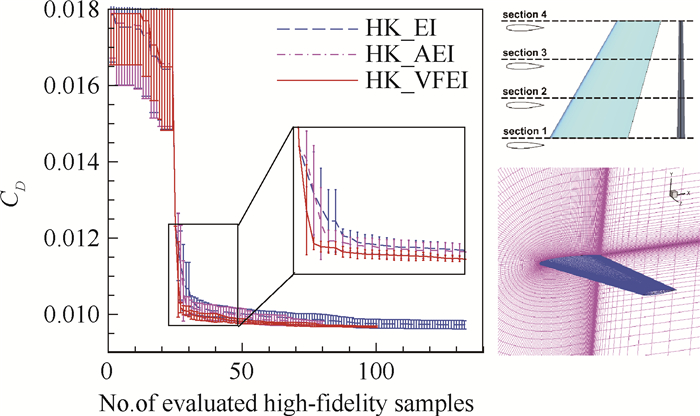
在HK模型方法的后续研究中,Ha等[288]采用不同组合的高低可信度CFD数据建立分层模型,并通过翼型的变可信度优化设计验证了该方法的可行性。Hu等[208]对HK模型进行了改进,他将原先反映高、低可信度函数之间的常数因子改为多项式响应面的形式,从而能更准确地表述高低可信度函数间的相关性,提高了HK模型的精度。宋超等[289]将样本点处的梯度信息引入到HK模型中,建立了耦合梯度信息的GEHK模型,并应用于RAE2822翼型的单点/多点气动优化设计中。本文作者[246]将分层Kriging模型推广到任意多层,发展了一种多层Kriging模型(Multi-level Hierarchical Kriging, MHK)。该方法的核心思想是将较低可信度模型作为较高可信度模型的全局趋势模型,递归式地从低到高依次建立不同可信度的Kriging模型,直到完成最高一层Kriging模型建模。文献[246]开展了基于MHK模型的气动优化设计算例研究,与两层的HK模型相比,优化效率又得到进一步提高,优化结果也得到改善,如图 4所示。目前,HK方法已经被国内外的大量学者采用[290]。NASA著名的《CFD 2030愿景》报告[2]曾指出变可信度代理模型方法在飞行器设计中具有巨大发展潜力,其中HK方法作为一种具有代表性的方法被引用。

目前,国内外针对变可信度代理优化的加点准则研究较少,通常将针对单可信度优化发展的加点准则直接应用于变可信度优化。这就意味着在优化过程中只能增加高可信度的样本点,没有充分利用低可信度数据来提高优化设计的效率。为此,Jo等[291]提出了一种根据现有高、低可信度样本点分布的统计特征,建立动态可信度指标来指导调用高低可信度CFD分析的方法。Huang等[281]发展了一种适用于多层可信度优化的改善期望加点准则(Augmented EI, AEI),该准则可以合理选择加点的可信度层及加点的具体位置。Mehmani等[292]提出了一种针对不同可信度分析模型的管理策略,利用模型转换开关在优化过程中合理地选择不同的可信度模型。其核心思想是在最近一次加点后,判断函数值改善量中模型误差占据的比分大小,当模型误差占据的比分较大时,则会选择高可信度CFD分析,否则进行低可信度CFD分析。张瑜等[55]提出了一种针对分层Kriging模型的变可信度改善期望(Variable-Fidelity Expected Improvement, VFEI)加点准则,可以自适应地选择对最优值期望改善量最大的可信度层进行加点,大幅提高了变可信度优化的效率。图 5展示了基于VFEI准则的ONERA M6跨声速机翼气动优化设计,表明VFEI方法可以提高变可信度优化设计的效率[55]。
将目标函数和约束函数关于设计变量的梯度信息引入代理模型建模,建立梯度增强代理模型,以较小的额外计算代价,可以达到大幅提高代理模型精度的目的。
在气动优化设计领域,目标函数和约束函数的梯度值可以通过Jameson教授发展的伴随方法[13-14]来获得。而一次梯度求解的计算量与一次流场控制方程求解的计算量基本相当,所以总的计算量约相当于2倍的流场计算量,并且与设计变量的数目基本无关。这样一来,建立合理近似精度代理模型所需CFD计算量大幅减少,优化效率得到显著提升。2002年,Chung和Alonso[285]将梯度增强Kriging(Gradient-Enhanced Kriging, GEK)模型应用于超声速公务机的气动布局优化设计中,自此梯度增强代理模型在气动设计优化领域引起了人们的关注。根据Kriging模型和梯度信息的不同结合方法,可以将梯度增强Kriging模型分为间接GEK和直接GEK模型。
间接GEK方法[293]引入梯度信息的方式是采用一阶泰勒展开来获得样本点x(i)相邻样本点处的响应值信息:
| $ \begin{array}{*{20}{c}} {y({\mathit{\boldsymbol{x}}^{(i)}} + \Delta {x_k}{\mathit{\boldsymbol{e}}_k}) \approx y({\mathit{\boldsymbol{x}}^{(i)}}) + \frac{{\partial y}}{{\partial {x_k}}}({\mathit{\boldsymbol{x}}^{(i)}})\Delta {x_k}}\\ {i = 1,2, \cdots ,n;k = 1,2, \cdots ,m} \end{array} $ | (11) |
式中:ek是设计空间的正交基矢量。通过这样的方法,某个样本点处的m个偏导数值就变成了m个附加样本点的响应值,然后再基于这n×(m+1)个样本点建立Kriging模型。间接GEK模型的主要缺点是建模的精度依赖于步长Δxk的选取:如果步长太小,则可能引起模型相关矩阵病态,而如果步长太大又会产生较大的数值误差。针对该问题,Liu[294]采用最大似然估计法来获得最优的步长。
而直接GEK方法将样本点处的梯度作为函数响应值以外的信息直接引入Kriging的建模样本数据集中,并利用增广的相关矩阵中交叉协方差项,来考虑函数响应值与梯度或梯度与梯度之间的相关性。直接GEK的预测模型定义为
| $ \hat y(\mathit{\boldsymbol{x}}) = \sum\limits_{i = 1}^n {{w^{(i)}}} {y^{(i)}} + \sum\limits_{j = 1}^m {\sum\limits_{i = 1}^n {\mathit{{\lambda }}_j^{(i)}} } \frac{{\partial {y^{(i)}}}}{{\partial {x_j}}} $ | (12) |
式中:w(i)为第i个抽样位置处函数值的加权系数;λj(i)为第i个抽样位置处函数对第j维设计变量偏导数的加权系数。有关直接GEK的建模理论可参见文献[7, 252]。
Laurenceau等[293-295]比较了Kriging、直接GEK、间接GEK模型对气动力预测的精度,发现在相同样本点数下两种GEK模型的精度都高于Kriging模型。Zimmermann[296]通过理论分析和数值算例,证实大多数情况下间接GEK的相关矩阵条件数都比直接GEK的大。此外,Laurent等[297]的数值算例表明间接GEK方法只在低维问题中显示出了与直接GEK方法相近的建模精度,而在高维问题中的表现不如后者。
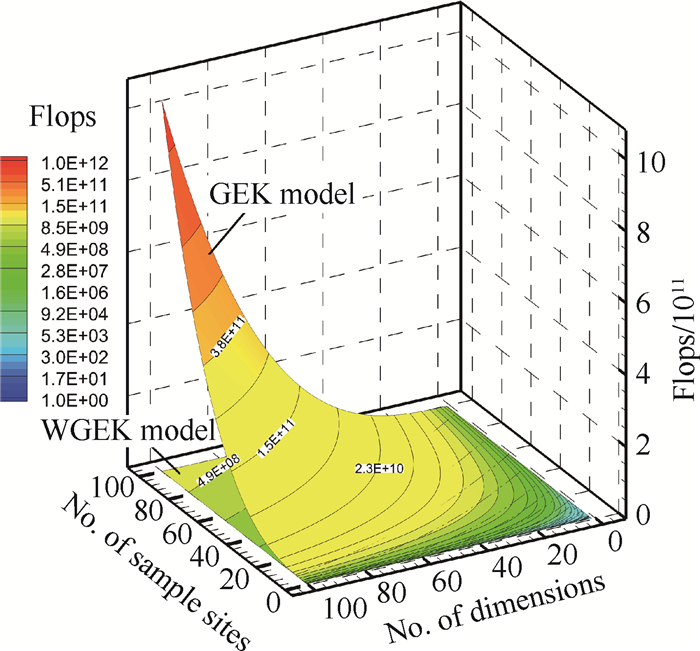
虽然GEK模型已在气动优化设计中得到一些初步应用,但也暴露出一些问题,主要体现在两个方面:①在优化过程后期,新加的样本点会聚集在最优值附近,这会导致相关矩阵的病态,从而使得代理模型建模不准确, GEK模型中梯度信息的引入使得相关矩阵病态的问题更加严重,这一现象可能是导致基于GEK的代理优化方法在优化过程后期收敛速度变慢的原因之一;②随着设计变量的增加,GEK模型的相关矩阵规模急剧增大,模型训练的计算量大幅增长,导致建模时间达到或超过了数值模拟分析本身的时间,同样出现了维数灾难现象,大大限制了其在大规模设计变量飞行器气动优化设计领域的发展。
针对相关矩阵的病态问题,许多研究者开展了诸多研究工作。Dimond和Armstrong[298]通过理论分析和数值算例证实了相关矩阵的条件数会影响Kriging模型的鲁棒性。Posa[299]考察了不同相关函数模型的选择对相关矩阵条件数的影响,发现相比于其他相关模型,高斯相关模型更容易导致相关矩阵出现病态。随后,Ababou等[300]通过大量数值实验得出了与Posa[299]一致的结论,并认为高斯相关函数无限可微的属性,是造成相关矩阵条件数过大的原因。在最近的研究中,Zimmermann[301]在数学上严格证实了高斯相关函数的数学特性使得它更容易引起相关矩阵的病态。他还研究了Kriging相关矩阵的条件数与最大似然估计(超参数优化)之间的联系,并发现在采用高斯相关函数时,距离权重θk对应的似然函数最优值往往靠近似然函数发散的区域,而似然函数的发散正是由相关矩阵条件数过大导致的[302]。
为了避免模型相关矩阵的病态,一种流行的做法是采用正则化方法,即在相关矩阵R的对角元素加上一个大于零的小量:
| $ {\mathit{\boldsymbol{R}}^\prime } = \mathit{\boldsymbol{R}} + \delta \mathit{\boldsymbol{I}} $ | (13) |
在地质统计学领域,该方法又被称作Nugget效应[303]。通过引入一定程度的回归,提高了插值结果的光顺性,从而达到减小相关矩阵条件数的目的[299]。Ranjan等[304]利用相关矩阵条件数作为约束来确定δ的下界,并提出一种“迭代正则化”的数值策略来降低引入Nugget效应对建模精度的影响。Peng和Wu[305]也采用相同方法确定δ的下界,并提出利用均方误差最小来动态确定该值的策略。Andrianakis和Challenor[306]研究了Nugget效应对Kriging模型和似然函数的影响。
另一种避免相关矩阵病态的策略是在模型训练或超参数优化的过程中,将相关矩阵的条件数作为约束,例如Won[307]和Johann[308]等将相关矩阵的条件数作为最大似然估计的一个约束:
| $ \begin{array}{*{20}{l}} {{\rm{max}}{\kern 1pt} {\kern 1pt} {\kern 1pt} {\kern 1pt} {\kern 1pt} {\kern 1pt} {\kern 1pt} {\kern 1pt} L(\mathit{\boldsymbol{\theta }})}\\ {{\rm{s}}{\rm{.}}{\kern 1pt} {\kern 1pt} {\rm{t}}{\rm{.}}{\kern 1pt} {\kern 1pt} {\kern 1pt} {\kern 1pt} {\kern 1pt} {\kern 1pt} {\kern 1pt} {\kern 1pt} {\kern 1pt} {\kern 1pt} {\kern 1pt} {\kern 1pt} {\kern 1pt} {\kern 1pt} {\kern 1pt} k(\mathit{\boldsymbol{R}}(\mathit{\boldsymbol{\theta }})) \le {k_{{\rm{max}}}}} \end{array} $ | (14) |
式中:L为超参数对应的似然函数;kmax即为相关矩阵条件数的上限。
有研究表明,直接GEK模型的相关矩阵条件数比间接GEK模型更小,但即便如此,直接GEK模型也往往比普通Kriging代理模型面临更为严峻的相关矩阵病态的问题[309]。目前,针对GEK模型相关矩阵病态的研究比较少,一般都采用与Kriging模型相同的正则化方法,例如一些研究者提出对函数值项和梯度项分别采用两种正则化小量的思路[308, 310]:
| $ {\mathit{\boldsymbol{R}}^\prime } = \mathit{\boldsymbol{R}} + \left[ {\begin{array}{*{20}{c}} {{\delta _1}\mathit{\boldsymbol{I}}}&{\bf{0}}\\ {\bf{0}}&{{\delta _2}\mathit{\boldsymbol{I}}} \end{array}} \right] $ | (15) |
美国桑迪亚国家实验室的Dalbey[311]提出了另一种解决思路:首先对相关矩阵利用选主元Cholesky分解方法,然后按照主元顺序对原相关矩阵进行重新排序,越靠后的样本点信息重要性越低,最后通过从后向前剔除样本点信息,来实现降低相关矩阵条件数的目的。他利用DAKOTA优化工具箱进行了数值建模实验,研究表明该方法降低了相关矩阵条件数,提高了GEK模型的建模精度。
针对GEK模型训练的计算量随设计变量和样本数量的增加而急剧增大的问题,本文作者等[253]在2017年提出了一种加权梯度增强Kriging(Weighted Gradient-Enhanced Kriging, WGEK)模型。该方法将GEK模型转化为一系列子GEK模型的叠加,每个子模型的样本集由所有样本点和其中一个样本点在所有维度方向的梯度值组成。首先建立一系列相关矩阵规模小得多的子模型,然后将这些子模型加权起来,获得所需的梯度增强代理模型。WGEK模型的预估值公式为
| $ \hat y(\mathit{\boldsymbol{x}}) = {\beta _0} + {\mathit{\boldsymbol{r}}^{\rm{T}}}(\mathit{\boldsymbol{x}}){\mathit{\boldsymbol{R}}^{ - 1}}[{{\mathit{\boldsymbol{\hat y}}}_{{\rm{S,sub}}}}(\mathit{\boldsymbol{x}}) - {\beta _0}\mathit{\boldsymbol{F}}] $ | (16) |
式中:

| 研究团队 | 年份 | 设计对象 | 问题维数 | 控制方程与梯度求解 |
| Alonso等[285, 312] | 2002 | 超声速公务机 | 5, 15 | Euler, 有限差分 |
| Xuan等[313] | 2009 | 空间再入飞行器 | 8 | Euler, 有限差分 |
| Laurenceau等[295] | 2010 | RAE2822翼型, AS28机翼 | 6, 45 | Navier-Stokes, Adjoint |
| Bompard等[314] | 2010 | NACA0012翼型 | 2 | Navier-Stokes, Adjoint |
| Yamazaki等[315] | 2010 | NACA0012翼型 | 16 | Euler, Adjoint |
| 韩忠华等[316] | 2015 | RAE2822翼型 | 18 | Navier-Stokes, Adjoint |
| 宋文萍等[289] | 2016 | RAE2822翼型 | 20 | Navier-Stokes, Adjoint |
| 韩忠华等[254] | 2017 | CRM机翼(反设计) | 108 | Navier-Stokes, Adjoint |
| 韩忠华等[253] | 2017 | ONERA M6机翼(反设计) | 36~108 | Navier-Stokes, Adjoint |
| 宋文萍等[317] | 2017 | ONERA M6机翼 | 63 | Navier-Stokes, Adjoint |
| 邱浩波等[196] | 2018 | NACA0012翼型 | 18 | Euler, Adjoint |
| 韩忠华等[318] | 2018 | CRM机翼 | 42 | Navier-Stokes, Adjoint |
| 邱浩波等[195] | 2020 | NACA0012翼型 | 8 | Euler, Adjoint |
对于传统的代理优化方法,每步更新代理模型时一般只采用一种加点准则,且只增加一个新的样本。即便是同时根据多种加点准则选择新样本点,一次迭代新增的样本点数仍然有限,严重制约了其在大规模并行优化设计中的应用。为此,研究人员发展了将代理优化算法与并行计算技术相结合的方法,将优化过程中产生的众多中间设计方案分配到多个计算节点中进行并行计算,可极大地加速优化的迭代历程,提高优化效率。
基于代理模型的并行优化算法与传统生物进化类全局优化方法非常类似。为了区别起见,本文将上述方法称为“基于代理模型的非生物进化方法”。该方法能够有效运用高性能计算机的并行运算能力和代理模型对所用历史样本数据的再利用能力,实现大规模并行优化设计。该优化机制运用最小化代理模型预测(MSP)、改善期望(EI)、改善概率(PI)、均方误差(MSE)、置信下界(LCB)等多种优化加点准则,在代理模型更新迭代的每一步,选取任意多个样本外形进行CFD并行计算。其核心思想是在初始样本(类似于初始种群)基础上,利用所有已知样本点数据集建立代理模型,然后采用多种加点准则分别独立地选取任意个新样本(类似于传统进化算法中的新种群);重复这种进化过程,直到产生的样本序列收敛于优化问题全局最优解。由于每一步优化迭代过程可选取大量样本,不仅可以在样本之间进行并行计算,每个样本外形自身也可进行网格分区并行计算,从而实现了真正意义上的大规模并行气动优化设计。
在上述的算法框架中,优化加点准则仍是核心机制。为了实现在每一步迭代过程中添加任意多个新样本,亟需发展一类新的加点准则。一般将这一类加点准则称为并行加点准则(或多点加点准则)。国内外研究者已经对并行加点准则开展了研究,提出了多种典型的并行加点准则。根据其构造原理,一般可以分为以下两类:
1) 基于单一加点准则的并行优化方法。Chevalier和Ginsbourger[319]率先在EI准则的基础上提出了“多元EI”准则(q-EI),可以在一步迭代中得到q个新样本。但该方法的实现需要借助蒙特卡洛抽样,并需要求解复杂的高维积分问题,因此当设计变量数目较多时计算成本会急剧增加,降低了工程实用性。出于降低计算成本的考虑,Ginsbourger等[320]又提出了“Kriging Believer(KB)”方法,其原理是将设计空间中EI最大值处用当前Kriging模型的预测值作为虚拟的样本响应值,随后建立虚拟代理模型,并再次寻找该虚拟新模型下的EI最大值点,上述过程不断重复q-1次即可得到所需的q个新样本点。由于在该过程中不需要重新训练模型参数,因此KB方法的计算成本相对较低。与之类似还有CL(Constant Liar)方法[320]。但是,研究表明,随着单步迭代中添加新样本数目的增多,这一类方法的优化效果会随之减弱[39]。近年来,Li等[321]借助于熵的概念,精确衡量了Kriging模型的不确定性,并据此提出了一种“EI&MI”准则,也可以实现并行加点。Cai等[322]也提出了一种基于EI函数及其概率分布函数的多点加点准则。
除了对EI准则进行拓展外,也可以针对EI函数自身的特点开展研究。Sóbester等[323]提出了一种将EI函数上的多个局部最大值当作新样本的方法。但由于无法确定EI函数局部最优解的个数,因此该方法无法保证每步迭代添加的样本点数目相同,从而给实际应用带来不便。近年来Zhan等[324]对该方法做出了改进。此外,Feng等[325]则从加权EI准则的原理出发,提出了一种基于多目标优化的并行加点方法。其原理是将EI表达式中分别代表局部发掘和全局探索的两项分别视作两个优化目标,求解此多目标优化问题便可得到一组Pareto解集,并从这组解集中选取任意多个点作为新样本。
值得一提的是,除EI准则外,其他常用的加点准则(如PI准则、LCB准则等)也能加以改进成为并行加点准则。Jones等[56, 326]曾指出,为PI准则设定不同的目标值即可实现添加多个新样本的目的。与之类似的,Laurenceau等[295]也提出通过改变LCB准则中的系数值来获得多个新样本。这一类方法虽然简单易行,但在实际情况中一般难以确定最合适的一组目标或系数。Chaudhuri和Haftka[327]针对该问题提出了使用PI准则并自适应选取合理目标值的方法,取得了初步成效。Viana等[68]则提出了一种选取联合PI函数上多个局部最大值作为新样本的方法。数值算例表明,该方法的优化效果随着新样本数的增加而减弱。
2) 多种加点准则组合的并行优化方法。Sekishiro等[328]首先提出了将基于EI准则得到的新样本和当前代理模型最优解(即MSP准则)同时加入样本集的方法,可以实现在一步迭代中添加两个新样本。研究表明,该方法对于气动优化设计而言非常实用[329]。Hamza和Shalaby[330]随后提出了一种同时使用3种加点准则并结合KB方法添加新样本的方法,可以在一步迭代中添加任意多个新样本。Chaudhuri等[331]提出了一种同时使用EI准则与多点PI准则[66]的并行加点方法,并将其成功应用于扑翼的气动优化设计中。Bischl等[332]则指出,可以将不同加点准则的子优化目标函数视作多个目标并求解该多目标优化问题,从而得到一组Pareto解集,并从中选取新样本。相同的原理也可以推广为使用多种代理模型,Viana等[68]就提出可以在同一组样本集的基础上建立不同代理模型,随后分别使用EI准则添加新样本的方法,也可在一步迭代中得到多个新样本。
为了将不同的加点准则进行合理组合,刘俊等[53]首先系统地比较了各种加点准则的异同,分析了其各自的优缺点。随后,在此基础上提出了一种同时使用EI、PI、LCB与MSP 4种加点准则的并行加点方法,实现了一步迭代添加4个新样本的方法,并将其成功地应用于一系列跨声速机翼的气动优化设计中[54]。从理论上讲,每种加点准则都有其内在的优缺点,而多种加点准则的组合在某种程度上可以弥补各自的缺点,起到增加样本多样性的效果(类似于遗传算法的交叉、变异机制),因而可改善优化质量。研究结果表明,该方法相较于EI准则,不仅优化效率有显著提高,优化质量也得到了改善。但由于受加点准则种类的限制,该加点方法在每一步迭代中所能添加的新样本数量无法任意给定,这无疑限制了其在大规模并行计算集群中的应用。为此,汪远等[260]提出了一种改进的组合并行加点准则,实现了可以使用多种加点准则添加任意多个新样本,进而将这些新样本分配至多个计算节点并行求解响应值,从而大幅度提高优化效率。该方法的优化机制如下:
| $ \begin{array}{l} S_{{\rm{ new }}}^{{\rm{ total }}} = \bigcup\limits_{n = 1}^N {{\kern 1pt} {\kern 1pt} {\kern 1pt} {\kern 1pt} S_{{\rm{ new }}}^{(n)}} = \\ {\kern 1pt} {\kern 1pt} {\kern 1pt} {\kern 1pt} {\kern 1pt} {\kern 1pt} {\kern 1pt} {\kern 1pt} {\kern 1pt} {\kern 1pt} {\kern 1pt} {\kern 1pt} {\kern 1pt} {\kern 1pt} {\kern 1pt} {\kern 1pt} {\kern 1pt} {\kern 1pt} {\kern 1pt} {\kern 1pt} {\kern 1pt} {\kern 1pt} {\kern 1pt} {\kern 1pt} {\kern 1pt} {\kern 1pt} {\kern 1pt} {\kern 1pt} {\kern 1pt} {\kern 1pt} {\kern 1pt} {\kern 1pt} \bigcup\limits_{n = 1}^N {{\kern 1pt} {\kern 1pt} {\kern 1pt} {\kern 1pt} {\kern 1pt} \left[ {\mathop {{\rm{argmax}}}\limits_{{x_1} \le x \le {x_u}} {\kern 1pt} {\kern 1pt} {\kern 1pt} {\rm{IS}}{{\rm{C}}^{\left( n \right)}}({\mathit{\boldsymbol{x}}^{(1)}},{\mathit{\boldsymbol{x}}^{(2)}}, \cdots ,{\mathit{\boldsymbol{x}}^{({q_n})}})} \right]} \end{array} $ | (17) |
式中:Snew(n)为第n种加点准则选取的新样本。图 8给出了采用组合并行加点准则进行代理优化的流程[260]。图 9和表 3展示了采用并行加点准则方法对DLR-F4机翼进行减阻优化设计的结果,优化中采用拉丁超立方抽样生成50个初始样本点,分别使用EI准则、基于EI准则的KB方法和组合并行加点准则添加新样本,样本总数为300,整个优化流程重复10次[260]。从优化结果可知,组合并行加点准则效果最佳。


| 加点准则 | 最优外形CD/count | 标准差/ count | 总迭代步数 | 计算时间/h | ||
| 最佳值 | 平均值 | 最差值 | ||||
| 基准机翼 | 279.8 | |||||
| EI | 260.11 | 265.36 | 280.53 | 6.9 | 250 | 497 |
| KB(EI-10) | 261.91 | 266.94 | 278.40 | 4.2 | 25 | 70 |
| CPISC-10(3-EI+3-LCB+3-PI+MSP) | 262.98 | 265.82 | 270.42 | 2.0 | 25 | 72 |
为了应对未来飞行器设计的需求,多目标气动优化设计方法逐渐成为气动优化设计的研究热点之一。多目标气动优化设计与单目标优化设计在保证优化设计的全局性和高效性上存在相同的矛盾,并且多目标气动设计问题往往具有更为复杂的设计空间,需要更多的样本点,进而需要付出更大的计算代价,极大限制了多目标气动优化设计方法在实际工程问题中的应用。
多目标气动优化设计问题的一般数学模型为
| $ \begin{array}{l} \begin{array}{*{20}{l}} {{\rm{min}} {f_1}(\mathit{\boldsymbol{x}}),{f_2}(\mathit{\boldsymbol{x}}), \cdots ,{f_p}(\mathit{\boldsymbol{x}})\quad p \ge 2}\\ {{\rm{w}}{\rm{. r}}{\rm{. t}}{\rm{. }}\quad {\mathit{\boldsymbol{x}}_1} \le \mathit{\boldsymbol{x}} \le {\mathit{\boldsymbol{x}}_{\rm{u}}}} \end{array}\\ \ {\rm{s}}{\rm{. t}}{\rm{.}}{\kern 1pt} {\kern 1pt} {\kern 1pt} {\kern 1pt} {\kern 1pt} {\kern 1pt} {\kern 1pt} {\kern 1pt} {\kern 1pt} {\kern 1pt} \left\{ {\begin{array}{*{20}{l}} {{h_i}(\mathit{\boldsymbol{x}}) = 0}&{i = 1,2, \cdots ,{n_{\rm{h}}}}\\ {{g_j}(\mathit{\boldsymbol{x}}) \le 0}&{j = 1,2, \cdots ,{n_{\rm{g}}}} \end{array}} \right. \end{array} $ | (18) |
式中:f(x)代表优化目标,可以是不同设计点的性能参数。当采用传统多目标优化算法进行求解上述优化模型时往往需要大量调用高可信度数值模拟,使得优化设计成本大幅增加。为了提高多目标气动优化设计的效率,基于代理模型的多目标气动优化设计方法逐渐得到发展和应用。一种简单的思路是通过建立不同目标的代理模型用以直接替代CFD分析,采用多目标遗传算法等传统多目标优化算法在代理模型上进行多目标优化,评估优化获得的非支配解集作为设计结果[232-333]。然而,面对复杂外形多目标气动优化设计问题,该方法需要大量的样本点来建立足够精确的代理模型。因此,亟需发展一种具备代理优化机制的多目标气动优化设计方法,来进一步降低计算成本。
21世纪以来,国内外研究人员在基于代理模型的多目标进化方法领域已经开展了较深入研究,并取得了一些有意义的研究成果[334]。Knowles[335]提出了将高效全局优化(EGO)方法与切比雪夫聚合方法相结合的ParEGO方法。在建立不同目标的代理模型以后,每一次迭代时通过随机选取目标权重系数将多目标问题转换为单目标问题寻优,找到新样本点用以更新代理模型。Keane[336]和Emmerich等[337]分别提出了Multi-EI和EHVI加点准则,将原本用于单目标优化问题的改善期望(EI)和改善概率(PI)推广到了多目标优化中。Beume[338]和Ponweiser[339]等发展了SMS-EMOA和SMS-EGO方法,将最大化超体积因子作为子优化目标来指导加点。这些工作,虽然能够提高传统无代理模型辅助的多目标优化算法效率,但是在每次迭代中只添加一个新样本点来更新代理模型,整个Pareto前沿不能在一次迭代中得到充分探索。为此,张青富等[340]将MOEA/D[341]与代理模型相结合,提出了MOEA/D-EGO方法。Lin[342]和Silver[343]等发展了类似的MOBO/D和s-MOEA/D方法。这些方法能够在一次迭代中同时添加多个样本点,进一步提高了优化效率。最近,文献[344]将4种典型的基于代理模型的多目标进化算法应用于翼型的多目标气动优化设计中进行对比分析。
近年来,基于代理模型的多目标气动优化设计方法在高升力翼型[345]、跨声速翼型[85]、高超声速飞行器宽速域翼型及机翼[261]、增升装置[333]、热交换器[346]、压气机转子[347]、超声速压气机叶栅[348]、高超声速乘波体[333]、再入式飞行器[349]等各类航空航天领域气动优化设计问题中得到了应用。图 10为采用基于代理模型的多目标气动优化设计方法,进行某宽速域翼型优化设计得到的Pareto前沿。

|
| 图 10 基于代理模型的高超声速宽速域翼型多目标气动优化设计 Fig. 10 Multi-objective aerodynamic shape optimization of wide-Mach-number-range airfoil using surrogate-based approach |
基于代理模型的混合反设计/优化设计方法,是一种将反设计方法与直接优化设计相结合的优化设计方法。通过借助高效全局的代理优化算法,可在设计空间内寻找兼顾反设计和直接优化设计目标且满足约束的飞行器气动外形。反设计方法通过目标特征流场分布(如目标压力分布),可以很好地运用设计者的经验和对流动机理的认识,但针对多目标、多约束问题显得无能为力。基于代理模型的直接优化设计则直接以气动性能指标(如阻力系数)为目标,通过优化算法自动寻找性能最优的外形。但搜索过程比较盲目,无法有效结合设计者的设计经验。为了兼顾两种方法的优势,将反设计方法和代理优化算法相结合,可使得优化算法在追求全局气动性能最优的同时保证局部流场特性良好。该方法的一般数学模型为
| $ \begin{array}{l} \begin{array}{*{20}{l}} {{\rm{min}} {f_{{\rm{dir}}}}(\mathit{\boldsymbol{x}}),{f_{{\rm{inv}}}}(\mathit{\boldsymbol{x}})}\\ {{\rm{w}}{\rm{. r}}{\rm{. t}}{\rm{. }}\quad {\mathit{\boldsymbol{x}}_1} \le \mathit{\boldsymbol{x}} \le {\mathit{\boldsymbol{x}}_{\rm{u}}}} \end{array}\\ \ {\rm{s}}{\rm{. t}}{\rm{.}}{\kern 1pt} {\kern 1pt} {\kern 1pt} {\kern 1pt} {\kern 1pt} {\kern 1pt} {\kern 1pt} {\kern 1pt} {\kern 1pt} {\kern 1pt} \left\{ {\begin{array}{*{20}{l}} {{h_i}(\mathit{\boldsymbol{x}}) = 0}&{i = 1,2, \cdots ,{n_{\rm{h}}}}\\ {{g_j}(\mathit{\boldsymbol{x}}) \le 0}&{j = 1,2, \cdots ,{n_{\rm{g}}}} \end{array}} \right. \end{array} $ | (19) |
式中:fdir(x)代表直接优化设计目标函数,可以是阻力等性能参数;finv(x)代表反设计目标函数,通常与局部压力分布相关。
目前,国内外对适用于飞行器气动外形的混合反设计/优化设计方法研究较少,大多数研究分属于反设计和直接数值优化设计这两大类里面。20世纪80年代初,Garabedian和McFadden[350]发展出通用的反设计方法——GM(Garabedian-McFadden)。由于设计出的翼型在激波附近不能和目标压力分布吻合,Malone等[351]在GM方法基础上做了改进,发展出MGM(Modified Garabedian-McFadden)方法。1984年,Takanashi[352]提出正反迭代-余量修正的反设计方法,其几何修正量来源于求解跨声速小扰动方程。该方法由于其计算分析程序可随意更换的优点而受到广泛关注和使用。1987年,NASA兰利研究中心的Campbell和Richard[353]提出DISC(Direct Iterative Surface Curvature)方法,又称为流线曲率法, 该方法核心在于提出翼型压力系数的变化量通常正比于翼型表面曲率的改变量的观点,并以此为基础建立数学模型。进入20世纪90年代,华俊等[354-355]对Takanashi的反设计方法进行了改进,并成功应用于跨声速翼型和自然层流翼型的设计中。2003年,杨旭东等[356]将流场计算、共轭方程数值求解、敏感性导数求解和优化算法4个方面进行结合,发展出了一种针对机翼气动外形的反设计方法。同年,詹浩等[357]将只针对单独翼面的余量修正方法发展到针对多翼面问题,形成一种处理多翼面升力系统的余量修正设计方法。2008年,李焦赞等[358]通过对压力分布进行约束优化,将优化的压力分布当做反设计的目标压力分布并利用华俊等[355]改进的正反迭代、余量修正的反设计方法进行翼型设计,减少了人为经验对设计结果的影响。2013年,白俊强等[359]在Gappy POD翼型反设计的快照采样过程中,用压力分布最接近目标压力分布的翼型替换基础扰动翼型,获得了离目标翼型更近的快照空间,有利于提高反设计的精度。此外,如前文所述,国内外在基于代理模型的直接气动优化设计方面也开展了诸多相关研究。陈静等[360]发展了基于代理模型的跨声速自然层流翼型混合反设计/优化设计方法,采用该方法获得的翼型升阻比较高,压力分布形态也相对更稳健, 图 11为采用混合反设计/优化设计方法得到的自然层流翼型的压力分布。
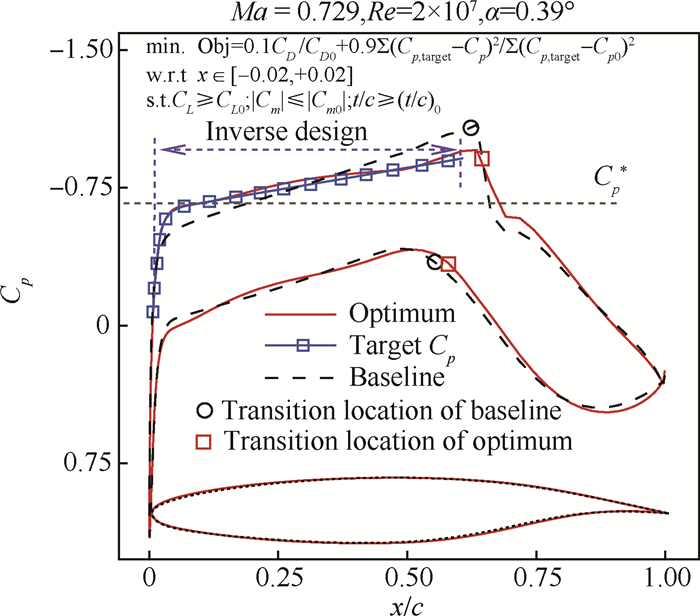
总的来说,基于代理模型的混合反设计/优化设计方法还处于初步发展阶段。该方法能够充分发挥代理优化算法和反设计方法的优势,既具有高效全局性,又能引入设计者的指导,体现“人在回路”的思想[139],在飞行器气动优化设计领域具有很大的发展潜力。
2.3 基于代理模型的稳健气动优化设计方法近年来大量试验研究已经表明,流场激波、流动的黏性效应以及其引起的分离等复杂非线性流动问题,往往对马赫数、迎角、气动外形的微小变化异常敏感。但由于在优化设计中并未考虑这些不确定性因素的影响,可能导致优化外形的气动特性随工况/几何外形的微小改变而剧烈变化,不符合工程实际使用需求。因此,如何设计出气动性能鲁棒且优良的外形是亟待解决的关键问题。稳健优化设计方法(RDO)正是针对传统优化设计方法单纯追求最佳性能而鲁棒性欠佳的问题而发展起来的一类优化设计方法。稳健优化设计的数学模型主要分为最小化目标均值和标准差、区间模型和最差性能改善3类。其中最小化目标均值和标准差模型应用最为广泛,目的是同时减小优化设计目标的均值和标准差,其数学表达式为
| $ \begin{array}{l} \begin{array}{*{20}{l}} {{\rm{min}} f[\mu (\mathit{\boldsymbol{x}}|\mathit{\boldsymbol{\xi }}),\sigma (\mathit{\boldsymbol{x}}|\mathit{\boldsymbol{\xi }})]}\\ {{\rm{w}}{\rm{. r}}{\rm{. t}}{\rm{. }}\quad {\mathit{\boldsymbol{x}}_1} \le \mathit{\boldsymbol{x}} \le {\mathit{\boldsymbol{x}}_{\rm{u}}}} \end{array}\\ \ {\rm{s}}{\rm{. t}}{\rm{.}}{\kern 1pt} {\kern 1pt} {\kern 1pt} {\kern 1pt} {\kern 1pt} {\kern 1pt} {\kern 1pt} {\kern 1pt} {\kern 1pt} {\kern 1pt} \left\{ {\begin{array}{*{20}{l}} {{\mu _{{{\rm h}_i}}}(\mathit{\boldsymbol{x}}|\mathit{\boldsymbol{\xi }}) = 0}&{i = 1,2, \cdots ,{n_{\rm{h}}}}\\ {{\mu _{{{\rm g}_j}}}(\mathit{\boldsymbol{x}}|\mathit{\boldsymbol{\xi }}) \le 0}&{j = 1,2, \cdots ,{n_{\rm{g}}}} \end{array}} \right. \end{array} $ | (20) |
式中:ξ=[ξ1, ξ2, …, ξnu]T为已知分布的nu个不确定变量;μ(x|ξ)和σ(x|ξ)分别为响应值的均值和标准差,共同构成目标函数f;μh表示等式约束的均值;μg表示不等式约束的均值。
由于稳健优化设计过程中需要进行不确定性量化(Uncertainty Quantification, UQ),需要大量计算真实函数响应值,所以相比于传统的确定性优化设计,其计算量巨大。随着代理模型技术的发展,在气动优化设计中越来越多地使用代理模型来代替耗时的CFD计算,实现对气动外形的力系数、压力分布的快速估算。基于这一思路,在UQ过程中也可以采用计算成本较低的代理模型来代替计算代价昂贵的CFD分析,从而提高不确定性量化的效率。
2006年,Ong等[361]提出了在信赖域内建立局部的代理模型以降低计算成本,从而辅助基于遗传算法的稳健优化设计。2009年,Shimoyama等[362]使用Kriging模型和数据挖掘技术对多目标稳健优化设计问题的稳健性进行预测,发现该方法可显著降低计算成本,提高优化设计的效率。Dwight等[309]针对不确定变量较多且真实函数计算成本较高的问题,在梯度增强的Kriging模型上使用稀疏网格技术进行UQ分析,从而提高了效率和精度。Chatterjee等[363]详细对比了不同代理模型在稳健优化设计中的性能,虽然都能降低计算成本,提高稳健优化设计的效率,但针对不同类型的问题需要选取合适的代理模型。高正红等[218]在对稳健气动优化设计的综述中指出,在UQ分析时使用代理模型辅助的蒙特卡洛方法能降低计算成本,在优化设计时使用GEK模型可显著提高代理优化方法的精度和效率。
1998年,Drela[364]开展了跨声速翼型、低雷诺数自然层流翼型的多点优化设计,研究发现虽然多点设计能够一定程度上改善设计翼型的稳健性,但其结果具有局部性,翼型的气动特性会在多个单点较优,而不是整个马赫数变化区间内都较优。2002年,Huyse等[365]提出了最大/最小化期望和方差的稳健设计方法,该方法不仅能使翼型的性能全面提高,还可以显著降低不确定性因素对翼型性能的影响。文献[366]在Huyse最大化期望值思想的基础上结合梯度优化,提出了期望值最大化设计方法,开展了翼型稳健气动优化设计研究。Zhang等[367]提出了基于混沌多项式展开模型的稳健优化方法,除了随机不确定变量(马赫数、迎角等)外,还首次将PCE方法应用于认知不确定性与混合不确定性的量化分析中。Rashad和Zingg[119]开展了来流马赫数不确定条件下的跨声速层流翼型稳健优化设计。Lewis等[368-369]开展了基于多目标稳健优化的数据处理方法研究,并将其应用于旋翼的稳健设计中。Lockwood等[370]使用梯度增强Kriging模型辅助的蒙特卡洛方法对绕圆柱体的高超声速流动进行不确定性量化,该方法在保证计算精度的同时能显著降低计算成本。Yamazaki[371]使用变可信度Kriging模型开展了来流马赫数和迎角不确定情况下的翼型稳健气动优化设计,并展示了该方法的高效性和实用性。
此外,王元元等[372]开展了马赫数不确定条件下的翼型稳健气动优化设计,借助改进的BP神经网络建立代理模型进行UQ分析,并应用于超临界机翼的翼梢小翼设计中。马东立等[373]采用基于BP神经网络代理模型的UQ方法,开展了考虑工况不确定性和几何不确定性(扭转角)的机翼稳健设计。Shahbaz等[374]对基于Kriging模型辅助的UQ方法开展研究,并将其应用于马赫数不确定条件下的ONERA M6机翼稳健气动优化设计中。图 12给出了优化设计前后机翼的阻力系数随马赫数的变化趋势,以及概率密度函数(Probability Density Function, PDF)的对比结果。邬晓敬等[375]采用基于Kriging模型的优化方法开展了来流马赫数不确定情况下跨声速翼型的稳健优化设计研究。赵欢等[220]采用改进的PCE方法进行UQ分析,并基于代理优化方法开展了马赫数和升力系数不确定条件下自然层流翼型的稳健气动优化设计研究。
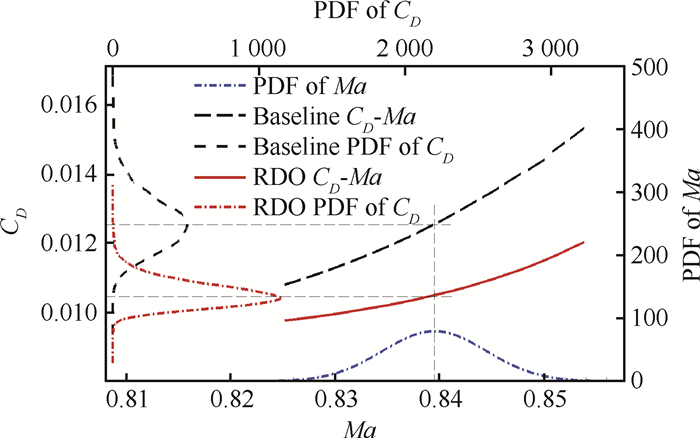
|
| 图 12 基于代理模型的ONERA M6机翼稳健气动优化设计 Fig. 12 Surrogate-based robust aerodynamic shape optimization of ONERA M6 wing |
飞行器设计除了考虑气动学科外,还涉及结构、控制、推进等多个学科,是一个多学科耦合的复杂系统性工程。例如在高亚声速机翼设计中,气动/结构两个学科的紧密耦合作用尤为突出,因而在设计之初就要考虑机翼气动弹性的影响。传统的机翼设计方法,根据经验给出期望的气动力分布,然后设计出能产生相同气动力分布的机翼型架外形。这样经验式的方法只能找到一个局部最优或相对较好的机翼设计方案,而且仅适用于常规布局的机翼设计。机翼气动/结构耦合优化设计方法可以充分发挥气动、结构两个学科间的耦合作用,使机翼获得更大的升阻比和更高的结构效率。
国外学者对机翼气动/结构耦合优化设计方法研究的比较早,取得了一系列的成果。美国学者Haftka[376]、Martins[377-380]、Alonso[381-382]等基于梯度优化方法开展了机翼气动/结构耦合优化设计的工作。欧洲的学者也发表了很多有关机翼气动/结构优化的文献,如德国宇航局(DLR)[383-385]、荷兰代尔夫特理工大学[386]等。
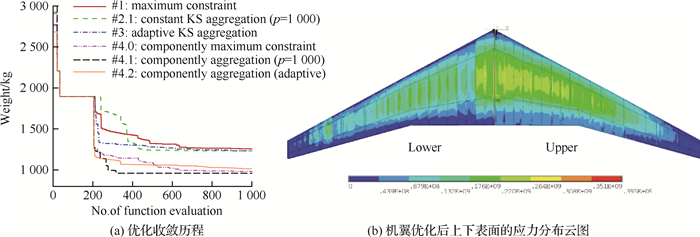
国内学者也进行了机翼气动/结构耦合优化设计的相关研究,主要分为梯度优化[235, 387]和代理优化两大类。由于代理优化算法的高效性和全局性,在机翼气动/结构耦合优化设计方面受到研究人员的青睐。张科施等[388]建立了基于代理模型的多学科优化框架,并对高亚声速运输机机翼开展了多目标、多约束的气动/结构综合优化设计,优化后的机翼具有更好的气动/结构综合性能。之后,张科施等[389]证明针对高亚声速运输机机翼进行考虑气动弹性的优化设计,比不考虑气动弹性的机翼优化结果有较大性能提高。针对具有上万个结构应力约束的机翼气动/结构耦合优化设计问题,张科施等[390]提出一种采用约束累积的处理方法,显著提高了代理优化算法的大规模约束处理能力,提高了优化设计效率。薛飞等[391]采用基于响应面的协同优化方法,进行了轻型飞机机翼气动/结构一体化优化设计。胡婕等[166]对客机机翼进行气动外形和结构参数化建模,通过基于响应面的两级优化方法求解机翼的气动/结构多学科设计问题,获得升阻比和结构重量最优的解集。董波等[392]结合了基于非等熵全速势方程的CFD方法与基于工程梁理论的结构设计方法,采用序列二次规划法,对由全局敏度方程构造的近似系统进行优化计算,并验证了该方法的可行性。卢文书等[393]基于CFD/CSD耦合计算方法和Kriging模型,建立了大展弦比复合材料机翼静气动弹性的近似模型并开展优化设计。李育超等[394]以运输机机翼为研究目标,基于Kriging模型发展了在初步设计阶段考虑气动弹性问题的机翼气动/结构优化设计方法。
图 13给出了采用代理优化算法进行气动/结构耦合优化设计的典型流程。图 14给出了文献[390]采用代理优化算法和约束累积方法,处理含上万个结构应力约束的气动/结构耦合优化设计的结果。
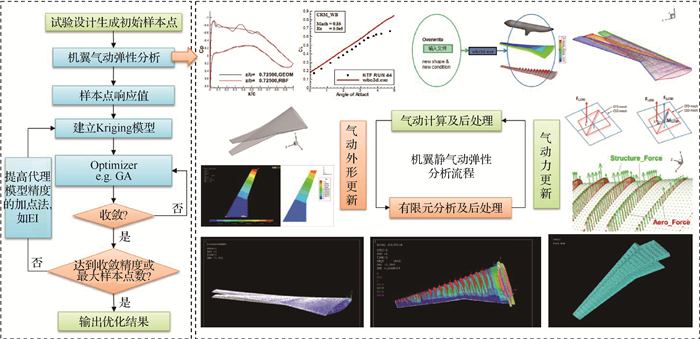
|
| 图 13 基于代理模型的气动/结构耦合优化设计典型流程 Fig. 13 Typical framework of surrogate-based aerodynamic/structural design optimization |
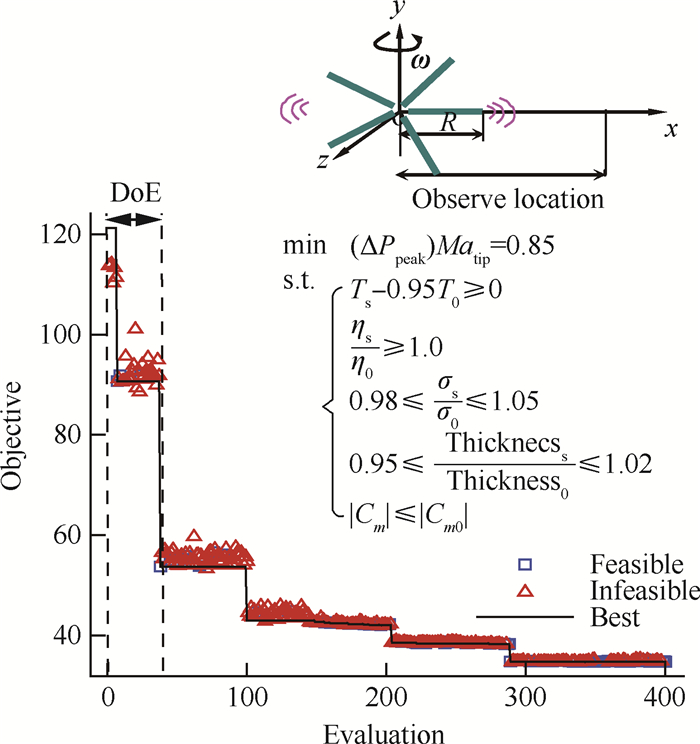
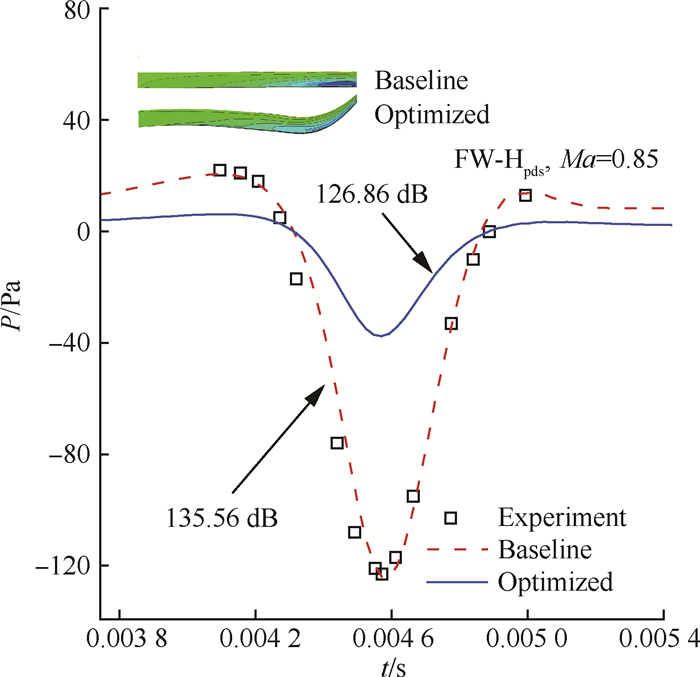
随着环保意识的增强,气动噪声、声爆等对环境和人类活动的影响逐渐受到重视。然而,飞行器的噪声、声爆等声学特性与气动性能往往是矛盾的。在保证飞行器气动性能的条件下,如何尽量降低噪声、声爆的影响,成为亟待解决的关键问题。基于代理模型的优化设计方法在兼顾气动性能与声学特性的飞行器设计方面,展现出了良好的应用前景。
在基于代理模型的气动/噪声综合优化设计方面,国内外学者已经针对旋翼、螺旋桨降噪开展了一系列研究。宋文萍等[395-396]结合Ffowcs Williams-Hawkings方程和RANS方程求解器,采用代理优化对旋翼翼尖形状进行了降噪优化设计。招启军等[397]基于径向基函数和遗传算法等对旋翼翼尖形状进行了优化设计,降低了其高速脉冲噪声。陈丝雨等[398]采用径向基函数模型代替费时的噪声分析方法,并结合遗传算法,开展了剪刀式尾桨气动与噪声特性综合优化设计。Yang等[399]采用遗传算法和Kriging代理模型方法优化了悬停状态下旋翼的翼尖外形,通过减弱桨尖激波强度,达到降低高速脉冲噪声的目的。Wilke[400]采用变可信度代理模型对直升机旋翼进行了气动优化设计。这些研究表明,代理优化算法在气动与噪声综合优化设计方面具有很大的应用潜力。图 15和图 16为旋翼降噪优化设计的结果,设计过程中保证了拉力及悬停效率不减,总设计变量数为106个。
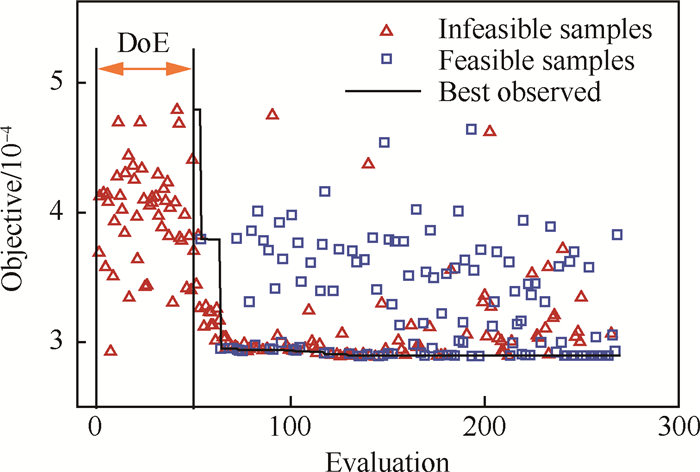
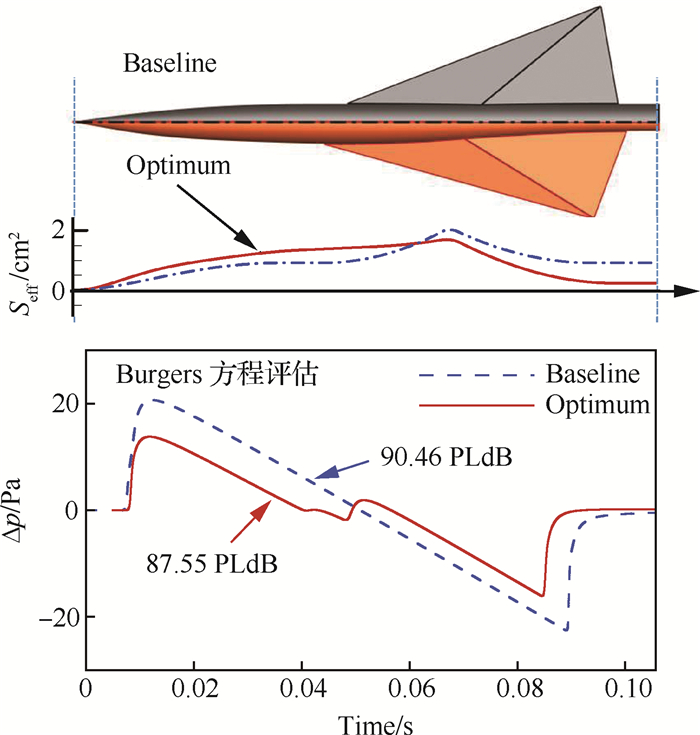
在气动/声爆综合优化设计方面,Chung和Alonso[312]将代理优化算法应用于超声速公务机的低声爆优化设计,其优化目标为阻力和远场声爆过压值。Chio等[266]为了降低计算成本,采用涡格法和粗细网格对飞机的气动力及声爆响应值建立了分层代理模型,并采用单纯形方法进行了优化设计。Kirz[401]基于代理模型对第二届声爆预测研讨会的轴对称标模进行低阻低声爆优化设计,优化外形的地面感觉声压级降低了4.82 dB,阻力降低了2个阻力单元。乔建领等[402]基于代理优化算法,对第一届声爆预测研讨会的翼身组合体标模开展了低声爆优化设计,优化外形的远场N波峰值降低了27.4%,波阻降低了5.4%。图 17和图 18所示为文献[402]中对翼身组合体标模进行低声爆优化设计的结果,经过高精度的远场声爆预测方法对优化后外形进行评估,展示了代理优化算法在低声爆优化设计中的应用能力。
对于军用飞行器而言,雷达隐身性能已成为先进战机的重要考量指标。目前,实现雷达隐身的主要途径有外形隐身技术、材料隐身技术和阻抗加载技术。其中,外形隐身技术是指通过改变飞行器的外形,从而在特定入射角范围内降低其RCS的设计技术。外形隐身技术是实现飞行器隐身的根本,是决定飞行器隐身性能的首要因素。然而,飞行器外形也是产生气动力和决定飞行器机动性能的重要因素。一般而言,气动性能和隐身性能对飞行器外形的要求存在矛盾,例如只考虑隐身性能的F-117A攻击机,其气动性能极差。
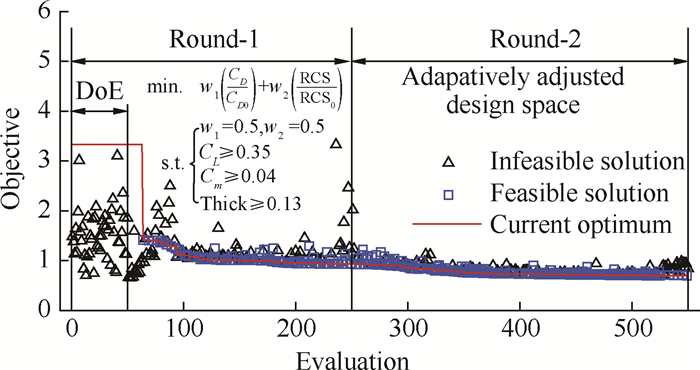
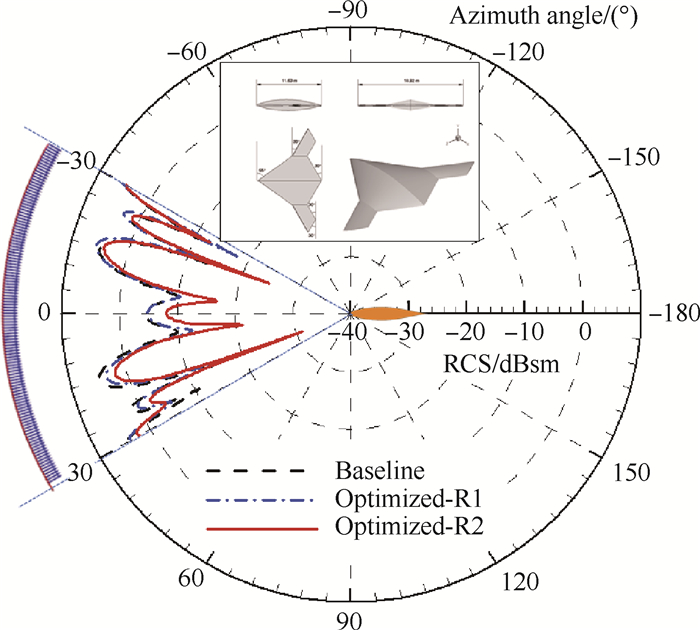
何开锋等[403-404]提出采用神经网络模型、模糊逻辑模型、Kriging模型等代理模型建立气动性能目标函数、隐身性能目标函数与设计变量之间的近似函数,从而无需使用面元法和物理光学法等数值方法求解气动性能和目标雷达散射截面(RCS)值,提高了气动/隐身综合优化设计的效率。王明亮等[405]开展了气动与隐身性能计算精度对飞行器外形设计的影响研究,研究表明采用低精度计算模型优化设计的外形难以获得最佳的性能,采用高精度计算模型优化可以获得性能更优的外形但计算量较大,优化效率需要提高。张彬乾[406]和焦子涵[407]等采用RBF模型进行气动性能、隐身性能的预测,用Pareto多目标遗传算法进行了飞翼布局内外翼段翼型气动/隐身多目标优化设计。张德虎等[227]发展了基于双层代理模型(DSM)的飞翼布局无人机气动/隐身综合优化设计方法,将回归型代理模型和插值型代理模型分别作为第1层和第2层代理模型,结合回归型代理模型反映全局分布和插值型代理模型局部精确拟和的优点,提高了代理模型预测精度。汪远[408]采用代理优化方法对某飞翼布局无人机构型开展了气动/隐身综合优化设计,包括内翼段翼型与全机巡航构型的设计。龙腾等[191]针对翼型气动/隐身多目标优化中存在的计算量大、权重难以确定等问题提出了基于自适应径向基函数代理模型和高效多目标规划策略的优化方法。
图 19~图 21[408]展示了采用代理优化算法,对飞翼无人机内翼段翼型进行气动/隐身综合优化设计的结果。经过两轮优化设计,最终外形的气动性能和前向±30°角域内的RCS分布都有明显改善,展示了代理优化算法在气动/隐身综合优化设计方面的应用潜力。

本文以飞行器精细化气动优化设计问题为背景,探讨了基于代理模型的高效全局优化设计方法这一前沿研究领域的现状和最新进展。首先,重点讨论了基于新型代理模型和新优化机制的气动优化设计方法研究进展。其次,介绍了代理模型在飞行器气动优化设计领域若干前沿问题中的应用研究。最后,综述了基于代理模型的多学科优化设计方法研究进展。
通过对400多篇文献的综述,认为目前代理优化所面临的关键问题及主要挑战包括:
1) “维数灾难”问题。近10年来,代理优化算法在优化效率、质量和鲁棒性方面取得了长足进步,已经从最初只能解决20维左右的气动外形优化设计问题,发展到可以解决100维以内机翼、翼身组合体和更复杂外形的气动优化设计问题。但是对于超过100个设计变量的更高维优化问题,其效率显著降低,仍然面临巨大挑战。
2) 气动优化设计的多极值特性问题。气动优化问题设计空间的多极值特性,对于算法选择具有重要影响。例如,已有研究发现,对于超临界翼型和变剖面的跨声速机翼减阻优化设计(如ADODG的Case 4),由于主要是减激波阻力,因而认为它不是一个多极值问题。但是,对于需要同时减小激波阻力和黏性阻力的问题(如自然层流翼型或机翼设计),或变平面形状(如ADODG的Case 6),以及设计变量变化范围较大的气动布局优化设计问题,多极值特性还是很明显的。对于这些多极值优化问题,需要进一步提高代理优化算法的全局搜索能力。
3) 变可信度代理优化算法的泛化问题。实际工程设计都会采用不同可信度的分析方法,因而变可信度优化设计无疑具有很大发展潜力。但是,现有方法的泛化能力明显不足。虽然有大量文章发表,但对于实际工程问题,如果使用不当,优化效果可能很不理想。正因如此,变可信度优化方法目前还主要停留在实验室研究阶段,并没有在实际工程设计中得到较广泛应用。如何提高其泛化能力,发展合理低可信度模型选择方法、更高精度代理模型建模和更有效的变可信度优化加点准则,是其中需要解决的关键问题。
4) 梯度增强代理模型的矩阵规模和条件数大的问题。将Adjoint方法计算的低成本梯度信息与代理模型相结合,是一种解决高维优化设计问题非常具有潜力的方法。虽然目前GEK模型的理论和算法已经基本成熟,但在复杂外形气动优化设计方面表现却并不理想。主要有两个方面的问题:一是相关矩阵规模过大,导致训练时间过长;二是相关矩阵条件数大,导致优化后期效果变差。
5) 大规模并行气动优化设计问题。多种加点准则组合的并行优化方法,可以在每一代优化迭代时选择任意多个新样本。这些样本之间可以并行计算,样本自身也可以通过计算网格分区进行CFD的并行求解,从而实现大规模的并行优化。但目前该方法还处于发展初期,今后需要采用万核以上的大规模并行计算进行验证。同时优化算法也还有较大的改进空间。特别是对于设计空间呈超多极值、高度非线性、强烈振荡等特性的复杂气动优化设计问题,还需要进一步提高算法的效率和鲁棒性。
6) 数值噪声及如何滤除的问题。由于不同样本外形的CFD计算可能未充分收敛或各个样本外形计算网格分布存在不一致性,使得CFD求解结果可能带有不同幅值和频率的数值噪声。这将对代理优化的效率和结果产生重要影响。另外,对于结合Adjoint方法的梯度增强代理模型,其梯度计算结果的数值噪声将会对代理模型的建模和优化设计产生重要影响。
经过大量文献调研和分析,认为今后在基于代理模型的高效全局气动优化设计方法方面值得开展的研究方向如下:
1) 针对“维数灾难”现象,结合代理模型和Adjoint方法是最具潜力的发展方向之一。其中,如何突破梯度增强代理模型在气动优化设计后期效果不理想的问题,成为需要重点解决的问题。例如,发展滤除函数和梯度数值噪声的方法,发展基于梯度的新型加点准则,发展大型相关矩阵的并行分解技术,都是非常有意义的研究方向。
2) 结合代理优化和基于伴随方法的梯度优化方法各自的优势,发展混合优化策略。如先采用较少的设计变量进行基于代理模型的全局优化,然后进一步在所得的最优解基础上提高设计变量数,并采用梯度方法进行优化,是一种值得研究的实用方法。
3) 研究发展具有更好泛化能力的变可信度优化方法。例如,文献[246]采用不同疏密网格的CFD计算作为高低可信度分析模型,如果再进一步引入文献[55]的变可信度加点方法,将可能形成一种具有很好泛化能力的“多层网格加速优化方法”。
4) 引入最新发展的机器学习、数据挖掘、数据融合等人工智能算法,结合数据库技术,研究发展新型代理模型和新的优化加点准则。
5) 发展更有效的多目标气动优化设计方法。基于张青富教授提出的MOEA/D方法的思想,将多目标优化问题分解成若干单目标优化问题,从而可以采用目前发展比较成熟的单目标代理优化算法进行求解,也是非常有前景的发展方向。
6) 针对稳健气动优化设计效率低的问题,需要发展更有效的不确定性量化方法和基于代理模型的稳健优化设计方法。
7) 将代理优化算法应用于复杂系统全局多学科优化设计问题,包括具有大规模设计变量和大规模约束,且各学科之间具有复杂耦合关系的工程设计问题。
| [1] | JAMESON A, VASSBERG J C. Computational fluid dynamics for aerodynamic design: Its current and future impact: AIAA-2001-0538[R]. Reston: AIAA, 2001. |
| [2] | SLOTNICK J, KHODADOUST A, ALONSO J, et al. CFD vision 2030 study: A path to revolutionary computational aerosciences: NASA/CR-2014-218178[R]. Washington, D.C.: NASA, 2014. |
| [3] |
周铸, 黄江涛, 黄勇, 等. CDF技术在航空工程领域的应用、挑战与发展[J]. 航空学报, 2017, 38(3): 020891. ZHOU Z, HUANG J T, HUANG Y, et al. CFD technology in aeronautic engineering field:Applications, challenges and development[J]. Acta Aeronautica et Astronautica Sinica, 2017, 38(3): 020891. (in Chinese) |
| Cited By in Cnki (6) | Click to display the text | |
| [4] |
张淼, 刘铁军, 马涂亮, 等. 基于CFD方法的大型客机高速气动设计[J]. 航空学报, 2016, 37(1): 244-254. ZHANG M, LIU T J, MA T L, et al. High speed aerodynamic design of large civil transporter based on CFD method[J]. Acta Aeronautica et Astronautica Sinica, 2016, 37(1): 244-254. (in Chinese) |
| Cited By in Cnki (8) | Click to display the text | |
| [5] |
白俊强, 雷锐午, 杨体浩, 等. 基于伴随理论的大型客机气动优化设计研究进展[J]. 航空学报, 2019, 40(1): 522642. BAI J Q, LEI R W, YANG T H, et al. Progress of adjoint-based aerodynamic optimization design for large civil aircraft[J]. Acta Aeronautica et Astronautica Sinica, 2019, 40(1): 522642. (in Chinese) |
| Cited By in Cnki | Click to display the text | |
| [6] |
高正红, 王超. 飞行器气动外形设计方法研究与进展[J]. 空气动力学学报, 2017, 35(4): 516-528. GAO Z H, WANG C. Aerodynamic shape design methods for aircraft:Status and trends[J]. Acta Aerodynamica Sinica, 2017, 35(4): 516-528. (in Chinese) |
| Cited By in Cnki (1) | Click to display the text | |
| [7] |
韩忠华. Kriging模型及代理优化算法研究进展[J]. 航空学报, 2016, 37(11): 3197-3225. HAN Z H. Kriging surrogate model and its application to design optimization:A review of recent progress[J]. Acta Aeronautica et Astronautica Sinica, 2016, 37(11): 3197-3225. (in Chinese) |
| Cited By in Cnki (32) | Click to display the text | |
| [8] | RUDER S. An overview of gradient descent optimization algorithms[EB/OL].(2016-01-19)[2019-08-06].http://sebastianruder.com/optimization-gradient-descent/index.html.[BFY] |
| [9] | WRIGHT S J, NOCEDAL J. Numerical optimization[M]. New York: Springer, 1999. |
| [10] | BYRD R H, HANSEN S L, NOCEDAL J, et al. A stochastic quasi-newton method for large-scale optimiza-tion[J]. SIAM Journal on Optimization, 2016, 26(2): 1008-1031. |
| Click to display the text | |
| [11] | POWELL M J D. Restart procedures for the conjugate gradient method[J]. Mathematical Programming, 1977, 12(1): 241-254. |
| Click to display the text | |
| [12] | KLAUS S, YUAN Y. Sequential quadratic programming methods[J]. Wiley Encyclopedia of Operations Research and Management Science, 2012, 154: 147-224. |
| Click to display the text | |
| [13] | JAMESON A. Aerodynamic design via control theory[J]. Journal of Scientific Computing, 1988, 3(3): 233-260. |
| Click to display the text | |
| [14] | JAMESON A. Optimum aerodynamic design using CFD and control theory: AIAA-1995-1729[R]. Reston: AIAA, 1995. |
| Click to display the text | |
| [15] | KENWAY G K W, MADER C A, HE P, et al. Effective adjoint approaches for computational fluid dynamics[J]. Progress in Aerospace Sciences, 2019, 110: 100542. |
| Click to display the text | |
| [16] | LYU Z, KENWAY G K W, MARTINS J R R A. Aerodynamic shape optimization investigations of the common research model wing benchmark[J]. AIAA Journal, 2015, 53(4): 968-985. |
| Click to display the text | |
| [17] | GILL P E, MURRAY W, SAUNDERS M A. SNOPT:An SQP algorithm for large-scale constrained optimiza-tion[J]. SIAM Review, 2005, 47(1): 99-131. |
| Click to display the text | |
| [18] | MARTINS J R R A, HWANG J T. Review and unification of methods for computing derivatives of multidisciplinary computational models[J]. AIAA Journal, 2013, 51(11): 2582-2599. |
| Click to display the text | |
| [19] | CHERNUKHIN O, ZINGG D W. Multimodality and global optimization in aerodynamic design[J]. AIAA Journal, 2013, 51(6): 1342-1354. |
| Click to display the text | |
| [20] | JAISWAL N K. Heuristic optimization[M]. Beilin Heidelberg: Springer, 1997: 17-30. |
| [21] | LEE K, El-SHARKAWI M. Modern heuristic optimization techniques:Theory and applications to power syst-ems[M]. Piscataway: Wiley-IEEE Press, 2008. |
| [22] | GONG C L, GU L X. Genetic algorithm based global optimization algorithm used to solving system analysis of multidisciplinary optimization[C]//IEEE International Conference on Intelligent Computing and Intelligent Systems. Piscataway: IEEE Press, 2010: 325-329. |
| [23] | DEB K, PRATAP A, AGARWAL S, et al. A fast and elitist multiobjective genetic algorithm:NSGA-Ⅱ[J]. IEEE Transactions on Evolutionary Computation, 2002, 6(2): 182-197. |
| Click to display the text | |
| [24] | DEB K, JAIN H. An evolutionary many-objective optimization algorithm using reference-point-based nondominated sorting approach, Part Ⅰ:Solving problems with box constraints[J]. IEEE Transactions on Evolutionary Computation, 2014, 18(4): 577-601. |
| Click to display the text | |
| [25] | VENTER G, SOBIESZCZANSKI-SOBIESKI J. Multidisciplinary optimization of a transport aircraft wing using particle swarm optimization[J]. Structural and Multidisciplinary Optimization, 2004, 26(1-2): 121-131. |
| Click to display the text | |
| [26] | SHAN S, WANG G G. Survey of modeling and optimization strategies to solve high-dimensional design problems with computationally-expensive black-box functions[J]. Structural and Multidisciplinary Optimization, 2010, 41(2): 219-241. |
| Click to display the text | |
| [27] | FORRESTER A I J, KEANE A J. Recent advances in surrogate-based optimization[J]. Progress in Aerospace Sciences, 2009, 45(1): 50-79. |
| Click to display the text | |
| [28] | GIANNAKOGLOU K C. Design of optimal aerodynamic shapes using stochastic optimization methods and computational intelligence[J]. Progress in Aerospace Sciences, 2002, 38(1): 43-76. |
| Click to display the text | |
| [29] | SCHMIT L A, FARSHI B. Some approximation concepts for structural synthesis[J]. AIAA Journal, 1974, 12(5): 692-699. |
| Click to display the text | |
| [30] | GIUNTA A A, WATSON L T. A comparison of approximation modeling techniques: Polynomial versus interpolation models: AIAA-1998-4758[R]. Reston: AIAA, 1998. |
| Click to display the text | |
| [31] | SIMPSON T W, BOOKER A J, GHOSH D, et al. Approximation methods in multidisciplinary analysis and optimization:A panel discussion[J]. Structural and Multidisciplinary Optimization, 2004, 27(5): 302-313. |
| Click to display the text | |
| [32] | SIMPSON T W, PEPLINSKI J, KOCH P N, et al. Metamodels for computer-based engineering design:Survey and recommendations[J]. Engineering with Computers, 2001, 17(2): 129-150. |
| Click to display the text | |
| [33] | VIANA F A C, SIMPSON T W, BALABANOV V, et al. Metamodeling in multidisciplinary design optimization:How far have we really come?[J]. AIAA Journal, 2014, 52(4): 670-690. |
| Click to display the text | |
| [34] | KRIGE D G. A statistical approach to some basic mine valuation problems on the witwatersrand[J]. Journal of the Southern African Institute of Mining and Metallurgy, 1951, 52(6): 119-139. |
| Click to display the text | |
| [35] | SACKS J, WELCH W J, MITCHELL T J, et al. Design and analysis of computer experiments[J]. Statistical Science, 1989, 4(4): 409-435. |
| Click to display the text | |
| [36] |
穆雪峰, 姚卫星, 余雄庆, 等. 多学科设计优化中常用代理模型的研究[J]. 计算力学学报, 2005, 22(5): 608-612. MU X F, YAO W X, YU X Q, et al. A survey of surrogate models used in MDO[J]. Chinese Journal of Computational Mechanics, 2005, 22(5): 608-612. (in Chinese) |
| Cited By in Cnki (270) | Click to display the text | |
| [37] | HAN Z H, ZHANG K S. Surrogate-based optimizat-ion[M]. InTech Book, 2012: 343-362. |
| [38] | FORRESTER A I J, SOBESTER A, KEANE A J. Engineering design via surrogate modeling:A practical guide[M]. Chichester: John Wiley & Sons, 2008. |
| [39] | VAVALLE A, QIN N. Iterative response surface based optimization scheme for transonic airfoil design[J]. Journal of Aircraft, 2005, 42(2): 413-420. |
| Click to display the text | |
| [40] | KRISHNAMURTHY T. Response surface approximation with augmented and compactly supported radial basis functions: AIAA-2003-1748[R]. Reston: AIAA, 2003. |
| Click to display the text | |
| [41] | SOBESTER A, LEARY S J, KEANE A J. On the design of optimization strategies based on global response surface approximation models[J]. Journal of Global Optimization, 2005, 33(1): 31-59. |
| Click to display the text | |
| [42] | YAO X, LIU Y. A new evolutionary system for evolving artificial neural networks[J]. IEEE Transactions on Neural Networks, 1997, 8(3): 694-713. |
| Click to display the text | |
| [43] | VATANDAS E. Hybridizing genetic algorithm with artificial neural network in the aerodynamic optimization of the forward swept wing: AIAA-2010-2915[R]. Reston: AIAA, 2010. |
| [44] | BANDLER J W, BIERNACKI R, CHEN S H. Space mapping technique for electromagnetic optimization[J]. IEEE Transactions on Microwave Theory and Techniques, 1994, 42(12): 2536-2544. |
| Click to display the text | |
| [45] | KHALATPOUR A, AMINEH R K, CHENG Q S, et al. Accelerating space mapping optimization with adjoint sensitivities[J]. IEEE Microwave and Wireless Components Letters, 2011, 21(6): 280-282. |
| Click to display the text | |
| [46] | SMOLA A J, SCHOLKÖPF B. A tutorial on support vector regression[J]. Statistics and Computing, 2004, 14(3): 199-222. |
| Click to display the text | |
| [47] | YUN Y, YOON M, NAKAYAMA H. Multi-objective optimization based on meta-modeling by using support vector regression[J]. Optimization and Engineering, 2009, 10(2): 167-181. |
| Click to display the text | |
| [48] | WANG Q, MOIN P, IACCARINO G. A rational interpolation scheme with super-polynomial rate of convergence[J]. SIAM Journal of Numerical Analysis, 2010, 47(6): 4073-4097. |
| Click to display the text | |
| [49] | WANG Q, MOIN P, IACCARINO G. A high-order multi-variate approximation scheme for arbitrary data sets[J]. Journal of Computational Physics, 2010, 229(18): 6343-6361. |
| Click to display the text | |
| [50] | CRESTAUX T, MAÎTRE O L, MARTINEZ J M. Polynomial chaos expansion for sensitivity analysis[J]. Reliability Engineering and System Safety, 2009, 94(7): 1161-1172. |
| Click to display the text | |
| [51] | NOVÁK L, NOVAK D. Polynomial chaos expansion for surrogate modelling:Theory and software[J]. Beton-und Stahlbetonbau, 2018, 113(2): 27-32. |
| Click to display the text | |
| [52] | FORRESTER A I J, KEANE A J, BRESSLOFF N W. Design and analysis of noisy computer experiments[J]. AIAA Journal, 2006, 44(10): 2331-2339. |
| Click to display the text | |
| [53] | LIU J, HAN Z H, SONG W P. Comparison of infill sampling criteria in Kriging-based aerodynamic optimizat-ion[C]//28th ICAS, 2012. |
| Click to display the text | |
| [54] | LIU J, SONG W P, HAN Z H, et al. Efficient aerodynamic shape optimization of transonic wings using a parallel infilling strategy and surrogate models[J]. Structural and Multidisciplinary Optimization, 2017, 55(3): 925-943. |
| Click to display the text | |
| [55] | ZHANG Y, HAN Z H, ZHANG K S. Variable-fidelity expected improvement for efficient global optimization of expensive functions[J]. Structural and Multidisciplinary Optimization, 2018, 58(4): 1431-1451. |
| Click to display the text | |
| [56] | JONES D R, SCHONLAU M, WELCH W J. Efficient global optimization of expensive black-box functions[J]. Journal of Global Optimization, 1998, 13(4): 455-492. |
| Click to display the text | |
| [57] | LOCATELLI M. Bayesian algorithms for one-dimensional global optimization[J]. Journal of Global Optimization, 1997, 10(1): 57-76. |
| Click to display the text | |
| [58] | BATTITI R, BRUNATO M. The LION way: Machine learning plus intelligent optimization[M]//Create Space Independent Publishing Platform, 2014. |
| [59] |
陈海昕, 邓凯文, 李润泽. 机器学习技术在气动优化中的应用[J]. 航空学报, 2019, 40(1): 522480. CHEN H X, DENG K W, LI R Z. Utilization of machine learning technology in aerodynamic optimization[J]. Acta Aeronautica et Astronautica Sinica, 2019, 40(1): 522480. (in Chinese) |
| Cited By in Cnki | Click to display the text | |
| [60] | QUEIPO N V, HAFTKA R T, SHYY W, et al. Surrogate-based analysis and optimization[J]. Progress in Aerospace Sciences, 2005, 41(1): 1-28. |
| Click to display the text | |
| [61] | KOCH P N, SIMPSON T W, ALLEN J K, et al. Statistical approximations for multidisciplinary design optimization:The problem of the size[J]. Journal of Aircraft, 1999, 36(1): 275-286. |
| Click to display the text | |
| [62] |
余雄庆. 飞机总体多学科设计优化的现状与发展方向[J]. 南京航空航天大学学报, 2008, 40(4): 417-426. YU X Q. Multidisciplinary design optimization for aircraft conceptual and preliminary design:Status and directi-ons[J]. Journal of Nanjing University of Aeronautics and Astronautics, 2008, 40(4): 417-426. (in Chinese) |
| Cited By in Cnki (55) | Click to display the text | |
| [63] | SEVANT N E, BLOOR M I G, WILSON M J. Aerodynamic design of a flying wing using response surface methodology[J]. Journal of Aircraft, 2000, 37(4): 562-569. |
| Click to display the text | |
| [64] | FERNANDEZ G, PARK C Y, KIM N H, et al. Issues in deciding whether to use multifidelity surrogates[J]. AIAA Journal, 2019, 57(5): 2039-2054. |
| Click to display the text | |
| [65] | PARK C Y, HAFTKA R T, KIM N H. Remarks on multi-fidelity surrogates[J]. Structural and Multidisciplinary Optimization, 2017, 55(3): 1029-1050. |
| Click to display the text | |
| [66] | HAFTKA R T, VILLANUEVA D, CHAUDHURI A. Parallel surrogate-assisted global optimization with expensive functions-a survey[J]. Structural and Multidisciplinary Optimization, 2016, 54(1): 3-13. |
| Click to display the text | |
| [67] | VIANA F A C, HAFTKA R T. Surrogate-based optimization with parallel simulations using the probability of improvement: AIAA-2010-9392[R]. Reston: AIAA, 2010. |
| Click to display the text | |
| [68] | VIANA F A C, HAFTKA R T, WATSON L T. Efficient global optimization algorithm assisted by multiple surrogate techniques[J]. Journal of Global Optimization, 2013, 56(2): 669-689. |
| Click to display the text | |
| [69] | BOUHLEL M A, MARTINS J R R A. Gradient-enhanced Kriging for high-dimensional problems[J]. Engineering with Computers, 2018(1): 1-17. |
| Click to display the text | |
| [70] | BOUHLEL M A, HWANG J T, BARTOLI N, et al. A python surrogate modeling framework with derivatives[J]. Advances in Engineering Software, 2019, 135: 102662. |
| Click to display the text | |
| [71] | LI J C, BOUHLEL M A, MARTINS J R R A. A data-based approach for fast airfoil analysis and optimization: AIAA-2018-1383[R]. Reston: AIAA, 2018. |
| Click to display the text | |
| [72] | MADSEN M H A, ZAHLE F, SØRENSEN N N, et al. Multipoint high-fidelity CFD-based aerodynamic shape optimization of a 10 MW wind turbine[J]. Wind Energy Science, 2019, 4: 163-192. |
| Click to display the text | |
| [73] | GRAY J S, HWANG J T, MARTINS J R R A, et al. OpenMDAO:An open-source framework for multidisciplinary design, analysis, and optimization[J]. Structural and Multidisciplinary Optimization, 2019, 59(4): 1075-1104. |
| Click to display the text | |
| [74] | HE X L, LI J C, MADER C, et al. Robust aerodynamic shape optimization-From a circle to an airfoil[J]. Aerospace Science and Technology, 2019, 87: 48-61. |
| Click to display the text | |
| [75] | BONS N P, HE X L, MADER C, et al. Multimodality in aerodynamic wing design optimization[J]. AIAA Journal, 2019, 57(3): 1004-1018. |
| Click to display the text | |
| [76] | CHEN S, LYU P Z J, KENWAY G, et al. Aerodynamic shape optimization of the common research model wing-body-tail configuration[J]. Journal of Aircraft, 2016, 53(1): 276-293. |
| Click to display the text | |
| [77] | DU X S, REN J, LEIFSSON L. Aerodynamic inverse design using multifidelity models and manifold mapping[J]. Aerospace Science and Technology, 2018, 85: 371-385. |
| Click to display the text | |
| [78] | THELEN A, LEIFSSON L, SHARMA A, et al. Variable-fidelity shape optimization of dual-rotor wind turbines[J]. Engineering Computations, 35(7): 2514-2542. |
| Click to display the text | |
| [79] | AMRIT A, LEIFSSON L, KOZIEL S. Multi-fidelity aerodynamic design trade-off exploration using point-by-point pareto set identification[J]. Aerospace Science and Technology, 2018, 79: 399-412. |
| Click to display the text | |
| [80] | LEIFSSON L, KOZIEL S, OWEN D R J. Adaptive response prediction for aerodynamic shape optimization[J]. Engineering Computations, 2017, 34(5): 1485-1500. |
| Click to display the text | |
| [81] | AMRIT A, LEIFSSON L, KOZIEL S. Design strategies for multi-objective optimization of aerodynamic surfaces[J]. Engineering Computations, 2017, 34(5): 1724-1753. |
| Click to display the text | |
| [82] | AMRIT A, LEIFSSON L, KOZIEL S T, et al. Efficient multi-objective aerodynamic optimization by design space dimension reduction and co-Kriging: AIAA-2016-3515[R]. Reston: AIAA, 2016. |
| Click to display the text | |
| [83] | KOZIEL S, LEIFSSON L. Simulation-driven design by knowledge-based response correction techniques[M]. Switzerland: Springer International Publishing Press, 2016. |
| [84] | REN J, LEIFSSON L, KOZIEL S, et al. Multi-fidelity aerodynamic shape optimization using manifold mapping: AIAA-2016-0419[R]. Reston: AIAA, 2016. |
| [85] | LEIFSSON L, KOZIEL S, TESFAHUNEGN Y A. Multiobjective aerodynamic optimization by variable-fidelity models and response surface surrogates[J]. AIAA Journal, 2016, 54(2): 531-541. |
| Click to display the text | |
| [86] | LEIFSSON L, KOZIEL S. Aerodynamic shape optimization by variable-fidelity computational fluid dynamics models:A review of recent progress[J]. Journal of Computational Science, 2015, 10: 45-54. |
| Click to display the text | |
| [87] | LEIFSSON L, KOZIEL S. Wing aerodynamic shape optimization by space mapping[J]. Advances in Intelligent Systems and Computing, 2014, 256: 319-332. |
| Click to display the text | |
| [88] | KOZIEL S, LEIFSSON L. Surrogate-based aerodynamic shape optimization by variable-resolution models[J]. AIAA Journal, 2013, 51(1): 94-106. |
| Click to display the text | |
| [89] | KOZIEL S, LEIFSSON L. Statistical-analysis-based setup of physics-based surrogates and optimization process resolution for variable-fidelity aerodynamic design: AIAA-2017-3328[R]. Reston: AIAA, 2017. |
| [90] | KOZIEL S, LEIFSSON L. Multi-level surrogate-based airfoil shape optimization: AIAA-2013-0778[R]. Reston: AIAA, 2013. |
| [91] | LEIFSSON L, KOZIEL S. Variable-resolution shape optimization: Low-fidelity model setup and algorithm scalability: AIAA-2012-5604[R]. Reston: AIAA, 2012. |
| Click to display the text | |
| [92] | KOZIEL S, LEIFSSON L. Multi-level CFD-based airfoil shape optimization with automated low-fidelity model selection[J]. Procedia Computer Science, 2013, 18(1): 889-898. |
| Click to display the text | |
| [93] | LEIFSSON L, KOZIEL S. Multi-fidelity design optimization of transonic airfoils using shape-preserving response prediction[J]. Journal of Computational Science, 2010, 1(2): 98-106. |
| Click to display the text | |
| [94] | KOZIEL S, LEIFSSON L. Surrogate-based modeling and optimization:Applications in engineering[M]. Heidelberg: Springer Nature Press, 2013. |
| [95] | KRAMER B, MARQUES A, PEHERSTORFER B, et al. Multifidelity probability estimation via fusion of estimators[J]. Journal of Computational Physics, 2019, 392: 385-402. |
| Click to display the text | |
| [96] | PEHERSTORFER B, WILLCOX K E, GUNZBURGER M. Survey of multifidelity methods in uncertainty propagation, inference, and optimization[J]. SIAM Review, 2018, 60(3): 550-591. |
| Click to display the text | |
| [97] | CHAUDHURI A, LAM R, WILLCOX K E. Multifidelity uncertainty propagation via adaptive surrogates in coupled multidisciplinary systems[J]. AIAA Journal, 2018, 56(1): 235-249. |
| Click to display the text | |
| [98] | PEHERSTORFER B, KRAMER B, WILLCOX K E. Combining multiple surrogate models to accelerate failure probability estimation with expensive high-fidelity models[J]. Journal of Computational Physics, 2017, 341: 61-75. |
| Click to display the text | |
| [99] | PEHERSTORFER B, CUI T, MARZOUK Y, et al. Multifidelity importance sampling[J]. Computer Methods in Applied Mechanics and Engineering, 2016, 300: 490-509. |
| Click to display the text | |
| [100] | NG L W T, WILLCOX K E. Multifidelity approaches for optimization under uncertainty[J]. International Journal for Numerical Methods in Engineering, 2014, 100(10): 746-772. |
| Click to display the text | |
| [101] | MARCH A, WILLCOX K E. Constrained multifidelity optimization using model calibration[J]. Structural and Multidisciplinary Optimization, 2012, 46: 93-109. |
| Click to display the text | |
| [102] | ROBINSON T D, ELDRED M S, WILLCOX K E, et al. Surrogate-based optimization using multifidelity models with variable parameterization and corrected space mapping[J]. AIAA Journal, 2008, 46(11): 2814-2822. |
| Click to display the text | |
| [103] | ROBINSON T D, WILLCOX K E, ELDRED M S, et al. Multifidelity optimization for variable-complexity design: AIAA-2006-7114[R]. Reston: AIAA, 2006. |
| Click to display the text | |
| [104] | SONG W B, KEANE A J. Surrogate-based aerodynamic shape optimization of a civil aircraft engine nacelle[J]. AIAA Journal, 2007, 45(10): 2565-2574. |
| Click to display the text | |
| [105] | ONG Y S, NAIR P B, KEANE A J. Evolutionary optimization of computationally expensive problems via surrogate modeling[J]. AIAA Journal, 2003, 41(4): 687-696. |
| Click to display the text | |
| [106] | KEANE A J. Wing optimization using design of experiment, response surface, and data fusion methods[J]. Journal of Aircraft, 2003, 40(4): 741-750. |
| Click to display the text | |
| [107] | LEARY S J, BHASKAR A, KEANE A J. A knowledge-based approach to response surface modeling in multifidelity optimization[J]. Journal of Global Optimization, 2003, 26(3): 297-319. |
| Click to display the text | |
| [108] | TOAL D J J, KEANE A J. Efficient multipoint aerodynamic design optimization via coKriging[J]. Journal of Aircraft, 2011, 48(5): 1685-1695. |
| Click to display the text | |
| [109] | KEANE A J. CoKriging for robust design optimization[J]. AIAA Journal, 2012, 50(11): 2351-2364. |
| Click to display the text | |
| [110] | KUYA Y, TAKEDA K, ZHANG X, et al. Multifidelity surrogate modeling of experimental and computational aerodynamic data sets[J]. AIAA Journal, 2011, 49(2): 289-298. |
| Click to display the text | |
| [111] | AHMED M Y M, QIN N. Surrogate-based aerodynamic design optimization: Use of surrogates in aerodynamic design optimization[C]//13th International Conference on Aerospace Sciences and Aviation Technology, 2009. |
| Click to display the text | |
| [112] |
邓枫, 覃宁, 伍贻兆. 基于并行EGO算法的激波控制鼓包减阻优化[J]. 南京航空航天大学学报, 2013, 45(4): 485-490. DENG F, QIN N, WU Y Z. Shock control bump optimization for drag reduction using parallel efficient global optimization algorithm[J]. Journal of Nanjing University of Aeronautics and Astronautics, 2013, 45(4): 485-490. (in Chinese) |
| Cited By in Cnki | Click to display the text | |
| [113] | AHMED M Y M, QIN N. Surrogate-based multi-objective aerothermodynamic design optimization of hypersonic spiked bodies[J]. AIAA Journal, 2012, 50(4): 797-810. |
| Click to display the text | |
| [114] | AHMED M Y M, QIN N. Metamodels for aerothermodynamic design optimization of hypersonic spiked blunt bodies[J]. Aerospace Science and Technology, 2010, 14(5): 364-376. |
| Click to display the text | |
| [115] | REIST T A, ZINGG D W, RAKOWITZ M, et al. Multifidelity optimization of hybrid wing-body aircraft with stability and control requirements[J]. Journal of Aircraft, 2018, 56(2): 442-456. |
| Click to display the text | |
| [116] | KHOSRAVI S, ZINGG D W. Aerostructural optimization of drooped wings[J]. Journal of Aircraft, 2017, 55(3): 1261-1268. |
| Click to display the text | |
| [117] | CHAU T, ZINGG D W. Aerodynamic shape optimization of a box-wing regional aircraft based on the reynolds-averaged navier-stokes equations: AIAA-2017-3258[R]. Reston: AIAA, 2017. |
| [118] | ZHANG Z J, ZINGG D W. Efficient monolithic solution algorithm for high-fidelity aerostructural analysis and optimization[J]. AIAA Journal, 2018, 56(3): 1251-1265. |
| Click to display the text | |
| [119] | RASHAD R, ZINGG D W. Aerodynamic shape optimization for natural laminar flow using a discrete-adjoint approach[J]. AIAA Journal, 2016, 54(11): 3321-3337. |
| Click to display the text | |
| [120] | REIST T A, ZINGG D W. High-fidelity aerodynamic shape optimization of a lifting-fuselage concept for regional aircraft[J]. Journal of Aircraft, 2017, 54(3): 1085-1097. |
| Click to display the text | |
| [121] | REIST T A, ZINGG D W, Aerodynamic shape optimization of a blended-wing-body regional transport for a short range mission: AIAA-2013-2414[R]. Reston: AIAA, 2013. |
| [122] | LEUNG T M, ZINGG D W. Aerodynamic shape optimization of wings using a parallel Newton-Krylov approach[J]. AIAA Journal, 2012, 50(3): 540-550. |
| Click to display the text | |
| [123] | WANG X J, WANG G G, SONG B W, et al. A novel evolutionary sampling assisted optimization method for high dimensional expensive problems[J]. IEEE Transactions on Evolutionary Computation, 2019, 23(5): 815-827. |
| Click to display the text | |
| [124] | SAFARI A, YOUNIS A, WANG G G, et al. Development of a metamodel assisted sampling approach to aerodynamic shape optimization problems[J]. Journal of Mechanical Science and Technology, 2015, 29(5): 2013-2024. |
| Click to display the text | |
| [125] | LONG T, WU D, GUO X S, et al. Efficient adaptive response surface method using intelligent space exploration strategy[J]. Structural and Multidisciplinary Optimization, 2015, 51(6): 1335-1362. |
| Click to display the text | |
| [126] | SHAN S Q, WANG G G. Metamodeling for high dimensional simulation-based design problems[J]. Journal of Mechanical Design, 2010, 132(5): 1-11. |
| Click to display the text | |
| [127] | WANG G G, SHAN S Q. Review of metamodeling techniques in support of engineering design optimization[J]. Journal of Mechanical Design, 2007, 129(4): 370-380. |
| Click to display the text | |
| [128] | NAMURA N, SHIMOYAMA K, OBAYASHI S, et al. Multipoint design optimization of vortex generators on transonic swept wings[J]. Journal of Aircraft, 2019, 56(4): 1291-1302. |
| Click to display the text | |
| [129] | NAMURA N, SHIMOYAMA K, OBAYASHI S. Expected improvement of penalty-based boundary intersection for expensive multiobjective optimization[J]. IEEE Transactions on Evolutionary Computation, 2017, 21(6): 898-913. |
| Click to display the text | |
| [130] | NAMURA N, SHIMOYAMA K, OBAYASHI S. Kriging surrogate model with coordinate transformation based on likelihood and gradient[J]. Journal of Global Optimization, 2017, 68(4): 827-849. |
| Click to display the text | |
| [131] | NAMURA N, OBAYASHI S, JEONG S. Efficient global optimization of vortex generators on a supercritical infinite wing[J]. Journal of Aircraft, 2016, 53(6): 1670-1679. |
| Click to display the text | |
| [132] | LUO C, SHIMOYAMA K, OBAYASHI S. A study on many-objective optimization using the Kriging-surrogate-based evolutionary algorithm maximizing expected hypervolume improvement[J]. Mathematical Problems in Engineering, 2015, 4: 1-15. |
| Click to display the text | |
| [133] | NAMURA N, SHIMOYAMA K, JEONG S, et al. Kriging/RBF-hybrid response surface methodology for highly nonlinear functions[J]. Journal of Computational Science and Technology, 2012, 6(3): 81-96. |
| Click to display the text | |
| [134] | PALAR P, SHIMOYAMA K. On the accuracy of Kriging model in active subspaces: AIAA-2018-0913[R]. Reston: AIAA, 2018. |
| Click to display the text | |
| [135] |
聂雪媛, 刘中玉, 杨国伟. 基于Kriging代理模型的飞行器结构刚度气动优化设计[J]. 气体物理, 2017, 2(2): 8-16. NIE X Y, LIU Z Y, YANG G W. Aircraft structure stiffness and aerodynamic optimization design based on Kriging surrogate model[J]. Physics of Gases, 2017, 2(2): 8-16. (in Chinese) |
| Cited By in Cnki | Click to display the text | |
| [136] |
姚拴宝, 郭迪龙, 孙振旭, 等. 基于Kriging代理模型的高速列车头型多目标优化设计[J]. 中国科学:技术科学, 2013, 43(2): 186-200. YAO S B, GUO D L, SUN Z X, et al. Multi-objective optimization of the streamlined head of high-speed trains based on the Kriging model[J]. Science China Technological Sciences, 2013, 43(2): 186-200. (in Chinese) |
| Cited By in Cnki (35) | Click to display the text | |
| [137] | YANG G W, CHEN D W, CUI K. Response surface technique for static aeroelastic optimization on a high-aspect-ratio wing[J]. Journal of Aircraft, 2009, 46(4): 1444-1450. |
| Click to display the text | |
| [138] | LI R Z, DENG K W, ZHANG Y F, et al. Pressure distribution guided supercritical wing optimization[J]. Chinese Journal of Aeronautics, 2018, 31(9): 49-61. |
| Click to display the text | |
| [139] |
李润泽, 张宇飞, 陈海昕. "人在回路"思想在飞机气动优化设计中演变与发展[J]. 空气动力学学报, 2017, 35(4): 529-543. LI R Z, ZHANG Y F, CHEN H X. Evolution and development of "man-in-loop" in aerodynamic optimization design[J]. Acta Aerodynamica Sinica, 2017, 35(4): 529-543. (in Chinese) |
| Cited By in Cnki (7) | Click to display the text | |
| [140] | ZHAO T, ZHANG Y F, CHEN H X, et al. Supercritical wing design based on airfoil optimization and 2.75D transformation[J]. Aerospace Science and Technology, 2016, 56: 168-182. |
| Click to display the text | |
| [141] | DENG K W, CHEN H X. A hybrid aerodynamic optimization algorithm based on differential evolution and RBF response surface: AIAA-2016-3671[R]. Reston: AIAA, 2016. |
| [142] | ZHAO T, ZHANG Y F, CHEN H X. Multi-objective aerodynamic-structural optimization of supercritical wing of wide body aircraft: AIAA-2016-1555[R]. Reston: AIAA, 2016. |
| Click to display the text | |
| [143] | ZHANG Y F, FANG X M, CHEN H X, et al. Supercritical natural laminar flow airfoil optimization for regional aircraft wing design[J]. Aerospace Science and Technology, 2015, 43: 152-164. |
| Click to display the text | |
| [144] | ZHAO T, ZHANG Y F, CHEN H X. Multi-objective aerodynamic optimization of supercritical wing with substantial pressure constraints: AIAA-2015-0763[R]. Reston, VA: AIAA, 2015. |
| Click to display the text | |
| [145] |
赵童, 张宇飞, 陈海昕, 等. 面向三维机翼性能的超临界翼型优化设计方法[J]. 中国科学:物理学力学天文学, 2015, 45(10): 84-96. HAO T, ZHANG Y F, CHEN H X, et al. Aerodynamic optimization method of supercritical airfoil geared to the performance of swept and tapered wing[J]. Scientia Sinica Physica, Mechanica and Astronomica, 2015, 45(10): 84-96. (in Chinese) |
| Cited By in Cnki (5) | Click to display the text | |
| [146] |
张宇飞, 陈海昕, 符松, 等. 一种实用的运输类飞机机翼/发动机短舱一体化优化设计方法[J]. 航空学报, 2012, 33(11): 1993-2001. ZHANG Y F, CHEN H X, FU S, et al. A practical optimization design method for transport aircraft wing/nacelle integration[J]. Acta Aeronautica et Astronautica Sinica, 2012, 33(11): 1993-2001. (in Chinese) |
| Cited By in Cnki (22) | Click to display the text | |
| [147] |
李润泽, 张宇飞, 陈海昕. 针对超临界翼型气动修型策略的强化学习研究[J]. 航空学报, 2020, 41(5): 623409. LI R Z, ZHANG Y F, CHEN H X. Study of reinforcement learning method for supercritical airfoil aerodynamic design[J]. Acta Aeronautica et Astronautica Sinica, 2020, 41(5): 623409. (in Chinese) |
| Cited By in Cnki | Click to display the text | |
| [148] |
余永刚, 黄勇, 周铸, 等. 飞翼布局气动外形设计[J]. 空气动力学学报, 2017, 35(6): 832-836, 878. YU Y G, HUANG Y, ZHOU Z, et al. Aerodynamic design of a flying-wing aircraft[J]. Acta Aerodynamica Sinica, 2017, 35(6): 832-836, 878. (in Chinese) |
| Cited By in Cnki | Click to display the text | |
| [149] |
郑传宇, 黄江涛, 周铸, 等. 飞翼翼型高维目标空间多学科综合优化设计[J]. 空气动力学学报, 2017, 35(4): 587-597. ZHENG C Y, HUANG J T, ZHOU Z, et al. Multidisciplinary optimization design of high dimensional target space for flying wing airfoil[J]. Acta Aerodynamica Sinica, 2017, 35(4): 587-597. (in Chinese) |
| Cited By in Cnki | Click to display the text | |
| [150] |
黄江涛, 刘刚, 周铸, 等. 基于离散伴随方程求解梯度信息的若干问题研究[J]. 空气动力学学报, 2017, 35(4): 554-562. HUANG J T, LIU G, ZHOU Z, et al. Investigation of gradient computation based on discrete adjoint method[J]. Acta Aerodynamica Sinica, 2017, 35(4): 554-562. (in Chinese) |
| Cited By in Cnki | Click to display the text | |
| [151] | HUANG J T, ZHOU Z, GAO Z H, et al. Aerodynamic multi-objective integrated optimization based on principal component analysis[J]. Chinese Journal of Aeronautics, 2017, 30(4): 1336-1348. |
| Click to display the text | |
| [152] | HUANG J T, GAO Z H, ZHOU Z, et al. An improved adaptive sampling and experiment design method for aerodynamic optimization[J]. Chinese Journal of Aeronautics, 2015, 28(5): 1391-1399. |
| Click to display the text | |
| [153] | WANG Q, ZHAO Q J. Rotor airfoil profile optimization for alleviating dynamic stall characteristics[J]. Aerospace Science and Technology, 2018, 72: 502-515. |
| Click to display the text | |
| [154] | WANG Q, ZHAO Q J, WU Q. Aerodynamic shape optimization for alleviating dynamic stall characteristics of helicopter rotor airfoil[J]. Chinese Journal of Aeronautics, 2015, 28(2): 346-356. |
| Click to display the text | |
| [155] | JIANG X W, ZHAO Q J, ZHAO G Q, et al. Integrated optimization analyses of aerodynamic/stealth characteristics of helicopter rotor based on surrogate model[J]. Chinese Journal of Aeronautics, 2015, 28(3): 737-748. |
| Click to display the text | |
| [156] | ZHAO G Q, ZHAO Q J. Dynamic stall control optimization of rotor airfoil via variable droop leading-edge[J]. Aerospace Science and Technology, 2015, 43: 406-414. |
| Click to display the text | |
| [157] |
朱正, 招启军. 低HSI噪声旋翼桨尖外形优化设计方法[J]. 航空学报, 2015, 36(5): 1442-1452. ZHU Z, ZHAO Q J. Optimization design method for rotor blade-tip shape with low HSI noise characteristics[J]. Acta Aeronautica et Astronautica Sinica, 2015, 36(5): 1442-1452. (in Chinese) |
| Cited By in Cnki (2) | Click to display the text | |
| [158] | SUN L, AN W, LIU X J, et al. On developing data-driven turbulence model for DG solution of RANS[J]. Chinese Journal of Aeronautics, 2019, 32(8): 1869-1884. |
| Click to display the text | |
| [159] | LYU H Q, XU Y D, GAO Y K, et al. A high-order discontinuous galerkin method for the two-dimensional time-domain Maxwell's equations on curved mesh[J]. Advances in Applied Mathematics and Mechanics, 2016, 8(1): 104-116. |
| Click to display the text | |
| [160] |
吴宽展, 刘学军, 吕宏强. 基于多输出高斯过程的超临界翼型优化[J]. 空气动力学学报, 2015, 33(6): 728-732. WU K Z, LIU X J, LYU H Q. A supercritical airfoil design based on multi-output surrogate model[J]. Acta Aerodynamica Sinica, 2015, 33(6): 728-732. (in Chinese) |
| Cited By in Cnki | Click to display the text | |
| [161] | LIU Z J, LIU X J, CAI X Y. A new hybrid aerodynamic optimization framework based on differential evolution and invasive weed optimization[J]. Chinese Journal of Aeronautics, 2018, 31(7): 1437-1448. |
| Click to display the text | |
| [162] | CHAI X, YU X Q, WANG Y. Multipoint optimization on fuel efficiency in conceptual design of wide-body aircraft[J]. Chinese Journal of Aeronautics, 2018, 31(1): 99-106. |
| Click to display the text | |
| [163] |
邢宇, 罗东明, 余雄庆. 超临界层流翼型优化设计策略[J]. 北京航空航天大学学报, 2017, 43(8): 1616-1624. XIN Y, LUO D M, YU X Q. Optimization strategy of supercritical laminar flow airfoil design[J]. Journal of Beijing University of Aeronautics and Astronautics, 2017, 43(8): 1616-1624. (in Chinese) |
| Cited By in Cnki | Click to display the text | |
| [164] | YU X Q, DU X P. Reliability-based multidisciplinary optimization for aircraft wing design[J]. Structure and Infrastructure Engineering, 2006, 2(3-4): 277-289. |
| Click to display the text | |
| [165] | WANG Y, YIN H L, ZHANG S, et al. Multi-objective optimization of aircraft design for emission and cost reductions[J]. Chinese Journal of Aeronautics, 2014, 27(1): 52-58. |
| Click to display the text | |
| [166] |
胡婕, 王如华, 王稳江, 等. 客机机翼气动/结构多学科优化方法[J]. 南京航空航天大学学报, 2012, 44(4): 458-463. HU J, WANG R H, WANG W J, et al. Multidisciplinary optimization of transport wing aerodynamic/structural integrated design[J]. Journal of Nanjing University of Aeronautics and Astronautics, 2012, 44(4): 458-463. (in Chinese) |
| Cited By in Cnki (18) | Click to display the text | |
| [167] |
胡添元, 余雄庆. 多学科设计优化在非常规布局飞机总体设计中的应用[J]. 航空学报, 2011, 32(1): 117-127. HU T Y, YU X Q. Preliminary design of unconventional configuration aircraft using multidisciplinary design optimization[J]. Acta Aeronautica et Astronautica Sinica, 2011, 32(1): 117-127. (in Chinese) |
| Cited By in Cnki (27) | Click to display the text | |
| [168] | HU T Y, YU X Q. Aerodynamic/stealthy/structural multidisciplinary design optimization of unmanned combat air vehicle[J]. Chinese Journal of Aeronautics, 2009, 22(4): 380-386. |
| Click to display the text | |
| [169] | WANG S, SUN G, CHEN W, et al. Database self-expansion based on artificial neural network:An approach in aircraft design[J]. Aerospace Science and Technology, 2017, 72: 77-83. |
| Click to display the text | |
| [170] | TAO J, SUN G, SI J Z, et al. A robust design for a winglet based on NURBS-FFD method and PSO algorithm[J]. Aerospace Science and Technology, 2017, 70: 568-577. |
| Click to display the text | |
| [171] | TAO J, SUN G. An artificial neural network approach for aerodynamic performance retention in airframe noise reduction design of a 3D swept wing model[J]. Chinese Journal of Aeronautics, 2016, 29(5): 1213-1225. |
| Click to display the text | |
| [172] | TAO J, SUN G. A novel optimization method for maintaining aerodynamic performances in noise reduction design[J]. Aerospace Science and Technology, 2015, 43: 415-422. |
| Click to display the text | |
| [173] | SUN G, SUN Y J, WANG S Y. Artificial neural network based inverse design:Airfoils and wings[J]. Aerospace Science and Technology, 2015, 42: 415-428. |
| Click to display the text | |
| [174] |
陶俊, 孙刚, 徐康乐. 基于人工神经网络的缝翼凹槽填充降噪设计[J]. 空气动力学学报, 2015, 33(4): 515-522. TAO J, SUN G, XU K L. Slat cove filler design for noise reduction based on artificial neural network[J]. Acta Aerodynamica Sinica, 2015, 33(4): 515-522. (in Chinese) |
| Cited By in Cnki (2) | Click to display the text | |
| [175] | JIN X, SUN G, LIU C J. Neural network and data mining method in aerodynamic optimization[J]. Applied Mechanics and Materials, 2011, 52-54: 1421-1426. |
| Click to display the text | |
| [176] | SONG X G, SUN G Y, LI G Y, et al. Crashworthiness optimization of foam-filled tapered thin-walled structure using multiple surrogate models[J]. Structural and Multidisciplinary Optimization, 2013, 47(2): 221-231. |
| Click to display the text | |
| [177] | SONG X G, ZHANG J, KANG S H, et al. Surrogate-based analysis and optimization for the design of heat sinks with jet impingement[J]. IEEE Transactions on Components, Packaging and Manufacturing Technology, 2013, 4(3): 429-437. |
| Click to display the text | |
| [178] | SONG X G, LV L Y, LI J L, et al. An advanced and robust ensemble surrogate model:extended adaptive hybrid functions[J]. Journal of Mechanical Design, 2018, 140(4): 041402. |
| Click to display the text | |
| [179] | SONG X G, LV L Y, SUN W, et al. A radial basis function-based multi-fidelity surrogate model:Exploring correlation between high-fidelity and low-fidelity models[J]. Structural and Multidisciplinary Optimization, 2019, 60(3): 965-981. |
| Click to display the text | |
| [180] | LV L Y, SHI M L, SONG X G, et al. A fast-converging ensemble infilling approach balancing global exploration and local exploitation:The go-inspired hybrid infilling strategy[J]. Journal of Mechanical Design, 2020, 142(2): 021403. |
| Click to display the text | |
| [181] | WANG X B, LIU Y Z, SUN W, et al. Multidisciplinary and multifidelity design optimization of electric vehicle battery thermal management system[J]. Journal of Mechanical Design, 2018, 140(9): 094501. |
| Click to display the text | |
| [182] | GAO X J, SHI M L, SONG X G, et al. Recurrent neural networks for real-time prediction of TBM operating parameters[J]. Automation in Construction, 2019, 98: 225-235. |
| Click to display the text | |
| [183] |
龙腾, 刘建, WANG G G, 等. 基于计算试验设计与代理模型的飞行器近似优化策略探讨[J]. 机械工程学报, 2016, 52(14): 79-105. LONG T, LIU J, WANG G G, et al. Discuss on approximate optimization strategies using design of computer experiments and metamodels for flight vehicle des-ign[J]. Journal of Mechanical Engineering, 2016, 52(14): 79-105. (in Chinese) |
| Cited By in Cnki (11) | Click to display the text | |
| [184] | SHI R H, LIU L, LONG T, et al. Filter-based adaptive Kriging method for black-box optimization problems with expensive objective and constraints[J]. Computer Methods in Applied Mechanics and Engineering, 2019, 347: 782-805. |
| Click to display the text | |
| [185] | SHI R H, LIU L, LONG T, et al. Filter-based sequential radial basis function method for spacecraft multidisciplinary design optimization[J]. AIAA Journal, 2018, 57(3): 1-13. |
| Click to display the text | |
| [186] | SHI R H, LIU L, LONG T, et al. Multidisciplinary modeling and surrogate assisted optimization for satellite constellation systems[J]. Structural and Multidisciplinary Optimization, 2018, 58(5): 2173-2188. |
| Click to display the text | |
| [187] | LONG T, WU D, CHEN X, et al. A deterministic sequential maximin Latin hypercube design method using successive local enumeration for metamodel-based optimization[J]. Engineering Optimization, 2016, 48(6): 1019-1036. |
| Click to display the text | |
| [188] | LONG T, LI X, SHI R H, et al. Gradient-free trust-region-based adaptive response surface method for expensive aircraft optimization[J]. AIAA Journal, 2018, 56(2): 862-873. |
| Click to display the text | |
| [189] | SHI R H, LIU L, LONG T, et al. Sequential radial basis function using support vector machine for expensive design optimization[J]. AIAA Journal, 2017, 55(1): 214-227. |
| Click to display the text | |
| [190] | SHI R H, LIU L, LONG T, et al. Surrogate assisted multidisciplinary design optimization for an all-electric GEO satellite[J]. Acta Astronautica, 2017, 138: 301-317. |
| Click to display the text | |
| [191] |
龙腾, 李学亮, 黄波, 等. 基于自适应代理模型的翼型气动隐身多目标优化[J]. 机械工程学报, 2016, 52(22): 101-111. LONG T, LI X L, HUANG B, et al. Aerodynamic and stealthy performance optimization of airfoil based on adaptive surrogate model[J]. Journal of Mechanical Engineering, 2016, 52(22): 101-111. (in Chinese) |
| Cited By in Cnki (1) | Click to display the text | |
| [192] | SHI R H, LIU L, LONG T, et al. Multi-fidelity modeling and adaptive co-Kriging-based optimization for all-electric geostationary orbit satellite systems[J]. Journal of Mechanical Design, 2020, 142(2): 021404. |
| Click to display the text | |
| [193] | WEI Z, LONG T, SHI R H, et al. Multidisciplinary design optimization of long-range slender guided rockets considering aeroelasticity and subsidiary loads[J]. Aerospace Science and Technology, 2019, 92: 790-805. |
| Click to display the text | |
| [194] | LONG T, WANG L, WU D, et al. A simultaneous computing framework for metamodel-based design optimization[C]//ASME 2014 International Design Engineering Technical Conferences and Computers and Information in Engineering Conference, 2014. |
| [195] | CHEN L M, QIU H B, GAO L, et al. Optimization of expensive black-box problems via gradient-enhanced Kriging[J]. Computer Methods in Applied Mechanics and Engineering, 2020, 362: 112861. |
| Click to display the text | |
| [196] | CHEN L M, QIU H B, GAO L, et al. A screening-based gradient-enhanced Kriging modeling method for high-dimensional problems[J]. Applied Mathematical Modelling, 2018, 69: 15-31. |
| Click to display the text | |
| [197] | CHEN L M, QIU H B, JIANG C, et al. Support vector enhanced Kriging for metamodeling with noisy data[J]. Structural and Multidisciplinary Optimization, 2018, 57(4): 1611-1623. |
| Click to display the text | |
| [198] | CAI X W, QIU H B, GAO L, et al. An efficient surrogate-assisted particle swarm optimization algorithm for high-dimensional expensive problems[J]. Knowledge-Based Systems, 2019, 184: 104901. |
| Click to display the text | |
| [199] | YANG Z, QIU H B, GAO L, et al. Surrogate-assisted classification-collaboration differential evolution for expensive constrained optimization problems[J]. Information Sciences, 2020, 508: 50-63. |
| Click to display the text | |
| [200] | YANG Z, QIU H B, GAO L, et al. A surrogate-assisted particle swarm optimization algorithm based on efficient global optimization for expensive black-box problems[J]. Engineering Optimization, 2018, 51(4): 549-566. |
| Click to display the text | |
| [201] | YANG Z, QIU H B, GAO L, et al. Two-layer adaptive surrogate-assisted evolutionary algorithm for high-dimensional computationally expensive problems[J]. Journal of Global Optimization, 2019, 74: 327-359. |
| Click to display the text | |
| [202] | ZHOU Q, WANG Y, JIANG P, et al. An active learning radial basis function modeling method based on self-organization maps for simulation-based design probl-ems[J]. Knowledge-Based Systems, 2017, 131: 10-27. |
| Click to display the text | |
| [203] | ZHOU Q, SHAO X Y, JIANG P, et al. An active learning metamodeling approach by sequentially exploiting difference information from variable-fidelity mod-els[J]. Advanced Engineering Informatics, 2016, 30: 283-297. |
| Click to display the text | |
| [204] | ZHOU Q, WANG Y, CHOI S K, et al. A sequential multi-fidelity metamodeling approach for data regress-ion[J]. Knowledge-Based Systems, 2017, 134: 199-212. |
| Click to display the text | |
| [205] | JIANG P, XIE T L, ZHOU Q, et al. A space mapping method based on Gaussian process model for variable fidelity metamodeling[J]. Simulation Modelling Practice and Theory, 2018, 81: 64-84. |
| Click to display the text | |
| [206] | ZHOU Q, WANG Y, CHOI S K, et al. A robust optimization approach based on multi-fidelity metamodel[J]. Structural and Multidisciplinary Optimization, 2018, 57(2): 775-797. |
| Click to display the text | |
| [207] | ZHOU Q, SHAO X Y, JIANG P, et al. An adaptive global variable fidelity metamodeling strategy using a support vector regression based scaling function[J]. Simulation Modelling Practice and Theory, 2015, 59: 18-35. |
| Click to display the text | |
| [208] | HU J X, ZHOU Q, JIANG P, et al. An improved hierarchical Kriging for variable-fidelity surrogate model-ing[C]//2016 International Conference on Cybernetics, Robotics and Control, 2016. |
| Click to display the text | |
| [209] |
宋保维, 王新晶, 王鹏. 基于变保真度模型的AUV流体动力参数预测[J]. 机械工程学报, 2017, 53(18): 176-182. SONG B W, WANG X J, WANG P. Predictions of AUV's hydrodynamic parameters based on variable-fidelity modeling[J]. Journal of Mechanical Engineering, 2017, 53(18): 176-182. (in Chinese) |
| Cited By in Cnki | Click to display the text | |
| [210] | WANG X, SONG B W, WANG P, et al. Hydrofoil optimization of underwater glider using free-form deformation and surrogate-based optimization[J]. International Journal of Naval Architecture and Ocean Engineering, 2018, 10(6): 730-740. |
| Click to display the text | |
| [211] | DONG H C, SONG B W, DONG Z M, et al. SCGOSR:Surrogate-based constrained global optimization using space reduction[J]. Applied Soft Computing, 2018, 65: 462-477. |
| Click to display the text | |
| [212] | WANG X, SONG B W, WANG P. Surrogate-based global sequential sampling algorithm[C]//9th International Symposium on Computational Intelligence and Design (ISCID), 2016. |
| Click to display the text | |
| [213] | DONG H C, SONG B W, WANG P, et al. Surrogate-based optimization with clustering-based space exploration for expensive multimodal problems[J]. Structural and Multidisciplinary Optimization, 2017, 57(1): 1-25. |
| Click to display the text | |
| [214] | DONG H C, SONG B W, DONG Z M, et al. Multi-start space reduction (MSSR) surrogate-based global optimization method[J]. Structural and Multidisciplinary Optimization, 2016, 54(4): 907-926. |
| Click to display the text | |
| [215] | DONG H C, SONG B W, WANG P. Surrogate-based optimization for autonomous underwater vehicle[C]//14th International Symposium on Distributed Computing and Applications for Business Engineering and Science (DCABES), 2015. |
| Click to display the text | |
| [216] | DONG H C, SONG B W, WANG P, et al. A kind of balance between exploitation and exploration on Kriging for global optimization of expensive functions[J]. Journal of Mechanical Science and Technology, 2015, 29(5): 2121-2133. |
| Click to display the text | |
| [217] | WANG P, SONG B W, ZHU Q F. Comparison of four decomposition algorithms for multidisciplinary design optimization[J]. Physical Review D, 2010, 81(4): 310-317. |
| Click to display the text | |
| [218] | ZHAO H, GAO Z H, XU F, et al. Review of robust aerodynamic design optimization for air vehicles[J]. Archives of Computational Methods in Engineering, 2019, 26(3): 685-732. |
| Click to display the text | |
| [219] | ZHU X Q, GAO Z H, DU Y M, et al. A decomposition-based multi-objective optimization approach considering multiple preferences with robust performance[J]. Applied Soft Computing, 2018, 73: 263-282. |
| Click to display the text | |
| [220] | ZHAO H, GAO Z H, GAO Y, et al. Effective robust design of high lift NLF airfoil under multi-parameter uncertainty[J]. Aerospace Science and Technology, 2017, 68: 530-542. |
| Click to display the text | |
| [221] | ZHAO K, GAO Z H, HUANG J T. Robust design of natural laminar flow supercritical airfoil by multi-objective evolution method[J]. Applied Mathematics and Mechanics, 2014, 35(2): 191-202. |
| Click to display the text | |
| [222] |
黄礼铿, 高正红, 张德虎. 基于变可信度代理模型的气动优化[J]. 空气动力学学报, 2013, 31(6): 783-788. HUANG L K, GAO Z H, ZHANG D H. Aerodynamic optimization based on multi-fidelity surrogate[J]. Acta Aerodynamica Sinica, 2013, 31(6): 783-788. (in Chinese) |
| Cited By in Cnki (9) | Click to display the text | |
| [223] |
左英桃, 王晓鹏, 陈云, 等. 一种高效的CFD/CSD耦合飞行器多学科优化设计方法[J]. 航空动力学报, 2014, 29(12): 2898-2904. ZUO Y T, WANG X P, CHEN Y, et al. An efficient method for multidisciplinary design optimization of aircraft based on CFD/CSD coupling[J]. Journal of Aerospace Power, 2014, 29(12): 2898-2904. (in Chinese) |
| Cited By in Cnki (3) | Click to display the text | |
| [224] |
黄江涛, 高正红, 白俊强. 基于任意空间属性FFD技术的融合式翼稍小翼稳健型气动优化设计[J]. 航空学报, 2013, 34(1): 37-45. HUANG J T, GAO Z H, BAI J Q. Study of robust winglet design based on arbitrary space shape ffd techni-que[J]. Acta Aeronautica et Astronautica Sinica, 2013, 34(1): 37-45. (in Chinese) |
| Cited By in Cnki (18) | Click to display the text | |
| [225] |
李焦赞, 高正红. 多变量气动设计问题分层协同优化[J]. 航空学报, 2013, 34(1): 58-65. LI J Z, GAO Z H. Multivariable aerodynamic design based on multilevel collaborative optimization[J]. Acta Aeronautica et Astronautica Sinica, 2013, 34(1): 58-65. (in Chinese) |
| Cited By in Cnki (10) | Click to display the text | |
| [226] | HUANG L, GAO Z H, ZHANG D H. Research on multi-fidelity aerodynamic optimization methods[J]. Chinese Journal of Aeronautics, 2013, 26(2): 279-286. |
| Click to display the text | |
| [227] |
张德虎, 高正红, 李焦赞, 等. 基于双层代理模型的无人机气动隐身综合设计[J]. 空气动力学学报, 2013, 31(3): 394-400. ZHANG D H, GAO Z H, LI J Z, et al. Aerodynamic and stealth synthesis design optimization of UAV based on double stage metamodel[J]. Acta Aerodynamica Sinica, 2013, 31(3): 394-400. (in Chinese) |
| Cited By in Cnki (3) | Click to display the text | |
| [228] |
李焦赞, 高正红. 多目标进化算法和代理模型技术在气动稳健优化设计中的应用[J]. 空气动力学学报, 2012, 30(1): 46-51. LI J Z, GAO Z H. The application of multi-objective evolutionary algorithm and surrogate model to aerodynamic robust optimization design[J]. Acta Aerodynamica Sinica, 2012, 30(1): 46-51. (in Chinese) |
| Cited By in Cnki (14) | Click to display the text | |
| [229] | ZHANG D H, GAO Z H, et al. Double-stage metamodel and its application in aerodynamic design optimizat-ion[J]. Chinese Journal of Aeronautics, 2011, 24(5): 568-576. |
| Click to display the text | |
| [230] |
王超, 高正红, 张伟, 等. 自适应设计空间扩展的高效代理模型气动优化设计方法[J]. 航空学报, 2018, 39(7): 121745. WANG C, GAO Z H, ZHANG W, et al. Efficient surrogate-based aerodynamic design optimization method with adaptive design space expansion[J]. Acta Aeronautica et Astronautica Sinica, 2018, 39(7): 121745. (in Chinese) |
| Cited By in Cnki | Click to display the text | |
| [231] | QIU Y S, BAI J Q, LIU N, et al. Global aerodynamic design optimization based on data dimensionality reduction[J]. Chinese Journal of Aeronautics, 2018, 31(4): 643-659. |
| Click to display the text | |
| [232] |
周旺仪, 白俊强, 乔磊, 等. 变弯翼型与增升装置多目标气动优化设计研究[J]. 西北工业大学学报, 2018, 36(1): 83-90. ZHOU W Y, BAI J Q, QIAO L, et al. A study of multi-objective aerodynamic optimization design for variable camber airfoils and high lift devices[J]. Journal of Northwestern Polytechnical University, 2018, 36(1): 83-90. (in Chinese) |
| Cited By in Cnki | Click to display the text | |
| [233] |
杨一雄, 杨体浩, 白俊强, 等. HLFC后掠翼优化设计的若干问题[J]. 航空学报, 2018, 39(1): 150-163. YANG Y X, YANG T H, BAI J Q, et al. Problems in optimization design of HLFC sweep wing[J]. Acta Aeronautica et Astronautica Sinica, 2018, 39(1): 150-163. (in Chinese) |
| Cited By in Cnki (2) | Click to display the text | |
| [234] |
白俊强, 王丹, 何小龙. 改进的RBF神经网络在翼梢小翼优化设计中的应用[J]. 航空学报, 2014, 35(7): 1865-1873. BAI J Q, WANG D, HE X L, et al. Application of an improved RBF neural network on aircraft winglet optimization design[J]. Acta Aeronautica et Astronautica Sinica, 2014, 35(7): 1865-1873. (in Chinese) |
| Cited By in Cnki (24) | Click to display the text | |
| [235] |
杨体浩, 白俊强, 辛亮, 等. 考虑静气动弹性影响的客机机翼气动/结构一体化设计研究[J]. 空气动力学学报, 2017, 35(4): 598-609. YANG T H, BAI J Q, XIN L, et al. Aerodynamic/structural integrated design for aircraft wing with static aeroelasticity effect[J]. Acta Aerodynamica Sinica, 2017, 35(4): 598-609. (in Chinese) |
| Cited By in Cnki | Click to display the text | |
| [236] |
陈颂, 白俊强, 史亚云, 等. 民用客机机翼/机身/平尾构型气动外形优化设计[J]. 航空学报, 2015, 36(10): 3195-3207. CHEN S, BAI J Q, SHI Y Y, et al. Aerodynamic shape optimization design of civil jet wing-body-tail configuration[J]. Acta Aeronautica et Astronautica Sinica, 2015, 36(10): 3195-3207. (in Chinese) |
| Cited By in Cnki (11) | Click to display the text | |
| [237] |
白俊强, 孙智伟, 董建鸿, 等. 考虑机翼尾流影响的运输类飞机后体气动外形优化设计[J]. 空气动力学学报, 2015, 33(1): 134-141. BAI J Q, SUN Z W, DONG J H, et al. Afterbody aerodynamic optimization design of transport airplane considering wing wake flow[J]. Acta Aerodynamica Sinica, 2015, 33(1): 134-141. (in Chinese) |
| Cited By in Cnki | Click to display the text | |
| [238] | QIU Y S, BAI J Q. Stationary flow fields prediction of variable physical domain based on proper orthogonal decomposition and Kriging surrogate model[J]. Chinese Journal of Aeronautics, 2015, 28(1): 44-56. |
| Click to display the text | |
| [239] |
邱亚松, 白俊强, 华俊. 基于本征正交分解和代理模型的流场预测方法[J]. 航空学报, 2013, 34(6): 1249-1260. QIU Y S, BAI J Q, HUA J. Flow field estimation method based on proper orthogonal decomposition and surrogate model[J]. Acta Aeronautica et Astronautica Sinica, 2013, 34(6): 1249-1260. (in Chinese) |
| Cited By in Cnki (12) | Click to display the text | |
| [240] |
王丹, 白俊强, 朱军, 等. 基于偏相关性分析的多设计要求快速优化设计方法[J]. 空气动力学学报, 2014, 32(2): 146-153. WANG D, BAI J Q, ZHU J, et al. Fast optimization design with multi-requirements based on the analysis of partial correlation[J]. Acta Aerodynamica Sinica, 2014, 32(2): 146-153. (in Chinese) |
| Cited By in Cnki (1) | Click to display the text | |
| [241] |
白俊强, 陈颂, 华俊, 等. 基于伴随方程和自由变形技术的跨声速机翼气动设计方法研究[J]. 空气动力学学报, 2014, 32(6): 820-826. BAI J Q, CHEN S, HUA J, et al. Transonic wing aerodynamic design based on continuous adjoint method and free form deform technique[J]. Acta Aerodynamica Sinica, 2014, 32(6): 820-826. (in Chinese) |
| Cited By in Cnki (7) | Click to display the text | |
| [242] |
段焰辉, 蔡晋生, 刘秋洪. 基于代理模型方法的翼型优化设计[J]. 航空学报, 2011, 32(4): 617-627. DAUN Y H, CAI J S, LIU H Q. Surrogate model based optimization for airfoil design[J]. Acta Aeronautica et Astronautica Sinica, 2011, 32(4): 617-627. (in Chinese) |
| Cited By in Cnki (34) | Click to display the text | |
| [243] | LI J C, CAI J S, QU K. Surrogate-based aerodynamic shape optimization with the active subspace method[J]. Structural and Multidisciplinary Optimization, 2019, 59(2): 403-416. |
| Click to display the text | |
| [244] | LI J C, CAI J S, QU K. Adjoint-based two-step optimization method using proper orthogonal decomposition and domain decomposition[J]. AIAA Journal, 2018, 56(3): 1-13. |
| Click to display the text | |
| [245] | HAN Z H, GÖRTZ S. Hierarchical Kriging model for variable-fidelity surrogate modeling[J]. AIAA Journal, 2012, 50(3): 1885-1896. |
| Click to display the text | |
| [246] | HAN Z H, XU C Z, ZHANG L, et al. Efficient aerodynamic shape optimization using variable-fidelity surrogate models and multilevel computational grids[J]. Chinese Journal of Aeronautics, 2020, 33(1): 31-47. |
| Click to display the text | |
| [247] | ZHANG K S, HAN Z H, GAO Z J, et al. Constraint aggregation for large number of constraints in wing surrogate-based optimization[J]. Structural and Multidisciplinary Optimization, 2019, 59(2): 421-438. |
| Click to display the text | |
| [248] | HAN Z H, CHEN J, ZHANG K S, et al. Aerodynamic shape optimization of natural-laminar-flow wing using surrogate-based approach[J]. AIAA Journal, 2018, 56(7): 2579-2593. |
| Click to display the text | |
| [249] |
韩忠华, 张瑜, 许晨舟, 等. 基于代理模型的大型民机机翼气动优化设计[J]. 航空学报, 2019, 40(1): 522398. HAN Z H, ZHANG Y, XU C Z, et al. Aerodynamic optimization design of large civil aircraft wings using surrogate-based model[J]. Acta Aeronautica et Astronautica Sinica, 2019, 40(1): 522398. (in Chinese) |
| Cited By in Cnki | Click to display the text | |
| [250] | HAN Z H, ZIMMERMANN R, GÖRTZ S. Alternative coKriging model for variable-fidelity surrogate model-ing[J]. AIAA Journal, 2012, 50(5): 1205-1210. |
| Click to display the text | |
| [251] | HAN Z H. Improving adjoint-based aerodynamic optimization via gradient-enhanced Kriging: AIAA-2012-0670[R]. Reston: AIAA, 2012. |
| [252] | HAN Z H, GÖRTZ S, ZIMMERMANN R. Improving variable-fidelity surrogate modeling via gradient-enhanced Kriging and a generalized hybrid bridge function[J]. Aerospace Science and Technology, 2013, 25(1): 177-189. |
| Click to display the text | |
| [253] | HAN Z H, ZHANG Y, SONG C X, et al. Weighted gradient-enhanced Kriging for high-dimensional surrogate modeling and design optimization[J]. AIAA Journal, 2017, 55(12): 4330-4346. |
| Click to display the text | |
| [254] |
韩少强, 宋文萍, 韩忠华, 等. 基于梯度增强型Kriging模型的气动反设计方法研究[J]. 航空学报, 2017, 38(7): 120817. HAN S Q, SONG W P, HAN Z H, et al. Aerodynamic inverse design method based on gradient-enhanced Kriging model[J]. Acta Aeronautica et Astronautica Sinica, 2017, 38(7): 120817. (in Chinese) |
| Cited By in Cnki (3) | Click to display the text | |
| [255] | HAN Z H, LIU J, SONG W P, et al. Surrogate-based aerodynamic shape optimization with application to wind turbine airfoils: AIAA-2013-1108[R]. Reston: AIAA, 2013. |
| Click to display the text | |
| [256] | SHI L X, HAN Z H, SHAHBAZ M. Surrogate-based robust airfoil design under aleatory operating conditions and geometric uncertainties: AIAA-2016-0810[R]. Reston: AIAA, 2016. |
| [257] | ZHANG Y, HAN Z H, SHI L X. Multi-round surrogate-based optimization for benchmark aerodynamic design problems: AIAA-2016-1545[R]. Reston: AIAA, 2016. |
| Click to display the text | |
| [258] | HAN Z H. SurroOpt: A generic surrogate-based optimization code for aerodynamic and multidisciplinary des-ign[C]//30th ICAS, 2016. |
| [259] | ZHANG Y, HAN Z H, LEIFSSON L T. Surrogate-based optimization applied to benchmark aerodynamic design problems: AIAA-2017-4367[R]. Reston: AIAA, 2017. |
| Click to display the text | |
| [260] | WANG Y, HAN Z H, ZHANG Y, et al. Efficient global optimization using multiple infill sampling criteria and surrogate models: AIAA-2018-0555[R]. Reston: AIAA, 2018. |
| [261] | LIU F, HAN Z H, ZHANG Y, et al. Surrogate-based aerodynamic shape optimization of hypersonic flows considering transonic performance[J]. Aerospace Science and Technology, 2019, 93: 105345. |
| Click to display the text | |
| [262] | CHANG K J, HAFTKA R T, GILES G L, et al. Sensitivity-based scaling for approximating structural respo-nse[J]. Journal of Aircraft, 1993, 30(2): 283-288. |
| Click to display the text | |
| [263] | ALEXANDROV N M, DENNIS J E, LEWIS R M, et al. A trust-region framework for managing the use of approximation models in optimization[J]. Structural Optimization, 1998, 15(1): 16-23. |
| Click to display the text | |
| [264] | AlEXANDROV N M, NIELSEN E J, LEWIS R M, et al. First-order model management with variable-fidelity physics applied to multi-element airfoil optimization: AIAA-2000-4886[R]. Reston: AIAA, 2000. |
| Click to display the text | |
| [265] | AlEXANDROV N M, LEWIS R M. Optimization with variable-fidelity models applied to wing design: AIAA-2000-0841[R]. Reston: AIAA, 2000. |
| Click to display the text | |
| [266] | CHOI S, ALONSO J J, KROO I M, et al. Multi-fidelity design optimization of low-boom supersonic business jets: AIAA-2004-1530[R]. Reston: AIAA, 2004. |
| [267] | CHOI S, ALONSO J J, KIM S, et al. Two-level multi-fidelity design optimization studies for supersonic jets: AIAA-2005-0053[R]. Reston: AIAA, 2005. |
| Click to display the text | |
| [268] | ZHENG J, SHAO X Y, GAO L, et al. A hybrid variable-fidelity global approximation modelling method combining tuned radial basis function base and Kriging correction[J]. Journal of Engineering Design, 2013, 24(8): 604-622. |
| Click to display the text | |
| [269] | HAN Z H, GÖRTZ S, HAIN R. A variable-fidelity modeling method for aero-loads prediction[J]. Numerical Fluid Mechanics and Multidisciplinary Design, 2010, 112: 17-25. |
| Click to display the text | |
| [270] | GANO S E, RENAUD J E, SANDERS B. Hybrid variable fidelity optimization by using a Kriging based scaling function[J]. AIAA Journal, 2005, 43(11): 2422-2433. |
| Click to display the text | |
| [271] | GANO S E, RENAUD J E. Update strategies for Kriging models for used in variable fidelity optimization[J]. Structural and Multidisciplinary Optimization, 2005, 32(4): 287-298. |
| Click to display the text | |
| [272] | GANO S E. Simulation-based design using variable fidelity optimization[D]. Notre Dame: University of Notre Dame, 2006. |
| [273] | GHOREYSHI M, BADCOCK K J, WOODGATE M A. Accelerating the numerical generation of aerodynamic models for flight simulation[J]. Journal of Aircraft, 2009, 46(3): 972-980. |
| Click to display the text | |
| [274] | BOOKER A J, DENNIS J E, FRANK P D, et al. A rigorous framework for optimization of expensive functions by surrogates[J]. Structural Optimization, 1999, 17(1): 1-13. |
| Click to display the text | |
| [275] | BAKR M H, BANDLER J W, BIERNACKI R M, et al. A trust region aggressive space mapping algorithm for EM optimization[J]. IEEE Transactions on Microwave Theory and Techniques, 1998, 46(12): 2412-2425. |
| Click to display the text | |
| [276] | BANDLER J W, ISMAIL M A, RAYAS-SANCHEZ J E, et al. Neuromodeling of microwave circuits exploiting space-mapping technology[J]. IEEE Transactions on Microwave Theory and Techniques, 1999, 47(12): 2417-2427. |
| Click to display the text | |
| [277] | BANDLER J W, CHENG Q S, NIKOLOVA N K, et al. Implicit space mapping optimization exploiting preassigned parameters[J]. IEEE Transactions on Microwave Theory and Techniques, 2004, 52(1): 378-385. |
| Click to display the text | |
| [278] | JONSSON E, LEIFSSON L, KOZIEL S. Aerodynamic optimization of wings by space mapping: AIAA-2013-0780[R]. Reston: AIAA, 2013. |
| Click to display the text | |
| [279] | KENNEDY M C, O'HAGAN A. Predicting the output from a complex computer code when fast approximations are available[J]. Biometrika, 2000, 87(1): 1-13. |
| Click to display the text | |
| [280] | FORRESTER A I J, SÓBESTER A, KEANE A J. Multi-fidelity optimization via surrogate modeling[J]. Proceedings of the Royal Society A:Mathematical, Physical and Engineering Sciences, 2007, 463(2088): 3251-3269. |
| Click to display the text | |
| [281] | HUANG D, ALLEN T T, NOTZ W I, et al. Sequential Kriging optimization using multiple-fidelity evaluations[J]. Structural and Multidisciplinary Optimization, 2006, 32(5): 369-382. |
| Click to display the text | |
| [282] | ZIMMERMANN R, HAN Z H. Simplified cross-correlation estimation for multi-fidelity surrogate coKriging models[J]. Advances and Application in Mathematical Sciences, 2010, 7(2): 181-202. |
| Click to display the text | |
| [283] | HAN Z H, ZIMMERMANN R, GÖRTZ S. A new coKriging method for variable-fidelity surrogate modeling of aerodynamic data: AIAA-2010-1225[R]. Reston: AIAA, 2010. |
| [284] | ZAYTSEV A. Reliable surrogate modeling of engineering data with more than two levels of fidelity[C]//International Conference on Mechanical and Aerospace Engineering, 2016: 341-345. |
| Click to display the text | |
| [285] | CHUNG H S, ALONSO J J. Using gradients to construct coKriging approximation models for high-dimensional design optimization problems: AIAA-2002-0317[R]. Reston: AIAA, 2002. |
| Click to display the text | |
| [286] | YAMAZAKI W, MAVRIPLIS D J. Derivative-enhanced variable fidelity surrogate modeling for aerodynamic functions[J]. AIAA Journal, 2015, 51(1): 126-137. |
| Click to display the text | |
| [287] |
郑君.基于变可信度近似的设计优化关键技术研究[D].武汉: 华中科技大学, 2014. ZHENG J. Research on key technologies of variable-fidelity approximation-based design optimization[D]. Wuhan: University of Science and Technology, 2014(in Chinese). |
| Cited By in Cnki | Click to display the text | |
| [288] | HA H G, OH S J, YEE K J. Feasibility study of hierarchical Kriging model in the design optimization proc-ess[J]. Journal of the Korean Society for Aeronautical and Space Sciences, 2014, 42(2): 108-118. |
| Click to display the text | |
| [289] |
宋超, 杨旭东, 宋文萍. 耦合梯度与分级Kriging模型的高效气动优化方法[J]. 航空学报, 2016, 37(7): 2144-2155. SONG C, YANG X D, SONG W P. Efficient aerodynamic optimization method using hierarchical Kriging model combined with gradient[J]. Acta Aeronautica et Astronautica Sinica, 2016, 37(7): 2144-2155. (in Chinese) |
| Cited By in Cnki (1) | Click to display the text | |
| [290] | COURRIER N, BOUCARD P A, SOULIER B. Variable-fidelity modeling of structural analysis of assembl-ies[J]. Journal of Global Optimization, 2016, 64(3): 577-613. |
| Click to display the text | |
| [291] | JO Y, YI S, CHOI S, et al. Adaptive variable-fidelity analysis and design using dynamic fidelity indicators[J]. AIAA Journal, 2016, 54(11): 3564-3579. |
| Click to display the text | |
| [292] | MEHMANI A, CHOWDHURY S, MESSAC A. Managing variable fidelity models in population-based optimization using adaptive model switching: AIAA-2014-2436[R]. Reston: AIAA, 2014. |
| Click to display the text | |
| [293] | LAURENCEAU J, SAGAUT P. Building efficient response surfaces of aerodynamic functions with Kriging and coKriging[J]. AIAA Journal, 2008, 46(2): 498-507. |
| Click to display the text | |
| [294] | LIU W Y. Development of gradient-enhanced Kriging approximations for multidisciplinary design optimizat-ion[D]. Notre Dame: University of Notre Dame, 2003. |
| [295] | LAURENCEAU J, MEAUX M, MONTAGNAC M, et al. Comparison of gradient-based and gradient-enhanced response-surface-based optimizers[J]. AIAA Journal, 2010, 48(5): 981-994. |
| Click to display the text | |
| [296] | ZIMMERMANN R. On the maximum likelihood training of gradient-enhanced spatial Gaussian processes[J]. Siam Journal on Scientific Computing, 2013, 35(6): 2554-2574. |
| Click to display the text | |
| [297] | LAURENT L, RICHE R L, SOULIER B, et al. An overview of gradient-enhanced metamodels with applications[J]. Archives of Computational Methods in Engineering, 2017, 26(1): 61-106. |
| Click to display the text | |
| [298] | DIAMOND P, ARMSTRONG M. Robustness of variograms and conditioning of Kriging matrices[J]. Mathematical Geology, 1984, 16(8): 809-822. |
| Click to display the text | |
| [299] | POSA D. Conditioning of the stationary Kriging matrices for some well-known covariance models[J]. Mathematical Geology, 1989, 21(7): 755-765. |
| Click to display the text | |
| [300] | ABABOU R, BAGTZOGLOU A C, WOOD E F. On the condition number of covariance matrices in Kriging, estimation, and simulation of random fields[J]. Mathematical Geology, 1994, 26(1): 99-133. |
| Click to display the text | |
| [301] | ZIMMERMANN R. On the condition number anomaly of Gaussian correlation matrices[J]. Linear Algebra and Its Applications, 2015, 466: 512-526. |
| Click to display the text | |
| [302] | ZIMMERMANN R. Asymptotic behavior of the likelihood function of covariance matrices of spatial Gaussian processes[J]. Journal of Applied Mathematics, 2010, 494070. |
| Click to display the text | |
| [303] | CRESSIE N. Statistics for spatial data[M]. New York: John Wiley & Sons, 2015. |
| [304] | RANJAN P, HAYNES R, KARSTEN R. A computationally stable approach to Gaussian process interpolation of deterministic computer simulation data[J]. Technometrics, 2011, 53(4): 366-378. |
| Click to display the text | |
| [305] | PENG C Y, WU C F J. On the choice of nugget in Kriging modeling for deterministic computer experiments[J]. Journal of Computational and Graphical Statistics, 2014, 23(1): 151-168. |
| Click to display the text | |
| [306] | ANDRIANAKIS I, CHALLENOR P G. The effect of the Nugget on Gaussian process emulators of computer models[J]. Computational Statistics and Data Analysis, 2012, 56(12): 4215-4228. |
| Click to display the text | |
| [307] | WON J H, LIM J, KIM S J, et al. Condition-number-regularized covariance estimation[J]. Journal of the Royal Statistical Society:Series B (Statistical Methodology), 2013, 75(3): 427-450. |
| Click to display the text | |
| [308] | JOHANN S, OLLAR J, MORTISHED C, et al. Gradient based hyper-parameter optimization for well-conditioned Kriging metamodels[J]. Structural and Multidisciplinary Optimization, 2017, 55(6): 2029-2044. |
| Click to display the text | |
| [309] | DWIGHT R P, HAN Z H. Efficient uncertainty quantification using gradient-enhanced Kriging: AIAA-2009-2276[R]. Reston: AIAA, 2009. |
| Click to display the text | |
| [310] | LUKACZYK T, TAYLOR T, PALACIOS F, et al. Managing gradient inaccuracies while enhancing optimal shape design methods: AIAA-2013-1042[R]. Reston: AIAA, 2013. |
| [311] | DALBEY K. Efficient and robust gradient enhanced Kriging emulators: 2013-7022[R]. Sandia Report Sandia National Laboratories, 2013. |
| Click to display the text | |
| [312] | CHUNG H S, ALONSO J J. Design of a low-boom supersonic business jet using coKriging approximation Models: AIAA-2002-5598[R]. Reston: AIAA, 2002. |
| Click to display the text | |
| [313] | XUAN Y, XIANG J H, ZHANG W H, et al. Gradient-based Kriging approximate model and its application research to optimization design[J]. Science in China Series E Technological Sciences, 2009, 52(4): 1117-1124. |
| Click to display the text | |
| [314] | BOMPARD M, PETER J, DESIDERI J, et al. Surrogate models based on function and derivative values for aerodynamic global optimization[C]//Proceedings of the European Conference on Computational Fluid Dynamics ECCOMAS CFD 2010, 2010. |
| Click to display the text | |
| [315] | YAMAZAKI W, RUMPFKEIL P M, MAVRIPLIS J D. Design optimization utilizing gradient/hessian enhanced surrogate model: AIAA-2010-4363[R]. Reston: AIAA, 2010. |
| Click to display the text | |
| [316] |
刘俊, 宋文萍, 韩忠华, 等. 梯度增强的Kriging模型与Kriging模型在优化设计中的比较研究[J]. 西北工业大学学报, 2015, 33(5): 819-826. LIU J, SONG W P, HAN Z H, et al. Comparative study of GEK (gradient-enhanced Kriging) and Kriging when applied to design optimization[J]. Journal of Northwestern Polytechnical University, 2015, 33(5): 819-826. (in Chinese) |
| Cited By in Cnki (3) | Click to display the text | |
| [317] | SONG C, SONG W P, YANG X D. Gradient-enhanced hierarchical Kriging model for aerodynamic design optimization[J]. Journal of Aerospace Engineering, 2017, 30(6): 04017072. |
| Click to display the text | |
| [318] | WANG H, HAN Z H, HAN S Q, et al. Combining adjoint-based and surrogate-based optimizations for benchmark aerodynamic design problems[C]//31st ICAS, 2018. |
| [319] | CHEVALIER C, GINSBOURGER D. Fast computation of the multi-points expected improvement with applications in batch selection[M]//Learning and Intelligent Optimization. Berlin Heidelberg: Springer, 2013: 59-69. |
| [320] | GINSBOURGER D, RICHE R L, CARRARO L. Kriging is well-suited to parallelize optimization[M]//Computational Intelligence in Expensive Optimization Problems. Berlin Heidelberg: Springer, 2009: 131-162. |
| [321] | LI Z, RUAN S L, GU J F, et al. Investigation on parallel algorithms in efficient global optimization based on multiple points infill criterion and domain decomposition[J]. Structural and Multidisciplinary Optimization, 2016, 54(4): 747-773. |
| Click to display the text | |
| [322] | CAI X W, QIU H B, GANG L, et al. A multi-point sampling method based on Kriging for global optimization[J]. Structural and Multidisciplinary Optimization, 2017, 56(1): 71-88. |
| Click to display the text | |
| [323] | SÓBESTER A, LEARY S J, KEANE A J. A parallel updating scheme for approximating and optimizing high fidelity computer simulations[J]. Structural and Multidisciplinary Optimization, 2004, 27(5): 371-383. |
| Click to display the text | |
| [324] | ZHAN D W, QIAN J C, CHENG Y S. Balancing global and local search in parallel efficient global optimization algorithms[J]. Journal of Global Optimization, 2017, 67(4): 873-892. |
| Click to display the text | |
| [325] | FENG Z W, ZHANG Q B, ZHANG Q F, et al. A multiobjective optimization based framework to balance the global exploration and local exploitation in expensive optimization[J]. Journal of Global Optimization, 2015, 61(4): 677-694. |
| Click to display the text | |
| [326] | JONES D R. A taxonomy of global optimization methods based on response surfaces[J]. Journal of Global Optimization, 2001, 21(4): 345-383. |
| Click to display the text | |
| [327] | CHAUDHURI A, HAFTKA R T. Efficient global optimization with adaptive target setting[J]. AIAA Journal, 2014, 52(7): 1573-1577. |
| Click to display the text | |
| [328] | SEKISHIRO M, VENTER G, BALABANOV V. Combined Kriging and gradient-based optimization method: AIAA-2006-7091[R]. Reston: AIAA, 2006. |
| Click to display the text | |
| [329] |
许瑞飞, 宋文萍, 韩忠华. 改进Kriging模型在翼型气动优化设计中的应用研究[J]. 西北工业大学学报, 2010, 28(4): 503-510. XU R F, SONG W P, HAN Z H. Application of improved Kriging-model-based optimization method in airfoil aerodynamic design[J]. Journal of Northwestern Polytechnical University, 2010, 28(4): 503-510. (in Chinese) |
| Cited By in Cnki (31) | Click to display the text | |
| [330] | HAMZA K, SHALABY M. A framework for parallelized efficient global optimization with application to vehicle crashworthiness optimization[J]. Engineering Optimization, 2014, 46(46): 1200-1221. |
| Click to display the text | |
| [331] | CHAUDHURI A, HAFTKA R T, IFJU P, et al. Experimental flapping wing optimization and uncertainty quantification using limited samples[J]. Structural and Multidisciplinary Optimization, 2015, 51(4): 957-970. |
| Click to display the text | |
| [332] | BISCHL B, WESSING S, BAUER N, et al. Learning and intelligent optimization[M]. Berlin Heibelberg: Springer, 2015. |
| [333] |
马洋.基于代理模型和MOEA/D的飞行器气动外形优化设计研究[D].长沙: 国防科技大学, 2015. MA Y. Research on the aerodynamic shape optimization of vehicle based on surrogate model and MOEA/D[D]. Changsha: National University of Defense Technology, 2015(in Chinese). |
| Cited By in Cnki (1) | Click to display the text | |
| [334] | JIN Y, WANG H, CHUGH T, et al. Data-driven evolutionary optimization:An overview and case studies[J]. IEEE Transactions on Evolutionary Computation, 2019, 23(3): 442-458. |
| Click to display the text | |
| [335] | KNOWLES J. ParEGO:A hybrid algorithm with on-line landscape approximation for expensive multi-objective optimization problems[J]. IEEE Transactions on Evolutionary Computation, 2006, 10(1): 50-66. |
| Click to display the text | |
| [336] | KEANE A J. Statistical improvement criteria for use in multiobjective design optimization[J]. AIAA Journal, 2006, 44(4): 879-891. |
| Click to display the text | |
| [337] | EMMERICH M, GIANNAKOGLOU K, NAUJOKSN B. Single and multiobjective evolutionary optimization assisted by Gaussian random field metamodels[J]. IEEE Transactions on Evolutionary Computation, 2006, 10(4): 421-439. |
| Click to display the text | |
| [338] | BEUME N, NAUJOKS B, EMMERICH M. SMS-EMOA:Multiobjective selection based on dominated hypervolume[J]. European Journal of Operational Research, 2007, 181(3): 1653-1669. |
| Click to display the text | |
| [339] | PONWEISER W, WAGNER T, BIERMANN D, et al. Multiobjective optimization on a limited budget of evaluations using model-assisted S-metric selection[C]//The 10th International Conference on Parallel Problem Solving from Nature, 2008. |
| Click to display the text | |
| [340] | ZHANG Q F, LIU W, TSANG E, et al. Expensive multiobjective optimization by MOEA/D with Gaussian process model[J]. IEEE Transactions on Evolutionary Computation, 2010, 14(3): 456-474. |
| Click to display the text | |
| [341] | ZHANG Q, LI H. MOEA/D:A multiobjective evolutionary algorithm based on decomposition[J]. IEEE Transactions on Evolutionary Computation, 2007, 11(6): 712-731. |
| Click to display the text | |
| [342] | LIN X, ZHANG Q, KWONG S. An efficient batch expensive multiobjective evolutionary algorithm based on decomposition[C]//2017 IEEE Congress on Evolutionary Computation (CEC). Piscataway: IEEE Press, 2017. |
| Click to display the text | |
| [343] | SILVA R C P, LI M, RAHMAN T, et al. Surrogate-based MOEA/D for electric motor design with scarce function evaluations[J]. IEEE Transactions on Magnetics, 2017, 53(6): 1-4. |
| Click to display the text | |
| [344] | ZUHAL L R, PALAR P S, SHIMOYAMA K. A comparative study of multi-objective expected improvement for aerodynamic design[J]. Aerospace Science and Technology, 2019, 91: 548-560. |
| Click to display the text | |
| [345] | KANAZAKI M, TANAKA K, JEONG S, et al. Multi-objective aerodynamic optimization of elements setting for high-lift airfoil using Kriging model: AIAA-2006-1471[R]. Reston: AIAA, 2006. |
| [346] | HILBERT R, JANIGA G, BARON R, et al. Multi-objective shape optimization of a heat exchanger using parallel genetic algorithms[J]. International Journal of Heat and Mass Transfer, 2006, 49(15): 2567-2577. |
| Click to display the text | |
| [347] | ENINI E. Three-dimensional multi-objective design optimization of a transonic compressor rotor[J]. Journal of Propulsion and Power, 2004, 20(3): 559-565. |
| Click to display the text | |
| [348] | VENTURELLI G, BENINI E. Kriging-assisted design optimization of S-shape supersonic compressor cascades[J]. Aerospace Science and Technology, 2016, 58: 275-297. |
| Click to display the text | |
| [349] | VIVIANI A, IUSPA L, APROVOTOLA A. Multi-objective optimization for re-entry spacecraft conceptual design using a free-form shape generator[J]. Aerospace Science and Technology, 2017, 71: 312-324. |
| Click to display the text | |
| [350] | GARABEDIAN F, MCFADDEN G. Design of supercritical swept wings[J]. AIAA Journal, 1982, 20(3): 289-291. |
| Click to display the text | |
| [351] | MALONE J B, VADYAK J, SANKAR L N. Inverse aerodynamic design method for aircraft components[J]. Journal of Aircraft, 1987, 24(1): 8-9. |
| Click to display the text | |
| [352] | TAKANASHI S. An iterative procedure for three-dimensional transonic wing design by the integral equation method: AIAA-1984-2155[R]. Reston: AIAA, 1984. |
| Click to display the text | |
| [353] | CAMPBEL L, RICHARD L. An approach to constrained aerodynamic design with application to airfoils[R]. Washington, D.C.: NASA Langley Technical Report Server, 1987. |
| Click to display the text | |
| [354] | HUA J, ZHANG Z Y. Transonic wing design for transport aircraft[C]//17th ICAS, 1990. |
| Click to display the text | |
| [355] |
华俊, 张仲寅, 施宁光. 现代自然层流翼型的设计方法[J]. 空气动力学学报, 1993, 11(1): 57-63. HUA J, ZHANG Z Y, SHI N G. Numerical design method for modern NLF airfoils[J]. Acta Aerodynamica Sinica, 1993, 11(1): 57-63. (in Chinese) |
| Cited By in Cnki (2) | Click to display the text | |
| [356] |
杨旭东, 乔志德, 朱兵. 亚、跨声速三维机翼气动外形反设计的控制理论方法[J]. 空气动力学学报, 2003, 21(1): 14-19. YANG X D, QIAO Z D, ZHU B. Subsonic and transonic wing inverse design using control theory[J]. Acta Aerodynamica Sinica, 2003, 21(1): 14-19. (in Chinese) |
| Cited By in Cnki (18) | Click to display the text | |
| [357] |
詹浩, 华俊, 张仲寅. 基于余量修正原理的多翼面气动力反设计方法[J]. 航空学报, 2003, 24(5): 411-413. ZHAN H, HUA J, ZHANG Z Y. Design of multi-lifting surfaces based on iterative residual correction[J]. Acta Aeronautica et Astronautica Sinica, 2003, 24(5): 411-413. (in Chinese) |
| Cited By in Cnki (14) | Click to display the text | |
| [358] |
李焦赞, 高正红, 詹浩. 基于目标压力分布优化的翼型反设计方法研究[J]. 弹箭与制导学报, 2008, 28(1): 187-190. LI J Z, GAO Z H, ZHAN H. Study on inverse design method of airfoil based on optimization of target pressure distribution[J]. Journal of Projectiles, Rockets, Missiles and Guidance, 2008, 28(1): 187-190. (in Chinese) |
| Cited By in Cnki (22) | Click to display the text | |
| [359] |
白俊强, 邱亚松, 华俊. 改进型Gappy POD翼型反设计方法[J]. 航空学报, 2013, 34(4): 762-771. BAI J Q, QIU Y S, HUA J. Improved airfoil inverse design method based on Gappy POD[J]. Acta Aeronautica et Astronautica Sinica, 2013, 34(4): 762-771. (in Chinese) |
| Cited By in Cnki (20) | Click to display the text | |
| [360] |
陈静, 宋文萍, 朱震, 等. 跨声速层流翼型的混合反设计/优化设计方法[J]. 航空学报, 2018, 39(12): 122219. CHEN J, SONG W P, ZHU Z, et al. A hybrid inverse/direct optimization design method for transonic laminar flow airfoil[J]. Acta Aeronautica et Astronautica Sinica, 2018, 39(12): 122219. (in Chinese) |
| Cited By in Cnki | Click to display the text | |
| [361] | ONG Y S, NAIR P B, LUM K Y. Max-min surrogate-assisted evolutionary algorithm for robust design[M]. Piscataway: Wiley-IEEE Press, 2006. |
| [362] | SHIMOYAMA K, JEONG S, OBAYASHI S. Real-world application of robust design optimization assisted by response surface approximation and visual data-min-ing[J]. Transactions of the Japanese Society for Artificial Intelligence, 2009, 24(1): 13-24. |
| Click to display the text | |
| [363] | CHATTERJEE T, CHAKRABORTY S, CHOWDHURY R. A critical review of surrogate assisted robust design optimization[J]. Archives of Computational Methods in Engineering, 2017, 26(1): 245-274. |
| Click to display the text | |
| [364] | DRELA M. Pros & cons of airfoil optimization[M]//Frontiers of Computational Fluid Dynamics, 1998: 363-381. |
| [365] | LI W, HUYSE L, PADULA S. Robust airfoil optimization to achieve drag reduction over a range of Mach numbers[J]. Structural and Multidisciplinary Optimization, 2002, 24(1): 38-50. |
| Click to display the text | |
| [366] | CROICU A M, HUSSAINI M Y, JAMESON A, et al. Robust airfoil optimization using maximum expected value and expected maximum value approaches[J]. AIAA Journal, 2012, 50(9): 1905-1919. |
| Click to display the text | |
| [367] | ZHANG Y, HOSDER S, LEIFSSON L, et al. Robust airfoil optimization under inherent and model-form uncertainties using stochastic expansions: AIAA-2012-0056[R]. Reston: AIAA, 2012. |
| Click to display the text | |
| [368] | RYAN K M, LEWIS M J, YU K H. A multi-objective post-optimality data handling approach to robust optimization: AIAA-2014-0803[R]. Reston: AIAA, 2014. |
| Click to display the text | |
| [369] | RYAN K M, LEWIS M J, YU K H. Comparison of robust optimization methods applied to hypersonic vehicle design[J]. Journal of Aircraft, 2015, 52(5): 1510-1523. |
| Click to display the text | |
| [370] | LOCKWOOD B A, RUMPFKEIL M P, YAMAZAKI W, et al. Uncertainty quantification in viscous hypersonic flows using gradient information and surrogate modeling: AIAA-2011-885[R]. Reston: AIAA, 2011. |
| Click to display the text | |
| [371] | YAMAZAKI W. Robust aerodynamic design optimization via variable fidelity surrogate model[J]. Transactions of the Japan Society for Aeronautical and Space Sciences, 2014, 57(2): 109-119. |
| Click to display the text | |
| [372] |
王元元, 张彬乾, 陈迎春. 基于改进粒子群算法的翼型稳健型气动优化设计[J]. 应用数学和力学, 2011, 32(10): 1161-1168. WANG Y Y, ZHANG B Q, CHEN Y C. Robust airfoil optimization based on improved particle swarm optimization method[J]. Applied Mathematics and Mechanics, 2011, 32(10): 1161-1168. (in Chinese) |
| Cited By in Cnki (10) | Click to display the text | |
| [373] |
蒙文巩, 马东立, 楚亮. 基于神经网络响应面的机翼气动稳健性优化设计[J]. 航空学报, 2010, 31(6): 1134-1140. MENG W F, MA D L, CHU L. Wing aerodynamic robustness optimization based on neural network response surface[J]. Acta Aeronautica et Astronautica Sinica, 2010, 31(6): 1134-1140. (in Chinese) |
| Cited By in Cnki (29) | Click to display the text | |
| [374] | SHAHBAZ M, HAN Z H, SONG W P, et al. Surrogate-based robust design optimization of airfoil using inexpensive monte carlo method[R]. 2016. |
| Click to display the text | |
| [375] | WU X J, ZHANG W W, SONG S F. Robust aerodynamic shape design based on an adaptive stochastic optimization framework[J]. Structural and Multidisciplinary Optimization, 2018, 57(2): 639-651. |
| Click to display the text | |
| [376] | HAFTKA R T. Optimization of flexible wing structures subject to strength and induced drag constraints[J]. AIAA Journal, 1977, 15(8): 1101-1106. |
| Click to display the text | |
| [377] | KENWAY G K W, MARTINS J R R A. Multipoint high-fidelity aerostructural optimization of a transport aircraft configuration[J]. Journal of Aircraft, 2014, 5(1): 144-160. |
| Click to display the text | |
| [378] | KENWAY G, KENNEDY G, MARTINS J R R A. Aerostructural optimization of the common research model: AIAA-2014-3274[R]. Reston: AIAA, 2014. |
| [379] | MATINS J R R A, POON N M K. An adaptive approach to constraint aggregation using adjoint sensitivity analysis[J]. Structural and Multidisciplinary Optimization, 2007, 34(1): 61-73. |
| Click to display the text | |
| [380] | MARTINS J, ALONSO J J, REUTHER J J. High-fidelity aerostructural design optimization of a supersonic business jet[J]. Journal of Aircraft, 2004, 41(3): 523-530. |
| Click to display the text | |
| [381] | ALONSO J R R A, MARTINS J R R A, REUTHER J, et al. High-fidelity aero-structural design using a parametric CAD-based model: AIAA-2003-3429[R]. Reston: AIAA, 2003. |
| Click to display the text | |
| [382] | ALONSO J J. Opportunities and challenges for multi-disciplinary analysis and optimization at exascale: AIAA-2015-3052[R]. Reston: AIAA, 2015. |
| Click to display the text | |
| [383] | KEYE S, RUDNIK R. Aero-elastic simulation of DLR's F6 transport aircraft configuration and comparison to experimental data: AIAA-2009-0580[R]. Reston: AIAA, 2009. |
| Click to display the text | |
| [384] | BREZILLON J, RONZHEIMER A, HAAR D, et al. Development and application of multi-disciplinary optimization capabilities based on high-fidelity methods: AIAA-2012-1757[R]. Reston: AIAA, 2012. |
| [385] | BACH T, HEINRICH L, DAHNE S, et al. Structural optimization of composite wings in an automated multi-disciplinary environment: AIAA-2014-2295[R]. Reston: AIAA, 2014. |
| [386] | ELHAM A, TIMMER B, Aerostructural optimization of a low sweep transonic wing with shock control bump: AIAA-2016-0160[R]. Reston: AIAA, 2016. |
| Click to display the text | |
| [387] |
黄江涛, 周铸, 刘刚, 等. 飞行器气动/结构多学科延迟耦合伴随系统数值研究[J]. 航空学报, 2018, 39(5): 101-112. HUANG J T, ZHOU Z, LIU G, et al. Numerical study of aero-structural multidisciplinary lagged coupled adjoint system for aircraft[J]. Acta Aeronautica et Astronautica Sinica, 2018, 39(5): 101-112. (in Chinese) |
| Cited By in Cnki | Click to display the text | |
| [388] |
张科施, 韩忠华, 李为吉, 等. 基于近似技术的高亚声速运输机机翼气动/结构优化设计[J]. 航空学报, 2006, 27(5): 810-815. ZHANG K S, HAN Z H, LI W J, et al. Multidisciplinary aerodynamic/structural design optimization for high subsonic transport wing using approximation technique[J]. Acta Aeronautica et Astronautica Sinica, 2006, 27(5): 810-815. (in Chinese) |
| Cited By in Cnki (83) | Click to display the text | |
| [389] |
张科施, 韩忠华, 李为吉, 等. 一种考虑气动弹性的运输机机翼多学科优化方法[J]. 空气动力学学报, 2008, 26(1): 1-7. ZHANG K S, HAN Z H, LI W J, et al. A method of coupled aerodynamic/structural integration optimization for transport-wing design[J]. Acta Aerodynamica Sinica, 2008, 26(1): 1-7. (in Chinese) |
| Cited By in Cnki (8) | Click to display the text | |
| [390] | ZHANG K S, HAN Z H, GAO Z J. Constraint aggregation for lager number of constraints in wing surrogate-based optimization[J]. Structural and Multidisciplinary Optimization, 2019, 59(2): 421-438. |
| Click to display the text | |
| [391] |
薛飞, 余雄庆, 姚卫星. 轻型飞机机翼气动/结构协同优化研究[J]. 计算力学学报, 2005, 22(4): 488-491. XUE F, YU X Q, YAO W X. Integrated aerodynamic/structural design of a light airplane wing using collaborative optimization[J]. Acta Aerodynamica Sinica, 2005, 22(4): 488-491. (in Chinese) |
| Cited By in Cnki (26) | Click to display the text | |
| [392] |
董波, 张晓东, 郦正能. 干线客机机翼气动/结构综合设计研究[J]. 北京航空航天大学学报, 2002, 28(4): 435-437. DONG B, ZHANG X D, LI Z N. Integrated aerodynamic/structural design optimization for wing of trunkli-ner[J]. Journal of Beijing University of Aeronautics and Astronautics, 2002, 28(4): 435-437. (in Chinese) |
| Cited By in Cnki (21) | Click to display the text | |
| [393] |
卢文书, 王帅培, 马元春. 基于CFD/CSD与Kriging插值模型的大展弦比复合材料机翼静气动弹性优化设计[J]. 应用力学学报, 2015, 32(4): 581-585. LU W S, WANG S P, MA Y C. Static aeroelastic optimization of a high-aspect-ratio composite wing based on CFD/CSD and Kriging model[J]. Chinese Journal of Applied Mechanics, 2015, 32(4): 581-585. (in Chinese) |
| Cited By in Cnki (5) | Click to display the text | |
| [394] |
李育超, 齐婵颖, 高通锋. 基于Kriging代理模型的运输机机翼多学科优化设计[J]. 航空科学技术, 2018, 29(3): 20-24. LI Y C, QI C Y, GAO T F. Multi-disciplinary optimization of transport aircraft wing based on Kriging surrogate model[J]. Aeronautical Science and Technology, 2018, 29(3): 20-24. (in Chinese) |
| Cited By in Cnki | Click to display the text | |
| [395] | SONG W P, HAN Z H, QIAO Z D. Prediction of hovering rotor noise based on Reynolds-averaged Navier-Stokes simulation[J]. Journal of Aircraft, 2007, 44(4): 1391-1395. |
| Click to display the text | |
| [396] |
郭旺柳, 宋文萍, 许建华, 等. 旋翼桨尖气动/降噪综合优化设计研究[J]. 西北工业大学学报, 2012, 30(1): 73-79. GUO W L, SONG W P, XU J H, et al. An effective aerodynamics/acoustic optimization of blade tip planform for helicopter rotors[J]. Journal of Northwestern Polytechnical University, 2012, 30(1): 73-79. (in Chinese) |
| Cited By in Cnki (10) | Click to display the text | |
| [397] | ZHU Z, ZHAO Q J. Optimization for rotor blade-tip planform with low high-speed impulsive noise characteristics in forward flight[J]. Proceedings of the Institution of Mechanical Engineers Part G:Journal of Aerospace Engineering, 2017, 231(7): 1312-1324. |
| Click to display the text | |
| [398] |
陈丝雨, 招启军, 范俊, 等. 悬停状态剪刀式尾桨气动/噪声特性优化分析[J]. 航空动力学报, 2019, 34(5): 1050-1060. CHEN S Y, ZHAO Q J, FAN J, et al. Optimization analysis for aerodynamic noise characteristics of scissors tail rotor in hover[J]. Journal of Aerospace Power, 2019, 34(5): 1050-1060. (in Chinese) |
| Cited By in Cnki | Click to display the text | |
| [399] | YANG C, AOYAMA T, CHAE S. Blade planform optimization to reduce HSI noise of helicopter in hover[J]. American Helicopter Society 64th Annual Forum Proceedings, Montreal, 2008, 64(3): 2218-2232. |
| Click to display the text | |
| [400] | WILKE G. Variable-fidelity methodology for the aerodynamic optimization of helicopter rotors[J]. AIAA Journal, 2019[in press]. |
| Click to display the text | |
| [401] | KIRZ J. Surrogate based shape optimization of a low boom axisymmetric body: AIAA-2018-2849[R]. Reston, VA: AIAA, 2018. |
| [402] |
乔建领, 韩忠华, 宋文萍. 基于代理模型的高效全局低音爆优化设计方法[J]. 航空学报, 2018, 39(5): 121736. QIAO J L, HAN Z H, SONG W P. An efficient surrogate-based global optimization for low sonic boom design[J]. Acta Aeronautica et Astronautica Sinica, 2018, 39(5): 121736. (in Chinese) |
| Cited By in Cnki (3) | Click to display the text | |
| [403] |
何开锋, 钱炜祺, 刘刚, 等. 飞行器气动隐身一体化设计方法研究[J]. 空气动力学学报, 2006, 24(2): 169-174. HE K F, QIAN W Q, LIU G, et al. Aircraft multi-objective design of aerodynamic and stealthy performa-nce[J]. Acta Aerodynamica Sinica, 2006, 24(2): 169-174. (in Chinese) |
| Cited By in Cnki (22) | Click to display the text | |
| [404] |
何开锋, 钱炜祺, 陈坚强, 等. 基于流体力学和电磁学方程数值求解的飞行器气动隐身一体化设计[J]. 空气动力学学报, 2009, 27(2): 180-185. HE K F, QIAN W Q, CHEN J Q, et al. Integrated aircraft design of aerodynamic and stealthy performance with numerically solving fluid dynamics and electro-magnetics equations[J]. Acta Aerodynamica Sinica, 2009, 27(2): 180-185. (in Chinese) |
| Cited By in Cnki (18) | Click to display the text | |
| [405] |
王明亮, 高正红, 夏露. 气动与隐身性能计算精度对飞行器设计的影响[J]. 飞行力学, 2009, 27(6): 14-17. WANG M L, GAO Z H, XIA L. Influence of aerodynamic and stealth performance computation precision on aircraft optimization design[J]. Flight Dynamics, 2009, 27(6): 14-17. (in Chinese) |
| Cited By in Cnki (7) | Click to display the text | |
| [406] |
张彬乾, 罗烈, 陈真利, 等. 飞翼布局隐身翼型优化设计[J]. 航空学报, 2014, 35(4): 957-967. ZHANG B Q, LUO L, CHEN Z L, et al. On stealth airfoil optimization design for flying wing configurat-ion[J]. Acta Aeronautica et Astronautica Sinica, 2014, 35(4): 957-967. (in Chinese) |
| Cited By in Cnki (27) | Click to display the text | |
| [407] |
焦子涵, 张彬乾, 沈冬. 翼型几何参数对隐身特性的影响研究[J]. 机械科学与技术, 2012, 31(12): 1980-1987. JIAO Z H, ZHANG B Q, SHEN D. Investigation on the effects of geometric parameters on airfoils stealth characteristics[J]. Mechanical Science and Technology, 2012, 31(12): 1980-1987. (in Chinese) |
| Cited By in Cnki (4) | Click to display the text | |
| [408] |
汪远.基于代理模型的高效并行气动优化设计方法及应用[D].西安: 西北工业大学, 2019. WANG Y. Efficient parallel surrogate-based optimization method and its application in aerodynamic design[D]. Xi'an: Northwestern Polytechnical University, 2019(in Chinese). |
| Cited By in Cnki (1) | Click to display the text |